• Donate
  • Our Purpose
  • Contact Us
Executive Magazine
  • ISSUES
    • Current Issue
    • Past issues
  • BUSINESS
  • ECONOMICS & POLICY
  • OPINION
  • SPECIAL REPORTS
  • EXECUTIVE TALKS
  • MOVEMENTS
    • Change the image
    • Cannes lions
    • Transparency & accountability
    • ECONOMIC ROADMAP
    • Say No to Corruption
    • The Lebanon media development initiative
    • LPSN Policy Asks
    • Advocating the preservation of deposits
  • JOIN US
    • Join our movement
    • Attend our events
    • Receive updates
    • Connect with us
  • DONATE
Levant

Economics – After the vote

by Executive Staff May 3, 2009
written by Executive Staff

Lebanon has often been used as a battleground for various regional and global disputes. Sometimes those battles are conducted with weapons. Over the last three years, the battle has involved aid money.
Lebanon has received billions in financial, military and development aid from around the world. Paris III saw dozens of nations pledge more than $7 billion to Lebanon. The country’s debt has been restructured with help from the European Union (EU) and international financial institutions. Saudi Arabia pumped cash into Lebanon during the 2006 war and funds development projects. Iran has built roads and reconstructed parts of South Lebanon and the Bekaa Valley. Qatar rebuilt Bint Jbeil and other villages devastated in 2006. And the United States (US) has provided military hardware and development aid to Lebanon.
With both coalitions in Lebanon’s parliamentary contest enjoying strong support from foreign government, could the outcome of the elections affect aid to Lebanon? And would economic support from countries backing the governing March 14 coalition — such as the US and Saudi Arabia — dry up if the March 8 coalition wins? Statements from Washington seem to indicate this is a possibility.
In March, senior US State Department official Jeffrey Feltman indicated the amount of US aid to Lebanon could depend on the results of the country’s parliamentary elections in June.
“We anticipate that the shape of the US assistance programs in Lebanon will be evaluated in the context of Lebanon’s parliamentary election results and the policies formed by the new Cabinet,” the former US Ambassador to Lebanon told a US Congressional committee.
A spokesperson for the US Embassy in Beirut confirms the State Department’s non-committal position, saying that US aid to Lebanon would be assessed in light of the forthcoming election results. “We don’t have a crystal ball,” says spokesperson Cherie Lenzen.
US aid to Lebanon has been America’s way of trying to compete with Hizbullah, which the US considers a terrorist organization, and to promote the pro-Western March 14.
“Many US policy makers fear that without significant outside support, the March 14 movement will not be able to

    Lebanon’s patrons

    Following the July 2006 war, some of Lebanon’s biggest financial supporters met to pledge loans and grant money to help rebuild the country, improve infrastructure and implement reforms. The most significant of these meetings was the Paris III conference in January 2007.
    Top pledges form the Paris III conference include:

  • The European Investment Bank: $1.25 billion
  • Saudi Arabia: $1.1 billion
  • The World Bank: $975 million
  • The United States: $890 million
  • The Arab Fund for Economic and Social Development: $750 million
  • The European Commission: $680 million
  • France: $650 million
  • The United Arab Emirates: $300 million
  • Other significant contributions include:
    SAUDI ARABIA: Pledged a total of $1.59 billion to Lebanon in assistance and deposits to the Central Bank of Lebanon in 2006.
    UNITED STATES: Pledged $140 million after 2006 war to rebuild the Mdeirej bridge, oil clean-up and to fund development projects.
    EUROPEAN UNION: Pledged $111 million for reconstruction of infrastructure, support of reforms, and humanitarian relief in 2006.

withstand Syrian and Iranian meddling through their Shiite proxies, Hizbullah,” says a 2007 Congressional Research Report on US aid to Lebanon.
US fears of March 8’s ascendancy caused American aid to skyrocket. Since the 2006 war, the US has sent $1.3 billion in assistance to Lebanon, according to the embassy. Before 2006, US aid totaled around $40 million annually. And for the first time in more than 20 years, a significant portion of the aid money (40 percent) is military aid. Still, this pales in comparison to the aid the US sends Israel.

Money for guns
The US has already provided $90.7 million to the Lebanese Armed Forced (LAF) in 2009. President Barack Obama’s administration has requested Congress approve additional assistance in the amount of $98.4 million. That would make the total amount of assistance for the LAF in 2009 $189.1 million.
But are Lebanese worried about losing American and other nations’ financial support and aid if March 8 wins? If some countries withdrew aid, would it have a significant impact on Lebanon’s economy?
“I think that this would be disastrous for the economy because the opposition believes in the ‘resistance society’ or the resistance Lebanon,” says March 14 parliamentary candidate Samy Gemayel regarding a possible March 8 win. “This means more and more wars and more and more instability and you know what […] effect a lack of stability has on the economy.”
Hanin Ghaddar, managing editor of NOW Lebanon, a pro-March 14 website, also worries about what a March 8 win could mean.
“All kinds of aid is coming from the West. That will probably stop if March 8 wins,” she remarks.
Ghaddar says the Future Movement is the only party with an economic plan. As for Hizbullah, “all they care about is having an independent army. They don’t care about the rest of the country. I’m sure Iran won’t be able to send us bags of money like they did before.”
But would the US really stop sending aid if March 8 wins?
Abdo Saad, director of the Beirut Center for Research and Information, doesn’t seem to think so. He believes it is in America’s interest to continue providing aid to Lebanon, no matter who wins the upcoming elections.
“US aid is insignificant in Lebanon,” says Saad, and even if March 8 does win, he predicted the aid “wouldn’t stop.”
Saad explained that it is unlikely other major donors — such as Saudi Arabia or the EU — would withdraw their assistance to Lebanon based on the outcome of the elections. Following the 2006 war, the EU pledged $111 million in aid, the US $140 million and Saudi Arabia $500 million, plus another $1 billion to Lebanon’s central bank, making Saudi Arabia one of Lebanon’s biggest financial supporters.
But with Syria taking steps to heal its rifts with Saudi Arabia and the US, competing aid to Lebanon might become less relevant. If the US and Iran make a diplomatic breakthrough, the political symbolism of the aid from either country would be much less significant than in years past.
Ali Hamdan, senior adviser to Parliament Speaker Nabih Berry — a leading March 8 figure — sounds an optimistic note about these recent rapprochements, especially in the context of the upcoming elections in Lebanon.
“We’re seeing with the new [US] administration serious reconsideration of all policies in the region,” he says. “I believe dialogue is leading that policy, and this is helpful for Lebanon.”
Hamdan dismissed Feltman’s statement as unhelpful, and said the US is “trying to influence the elections, and this will open the door to other camps” to do the same.
Hamdan says the US government should not contradict itself, as US officials have repeatedly stated that there should not be foreign interference in Lebanon’s elections. He expects the US to respect the outcome of the elections.
But Lebanon is not the Palestinian territories, where the US notoriously supported an election and then condemned the result. More specifically, it’s not Gaza, where the US and EU have imposed sanctions on the territory, controlled by Hamas which, like Hizbullah, is classified by the US as a terrorist organization. In Lebanon, it would be virtually impossible to isolate and sanction Hizbullah and its allies without also harming those parties America supports.

Clinton’s cards
Late last month, US Secretary of State Hillary Clinton said she was concerned about an opposition victory. But she indicated that punishing the Lebanese for a March 8 win would be difficult, since US aid already flows to a government that includes Hizbullah.
“We are currently supporting the Lebanese government, which has Hizbullah in it and we are doing that because on balance it is in the interest of the US,” Clinton said in a testimony before a US Congressional subcommittee on April 23. Clinton visited Lebanon a few days later to meet with President Michel Suleiman. She also visited the tomb of former Prime Minister Rafiq Hariri.
Clinton’s statement in some ways echoed an argument March 8 has used since 2006. Yassine Jaber, an Amal parliament member from Nabatieh running for re-election, says no matter who wins, the Lebanese government by nature must be a coalition including all of Lebanon’s political parties and factions.
“If we get a majority, we want to insist that whoever is in the minority take part in any government,” he says. “All major speakers amongst the 8th of March have been saying once and again that we want a full partnership.”
Mohamad Abou Hamia is bitter about US assistance to Lebanon. The professor of economics at the Lebanese American University said the country wouldn’t need that much international aid if the US and other donors had pushed for a quicker end to the 2006 war.
“If the US really would like to help Lebanon, they could have done it four years ago [by] stopping the destructions of its villages, towns and infrastructure,” he says. “US aid has never been that important to many Lebanese.”
“Why wait for the election outcome?” Hamia asks. “I don’t believe many Lebanese are counting on US aid to solve their economic problems, and I don’t think Lebanon is [so] vital to US interests that the US government will rush to help its economy fundamentally after the coming election.”
Abdo Saad of the Beirut Center for Research has an alternative strategy if US money dries up.
“We could get aid from somewhere else, like Iran,” he says. “Iran has already paid $1 billion in reconstruction aid to Hizbullah.”
But for some Lebanese, talk of Iranian aid and the politics of resistance associated with the March 8 coalition haven’t served Lebanon’s economy well, or even done enough to help its own supporters.
“March 8 represents a country I don’t want to be in,” says Eli Khoury, CEO of Saatchi and Saatchi Levant and a self-described cedar revolutionary. “They represent Iran, or Syria at best. I don’t see a Syria and an Iran that people aspire to.”
Khoury remarks that Lebanon’s political parties’ economic platforms are directly linked to their stances on other political questions.
“An economy can only prosper if there’s freedom of speech. They [Hizbullah] don’t allow it now. Imagine if they were in power,” he says.
MP Jaber dismisses these statements by March 14 supporters as scare tactics.
“I think that someone is trying to scare the Lebanese voters to take decisions so they elect under fear,” he says. “The 8th of March bloc does not propose to run the country. We believe very much in a democracy built on consensus.”
Consensual rule and power sharing are cornerstones of the Lebanese governing system. But election analysts say the coalition that wins the 2009 election is likely to do so by only a slim majority.
“Nobody will get an absolute majority in parliament,” says Jad Chaaban, an economics professor at the American University of Beirut. Chaaban believes that whatever the election outcome, “it won’t affect Lebanon’s relationship with the West.”

May 3, 2009 0 comments
0 FacebookTwitterPinterestEmail
Comment

The third way in Iran

by Gareth Smith May 3, 2009
written by Gareth Smith

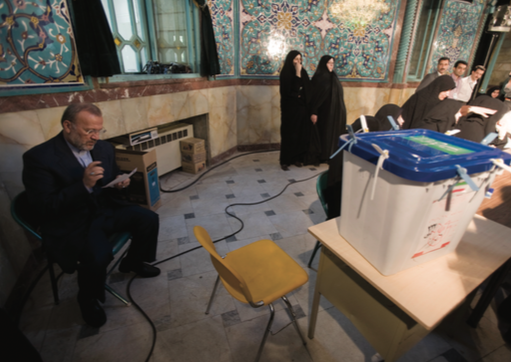
The ‘third way’ is associated with both Tony Blair and Bill Clinton, but pitching for the middle ground is one of the oldest and most effective electoral strategies. Mir-Hossein Musavi, 67, is currently putting forward his own ‘third way’ to try and win Iran’s presidential election in June.

For both the British Labour Party and the US Democrats, the third way was a response to defeat. Likewise, Musavi has recognized the need for Iran’s reformists to adjust to a series of lost elections, including the 2005 presidential poll that brought hardliner Mahmoud Ahmadinejad to office.
Musavi is stressing the importance of both “principles” — the buzzword of the “principlists” or fundamentalists — and “reforms,” the buzzword of the reformists. And Musavi, although largely out of the public eye since being prime minister in the 1980s, has already disappointed those who relished the presidential election as a Manichean struggle between left and right.
These included both the radicals — at home and abroad — who wanted former reformist president Mohammed Khatami to stand again and the supporters of president Ahmadinejad.
Before Khatami pulled out in March, the Ahmadinejad camp was aiming to rally principlists by attacking the former president as a Trojan horse who would willingly or unwillingly undermine the Islamic Republic through a renewal of the student unrest that characterized his presidency of 1997-2005.
The prospect of such confrontation must have alarmed Ayatollah Ali Khamenei, the supreme leader, for whom elections should strengthen Iran rather than exacerbate internal differences. In a major speech in March, Ayatollah Khamenei explicitly rejected backing any particular presidential candidate, presumably to counter the notion he favors Ahmadinejad.
Compared to Khatami, Musavi is an almost reassuring candidate for regime loyalists. Known to older Iranians from his period as prime minister — a post that no longer exists — during the 1980-88 war with Iraq, he evokes a time of sacrifice and egalitarianism now remembered by some as a golden age.
Khatami’s candidacy would have been far more divisive. As Mohammad Atrianfar, former editor of the reformist Shargh newspaper put it, Khatami faced two options. He could either run for the presidency and face “heavy political attacks without achieving real changes,” or he could back Musavi, “who might implement fewer reforms but has more chance of being elected.”
While Musavi, like Khatami, wants social and political reforms, he is also concentrating on the day-to-day economic issues so often neglected by the reformists. Iran faces a fiscal crisis brought on by falling oil revenue, and dealing with it will require some tough decisions. Long overdue changes, especially the phasing out of universal subsidies of staple goods like bread, will require public understanding and acceptance.
While Ahmadinejad remains in poll position as an incumbent and a proven communicator with the mass electorate, he could be vulnerable to Musavi even on his chosen ground of “social justice.” But even with Khatami out of the race, Musavi will not carry the reformist banner alone. At 71, Mehdi Karrubi, the former parliamentary speaker, is unlikely to easily give up what will presumably be his last crack at the presidency.
At the end of the spectrum, the withdrawal of Khatami has made many conservatives more willing to speak out against Ahmadinejad, who has over his four years in office alienated many natural allies. The president has faced a bitter struggle in the conservative-controlled parliament, with his budget for the current year drastically amended.
Like Musavi, parliamentary deputies accuse Ahmadinejad of frittering away record oil revenue on ill-advised development projects around the country. Banks say the government policy of subsidizing loans has piled up record levels of bad debt and stoked inflation to its current level of 26 percent.
There has also been talk among conservatives about broadening the government after June’s election. The idea has been put forward by several heavyweights — including former President Akbar Hashemi Rafsanjani, Ali Akbar Nateq Nuri, an advisor to Ayatollah Ali Khamenei, and Mohsen Rezaie, the former commander of the Revolutionary Guards.
Many conservatives are not just concerned over Ahmadinejad’s domestic policies but are uneasy that his international radicalism — particularly in taunting the Israelis and in asserting Iran’s nuclear program — is not suited to delicate times.
Their calculation is that Ahmadinejad will likely continue as president after June, and they want him hemmed in. Hence, they would welcome a broader range of ministers in domestic portfolios. They would prefer that what they see as the president’s excitability does not complicate Iran’s diplomacy — even though Iran’s international approach will continue to be set by the leadership group, with Ayatollah Khamenei pre-eminent.
Hence an electoral challenge from another conservative — possibly Mohammed Bagher Ghalibaf, Tehran’s mayor — cannot be ruled out. But in any case, many conservatives would lose no sleep if Musavi polls well or even wins in June.

Gareth Smyth is the Financial Times Tehran correspondent

May 3, 2009 0 comments
0 FacebookTwitterPinterestEmail
Society

Watches – BaselWorld 2009

by Executive Staff May 3, 2009
written by Executive Staff

BaselWorld — the world’s most important watch and jewelry show — opened its doors again this year to exhibit the most luxurious and prestigious brands to the pleasure of watch and jewelry enthusiasts.

While 2008’s show broke all record figures with 106,000 visitors, the current financial crisis has decreased attendance numbers. This year’s show had “at least 20 to 30 percent less people,” says Barkev Atamian, business manager at Ets. Hagop Atamian, one of the leading watch distributors in Lebanon.

Fewer Visitors
Actually, only 12 percent less people visited this year’s BaselWorld. In precise numbers, there were 93,000 visitors and 1,952 exhibitors present. Exactly 2,973 accredited journalists were also present at the show to find out what the other 95,000 people were talking about, according to the Swiss Exhibitors Committee.
Certainly, exhibitors would have preferred to see the number of visitors exceed the 100,000 mark. But in current conditions, an even bigger drop was expected.
“I don’t know about other brands, but actually we had quite a big crowd everyday and sales were really very good,” says Eric Vergnes, Middles East’s general manager at TAG Heuer.
“Particularly for the market of the Middle East where we sold products a bit less compared to last year, but better than expected.”
The same statement came from many brand managers who expected much worse, and were pleasantly surprised. Georges Bechara, brand manager of Zenith in the MENA region says, “I am happy personally with the orders that we took in Basel despite the crisis.”
Bechara further explains that the mood in general was positive, and echoes Vergnes by adding that good orders came from the Middle East market, which is still better positioned compared to other regions.
But the effects of the economic downturn are still rippling across the Middle East, and it showed. Buyers and collectors have less money to buy, or to travel, or they are less keen on spending their money on ritzy accessories. Jean Tamer, president of Tamer Frères, the official distributor of many luxurious watch brands like Audemars Piguet and Breitling in Lebanon, attributes the decrease to the SIHH (Salon International de la Haute Horlogerie) which took place in January in Geneva.
“The SIHH used to be in Geneva a couple of days after Basel. This year SIHH [left] Basel, so many customers avoided two trips to Switzerland,” says Tamer.

Pre-Basel
Many watchmakers usually release pre-Basel teasers one or two months before BaselWorld to draw their big clients’ attention. As BaselWorld is for everyone, pre-Basel is private for the manufacturers themselves, which enables them to have the full attention of their invitees and pace the viewing of the merchandise. This year, Rolex, Zenith, Versace and other brands have canceled their traditional pre-Basel shows for different reasons.
“This time we didn’t [do a pre-Basel]. I think we made the right choice because we won’t have the return on investment that we want. So we prefer to concentrate on Basel,” says Bechara from Zenith. He further explains that last year’s pre-Basel in Dubai was the ‘dream pre-Basel’ which cannot be repeated this year in such an economic climate.
Versace has not entirely canceled pre-Basel, but as Paulo Marai, managing director of Versace Watches explains, “Normally we had these people fly from all over the world. Now we decided this year to hold the meetings within the regions.” In other words, Versace wants to decrease the money its clients and partners spend and go to them, while also personalizing its products to meet the needs of each region.
“We took advantage of the difficult moments to have a more tailor-made strategy,” Marai says.

BaselWorld 2010
As BaselWorld 2009 closed its doors, it won’t be long before watchmakers find themselves preparing for BaselWorld 2010, held from March 18 to 25 in Basel, Switzerland. Hopefully, better market conditions will allow manufacturers to present their novelties and not have to worry about fewer sales or visitors. As Swiss Watch Federation President Jean-Daniele Pasche wrote in the BaselWorld Daily News on March 30, “The Swiss watch industry remains confident in its ability to live through these turbulent times thanks to its great resources. Its ability to innovate in technology and styling, its training, brands and global presence.”

May 3, 2009 0 comments
0 FacebookTwitterPinterestEmail
Financial Indicators

Regional equity markets

by Executive Staff April 10, 2009
written by Executive Staff

Beirut SE  (one month)

Current Year High: 1,629.74  Current Year Low: 705.56

The BLOM Stock Index tracking share prices on the Beirut Stock Exchange closed the March 27 session at 1047.92 points, 20 points lower than its close on February 27. The BSI is down 11 percent from the start of 2009. In the review period, eight sessions to close with a gain were outnumbered by 12 sessions that saw the market drop. However, all trading sessions ended with index fluctuations of less than one percent, except for March 25 when the index slipped 1.44 percent, pulled down by six percent and 3.2 percent price losses in the two share classes of real estate firm Solidere when a substantial amount of shares were offered for sale at a discount to the previous close. In Beirut, analysts assumed that this sudden drop in the share price of Solidere was triggered by an individual trader’s need for cash. In fiscal news, the Lebanese Republic announced that it successfully swapped $2.1 billion in Eurobonds with maturity in 2009 for longer-term bonds, which will mature in 2012 and 2017. As the elections for the Lebanese parliament are taking more and more hold of public attention, the BSE will likely be under the spell of the elections in the second quarter.

Amman SE  (one month)

Current Year High: 5,043.72  Current Year Low: 2,550.70

The Amman Stock Exchange (ASE) rode the bandwagon of market gains to close the March 29 session four percent higher at 2,721.48 points when compared with the close at the end of February. The positive sessions in March cut the ASE Index’s contraction in the first quarter of 2009 down to 1.3 percent. For the first quarter of 2009, the insurance sector index was the best performer on the ASE with a 16.3 percent gain. Banking took the other end of the share price spectrum, weakening 17 percent from the start of 2009. Banking was also the only sector to underperform the general index in March whereas the services index, up 7.4  percent, accounted for the month’s strongest gain. Real estate sector companies attracted significant action from traders while the undisputed top share price gainer was the specialized mortgage insurance firm Darkom Finance and Investments Co. The share price of the company, which had started operations in mid 2008, rose 68 percent in March.

Abu Dhabi SM  (one month)

Current Year High: 5,148.49  Current Year Low: 2,136.64

The larger of the UAE securities markets closed at 2,545.65 points on March 29 in a second consecutive month of gains, achieving 7.1 percent from the end of February. Gains rolled nicely in almost every session starting March 18 and the momentum flattened at the end of the review period as attention shifted towards first-quarter result expectations, which are mixed. The energy and telecommunications sub-indices led the market up with gains of 19.5 percent and 18 percent, whereas the construction index lagged behind and couldn’t catch the up-train. Construction ended 26 percent lower, however, real estate gained 8.3 percent. The strongest gainer in the period was the new health insurance specialist, Green Crescent Insurance Co; whereas the insurance sector index was flat, debutant Green Crescent added 38 percent in its first two trading sessions when compared with the issue price. Building materials company Arkan was the market’s biggest loser in March. The scrip, which had dropped about 55 percent in the first half of the month, made good some of its losses in the second half but ended the review period 37.8 percent lower.

Dubai FM  (one month)

Current Year High: 5,859.57  Current Year Low: 1,433.14

The Dubai Financial Market (DFM) closed at 1,604.71 points on March 29, representing a gain of just under three percent in the month of March. The trading range fluctuated between an intra-month low of 1,490 and a high of 1,623 points. The utilities sub-index was the strongest performer on the DFM but most sectors moved in positive territory, except for banking which ended the review period 1.6 percent lower and materials which lost five percent. When compared with the end of 2008, however, materials, investments, and real estate are all still quite deep in the hole, with losses ranging from 14 percent to 40 percent. Dubai Islamic Bank and sharia-compliant insurer Salama Group were the best performers of the month, moving up 33 percent and 29.5  percent, respectively. Drake and Skull International, the construction group which started trading last month on the DFM after waiting with its entry as long as possible since its initial public offering in July 2008, was not so lucky. The new stock was the DFM’s biggest loser in March, ending the period 33 percent lower from its issue price of 1 AED per share.  

Kuwait SE  (one month)

Current Year High: 15,654.80            Current Year Low: 6,391.50

The Kuwait Stock Exchange (KSE) Index ended the review period at 6,739.70 points on March 29, representing a climb of more than 5.4 percent from the last session in February. March performance mitigated the unfriendly picture of the first quarter, but the year-to-date loss at 13.4 percent remains one of the steeper slides on Arab bourses in 2009. By respectively adding 20 percent, 13 percent and 12 percent, the food, banking, and investment sub-indices were on the forefront of the bourse’s uptrend in March and most other sector indices moved range bound with the general index, except for insurance, which weakened in early March and stayed at the bottom during the review period. While the KSE still saw 12 companies lose between a fifth and half of their share prices in the month of March, this was more than countered by the number of gainers where 34 companies appreciated in share price by 20 percent or more — as biggest gainer, real estate company Massaleh almost doubled its share price, whereas Gulf Insurance Company had a second month of turmoil and ended 49.4 percent lower. Political worries weighed on the KSE as discussions of an economic stimulus package were juxtaposed with resignation of cabinet and dissolution of parliament.

Saudi Arabia SE  (one month)

Current Year High: 10,291.47            Current Year Low: 4,264.52

The Saudi Stock Exchange (TASI) closed at 4,752.32 points on March 25, up 8.39 percent from the last close in February. It ended the first quarter with a loss of 1.05 percent when comparing the March 25 close with the last close in 2008 and with a loss of 5.87 percent when compared with the close on the first trading day. The difference in TASI performance between the two methods of defining the year-to-date period in 2009 is exceptionally wide which is a reminder of the volatility of the trading, making it more interesting to check other vitality stats. The TASI trading volume in the first quarter represented close to 75 percent of total GCC trading volume, a dominant proportion of regional trading activity and substantially higher than the Saudi bourse’s 44 percent share in total GCC market cap at the end of Q1, according to Zawya financial data. Led by three insurers and debutant Ethihad Atheeb, the share prices of 24 stocks rose by more than 25 percent apiece, whereas nine stocks shed a quarter of their wealth or more. Overall, gainers outnumbered losers by healthy margins in the quarter, but the ratio in March was about equal. 

Muscat SM  (one month)

Current Year High: 12,109.10            Current Year Low: 4,223.63

The only market that suffered a drop in its general index in March 2009 was Oman. Whereas it had held up better than other GCC exchanges in February, the Muscat Securities Market Index closed at 4,722.95 points on March 29, representing drops of 2.69  percent on the month and of 13.2  percent on the year. The industry sub-index made an upward escape in the March review period and closed 9.2 percent higher; banking and services did not manage to cross into positive territory. Losers outnumbered gainers four to three in the review period from February 26, but it is not to be overlooked that the majority of share price drops were contained in the bracket of less than 10 percent. Market cap leader Omantel, whose CEO resigned at the end of March, suffered a 14.4 percent contraction in share price in the review period. While the company had reported positive results for 2008, its Q4 net profit declined by two thirds due to a difficult time at its subsidiary in Pakistan. Banking heavyweight Bank Muscat showed a slight share price gain at 1.4 percent in March. 

Bahrain SE  (one month)

Current Year High: 2,902.68  Current Year Low: 1,572.19

Of the six GCC bourses that showed gains in the month of March, the Bahrain Stock Exchange (BSE) Index added the least, with a 0.85 percent index improvement to 1,590.92 points at its March 29 close when compared with the last session in February. The BSE has a negative performance for the first quarter, with a drop of 11.2  percent since the start of the year. Banking (-18.5  percent) and services (-13.5 percent) were the sectors with significant underperformance in the first three months of 2009. In March, however, the previously oversold banking index made a contrarian move and outperformed the general index by more than five percentage points, with investments (+1.1  percent) a distant second place in up-moving sectors. As the financial world is awaiting the next round of global restructuring talks, this time by the G20, the tiny Bahraini bourse is as good an example as any for the uncertainty of markets under the thumb of global influences. While a pessimistic band of dark augers, the region’s investment houses described recent upswings in developed markets as bear market rallies and not as a swing into recovery. One may be wise not to exclude any possibilities, not even positive surprises later in 2009.

Doha SM  (one month)

Current Year High: 12,627.32            Current Year Low: 4,230.19

Investors on the Doha Stock Market (DSM) apparently exhausted their capacity for pessimism and, at least for the review period from February 26 to March 29, they made the stocks shine on the DSM. The general index added net 660 points over the period to its close at 5,098.51 points on March 29, representing a GCC-leading gain of 14.9 percent even as profit taking occurred in the last session of the review period. Volatility on the DSM was significant, at 48 percent according to Zawya. Industrial and banking outperformed the general index, while the insurance index underperformed. Notably, many large caps were in demand and gainers included all five of the strongest companies by market cap: Industries Qatar (+30.9 percent), Qatar National Bank (+37.7 percent), Qatar Telecom (+16.4 percent), Qatar Islamic Bank (+8.9 percent) and Ezdan Real Estate (+39.7 percent). Other strong gainers were Ahli Bank and Qatar Commercial Bank. The banking sector received positive news at the beginning of March as the government took measures to infuse liquidity into banks through a decision to purchase investment portfolios held by banks on the DSM.

Tunis SE  (one month)

Current Year High: 3,418.13  Current Year Low: 2,685.76

Adding 29.5 points from February 26 to March 27 means that the Tunindex of the Tunisian Stock Exchange benefited only with a one percent gain from the positive developments, which pushed the Nasdaq for the first time this year into the black on March 26 and let most GCC securities markets partly recover from their losses in the first ten or eleven weeks of the year — but then the TSE was already moving up in the first two months of 2009 so that its status at the end of Q1 is 6.6 percent up year-to-date. Battery manufacturer Assad was the market’s top advancer in March with a 16 percent increase in its share price. Market cap heavyweights Poulina Holding and Banque de Tunisie recorded moderate drops in their share prices, weakening by 2.3 percent and 1.1  percent, respectively.

Casablanca SE  (one month)

Current Year High: 14,878.30            Current Year Low: 9,405.86

Buying moods from earlier in 2009 faded on the Casablanca Stock Exchange (CSA) in March and the Index retreated 5.3 percent to close at 10,628.29 points on March 27. The index slipped especially in the period between March 16 and 24 before adding about 200 points to the end of the review period. For the year to date, the weaker performance in March means that the CSE Index neared the end of the first quarter at a 3.25 percent lower reading than at the start of 2009. In news relating to listed companies, the Moroccan government announced the licensing of a new mobile operator. The third GSM license went to a company called Wana, part of the Omnium North Africa conglomerate. Maroc Telecom, the market cap leader on the CSE, saw its share price under pressure after the announcement and ended March 4.8 percent lower. Maroc Telecom formally announced its 2008 results on March 23, reporting an increase in net profits of almost 19 percent.

Egypt CASE (one month)

Current Year High: 11,935.67            Current Year Low: 3,389.31

The Egyptian bourse, long seen as the region’s exchange with the strongest alignment to international markets, in March boomed more than any other Arab securities market. The EGX 30 Index closed the March 29 session at 4,332.56 points, signifying a 20.5 percent increase from the last session in February. However, it is a reminder of how steeply the EGX fell in the first two months of 2009 that the index is still 5.74 percent down from the start of the year. With only seven companies seeing their share prices go deeper in the red in March, the positive mood on the exchange was broad even as its capability of endurance cannot be judged as yet. Two companies in the market’s medium to small size range more than doubled their share prices in March but more significantly, the market cap heavyweights Orascom Telecom Holding and Orascom Construction Industries respectively added 43.4 percent and 27 percent and were way up there in the gainers together with a diverse spectrum of companies from real estate to manufacturing.

April 10, 2009 0 comments
0 FacebookTwitterPinterestEmail
Banking & Finance

Money Matters by BLOMINVEST Bank

by Executive Staff April 10, 2009
written by Executive Staff

Regional stock market indices

Regional currency rates

Cairo to build a $2 billion power plant

Cairo will be constructing a $2 billion power plant in Ain Sokhna on the Gulf of Suez. The plant will provide 1,300 megawatts (MW) of steam power and will be the first in Egypt to use supercritical technology. A similar venture will increase the overall efficiency of the plant allowing a faster response to the change in demand while reducing emissions. The project will be financed by two loans and several funds by Arab contributors. The first loan amounting to $450 million is signed with the African Development Bank and will cover 22 percent of the cost of the project, while the second loan will be given by the World Bank and will amount to $600 million. The remaining funding for the project will come from the Egyptian Electricity Holding Company (EEHC), the Arab Fund for Economic & Social Development (AFESD), and the Kuwaiti Fund for Arab Economic Development (KFAED).

Saudi company to sign $2.5 billion power project

The Saudi Electricity Company (SEC) will sign a deal with both Korea Electric Power corporation and the local Acwa Power International for the $2.5 billion Rabigh independent power project (IPP). The SEC stated that it will announce the pre-qualified bidders for the PP11 IPP power project in Riyadh by the end of March. The SEC changed the shareholding structure of the project, giving a 51 percent stake for the winning bidder, while the remaining 49 percent will be sold in an initial public offering (IPO). The old ratio had been 40:60, giving the bulk to individual shareholders. In another economic highlight, inflation in Saudi Arabia is excepted to continue falling this year. Consumer prices retreated in February to 6.9 percent from 7.9 percent in the previous month.

UAE inflation to drop in 2009

The key drivers of inflation in 2008 — liquidity, cost of housing and cost of food — are not expected to increase this year. Therefore, inflation in the UAE is expected to ease to two to three percent in 2009. Next year is expected to be the year of recovery from the financial crisis for the Gulf, Asia and Africa, which are relatively less affected than the US, UK and the Eurozone, where the recovery is expected to take a longer period. Moreover, the UAE is putting into action the lessons learned from the recession. For example, the other side of the downturn in the UAE’s real estate sector could be positive for the economy as funds and human resources that were primarily geared for the real estate sector could now be used in other productive industries. In addition, the fiscal and monetary measures taken by the UAE authorities, in the form of direct liquidity injections, has boosted the confidence of investors locally and regionally. This confidence is being confirmed by the current satisfactory levels of credit growth that range between 10 percent to 15 percent, after reaching 49 percent last June.

April 10, 2009 0 comments
0 FacebookTwitterPinterestEmail
North Africa

Clashing cells

by Executive Staff April 10, 2009
written by Executive Staff

Maroc Telecom (MT) has long held a dominant share of Morocco’s mobile market, but a new entrant will increase competition for the kingdom’s subscribers. On February 4, the National Agency for the Regulation of Telecommunications (Agence Nationale de Réglementation des Télécommunications, ANRT) announced that the third second-generation (2G) mobile license had been awarded to Wana, a subsidiary of domestic conglomerate Omnium Nord Afrique (ONA).

Wana’s new 2G GSM license, which pits it against current incumbents MT and Méditel, is only the latest addition to the company’s telecoms portfolio that also includes a third generation (3G) license awarded in 2006. Details on the exact amount of Wana’s bid have not yet been released, but both the ANRT and Wana have described it as a “significant investment.” The new 15-year nationwide license gives Wana access to a market that includes 22.82 million mobile subscribers, according to figures published by the ANRT.

Despite its late start, Wana will hope to take advantage of an under-saturated market, which has a penetration rate of 74 percent, and to entice subscribers with competitive technology and pricing.

ANRT announced the tender on October 30, 2008 as a measure to boost competition and bring down prices in the sector. Since its creation in 1998, after the amendment of the Post Office and Telecommunications Act, the ANRT has been charged with modernizing, regulating and supervising the telecoms sector, while implementing the law, which calls for increased competition to provide consumers with more choice and better products and services. MT, the formerly state-owned company, had a monopoly over the sector until liberalization began in 1999.

MT is a formidable competitor with Vivendi, Europe’s largest entertainment group, now holding a controlling 54 percent share in the company. According to the most recent figures released by the ANRT, Wana controls 1.2 percent of the market, while MT and Meditel have market shares of 65.6 percent and 33.2 percent, respectively.

Despite increased competition from the new entrant, MT has stated that it expects to build on its 2008 growth, predicting a revenue increase of more than three percent this year. On February 23, MT announced that its 2008 net profits rose 18.5 percent year-on-year to $1.16 billion, and that its consolidated earnings from operations were up 13.5 percent to $1.62 billion, with revenue growing 7.2 percent to $3.53 billion, mostly on the back of mobile customers.

As the telecommunications arm of ONA, Wana already has a strong foundation to build on. ONA is Morocco’s biggest conglomerate, with broad interests such as banking, insurance, retailing and mining. Although Wana has been active in other segments of the telecoms market, such as Internet and fixed-line telephony, the new license gives it access to one of the sector’s most lucrative areas. The first mobile phone network, introduced in Rabat in 1989, had 700 subscribers, a figure that jumped to three million by 2000. Mobile phone use has continued to rise and the current national penetration rate of 74 percent far exceeds ANRT’s growth prediction. A 2004 study forecast that it would take until 2014 to reach this level.

Mobile subscribers jumped from 700 in 1989 to three million by the year 2000

Spinning the web

Despite the impressive subscriber growth to date, the government is doing even more to expand the reach of the kingdom’s mobile phone network. In November 2006, the ANRT adopted the Program for Universal Access to Telecommunications (PACT), which aims to connect some two million people and 9,200 remote villages by 2011. The program extends to telephony and Internet services. MT recently signed a $342 million contract to connect more than 7,000 towns and villages nationwide, which represents some 80 percent of the PACT program.

Morocco’s mobile expansion is part of a larger regional trend. Cell phone sales have proved resilient in the Middle East and Africa and purchases are projected to increase 14.77 percent from 176 million units in 2008 to 202 million units in 2009, as prices for handsets fall and more 3G networks are established.

For the kingdom, mobile telephony contributes significantly to the value of the telecoms sector as a whole. Its continued liberalization is expected to increase the industry’s proportion of GDP from seven percent in 2008 to 10 percent in 2009. At a time when other sectors are facing declining demand, telecom is a bright spot in Morocco’s economy.

April 10, 2009 0 comments
0 FacebookTwitterPinterestEmail
North Africa

Private accounts on hold

by Executive Staff April 10, 2009
written by Executive Staff

Algeria’s banking reform has been slow but could pick up later this year as the general election approaches. The sector appears to have avoided the worst of the global economic crisis, having had little exposure to toxic loans and low levels of overseas activity. Prime Minister Ahmed Ouyahia remarked last October that the Algerian economic and financial system was protected from the worst of the crisis as it was not as “evolved and our stock market is not fully integrated into the world financial markets.”

The downturn in the international markets has slowed the reform process. A key component of the reform platform was the privatization of some of the six state banks, with the first of these — Crédit Populaire d’Algérie (CPA) — initially slated for sale in early 2008.

Having planned to sell a 51 percent stake and received expressions of interest from a number of foreign banks, the government announced it was suspending the privatization of CPA indefinitely due to concerns over the impact of the global financial crisis. Officials said that conditions were not right for the sale, which the state hoped would raise some $1.5 billion.

It was also suggested that the overall privatization process had been put on hold due to concerns within Algeria over foreign dominance of the banking sector, as well as perceptions that overseas investors across the economy were repatriating profits without contributing to the country.

The Banque d’Algérie serves as both the country’s central bank and as the regulator for the sector. Though the Banque d’Algérie lists 16 private banks as operating in Algeria, it is the six state-owned institutions that dominate the market. According to a report issued by the Gulf Investment House in December 2008, state banks account for 95 percent of the sector’s total assets. To a large extent, this is due to a 2004 government decree that requires public sector entities to work exclusively with state banks, restricting deposit flows to the private segment.

However, Minister of Industry and Investment Promotion, Hamid Temmar, told parliament in mid-January that the government remained committed to privatization and said that the only state enterprises that would not be sold off were those in the energy sector — Sonatrach and Sonelgaz — and the national railway.

Public banks too have problems of their own. Though they do not have any difficulty in attracting deposits, they are proving less successful in keeping staff. According to a report by the Professional Assembly of Banks and Financial Institutions, more than 2,500 officers of state banks have transferred to the private sector since 2001, lured by higher wages. To try to stem the outward flow of staff, the government offered the state’s 23,000 bank employees up to 30 percent pay rises in June 2008.

With a presidential election scheduled for April 9, there is a chance that the stalled privatization process may be reignited, along with the program of banking reform.

The need for reform in the banking sector was highlighted in the latest study by the US-based Heritage Foundation on the openness of the global economy. In its 2009 Index of Economic Freedom, Algeria’s overall economy was ranked 107 out of the 183 countries assessed and 14 out of 17 countries in the Middle East and North African region, with a score of 56.6 out of 100. However, while scoring highly in some categories, such as 72.5 for business freedom, Algeria’s worst result was in financial freedom, rating just 30 points, almost 20 points below the global average.

The report said that the pace of overhauling the banking sector in Algeria had been slow and uneven and that “reform is critical if resource allocation and private sector development are to improve.”

The government wants to see greater diversity in the economy, to move away from a dependency on the energy industry and to broaden the private sector. To achieve this, it will need to push ahead with its reforms of the banking industry, especially the privatization of state lenders, a step that would result in the return of public funds into the private sector.

April 10, 2009 0 comments
0 FacebookTwitterPinterestEmail
Levant

Tanking up with tax

by Executive Staff April 10, 2009
written by Executive Staff

At a time when oil prices are half of what they were a year ago, the retail price of gasoline in Lebanon has been stagnant or climbing. For example, in July 2007 when the price of Brent crude was around $78 per barrel, the government raised taxes on gasoline which pushed the price from $14.90 per 20 liters — the standard measurement for gasoline in Lebanon — to $15.64 per 20 liters. This is roughly the same price of gasoline in today’s retail market, at a time when crude sells at around $50 per barrel. Needless to say, this illogical development is confusing for the consumer.

In 1985, then Minister of Finance Camille Chamoun issued a governmental decree abolishing state subsidies on gasoline; so legally the subsidy was removed. However, the government has levied a tax on gasoline, which it increases or decreases at will. When the government decreases the tax, gasoline prices drop giving the feel of a subsidy.

Further exacerbating the situation is that most people in Lebanon rely on private transport. Lebanon’s approximately 1.4 million registered vehicles consume around five million liters of gasoline per day, according to Bahij Abou Hamzeh, president of the Association of Petroleum Importing Companies (APIC) in Lebanon.

Another factor experts in Lebanon point to is unfair competition. “There is an oligopoly controlling gasoline imports to Lebanon and this is the heart of the problem,” says Jad Chaaban, professor of economics at the American University of Beirut and acting president of the Lebanese Economic Association. “The prices are set by the Ministry of Energy in consultation with the APIC. When you have an oligopoly controlling an import sector you cannot pass on decreasing or rising prices with the same efficiency as when you have a competitive market.”

Collusion in a free market

For his part, Abou Hamzeh admits that the association does collude with the Lebanese Ministry of Energy, but insists that the market is open to anyone who has the means to set up the infrastructure.

“We regulate the market in cooperation with the ministry but we have to do it because it’s the only product in Lebanon that has a ceiling for the price,” claims Abou Hamzeh. “The government is setting the ceiling of the price on a weekly basis. This doesn’t mean we cooperate in order to monopolize the market; it’s not what we are after.”

Abou Hamzeh blames the government who earlier this year raised the level of taxes on gasoline to $6.35 per 20 liters of imported gasoline when the price of oil was at around $35 per barrel. Abou Hamzeh adds that the gasoline price ceiling, set weekly, is too low. “The government imposes a ceiling according to the international prices and a small margin to cover additional costs,” says Abou Hamzeh. “This margin does not cover our costs. We cannot continue like this; we are making a loss not a profit.”

Whether or not competition is fair, one thing does remains clear: that the government is making a lot of money. Most estimates are that government revenues from gas tax will increase this year to around $466 million as opposed to $199 million in 2008. On March 19, the Lebanese General Confederation of Labor Unions gathered in front of the Lebanese parliament to protest the high prices and taxes on gasoline and around 150 cars blocked one of Beirut’s main commercial districts.

Tax of necessity

The government, however, seems to have little choice when it comes to removing the tax, since it is already drowning in a sea of debt and in need of more revenue. Furthermore, according to a high ranking member at the Ministry of Finance who spoke on condition of anonymity, the government must keep the higher gasoline tax in place because it has already reneged on two of its other promises made to donors at Paris III: the five to seven percent taxation on bank deposits and the increase of Value Added Tax (VAT). The cherry on top may be that many in the government are reluctant to enact policy due to the upcoming elections in early June.

“When we protest the government tells you, ‘you are right but now we have to have the election’,” says Abou Hamzeh.

Whatever the reasons may be, for the immediate future it seems that the high gasoline prices and price fixing will continue. Once again it seems it will be Lebanon’s people and industries that pay the final price.

April 10, 2009 0 comments
0 FacebookTwitterPinterestEmail
Levant

Carrying capacity

by Peter Grimsditch April 10, 2009
written by Peter Grimsditch

Turkey has high hopes of becoming a major transit hub for land and sea cargo freighting, linking Central Asia and the Middle East with Europe, though it will need to invest heavily in infrastructure if its hopes are to be fulfilled. The transport grid already has around 11,000 kilometers (km) of rail lines; 430,000km of roads, including 62,000km of motorways and main roads; a network of ports along its Black Sea, Aegean and Mediterranean coasts and at least one airport in each of its 81 provinces. Even so, the results of a joint study conducted by the European Commission and Turkey’s Ministry of Transport and Communications, released in 2008, showed Turkey has a long way to go before its transport network can service the future needs of the economy.

The Transport Infrastructure Need Assessment (TINA) said priority should be given to improving transport in the North-South and East-West axes to better integrate Turkish transport with international transport networks; upgrading intermodal transport facilities and services, and improving the country’s ports and maritime connections. These improvements will be needed if the assessment’s projections are correct. The report said Turkey’s road freight demand would reach at least 305 million tons by 2020, more than 230 percent up on 2004, the base year used for the study. Train hauled cargos are predicted to more than double to 31.5 million tons, while the merchant marine is expected by 2020 to lift its base total by around 60 percent to 25.3 million tons.

Finding the cash

To meet this demand, Turkey will need to invest more than $25 billion by 2020, with $11 billion dedicated to its rail network and $10.75 billion on roads, according to TINA. The key challenge will be to raise this cash at a time when many other calls are being made on the limited national treasury — including upgrading electricity generation and distribution grids, resolving environmental issues such as waste water processing and improving the health and education services. Though some of this funding gap could be filled by assistance from the EU through its trans-European transport network (TEN-T) program, most of the money will have to come from the state or the private sector, both of which are currently finding it hard to raise funds due to the tight credit markets.

Some of these major projects are well advanced, such as the Marmaray rail project which includes a tunnel beneath the Bosphorus that will link Europe to Asia, and a new high-speed train connection between Ankara and Istanbul. However others, such as duplication of many of the country’s main rail lines, remain on the drawing board. While the government is looking to upgrade and extend infrastructure links with limited fiscal means, the transport industry may find itself in less of a position to enjoy the benefits of the improved networks, at least in the short-term. With Turkey’s economy slowing, in line with those of its major export markets, there has been a fall in demand for long haul road, rail and maritime freighting.

The outline of decline

According to figures released by the Turkish Exporters Association (TIM) in March, overseas sales dropped 35 percent year-on-year in February to $6.87 billion. Industrial output is also contracting, down by 17.6 percent in December compared to the same month in 2008, the Turkish Statistical Institute reported. Lower industrial production means fewer raw materials are being freighted to factories, fewer finished products need to be shipped out, while falling export demand sees reduced calls being made on Turkey’s cargo haulage capacity.

The number of long haul trucks being shipped across the Dardanelles Strait is down by more than 20 percent so far this year, according to local ferry officials. Additionally, according to Erol Yücel, assembly chairman of the Turkish Chamber of Shipping, the steep drop in demand for shipping capacity due to low cargo levels has seen rental prices for ships fall by as much as 98 percent. Turkish exports, and therefore production and the transport sector, may get a boost from the sharp drop in the value of the local currency, with the Turkish lira hitting an all-time-low of 1.78 against the US dollar on March 10. With the cost of Turkish goods becoming more attractive, trade could pick up, helping the transport sector onto the road to recovery.

Peter Grimsditch is Executive’s Turkey correspondent

April 10, 2009 0 comments
0 FacebookTwitterPinterestEmail
Levant

Thy neighbor’s trade

by Executive Staff April 10, 2009
written by Executive Staff

The economies of Syria and Lebanon have been closely intertwined since before they achieved independence from France in the 1940s. Now, with the two countries having recently opened embassies in one another’s capitals for the first time, an increasingly open and private-sector economy in Syria and a period of relative regional stability, there is now more potential than ever to take advantage of trade opportunities. These include not just goods, but services, expertise and labor – all of which illustrate Syria and Lebanon’s interdependent relationship.

Historical economic ties

Lebanon began its trade relationship with Syria in 1926 when it became an independent republic under French control. That same year, the Port of Beirut opened and Lebanon became Syria’s gateway to the world.

When Lebanon and Syria achieved independence from France in 1943 and 1946 respectively, the two countries continued a mutually beneficial economic relationship wherein Syria took advantage of Lebanon’s services, technical expertise and modern banking system, and Lebanon was able to make use of Syria’s labor force.

This complementary relationship was reinforced further in 1958. That year, Egypt and Syria merged to form the United Arab Republic, which led to the nationalization of Syria’s economy, leading many Syrian entrepreneurs to relocate to – or at least deposit their money in – Lebanon.

Lebanon’s civil war, from 1975 to 1990, marked the end of an era for the small eastern Mediterranean country’s reputation as the “Switzerland of the Middle East,” so-called because of its renowned top-quality banks in a stable climate. Still, during this time Syrians continued to use Lebanon’s banks because of their reliable services and secrecy policies.

Following the end of the war in 1990, Lebanon’s need for help with its reconstruction created a boom in need for Syrian labor. Throughout the 1980s and 1990s there were as many as a million Syrian laborers in Lebanon in any given period. At the same time, while wealthier Syrians waited for economic reform in their country, they used Lebanon’s renowned financial services and shopped at Beirut’s high-end retail stores to purchase items not available in Syria.

That all changed in February 2005 when Lebanon’s former Prime Minister Rafiq Hariri was assassinated.  Syria was implicated in the assassination, but denies any involvement. Violent attacks on Syrian workers caused most of them to flee Lebanon, Syrians withdrew billions of dollars from Lebanese banks and Syrian shoppers abandoned their weekend trips to Beirut during a period of nationwide anti-Syrian sentiment.

The following years saw a thaw in Syrian-Lebanese political relations. Business has returned, but not at the same rate as before. Today, there are an estimated 300,000 Syrian workers in Lebanon, less than half of the pre-2005 level. Syrians who brought their business back home in 2005 have kept it there for the most part, mainly because luxury retailers and private banks in Syria have improved their quality and services to a level comparable to that of Lebanon.

With Syria’s ongoing economic opening and Lebanon beginning to warm-up politically to its next door neighbor, it appears that the two countries are in a good position to return to their traditionally mutually beneficial economic relationship.

“Even during the most difficult of times, trade relations slowed down, but then improved. This cannot stop. After… 2005, the only way left to go is up,” says Syrian political analyst Sami Moubayed.

Syria has traditionally resorted to trade pressure whenever relations with Lebanon have been tense

Politics and geography of trade

When it comes to trade between the two countries, Syria is at a definite political and geographic advantage. With a 375 km border with Syria that constitutes the only route for overland trade — the 79 km border to the south has been closed since 1948, when Israel became a state — Lebanon is dependent on Syria for its trade with most of the world. Transit through Syria represents 60 percent of Lebanon’s trade.

“Syria has traditionally resorted to trade pressure, whenever relations were [tense] between the two countries, to affect the political flow between Syria and Lebanon,” says Moubayed. “There are no other outlets from Lebanon, except the sea, or Israel, for ground trade. When pressure of this sort is applied, it certainly affects political events, always in Syria’s favor, however.”

In 1950, for example, Prime Minister Khaled al-Azm would shut the border, to pressure Lebanon into changing political dialogue, or positions, knowing that if the borders with Syria were sealed, its trade with the outside world would suffer.

More recently, in 2005 and 2006, Syria shut its borders with Lebanon, again to put political pressure on its smaller neighbor.

Still, goods usually reach their intended recipient somehow, regardless of political pressure.

“It’s a myth that the Syrian-Lebanese border is or can be closed to goods from the other side of the border,” says Samer Abboud, assistant professor in the department of political science at Susquehanna University in Pennsylvania. “The border is quite porous and will remain so even if there is full trade liberalization and improved transportation networks.”

 Nevertheless, currently there is some hope that better political relations will open the door for joint development projects.

“While private investment continues to grow in Syria, what’s missing are bilateral projects,” says Jihad Yazigi, editor of the Damascus-based economic bulletin, the Syria Report. “It’s not enough to open the borders if you don’t have strong government commitments. At the government level, there’s little coordination. Even in the West, there’s government involvement in bilateral projects. For big projects, private business can’t do much.”

For example, Yazigi suggests, “With daily power outages in Lebanon and Syria, we need more power plants.” Or, “Maybe the two countries could find a way to share water better.” He believes, “The two countries need to debate publicly.”

“Despite the obstacles – transport, financing, long border crossings – inter-Arab trade represents almost 20 percent of total Arab trade, when oil is factored out,” noted Abboud. “This is a very high figure and speaks to the already existing trade between countries that need to be supported through infrastructural and institutional developments.”

Getting goods across the border

At any time of the day or night, cars and trucks can be seen lined up at the official Syrian-Lebanese overland border crossings and in the Bekaa Valley, flare lights signal communication between smugglers.

No matter how cumbersome the process of trade between Lebanon and Syria, the two countries continue to meet the demand for one another’s products – be it at one of the three official border crossings, using the unofficial crossings or catering to the niche markets on either side of the border.

For Lebanese consumers, that often means clothing, agriculture, oil and other products that are less expensive in Syria.

But in the past several weeks this has been changing, with oil and some agriculture prices in Syria surpassing those of Lebanon – a sign of the times for both countries.

“Some prices of goods in Syria are higher than in Lebanon. The situation is completely different after 2000. Usually, Lebanon is the free market and Syria is the closed market. Now that is changing,” says Syrian economist Samir Aita.

Syrians are buying Lebanese goods, including everything from Portland cement, Lebanon’s biggest export to Syria, to Western products that can’t be found in Syria. There is a thriving black market of American products that are illegal due to the United States’ sanctions imposed on Syria.

Most of these items tend to be electronics, such as computer parts, which can be “re-exported” from Lebanon at an extra fee. “We (the Lebanese) don’t do this for free,” says Beirut-based Hussein Zeaiter, assistant professor of business and economics at the Lebanese American University.

“Illegal trade is probably higher than official trade,” estimates Abboud. “Illegal trade patterns have always existed between the two countries. While there is a host of trade in illegal goods – drugs and weapons – most of the actual trade is in basic products that are just taken across the border on a daily basis in cars and taxis and goes unreported or under-reported by officials. Export receipts are also a huge problem on the border.”

He adds that, “there have been few attempts to regulate it because the illegal trade functions almost as its own economy with powerful networks controlling large swaths of trade, or, on the micro-level, border officials being bribed to look the other way.” 

Illegal trade functions almost as its own economy, with powerful, large-scale networks

 Swapping labor for expertise

Throughout their history, Lebanon and Syria have been able to use the other’s workforce to their mutual advantage. Lebanon has benefited from Syria’s cheap laborers, who have been willing to do jobs that most Lebanese refuse to do, which in turn eases Syria’s high unemployment rate.  At the same time, Syria has benefited from Lebanon’s well-educated entrepreneurs and bankers who have helped Syrian private investors before and during the country’s economic opening.

“Lebanon has been an important place for services to Syrians,” notes Aita. “But in the last three to four years, Syria has been working to capacity.” As for Lebanon’s traditional role as Syria’s banker, he sees Syria beginning to hold its own in that sector.

“A lot of top management bankers have been coming from Lebanon to Syria,” Aita says. “But this is diminishing. Now, there is a lot of Syrians working at Lebanese banks.” Syria’s unprecedented growth rate last year of 6.5 percent and its own construction boom, combined with Lebanon’s continued anti-Syrian sentiment and a trend toward favoring Egyptian workers, has meant a continued steady decline in Syrian laborers in Lebanon.

“Mistakes on both sides meant that Syrians are no longer going to Beirut for shopping and services the way they did in the past,” Aita says. “And now there’s less need for Syrians to go to Lebanon.”

It does indeed seem that Syria is no longer closed economically.  However slowly, the dynamic is changing. Aita concludes by saying, “Lebanon’s role as Syria’s banking hub will disappear in three to four years. Both countries will have to rethink their roles toward themselves and each other.”

April 10, 2009 0 comments
0 FacebookTwitterPinterestEmail
  • 1
  • …
  • 472
  • 473
  • 474
  • 475
  • 476
  • …
  • 686

Latest Cover

About us

Since its first edition emerged on the newsstands in 1999, Executive Magazine has been dedicated to providing its readers with the most up-to-date local and regional business news. Executive is a monthly business magazine that offers readers in-depth analyses on the Lebanese world of commerce, covering all the major sectors – from banking, finance, and insurance to technology, tourism, hospitality, media, and retail.

  • Donate
  • Our Purpose
  • Contact Us

Sign up for our newsletter

    • Facebook
    • Twitter
    • Instagram
    • Linkedin
    • Youtube
    Executive Magazine
    • ISSUES
      • Current Issue
      • Past issues
    • BUSINESS
    • ECONOMICS & POLICY
    • OPINION
    • SPECIAL REPORTS
    • EXECUTIVE TALKS
    • MOVEMENTS
      • Change the image
      • Cannes lions
      • Transparency & accountability
      • ECONOMIC ROADMAP
      • Say No to Corruption
      • The Lebanon media development initiative
      • LPSN Policy Asks
      • Advocating the preservation of deposits
    • JOIN US
      • Join our movement
      • Attend our events
      • Receive updates
      • Connect with us
    • DONATE