• Donate
  • Our Purpose
  • Contact Us
Executive Magazine
  • ISSUES
    • Current Issue
    • Past issues
  • BUSINESS
  • ECONOMICS & POLICY
  • OPINION
  • SPECIAL REPORTS
  • EXECUTIVE TALKS
  • MOVEMENTS
    • Change the image
    • Cannes lions
    • Transparency & accountability
    • ECONOMIC ROADMAP
    • Say No to Corruption
    • The Lebanon media development initiative
    • LPSN Policy Asks
    • Advocating the preservation of deposits
  • JOIN US
    • Join our movement
    • Attend our events
    • Receive updates
    • Connect with us
  • DONATE
GCC

Private equity – Fat times thin quick

by Executive Staff April 3, 2009
written by Executive Staff

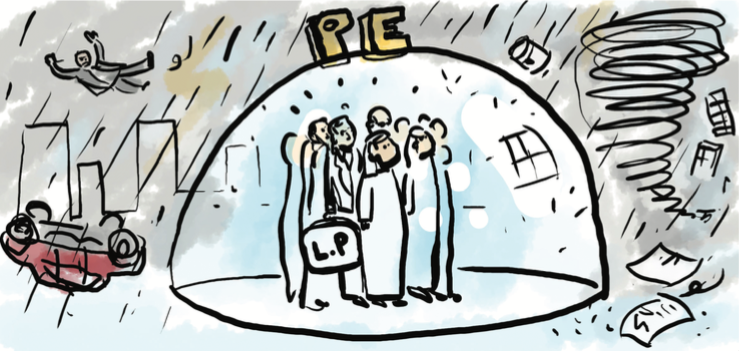
Unlike buying a few shares in a public company, private equity (PE) investment is a commitment that cannot be taken lightly. That is perhaps why most experts believe some two-thirds of institutional PE investors are on the sidelines waiting for better days. Who can blame them? Just like any other asset class in the region, PE is still licking its wounds after the beating that it took from the public markets, not to mention the de-leveraging costs that PE firms and portfolio companies across the region continue to shoulder as they brace themselves for a dismal year to come. Accordingly, it’s little wonder that most institutional investors who are willing to deploy money would rather consider more liquid investment options than further investment in PE, even at current market valuations.

“The nature of the private equity funds, reputed for their long term investment horizon, is not an attractive attribute for today’s investors who value liquidity,” says Rami Bazzi, senior executive officer at Injazat Capital.

The ensuing atmosphere in the region has become one of understanding between firms and limited partners (LPs) about capital commitments that were expected to be called over the past six months or in the foreseeable future.

“We told our LPs in November [2008] ‘be comfortable and relax… we are not going to be making any capital calls before we talk to you first because we don’t want to put you in an embarrassing situation of making a capital call that you can’t meet,’” says Ammar Al Khudairy, managing director & CEO of Amwal Al Khaleej Investment Co. Ironically, much of the stress on PE firms to make capital calls and on LPs to meet them has been lifted due to the systemic effects of the economic downturn.

“LPs would have defaulted initially [had capital been called], but deal making has reduced considerably considering the situation with LPs. At the same time, PE funds would not want to be at risk of signing a deal for which the funding may not come through thus jeopardizing the entire fund itself,” says Tamer Bazzari, deputy CEO of Rasmala.

To call or not to call

Nonetheless, it has already been around six months since this ‘period of understanding’ began. Since then, most PE firms have managed to hold off on making capital calls, but others have had no choice but to make that untimely call.

“At least one group has told us in January that they had frozen investment and made a capital call and only came up with 90 percent of the call. With regards to the other 10 percent, the investor just said ‘we can’t do it,’” says Benjamin Newland, partner at King and Spalding, a multinational law firm that consults in the regional PE market. The phenomenon of defaulting is indicative of a wider problem in the PE sector.

“There is going to be a ‘point of pain’ going forward for the PE industry, which is LPs being unable to fulfill their capital call obligations because of their own liquidity issues,” says Yahya Jalil, senior executive officer and head of private equity at The National Investor.

Robert Hall, head of transaction services Middle East & South Asia at KPMG, adds that “some LPs will continue to provide cash and there will be others who will refuse to make further capital calls and legal action will be taken against those.”

Having to deal with the liquidity issues of LPs is undoubtedly going to be a battle that will be waged until the end of this downturn. Nevertheless, PE firms will have to make nice with LPs whether they like it or not because, at the end of the day, firms will have to coax them into investing in an intrinsically illiquid sector at a time when cash is king.

“In an asset allocation waterfall where fixed income instruments receive most of the money… PE happens to be at the end of the asset allocation priority. Very clearly, not many LPs want to take additional risk in order to generate additional returns, when normal levels of return… are at risk,” says Bazzari. “Investors are seeking liquid investments to enable them to re-allocate when needed, a luxury private equity investments do not normally provide,” he continues.

Even institutional investors that have already committed to the PE sector will by default commit less money to the sector. “If a family conglomerate or a large institution has a target allocation for PE which is eight to 10 percent, and the value of their public portfolio shrinks, that eight to 10 percent will also shrink into a smaller base for PE with much fewer dollars [sic],” says Jalil.

In reality the current gap between the interests of general partners (GPs) and LPs was a long time in the making and despite the fact that there will be much friction in the next cycle, this is not necessarily a bad thing. PE in the region has to some extent been a victim of its own success, especially in the last three years. According to research conducted by Zawya Private Equity Monitor (ZPEM) and the Gulf Venture Capital Association (GVCA) of the total investments made in the PE sector over the last decade, approximately 86 percent were made in the last three years (2006 to 2008), with approximately 39 percent and 27 percent made in 2007 and 2008, respectively. While 27 percent in 2008 is still an admirable figure in terms of growth, it is symptomatic of a downward trend that is now manifesting itself in the industry.

Private equity activity in the MENA region has declined in 2008, both in total size and in number — 31 percent and 22 percent, respectively — according to ZPEM and the GVCA. Growing at such break-neck speeds — a CAGR of 48 percent in the past three years — has resulted in GPs charging almost exorbitant management fees and carrying commissions, while LPs were fishing for multiples that were out of sync with what the market could sustain in the medium to long term.

But as investment appetite has all but dried up, GPs are realizing that they can no longer afford to maintain a predominately opportunistic attitude towards their investors.

“Investors and LPs will be looking for a greater level of alignment of interests which will come in several respects. LPs will require GPs to have more ‘skill in the game’ and more of their own money alongside that of LPs, not just to be asset managers but also to have principle investments,” says Hisham El-Khazindar, managing director and co-founder of Citadel Capital. “There is going to be some pressure on management fees, particularly for the larger funds, as investors ask for the management fees to come down and harder return on investment (ROI) hurdles before PE firms are allowed to carry.”

As far as carries are concerned, the more intertwined the interests of funds and investors become, the less this becomes an issue.

“I don’t think anyone will be negotiating carries now because everyone realizes that there is a full alignment of interests,” says Al Khudairy. In the second quater of 2009 the PE industry will have to reconcile with the idea that unless mutual interests converge, many GPs could find themselves looking for a new profession.

April 3, 2009 0 comments
0 FacebookTwitterPinterestEmail
Executive Insights

Should investors enter the dragon or greet the elephant?

by Rehan Syed April 3, 2009
written by Rehan Syed

As global investors we face a dilemma — whether to make the next round of investment in the once solid developed markets or always fragile but promising emerging markets. Conventional wisdom argues that developed nations historically lead the emerging world out of recessions. Is this time any different? While a return to economic stability in the developed world is a prerequisite, the burden of driving growth will fall more than ever on the shoulders of the big new emerging markets of the ‘dragon’ China and the ‘elephant’ India. In the next few years, China will likely overtake Japan to become the world’s second largest economy.

A rare and unpredictable year for China

While ‘tiger’ often suffixes China, and ox metaphors are du jour, our edgier ‘dragon’ underscores the unpredictability of 2009’s economic outcome, pivoting around a heroic fiscal stimulus plan and China’s large collateral impact on other emerging markets. A feared Chinese hard landing, defined as sub five percent real GDP growth, will no doubt have a ripple effect, since over half of Chinese trade is with other emerging markets. Another reason to be edgy on China this year is potential social unrest since 20 million migrant workers are estimated to have lost jobs in the current crisis, often returning to villages where their land has been repossessed for development. Also, China faces a rare triple anniversary of controversies, notably the 10th anniversary of Falun Gong’s banning, the 20th of the Tiananmen uprising and the 50th of the Tibetan uprising, including the Dalai Lama’s escape to India. While less melodramatic, this year will also be eventful for India given its much-anticipated mid-year national election.

Weak outlooks?

In 2009 we expect China and India will grow about 5.5 percent and five percent, respectively, which is more pessimistic than the current consensus view of 7.7 percent and six percent. This is still well ahead of world GDP, which is likely to shrink one percent in 2009, thus partially offsetting the US and EU drag of about -2.5 percent in 2009, before rebounding to 2.5 percent in 2010. The stated government growth targets for 2009 are lofty at eight percent for China and seven percent for India, both unrealistic and with more downside risk for India.
In the past year, the equity markets of both have crashed and are now at historical valuation lows. While global stocks, as measured by the MSCI World index, were down a stiff 42 percent in 2008, India swooned 52 percent, China A-Shares crashed 65 percent and China H-shares were off a relatively better 51 percent. Year to date, China A- shares are up strongly but H-shares are about flat and India is down seven percent. Both Indian and Chinese H- Share markets trade at almost trough valuations with price- earnings ratios below 10 times.

From these depressed valuation levels, which of the two will fare better in the recession and eventual recovery, China or India? Beyond the obvious disparity of centralized vs. federalized governance structure, there are critical differences between the two — in terms of domestic consumer spending, exposure to the overstretched US consumer, foreign exchange reserves, trade balance, fiscal deficit and, most importantly, the degree of stimulus spending. The interplay of these is important but difficult to forecast and complexity is compounded by the lack of transparency, especially in oft-murky Chinese statistics.

Recent data is dreadful, but more so for China

After an exceptional run of nine to 10 percent real GDP growth for the past quarter century, which peaked at 13 percent growth in 2007, Chinese growth is sputtering. The major reasons for this are exhaustion of the export driven growth model compounded by a credit crunch, which squeezed trade finance, tail-off in capital investment, inventory destocking and a continuation of the real estate slump. Other metrics that confirm this steep fall in economic activity include electricity consumption, a reliable proxy for industrial production, which was -4 percent in recent months versus 12 to 15 percent growth in recent years, far worse than in the prior downturns of 1998 and 2001. This decline is partly due to inventory destocking, but could have been worse had it not been for improved inventory management, which has resulted in inventory stock of 35 to 40 percent of GDP versus well above 50 percent in prior downturns. Finally, export growth, which was running at 20 percent or more in recent years, is down about 25 percent this year and would have been worse had China not diversified away from the US, which was over 30 percent of exports a year ago and is now below 20 percent.

On the other hand, India has also slowed from a peak of 9.5 percent real GDP growth in 2007 to 5.5 percent, with exports down 15 percent in recent months. However, it is less pressured than China because of its less cyclical economic structure, with much heavier services mix and less export dependence on the US and EU. India’s exports are less cyclical, since services are about 35 percent of exports and least-cyclical IT services are 40 to 45 percent of service exports. Finally, Indian exports, which have tripled in the past five years, are now more competitive due to a sharp 25 percent recent fall in the currency relative to both US dollars and China’s yen. While China might be tempted to dangerously devalue as they did in 1994, they will be held back by political pressure from its vital trade partner, the US. In fact, we are likely to see continued appreciation if growth rebounds, albeit at a reduced pace versus the past three years.

Stimulus is far greater in China and could rise

China has launched a more aggressive stimulus policy than India and most other emerging markets. While it has grandiosely announced plans to spend $586 billion over two years, which equates to seven percent of GDP per year, some analysts have tarred it as an inflated plan that includes a rehash of previously committed spending. Even if the real spend is only half that figure, it still exceeds India’s paltry one percent of GDP. The equity markets have already priced in these announcements but we expect there could be more stimulus to come from China since the current announcements result in a deficit of ‘only’ 2.6 percent in 2009, lower than India’s — and America’s — elephantine annual fiscal deficit of about 10 percent. If GDP growth disappoints, we expect additional stimulus deficit spending in China, exceeding the governments’ current goal of limiting it to three percent of GDP. Given India’s already-high deficit, it has very limited room for additional stimulus, hence the higher downside risk.

Key structural differences will endure

As the table [on the previous page] shows, there are vast differences between the two countries’ economic attributes, which hint at continued growth opportunities well past the current turmoil. China is poor with GDP per capita of about $3,300 and about one third of its 1.4 billion population living on less than $2 per day, while India is worse off with GDP per capita of about $1,000 and over two thirds of its 1.2 billion people get by on a $2 daily budget. India’s population density is substantially higher and getting worse with an annual growth of 1.2 percent per year, double China’s 0.6 percent per year. Over the next couple of decades, this will result in a gray China and a youthful India, a demographic dividend that will translate into productivity only if India improves its lagging primary education system, especially in the rural areas where the bulk of the population resides. Finally, India is less cyclical because its GDP is about two-thirds domestic consumer spending driven, versus only about a third for China. China’s core challenge in the near future is to shift the economy from being manufacturing and export driven to being more like India, with higher services and domestic consumption.

Average into China now, await lower Indian entry point

Waiting for a turn in macroeconomic data is too late since equity markets will attempt to lead by about six months. In China, while news flow might worsen in the next month or two, some early indicators point to the fiscal stimulus working, such as bank loan growth, which is up strongly recently. While one statistic does not make a trend, oversold markets could result in large upside moves. We favor the H-share route given they trade at a wide discount to A-shares and have better transparency in these murky times. Since bottom picking seldom works, we advocate averaging in over the next six months, accumulating on dips and accelerating if the HSCEI index retests October lows of 5,000, especially if you have at least a five-year horizon to mitigate market risk. If you think that is an awfully long horizon, keep in mind that once-emerging Japan equities still trade 75 percent below their 1989 peak. Also, diversify and allocate your portfolio wisely, since Chinese equities are only about seven percent global stock market capitalization and India’s even less at two percent.

With India, saunter slowly like the elephant, and start to build positions in the mid-to-late second quarter around the national elections, which will likely have major impact on investor sentiment. During the last major election of 2004, an unfavorable outcome resulted in a 20 percent market drop within two months and we would buy into any similar dislocation. Since fiscal pump priming is limited by the deficit-laden nature of the budget and the high 72 percent debt to GDP ratio, a favorable election outcome will be defined as a stable reformist government given the fractious political landscape. Such stability is key to macroeconomic reform, especially financial services reform and privatization of inefficient national assets, which are critical to unlock economic potential.
Borrowing from a former president of the US — the country where this recession began — the Chinese use two brush strokes to write the word ‘crisis’: one brush stroke stands for danger, the other for opportunity. In this crisis, be aware of the danger, but recognize the opportunity, as a lot of negative news is being priced into the markets.

Rehan Syed is the head of portfolio management at the ABN AMRO Private Bank in Dubai. The opinions expressed here are personal and not necessarily those of his employer

April 3, 2009 0 comments
0 FacebookTwitterPinterestEmail
Finance

UAE – Dubai bails

by Executive Staff April 3, 2009
written by Executive Staff

Earlier this year when Abu Dhabi capitalized five of its own banks, panic spread throughout the Dubai banking sector. Waiting with baited breath, bankers in the ailing emirate anticipated action by the federal or local government to rescue Dubai’s banking sector. Finally, at the end of February, the Dubai government issued a $20 billion long-term bond program, selling the first half of the bond to the UAE Central Bank (CBUAE). Central Bank Governor Sultan Nasser Bin Al Suwaidi said he hopes to bridge the banking sector’s reported $30 billion gap between bank deposits and loans and beef-up the advances- to-deposit ratio in collaboration with the Ministry of Finance. While many referred to this bond program as a ‘bailout,’ the government labeled the move a ‘stimulus plan’ for the banking sector and economy as a whole. More important, however, is the message the Dubai sovereign sent out via this latest initiative: Dubai is just as capable as its sibling emirates. Economy minister Sultan Bin Saeed Al Mansouri said he believes that the government’s latest measures should be adequate to hold up the UAE economy for the next nine months.

Road to recovery
Since the global financial turmoil began ravaging the UAE economy in the fourth quarter of 2008, many steps have been taken to ease market pressures and boost liquidity, beginning with the central bank’s $32.67 billion emergency funding facilities, followed by Abu Dhabi’s capital injection of $4.4 billion into five of its banks and now with the latest Dubai sovereign’s $20 billion bond issuance. Raj Madha, director of equity research at EFG- Hermes in Dubai, says after the Abu Dhabi bank capitalizations, “the Dubai banks were a little left out in the cold. This [bond issuance] goes some way to addressing that imbalance.”
Moody’s Middle East analyst John Tofarides reiterates the program’s benefits stating: “the banks indirectly benefit from this bond issue as federal support helps to recoup confidence in the system.” The bond issuance “alleviates potential pressures to Dubai banks for taking up loans that cannot be internationally financed as a result of dried market funding conditions,” he adds.
Robert Thursfield, director in the financial institutions group at Fitch Ratings UAE, notes it is “unclear how much, if any, of the [bond] will be used to support the banks. If some is allocated to the banking sector, then a recapitalization as per the one in Abu Dhabi could occur.” While the picture is still murky as to what the direct implications will be on Dubai banks, these days any action is good action.
Last month, Al Suwaidi emphasized the need for banks and other financial institutions to pay off their outstanding international debts, “with 100 percent reliance on local funding… At the moment, the UAE banking system is localizing liabilities of banks; that is, getting rid of foreign inter-bank deposits. Also, it is repaying syndicated loans, medium-term notes and European commercial paper to reduce risk of non-renewal of such liabilities at the wrong time.”
Inter-bank rates have been slashed across the GCC, with Madha noting that “lower inter-bank rates give headroom for profitability pricing risk.” EFG-Hermes data suggests, continues Madha, that three-month inter-bank rates “fell to a low of 1.88 percent. I think the greater issue is the perceived levels of risk — and these are still high — given pressure on labor markets, tourism, financial services and construction.”
To aid the recovery, the central bank also plans to cut interest rates by the second quarter of this year. Al Suwaidi mentioned that the CBUAE intended to ostracize the country’s banking sector from the global arena in order to protect the system against any ensuing international crises, but he insisted this would not include any rumored actions related to de-pegging the dirham from the US dollar.
Despite the latest moves by the federal and local sovereign entities, renowned ratings agency Standard & Poor’s recently announced plans to review numerous institutions for downgrade across Dubai, including four Dubai-based banks. The rationale behind the downgrade is due to the continued deterioration in the Dubai real estate market and its serious effects on local banks, as well as the overall weakening economy. The banks nominated for ratings review are Mashreqbank, Dubai Islamic Bank, as well as Emirates Bank International and National Bank of Dubai — now collectively known as Emirates NBD — due to residual debt prior to their merger.
Experts and business leaders alike find the new bond program a positive development for Dubai banks. Moreover it is “a step towards avoiding any unpleasant surprises,” says Tofarides. Thursfield trusts that this year “will be very challenging for the banks” and is confident that “the challenges will persist into 2010.” With tightened liquidity, delinquencies on loan portfolios, systemic risks, depleting deposits and much more, banks in the UAE undoubtedly have a grueling year ahead of them.

April 3, 2009 0 comments
0 FacebookTwitterPinterestEmail
Executive Insights

The future is online

by Gabriel Chahine & Jayant Bhargava April 3, 2009
written by Gabriel Chahine & Jayant Bhargava

Reading newspapers, watching television and listening to the radio may no longer be preferred options for consuming media. Mobile handsets and computers are gaining importance as means to access mass media, especially with younger audiences. Media usage has fragmented and many more advertising platforms now exist. New media will gather a 19 percent share of global advertising by 2011. These platforms enable a greater precision in targeting and accountability, while allowing for interactivity and innovation. During the current economic climate, new media has a clear advantage.

This has profound implications for traditional media players. Their distribution channels are controlled by a new breed of competitors. The Internet gorillas dominate online traffic, whereas telecommunication companies control the touch-points with mobile media consumers. New formats, such as paid search, dominated by Internet players are eating into their bread and butter. The new media game involves a dynamic, complex and interconnected ecosystem in which ad agencies, telecommunications, media, Internet and technology players depend on one another to thrive. But it is also a brutal competitive arena, rapidly distinguishing winners from losers.

In the MENA region, the game is just beginning. New media accounts for less than two percent of ad spend. Unlike developed countries, delivering content over mobile forms the primary new media revenue source. Low Internet penetration, availability of digital Arabic content and advertising capabilities remain key challenges. Consumers are displaying similar preferences as those in developed countries. Young people make up a relatively high percentage of the population. Overall, the regional new media market is fertile with leaders yet to be established.

Are the rules still the same?

As always, consumers define the rules. The consumer today has more control and choice. Consumption is no longer passive. Consumption is becoming a norm. So yes, the rules are changing. This is transforming the recipe for building a successful digital media brand. The challenge is not limited to real-time consumption of content. Editors need to engage in two-way communication allowing user participation. Building a digital community within the context of a brand is essential. Ability to leverage technology and develop partnerships is more important than ever.

The youth segment rarely uses traditional platforms. Hearst, recognizing this trend, transformed Elle Girl into an online-only brand. Other segments — such as leisure male, female socialites and professionals — are expected to follow suit, more so when today’s youth transition into these segments. For now it is crucial to leverage the loyalty of traditional assets to create equity on digital platforms, before users choose a different digital brand for the same content needs. Marketers are demanding new models of interactions with agencies. The traditional models lack the required speed-to-market and ability to create a dialogue with consumers. A recent cross-industry study in the US confirmed that advertisers believe closer and more collaborative partnerships with media companies will be important to their marketing initiatives.

Media companies have the opportunity to take on responsibilities that were once the exclusive preserve of ad agencies. Ninety-one percent of media companies surveyed already provide some kind of advertising service such as campaign development and branded content creation.

In the US, newspapers took 127 years to reach $20 billion in ad revenues; online media have garnered that amount in just 13 years. Regionally, advertising investment per user is two dollars, compared with $59 in the US or the global average of $27. Regional offerings are suboptimal and do not cover the wide spectrum of needs. Popular local sites lack qualities essential for advertisers. The successful traditional brands are not well represented on digital platforms. International players are not focusing on the region, yet they dominate the traffic, although not by intent or design. Today’s opportunities may well be taken and guarded by the time the market becomes lucrative. Fortunately, paid search is not expected to be the primary format. A targeted local offering has the potential to not only capture a prominent share but also to play a critical role in creating the market.

What strategies are media players adopting?

Take existing assets online — it is key to enable users to consume and participate with their favorite content at the time of their convenience and in the form they prefer.

Build new media brands — new media provides an efficient way to target segments not covered by traditional formats. It also enables companies to aggregate content from existing titles to provide a differentiated experience. For instance, Conde Nast created menstyle.com by combining GQ and Details magazines.

Build a digital content business — new media provides a unique platform to monetize the long tail. The large libraries, which do not find a place on TV grids or magazine pages, can be monetized easily.

Build a media portal — media players could integrate traffic-generating applications, like e-mail and marketplace, into their content propositions. To illustrate, the strategic merger of Time Warner with AOL accelerated the digital transformation of Time Warner. Today, AOL is syndicating content not only from Time Warner, but also from other media sources.

Who will win the ‘New Media’ game?

Each player has established a sweet spot along the digital value chain and is devising strategies to lead the game. Business models are constantly evolving and their sustainability is yet to be established. Relative values of traffic generation and aggregation, content and customer intelligence will be key in defining the leader. But one thing is certain, no player can win alone. Collaboration is king. The ability to forge the right partnership at the right terms and at the right time will define the winner.

Gabriel Chahine is partner and Jayant Bhargava senior associate at Booz & Company

April 3, 2009 0 comments
0 FacebookTwitterPinterestEmail
Finance

Global economic crisis – A six-month tally of woe

by Executive Staff April 3, 2009
written by Executive Staff

In October 2008, Alan Greenspan, the 1987 to 2006 chairman of the US Federal Reserve, testified before congressional leaders in Washington saying “I was shocked when the system broke down, my ideology and model that I always believed in proved me wrong.” He hastened to add that, “the crisis will pass” and that the then proposed $700 billion rescue package “is adequate to serve the needs.” In December 2008, he went on to say that “the global stock market value wiped out this year is $30 trillion, but human nature being what it is, we can count on a market reversal within six months to a year.”

Six months into the crisis, economic reality defies Mr. Greenspan’s assessments and predictions. The lost value in stocks has reached $50 trillion — nearly double his estimate and almost as much as last year’s world global output that is estimated to be $55 trillion.
In the meantime, the initial US rescue package was augmented by one trillion dollars this February, making the current US operation to save its economy more than 10 times bigger in real terms than the Marshall Plan of the late 1940s, which helped the European continent recover from a devastating war by increasing industrial production by 35 percent and restoring agricultural production to its pre-war levels in just four years.

A crisis like no other
This time it may take longer than four years for the world economy to get back to what it was before the crisis, as expectations for recovery are deteriorating by the day. Last November, the International Monetary Fund (IMF) predicted a slow down of the global output growth rate to two percent in 2009, from an average annual growth of five percent in the preceding years. In January, it revised this estimate to “possibly negative.” In economics, it is customary to qualify pessimistic expectations. Last December, the World Bank forecast a positive global growth of one percent, but in March that was revised to negative growth of possibly “up to two percent.” The Bank also expects that as a result of the crisis, global poverty will increase by 100 million, while the International Labor Organization foresees an increase in global unemployment by 50 million.
The ideology that Mr. Greenspan referred to is by now well known. It was practiced in its purest form, especially by the US and the UK. Since 1979, the year President Ronald Reagan was elected in the US and Margaret Thatcher in the UK. It was based on three pillars:
First, too much faith in unregulated markets — and there is a fundamental difference between ‘free markets’ and ‘markets’. Second, too much reliance on interest rates alone to manage the whole economy — at the expense of sensible fiscal policy, especially in the area of social services. Third, too much of a belief that central banks can and should avoid recessions happening on the watch of the government of the day — in defiance of the expected independence of central banks. This led to excessive leverage (debt creation) by financial institutions and unrealistic borrowing by households for housing (mortgages) and current consumption (read: credit cards).
Of course, elected politicians in democracies cannot have it their way unless the electorate is on their side. Both the UK and US have unquestionable democratic processes and educated voters in democracies tend to follow — with spasmodic deviations — what they believe is best for their own interests. The rhetoric that followed the so-called ‘neoconservative’ ideological revolution since the 1980s did just that: it used an array of populist arguments that made the majority of the electorate believe that free markets can best serve their interests and that economic insecurity can become a thing of the past.
Policies supporting this ideology followed suit. Firstly, shares of privatized companies in the UK were offered at low prices and appealed both to the short- sighted and the long-sighted. The short-sighted bought shares to make a quick profit by reselling them. The long- sighted bought them to start building a bigger nest egg as it was felt that returns on investments in stock markets were bound to increase fast.
Second, by offering subprime mortgages that have a high risk of default — one of the culprits of the crisis — house ownership increased (good for the citizens), corporate profits boomed, especially in the construction sector and the financial markets (good for economic growth), while the pressure on governments to fund low- cost social housing decreased (good for the public debt). What could be more appealing than this ‘triple win’?
Third, recommendations for securing the financial stability of the elderly overstated the growth and security of financial investments. Voters were aware that they had smaller families than their parents and that there would be fewer future workers to support their own pensions. In the meantime, they were facing increasing payroll taxes in the form of pension contributions, requirements for staying on longer at work and decreasing levels of pensions. Privately funded pensions based on returns on individual savings accounts invested in financial markets were marketed as another winning alternative and as a fair one. They were expected to provide higher pensions due to the then state-provided social insurance. And their ideological appeal was significant: those who earned and saved more would have a bigger pension than those who earned less — those with less were assumed to be lazy rather than unfortunate.

The model of greed
The rhetoric included many other arguments, but let’s mention just one more. In an interconnected, globalized economy it does not make much difference who saves and who consumes as long as the whole thing balances out. In such a world, over-spending by consumers in some countries — such as the US and the UK — can be the antidote to the thriftiness of other countries, notably China.
All in all, it was an ideology based on what is now widely termed as ‘greed’, though the word seems to be equally, and incorrectly, used both for workers and households who justifiably aspire to a better life in the already high income economies, as well as for financial executives and the 1,300 billionaires that have been created in the last couple of decades. In the words of economist Paul Krugman, the most recent Nobel laureate, it was the ideology of “private good, public bad” that prevented the development of sensible regulation for the expanding financial sector. Lack of regulation created asset inflation over time, which was deflated instantly after the onset of the crisis. The total 2008 financial losses were 40 percent for UK’s FTSE, 45 percent for the European FTSEurofirst, 42 percent for Japan’s Nikkei, 48 percent for Hong Kong’s Hang Seng, 39 percent for the New York’s S&P and 65 percent for China’s stock market.
None of this is surprising. Many people talked about the looming crisis, but strong arguments are not always enough to overcome strong political powers. Some of those in power did listen. For example, during the East Asian financial crisis in 1997, the prescribed rescue packages were criticized for being too based on ideological thinking — some called it the ‘Washington Consensus’. They said it put too much emphasis on fiscal austerity, raising interest rates and privatization. Furthermore, they said, “let the banks fail.” Today, Western economies follow the opposite track. Their recovery plan is based on expansionary fiscal policies, low interest rates and rescuing private companies and banks.
Similarly, soon after the 1997 crisis, the aforementioned Krugman became one of the many critics of the risk management model that replaced the role of regulation in the financial markets and eventually, and predictably, failed to ensure that the inrush of capital created in the financial markets was prudently invested. In 1999, Peter Warburton, a UK economist, published a 350- page book that focused on how the central banks were imperiling the world’s economy. The book’s message is obvious from its title, “Debt and Delusion.” In 2001, Joseph Stiglitz, a US economist who got a 2001 Nobel Prize, explicitly advised the Bank of Iceland what it had to do to avoid becoming the “champion victim” of the crisis. As recently as 2006, Nuriel Roubini, another US economist, earned a similarly unenviable title, “the prophet of doom,” after a lecture he delivered to an uninterested IMF, the international organization in charge of overseeing the global financial system.
Despite the warnings, the ideology crossed political boundaries. The Labor Party in the UK, referred to as “New Labor” after it took power over from the successive conservative administrations between 1979 and 1997, pledged to decrease child poverty by half to 1.7 million children by 2010 and to eradicate it by 2020. It is now estimated that 2.3 million children will still be in poverty in 2010, a discrepancy of 35 percent from the stated target, due to a financing gap of $6.15 billion a year. Let’s put these numbers in context. First, without any new policies to help low-income families — a likely scenario amidst the current crisis — child poverty could rise to 3.1 million by 2020, a number similar to the number of poor children in 1999 when the pledge was made. Second, the Royal Bank of Scotland paid nearly $5.87 billion in bonuses in 2007 and posted $35 billion losses in 2008, the largest corporate loss in the history of the UK. Third, the value of employees’ private pension funds dropped by nearly a third from $810 billion to $579 billion between October 2007 and October 2008. In the US, $2 trillion was wiped out in equity value from 401(k) and individual retirement accounts in the two months following the start of the crisis, nearly half the holdings in those plans.
The time has come to listen. This is already happening. In February, the new US administration under President Barack Obama added $1 trillion to what Mr. Greenspan thought was adequate to rescue the economy. Whether this will be sufficient, and how it will be spent in practice remains to be seen. For example, the faltering American Insurance Group (AIG), once the leading insurer in the world, is to receive $170 billion in rescue funds, but still faces hazards in its $1.6 trillion portfolio of complex derivatives.
This month, British Prime Minister Gordon Brown declared that he takes “full responsibility” for his role in the banking failures that led to the global recession. In the meantime, housing waiting lists have reached record levels, having increased by 55 percent compared to five years ago and they are expected to double by 2011. Some of this increase will be, of course, the result of repossessions and increasing unemployment as well as lower construction activity. However, much is also due to the shortage of social housing, whose availability decreased over time.

The economic gear shift
Probably nothing constitutes a more dramatic admission of change than the criticism of the now opposition conservative shadow housing minister saying, “The [Labor] government’s record on social housing is embarrassing — the average annual number of social rent properties delivered has halved since 1997.” The other main opposition party in the UK, the Liberal Democrats, is no more polite. “The government allowed the bubble in the housing market to get out of hand for many years. We are now seeing the results of that bubble bursting,” they said. Now the government’s target is to build 240,000 new homes each year until 2016, while Gordon Brown admitted that “the economic downturn marks the end of the era of laissez-faire government.”
One cannot but welcome a more balanced approach to managing the economy. The days of the glorification of financial markets as a magic creator of wealth have come to an end. Financial markets are not an end in themselves, but a means that enables the real economy to be more productive. Along with the individual efforts of the US, the UK and other high-income and developing economies, the UN set up a commission of experts chaired by Joseph Stiglitz to put forward “credible and feasible proposals for reforming the international monetary and financial system in the best interest of the international community.” There is also increasing recognition of the importance of multilateralism. Both the IMF and the World Bank are currently looking into governance structures that would increase their effectiveness.
Luckily, the attempt to create a one-sided global ideology failed. Hopefully, the attempt to find shared global solutions will succeed.

PROFESSOR ZAFIRIS TZANNATOS is a Beirut-based economist and was previously advisor to the World Bank and chair of the economics
department at the American University of Beirut

April 3, 2009 0 comments
0 FacebookTwitterPinterestEmail
Executive Insights

The bankers’ duel for deposits

by Julien Faye & Sameer Chishty April 3, 2009
written by Julien Faye & Sameer Chishty

The global financial crisis has hit Gulf banks hard. The catalysts that boosted their growth — high oil prices, a booming real estate market and strong credit ratings — have run out of steam. The challenges now are many. As the region’s equity markets tumbled, so did the banks’ lucrative wealth management services. The likelihood of additional asset write-downs has triggered concerns about banks’ balance sheets. Moreover, Gulf bankers have seen cheap wholesale funding dry up and are reluctant to lend to each other, leading to higher cost of funds and liquidity shortfalls.

The region’s banks are now locked in a battle for the lifeblood of banking — retail deposits. Winning this battle may be a matter of survival. The deposit opportunity is big as Gulf investors keep over 40 percent of their financial wealth in deposits. Deposits are also a low-cost source of funds. They can cost banks as little as one percent of capital versus seven percent for bonds.
To make the most of the deposit opportunity, banks need to focus on four areas: pricing, products, promotions and people.

Pricing — be nimble. 

Banks must urgently deal with how best to price offerings to lure and retain depositors. The big risk is that banks will be dragged into a price war, encouraged by government deposit guarantees. Simply to offer higher rates for deposits will only encourage customers to churn their accounts. Gulf bankers need to ensure the rates they pay on deposit products are aligned with their average cost of funds. They can also be more analytical about gauging how responsive different customer segments are to different rates. Lenders can offer rate-sensitive depositors higher- yielding products. In the UAE, a foreign bank offers a six percent rate of return on a one-year $13,500 deposit. Smart banks will compensate less rate-sensitive customers by emphasizing convenience and benefits. Banks must closely monitor competitors’ moves and act preemptively to retain customers — without triggering a price war. Some banks are converting short-term demand deposits into longer-term holdings. Several local banks are looking at offshore depositors.

Products — innovate.

The most innovative banks develop a deep understanding of customer buying behavior and target product offerings accordingly. By bundling products, for example, banks can offer savings accounts that entitle the holder to a home loan at a preferential rate once the customer accumulates enough assets in his or her deposit account. Watch for Gulf lenders to boost product offerings by highlighting non- price benefits such as a tie-in with an airline where a depositor gets air miles for opening an account. Some banks, like HSBC, have already started innovating. Its new ‘e-saver account’ permits UAE customers to open the account instantly online with no management fees, no minimum balance and a 5.3 percent rate.

Promotion — The right timing.

Smart banks will promote attractive offers when customers are most likely to respond, such as when a customer’s deposits mature. To build awareness of deposit products, they will launch promotional campaigns visible to customers wherever they come in contact with the bank — from branch windows to ATM receipts.

Bankers can also increase deposits by providing incentives to customers with salary accounts to directly deposit a percentage of their earnings each month.

People — Recruit, reward.

With the spotlight on deposits, banks will recruit top talent to staff product management and marketing support for their deposits operation, as well as build high-powered analytical capabilities. They will deploy their new talent to improve the end-to-end customer experience, such as setting up effective application processes. Successful banks will also set up dedicated deposit teams and reward employees who bring in new deposits and cross-sell products to existing customers.

For Gulf banks coping with falling profits, the stakes couldn’t be higher in the battle for deposits. Those banks that are analytical and innovative enough will become the places where much of the Gulf’s money is kept. Or, at least, they will secure their positions in a region that still has strong long-term growth prospects.

Julien Faye leads the financial services practice for Bain & Company in the Middle East and is based in Dubai. Sameer Chishty is a partner in the firm’s financial services practice, based in Hong Kong.

April 3, 2009 0 comments
0 FacebookTwitterPinterestEmail
GCC

The dollar’s exposure

by Executive Staff March 22, 2009
written by Executive Staff

“The dollar is our currency, but your problem,” quipped US Secretary of the Treasury, John Connolly, to his European counterparts in 1971. Today, nearly 40 years later, his words couldn’t ring truer. While the value of the US dollar weakened relative to the world’s other major currencies for most of the George W. Bush presidency, the slide became ever more precipitous in the first half of 2008. This helped spur inflation across the Middle East — where the value of many countries’ currencies are pegged to the greenback — as imports priced in euros, yens and anything other than dollars quickly became more expensive.

For states in the Gulf Cooperation Council (GCC), the equation was even more costly as the dipping dollar eroded the value of their trillions in accumulated dollar holdings. New revenues from oil receipts are also priced in dollars, and so even as the dollar price per barrel of oil reached record highs through the first half of 2008, the value of each dollar earned from oil was declining.

What was pushing the dollar down? The factors are numerous, complex and interrelated, but part of the answer is that America has been living well beyond its means and is thereby exposed to significant liabilities. Total US government debt surpassed $10 trillion in September 2008, helped along by the trillion dollar tax cuts early in Bush’s presidency and the hundreds of billions absorbed by military adventures in Iraq and Afghanistan. More generally, however, the American economy simply consumes more than it produces and has been doing so for a long time — in 2008 this imbalance amounted to $677 billion. The US has run an annual balance of payments deficit on current accounts of approximately six percent of GDP for most of the last decade, implying that for every $100 worth of goods and services produced, America consumes $106 worth. Where does the other six dollars come from? In essence, America has been borrowing money from the rest of the world.

If the Americans could have continued forever printing more dollars to send out into the world in exchange for the tangible products the rest of the world makes, they might not have had a problem. However, as total American debt lurched ever higher through the 2000s, moneylenders everywhere began to question America’s ability to pay this money back. These creeping doubts meant that US debt — effectively the dollars sent abroad — became less attractive to hold onto, thus contributing to the dollars declining value.

US dollar against major world currencies

Monthly average values

Welcome to the financial crisis

The grinding slow-down in the US economy through 2008 led the US Federal Reserve Bank to continually lower interest rates to try and encourage growth, with the January 2008 rate of 4.25 percent falling to 0.25 percent — effectively zero — by year’s end. Yet as the global financial crisis began to cascade and investors’ August of angst morphed into September’s sheer panic, capitalists grabbed their money and ran to where they always run when Armageddon seems nigh, the pocket of their champion, Uncle Sam.

“Despite the next to nothing yield offered by dollar denominated investments, a flight to safety into US dollars and government bonds has kept the US dollar from collapsing,” wrote Kathy Lien, director of currency research at FX360.com, in a December 2008 report. “The concern for safety was so high that investors were willing to take negative yields just to park their money with the US government.”

Thus, since August 2008 the dollar’s dive has U-turned — albeit, far from smoothly — riding demand for dollar-shelter and appreciating nearly 20 percent against the euro between July 2008 and February 2009. How can this be happening when there are so many good reasons to sell the dollar? The non-partisan Committee for a Responsible Budget estimated that the different bailouts and stimulus packages the US government has announced will total $2.6 trillion in new spending; Morgan Stanley predicts the 2009 US deficit at $1.5 trillion, or some 10 percent of GDP. While some of this new spending will be paid for through new borrowing, the rest of the money will be created, in essence, out of thin air.

“The Federal Reserve is basically printing money and using that money to flood the market with liquidity, eroding the value of the US dollar in the process,” noted Lien. “The central bank will not be worried about a weaker currency and will in fact welcome one because they know that a weaker currency is like an interest rate cut in many ways because it helps to support and stimulate the economy.”

Foreign exchange traders are a cynical lot. More than one has noticed the long-term benefits to America in driving the dollar down. Effectively, it allows the US to renege on a portion of its foreign debt, as US debt is denominated in dollars. If, for example, an American borrowed $100 worth of euros and used them to purchase goods in July 2007, they would have been able to buy 73 euros worth of stuff. If they repaid the $100 a year later in July 2008, after the US dollar had declined in value, it would only have bought 64 euros worth of stuff, meaning whoever lent America that money is getting short changed.     

As well, American workers need jobs and American politicians lose theirs when unemployment remains high. A high value for the dollar means that foreign imports into the US are continually displacing American producers, while a low dollar produces a surge in exports and creates jobs for middle class Americans, thereby preserving political careers.

“The G.C.C. states are locked into the dollar and the fate of the dollar is their fate as well”

The Chinese checker

While many countries worry about dollar devaluation, few have more to lose than China, by far America’s largest lender with a staggering $1.95 trillion in its foreign exchange reserves. The US has been able to run such a large balance of trade deficit for so long in large part because China has, essentially, been recycling its trade surplus — which was $262 billion in 2008 — back into buying US treasury bonds, supporting the dollar’s value, keeping US interest rates low and lending America back the money to buy more Chinese goods. Daniel Sternoff, director of emerging markets and energy research at Medley Global Advisors (MGA), explains that China’s trade surplus will shrink if China’s exports fall as the world economy weakens, or if China’s own $580 billion economic stimulus package to bolster domestic demand successfully props up its economy, keeping imports “at a relatively decent level.” These possible scenarios make it uncertain whether China will continue to have sufficient trade surpluses in 2009 to recycle back into the US treasury market to prop up the dollar.

“And that’s just a question of what’s the overall supply of dollars they have to be purchasing more,” says Sternoff. “Whether they will begin to sell their reserves outright is more of a political question, and we have received some indications that they are going to be spending at least $300 billion of their foreign exchange reserves.” 

A nightmare scenario for the US and the global economy at large would be if China began dumping its US reserves. This would flood currency markets with dollars, causing their value to drop, in turn evaporating the value of US dollar savings held by countries, companies and people the world over and writing off the US as the globe’s largest export market. Beijing has “serious worries over the potential for much greater dollar weakness and the erosion of the value of their holdings,” and has been looking for ways to try and diversify its reserve holdings, Sternoff points out. Yet he adds that the Chinese also “have a very strong vested interest in the stability of the global financial system and in the stability of the US economy… They’re not about to start currency wars with the US by shooting themselves in the foot by selling their bond holdings.” A second nightmare scenario is that the vast overhang of dollars in portfolios around the world has grown to a magnitude that may be beyond the control of any single group of players — and that when everyone is worrying about currency depreciation, it may only take a small event to spark a stampede for the exits.

GCC’s dollar marriage

The fabric of Gulf economies has been intertwined with the dollar since the 1970s arrangement with the Organization of Petroleum Exporting Countries (OPEC) to have oil sales priced exclusively in dollars. With five out of the six GCC currencies currently pegged to the dollar, Kevin Muehring, a financial journalist specializing in macro economics and monetary policy, remarks that, “for better or for worse, the GCC states are locked into the dollar and the fate of the dollar is their fate as well.” The Gulf’s banking systems are structured around the dollar, the banks, the government and the private sector all hold huge proportions of their assets in dollars and, most importantly, “oil is priced in dollars and therefore most of their revenues, before they are converted into their domestic currencies through government spending, are in dollars,” says Muehring.

However, one need only look to Iran to see that a dollar divorce is, although long and unpleasant, possible. In 2003, the world’s fourth largest oil producer began large-scale movement of its foreign-held assets out of dollars and as American financial sanctions continued to press on the exposed parts of the Persian purse, Tehran announced in April 2008 that it was no longer taking dollars in exchange for its oil.

“We agreed with all the buyers of Iran’s crude to trade oil in currencies other than the dollar,” said Hojjatollah Ghanimifard, international affairs director of the National Iranian Oil Company, to the Fars News Agency. “In Europe, Iran’s crude is being sold in euro, in Asia in euro and yen.”

Kuwait also caused ripples through the Gulf when it became the first GCC country to break ranks and de-peg from the dollar in May 2007, instead locking its dinar into an exchange rate mechanism based on a ‘currency basket’, including the dollar, the euro, the pound and the yen.

“The massive decline in the dollar’s exchange rate against main currencies… has contributed to the increase in local inflation rates and this step is part of the central bank’s efforts to curb inflationary pressure,” said Sheikh Salem Abdul-Aziz al-Sabah at the time.

Inflation due to dollar devaluation had other GCC states openly speculating through the first half of 2008 that they might also de-peg their currencies, “but now, this discussion is not happening,” remarks Sven Behrendt, associate scholar at the Carnegie Middle East Center in Beirut. In recent years Gulf states have funnelled much of their surplus oil revenues into sovereign wealth funds (SWFs) to reinvest, with the Council on Foreign Relations estimating the Gulf SWFs’ 2007 external portfolio at $1.3 trillion. However, the global financial storm has pummeled Gulf SWF holdings, with the Abu Dhabi Investment Authority alone estimated to have lost some $140 billion through 2008.

“They shifted a lot into equity, and with that came a higher risk exposure to their portfolios,” says Behrendt. “Now they’ve burned — quite substantially — their fingers in some of their investments.”

Given the lack of transparency with which the SWFs operate, accurate fiscal assessments are difficult, but what is clear, says Behrendt, is that they have been burned with heavy losses and are now among those sheltering their bundles of cash in US treasury bonds, in turn helping to keep the dollar high.

Should a viable alternative to the dollar reveal itself to investors, support for the dollar will collapse

Forever a dollar world?

Everybody uses US dollars because everybody else accepts them, but this was not always the case. Historically, the pound was the world’s general medium of exchange and the invoice currency of much of international trade. In the 1960s, however, major weaknesses in Britain’s economy forced London to de-value the domestic currency and the sterling lost its international shine, making way for the assent of global dollar hegemony. Today, with the US economy plummeting and the greenback baring an ever-growing debt, is the dollar’s reign near its end?

Muehring, the financial journalist, acknowledges the dollar will experience massive downward pressure in 2009, but “the offsetting pressures will be the lack of currency alternatives as the underlying economies of both the euro and the yen are in worse shape than the US.”

This was highlighted last month when German Finance Minister Peer Steinbrueck stated that a number of the 16 euro zone countries were “getting into trouble” and may need help — read ‘financial bailout’ — from the euro’s two biggest economies, Germany and France. Bloomberg reported European countries have committed more than $1.5 trillion to “save their banking systems from collapse,” and a number of countries are now staggering under the debt-load. The cost of insuring the debt of Ireland, Greece and Spain against default is at an all-time high. As well, Austria’s exposure to banks in eastern Europe has Vienna pleading with the EU for help, as the country “is on the hook for so much money that essentially if they don’t get paid by eastern Europe they’ll go bust,” said Marc Faber, managing director of Marc Faber Ltd., to Bloomberg. 

And so as the global financial crisis pushes counties and economies to the cliff’s edge, investors continue to huddle under the dollar for lack of anywhere else to hide. But the foundations of the dollar’s dominance are cracking and should a viable alternative reveal itself to lure investors away, support for the dollar will collapse.

March 22, 2009 0 comments
0 FacebookTwitterPinterestEmail
Levant

Politics over pragmatism

by Peter Grimsditch March 22, 2009
written by Peter Grimsditch

If the International Monetary Fund (IMF) were putting up candidates in this month’s municipal elections in Turkey, the best advice would be for them to withdraw before being trounced. On one side, the ruling Justice and Development Party, or AKP, is spending lavishly on certain local authorities while holding off on raising tax revenues. Those killjoys from the IMF have been campaigning for months for Prime Minister Recep Tayyip Erdogan to do exactly the opposite. If Turkey wants a new standby loan to see it through the tough times of 2009, say the men with built-in calculators, it needs to be less profligate.

A “deal” has been on the cards allegedly since last November and even in February Erdogan claimed the talks were progressing well despite a “last minute hitch” when the IMF was said to have injected some “unacceptable conditions.” A team from the Fund spent most of January in Turkey seeking to hammer out a deal before suspending the talks. Smart money (and certainly not the IMF’s) is going on a forecast that no agreement will be reached before the elections on March 29. A plummeting currency and rising unemployment are making life difficult for the Turks as it is, without the possibility of cutting public spending and improving tax collection.

The indication of economic performance afforded by early 2009 numbers make for grim reading. Officially the government’s policy is still to aim for four percent growth this year, a number it has been adhering to despite advice from the IMF and others that it was not only unattainable, but ruinous. In January, the budget deficit rose by 466 percent year-on-year to $1.65 billion, overall revenues limped up a mere 0.3 percent, tax revenues fell by 2.4 percent and spending shot up 15.3 percent. In face of the inevitable, some economists are now predicting that a two percent drop in GDP this year is far more likely than growth of any size.

Greasing democracy’s palm

While the IMF is talking of belt-tightening and even said to be suggesting a tax on pensions to help fund the social security system, AKP local authorities are distributing free food, washing up liquid and, reportedly, fridges and cookers, a tactic reminiscent of the Lebanese parliamentary elections of 2000.

In Ankara, the AKP-controlled metropolitan municipality awarded $64 million in local tenders in the first six weeks of 2009. The equivalent 2008 figure for the whole of January and February was $12 million. One tender this year for $26.6 million to buy washing up liquid, soap, detergent, beans, rice, jam, vegetable oil, pasta and cheese was won by Orpas Gida, with a note on the tender saying the products were to be delivered to locations specified by the head of the municipality’s social services department. In 2008 the exercise cost $1.4 million. The voters also know the temporary rules of the election game, with reports from throughout the country of the owners of illegally constructed buildings (of which there are many) using the campaign period to add another floor, reasoning that no local authority of sense would raise objections just ahead of polling day.

Meanwhile, more conventional ways of trying to stimulate the economy, which at any other time would have appeared sound suggestions, look increasingly hollow these days. New measures announced in February allow investors up to a 75 percent reduction in corporate tax for five years if they create at least 100 jobs and move textile plants to the eastern or south-eastern parts of the country before 2010. To help the car industry, the government is urging drivers to scrap their old vehicles to buy new ones. The central bank cut its benchmark interest rate by 1.5 percent to try to encourage business to borrow and grow. In practice, one of few expansion areas is the number of unemployed, with a rise of more than two percentage points in the last quarter of 2008 to 12.3 percent.

All of this depressing statistical news makes the more lurid politics of the mayoral race in Kecioren almost a welcome diversion. The AKP incumbent Turgut Altmok has pulled out of the election after photos were handed to the party leadership of him and a woman with whom it was claimed he was having an affair. The real problem appears to have been less his alleged dalliance than the fact that he refused to accept influence from the mayor of the neighboring Ankara Municipality about who should be on the AKP ticket.

March is going to be an interesting month.

Peter Grimsditch is Executive’s Turkey correspondent

March 22, 2009 0 comments
0 FacebookTwitterPinterestEmail
Levant

Aid work on a shoestring

by Executive Staff March 22, 2009
written by Executive Staff

“Give me the money that has been spent in war and I will clothe every man, woman, and child in an attire of which kings and queens will be proud,” said 19th century US senator and anti-slave leader Charles Sumner in reference to the US Civil War. His words have lost no salience since. The war in Iraq, for instance, has cost US tax payers at least $3 trillion according to research conducted by the former chief economist at the World Bank, Joseph E. Stiglitz. That’s enough money to put a lot of shirts on a lot of backs.

In Lebanon, war has become somewhat of a national sport pitting the interests of regional and global players against each other in a seemingly endless saga of death and destruction. Indeed, the latest episode of Lebanon’s war saga that took place in 2006 between Israel and Hizbullah proved no different, leaving dead around 1,200 Lebanese dead — mostly civilians — and 160 Israelis, mostly soldiers. Human suffering aside, Lebanon’s Council for Development and Reconstruction (CDR) estimated that the total material cost of the war stood at $3.6 billion.

Lebanon’s many needy

What was unique about the 2006 conflict, however, was the speed and magnitude of international humanitarian assistance in the form of funding that poured into Lebanon upon the cessation of hostilities.  A host of non-governmental organizations (NGOs) have since moved in to provide the humanitarian relief and development assistance needed for the country to recover from the conflict. Furthermore, the Nahr el Bared conflict in 2007 between the Lebanese army and the Fatah al-Islam militant organization kept the focus on Lebanon in terms of funding for humanitarian assistance. The Italian Government alone has committed over $217 million towards emergency relief and infrastructure in Lebanon since the 2006 war.

Today, however, Lebanon enjoys relative political stability, with Merril Lynch estimating 2009 growth at 2.7 percent, while most of the countries that have pledged money towards humanitarian efforts in the country are contracting. “The global financial crisis has affected humanitarian work around the globe. Countries worldwide have to make reductions and external elements are an obvious selection,” says Christina Bennike, Lebanon country program manager at the Mines Advisory Group (MAG), a British mine clearance organization.

Additionally, the transient nature of humanitarian work entails a specific work model that comes in three stages: the emergency phase (during and directly after a conflict or natural disaster), the post-war construction and capacity building phase and, finally, the development phase characterized by long, drawn out funding cycles. This natural progression also brings with it funding constraints that complicate the budgets of humanitarian organizations operating in Lebanon.

“Funding for projects during the crisis period could typically be expedited in around three months as opposed to the time it takes today which can be up to a year,” says Wolfgang Hager, EU senior policy adviser to the Lebanese Government. “Projects are now moving into more of a maintenance phase.”

As such, most revenue streams flowing into Lebanon for emergency and construction phases are expected to dry up by the end of this year. “The final phase of financing for our emergency program will [go from] 2009 until 2010 and I don’t think we continue with financing after that,” says Fabio Melloni, director of the Italian development cooperation office, the humanitarian and development arm of the Italian government.

“Usually when you have a crisis situation in any country you have a lot of international NGOs and donors that will come in and give a lot of money to handle emergency relief issues and then all of a sudden they leave,” adds Ghassan Makarem, editor and media coordinator at Lebanon Support, an organization that coordinates humanitarian efforts in Lebanon. “People already got their money for the first part of 2009. The problems will start when they apply for funding for 2010 or late 2009.”

Time to tighten the belt

As the cash flow of large donors becomes increasingly restricted, humanitarian relief organizations and some NGOs are feeling the crunch.

“This year we are getting half the budget we received last year, for projects of a similar nature [sic],” said a senior director of a European NGO, speaking on condition of anonymity.

Sarah Shouman, country director at Search for Common Ground, says “there is definitely going to be an effect on NGO funding and donors will be a lot more stringent on their regulations as to how they give out funding. Everyone is going to feel that and be taken aback.”

On some levels the lack of funding has already begun to materialize through the scaling down of projects essential to the well-being and development of the Lebanese population. Two of the seven international mine clearing organizations in the country have already shut down due to a lack of funding and it seems likely others will follow.

“Last year we had 22 [mine clearing] teams; at the beginning of this year we had 18 and now we are down to 15. We stand to loose more than half of our teams,” says Bennike. “The more we reduce teams the less likely there will be a handover of land, which is going to impede economic recovery, the construction of villages and homes as well as increase civilian casualties.”

As if that wasn’t enough, another natural element of the humanitarian sector is to move with the tide of wars and natural disasters. “Unfortunately, with the NGO game wherever the need is; you have to rush there,” says Shouman. Ergo, the recent Israeli onslaught on Gaza is expected to deplete the already skeletal coffers of large donors like the EU and the US. To some extent this transference of priorities has already begun to materialize. On February 18, the EU announced in a joint statement that it will grant the UN agency for Palestinian refugees (UNRWA) a further $51 million to meet humanitarian needs in the Gaza Strip.

Naturally, the combination of these factors has begun to affect Lebanon’s real economy as many people who were employed in these organizations are either on the verge of being unemployed or have already been handed a pink slip.

“The [number of] jobs will drop with the money,” explains Makarem. “There have been situations where all of a sudden you have all of the men in a village… unemployed.” Also complementary businesses stand to suffer once their cash cows leave Lebanon for greener pastures. “It’s over for the suppliers and some of them know it, but there is nothing they can do about it,” adds Makarem.

All in all, it looks like the party is over for the humanitarian sector in Lebanon. Most of what’s left to do inside the country will either be completed by the end of this year or pan out across several years and funding cycles before eventually being handed over to local partners and the Lebanese government. What remains to be seen is whether Lebanon’s government and civil society can shed their sectarian pretensions, step up to the plate and help themselves instead of having others do it for them.

Israel’s recent gaza onslaught is expected to deplete the coffers of donors like the U.S and E.U.

March 22, 2009 0 comments
0 FacebookTwitterPinterestEmail
Levant

Rockin’ the shop

by Executive Staff March 22, 2009
written by Executive Staff

The global music industry is facing hard times. Over the last five years, sales of legal ‘hard copies’ (CDs, DVDs, cassettes and records) have declined sharply, due to the rise of MP3 and iTune formats, as well as Internet downloading. Some of these losses have been partially replaced by legal online sales — amounting to 15 percent of music sales worldwide by 2007, according to figures from the International Federation of the Phonographic Industry (IFPI), but the industry has been slow to grapple with new technologies and the changing consumer mentality. Add to this volatile mix the global economic crisis and a severe credit crunch, and the emerging picture seems gloomy indeed. Yet artists, retailers and producers are not all that pessimistic.

Tony Sfeir is the founding manager of both the retail shop CD-Thèque and independent label Incognito Records. He sees himself as the classic ‘disquaire,’ offering a near-complete knowledge of his products to customers and making it a point to let them discover new music. Sfeir takes his business extremely seriously. In fact, he even closed down CD-Thèque’s second outlet in Hamra when another professional disquaire could not be found.

“You know you have found a real tradesman when people say they bought their music from Raymond, not from the CD-thèque,” says Sfeir, referring to one of his employees. The closure has cost the company part of its turnover, but Sfier believes it has generated credibility, saying “CD-thèque has loyal customers who returned to the original establishment in Ashrafiyeh.” He quotes the 2008 turnover of CD-thèque as around $700,000 — down from $800,000 in 2007 due to the shop closure — estimating this to be 20 percent of the legal sales market in Beirut. He has yet to see a drop in sales due to the financial crisis.

The franchise guys

Anthony Ziade, CEO of the Virgin Megastore franchise for Lebanon and KSA, is equally optimistic about customer loyalty, feeling that Virgin has no real competition in Lebanon on the level of the overall shopping experience on offer. The concept of Virgin Megastore is a combination of music, books, films, multimedia hardware, musical instruments and a cafe. “Music is the anchor of Virgin, it is the first thing you connect with our Megastores, so we will keep selling hard copies – even if they represent only a fraction of our sales volume now.” Music has dropped from over 50 percent of turnover back in 2001 to a mere 15 percent in 2008. This is a global evolution. At Virgin France, music represents only seven to eight percent of total sales volume today and even that figure continues to drop. Yet Ziade is not considering selling MP3’s in the Megastore or through its website.

“I don’t think the Middle Eastern public is ready for that yet, even in Lebanon,” he says. The crisis is not making itself felt in Virgin’s sales yet, Ziade claims. It has, however, manifested on the supplier side, where the retailer is experiencing some shrinkage in its sourcing, as some producers and distributors have gone out of business or face difficulties obtaining credit. Suppliers are also less eager to give credit, demanding upfront payments instead and following up payments very closely. Despite the difficulties, Virgin Megastore has now branched out to Saudi Arabia, where it has taken the retailer some time to get started. The concept of Virgin Megastore is a controversial one in KSA. “We faced many hurdles from the side of the government, what with censorship and related issues, but we are now proud to present a respectable range of CDs, DVDs and books — albeit more limited than in Beirut of course,” says Ziade.

Hady Hajjar, marketing manager of the recording label Rotana Music, doesn’t see the global crisis as a major threat either. “We are not just selling ordinary products. Music is a universal language and people will always need music in one way or another. We have 120 stars in our portfolio, including all the big names in the Middle East.” Hajjar therefore doesn’t see the financial crisis as a major threat, although he admits Rotana has been affected by the global drop in music sales. To counter these losses, the Rotana empire, as Hajjar likes to call it, has been branching out to include management and event organization, as well as a digital department for the sale of ringtones and digital online formats. In 2008, the company signed contracts with Zain and Mediaphone to cover the region. Additionally, it has started licensing out its music to companies around the world in an effort to reach Arab households worldwide, and acquiring licensing contracts from Sony, Universal, Fox and Disney to distribute their music and films through its own distribution network in the region.

New scenes

Although Rotana is an established authority on the Arabic music scene, the company is always on the lookout for new talent, trying to keep its finger on the pulse of the ever-changing tastes of the young. Amanda Hartford manages Rotana Musiqa, one of Rotana’s multiple satellite channels, which features a show closely tracking hip-hop, techno and alternative music in the region. She is fascinated by what’s brewing now in terms of new developments. “Compared to only three years ago, young musicians — whether rappers, DJ’s or rockers — are becoming very professional. Scenes are rapidly evolving, especially in Lebanon, but also the clubbing scene in Egypt and hip-hop in Saudi Arabia, to name just a few.” Rotana has been sponsoring events like the Sound Bomb hip-hop festival in Beirut last fall and while these artists do not fit into any of the company’s formats at the moment, Hartford sees it eventually reaching the point where sub-labels will be set up for the different genres.

Yet questions are cropping up about how open the industry is to newcomers. Rima Khcheich is an up and coming Lebanese singer, who combines her classical tarab training with jazz influences. She has released three albums with the Dutch Yuri Honing Trio. She claims the situation for Arabic music in general today is bad, complaining that only commercial music has a chance to reach the audience, while artists who are working to develop their own voice do not get a lot of chances to produce their music, let alone to get it distributed.

“I produced my own first CD, so production is possible if you are determined, but distribution is another matter,” says Khcheich.

Sfeir feels the key is to create a separate or alternative scene. “With Incognito, we have started from the bottom up and I think that is the key to our success. We started with releasing budding musicians who gravitated around the CD-thèque,” he adds. The shop started publishing a magazine, organizing events and in that way eventually managed to create an interest in the music it wanted to release. The original Incognito label focused on rock and alternative music, such as Scrambled Eggs and Mazen Kerbaj. In 2006, the sub-label New Oriental Sounds was created, which releases classical Arabic music from across the region with a modern touch, in jazzy or experimental interpretations, or blended with a more Western-oriented sound.

This has proven quite popular, to the point where Incognito is now selling between 7,000 and 8,000 copies of its bestselling products. Together with their distribution of other labels, this has resulted in a turnover of $800,000 for 2008. “We are nowhere near the level of something like the Cuban scene yet, which is known and appreciated throughout the world, but we are trying to build a similar name for Beirut internationally,” he claims.

Piracy

Both independents and established companies agree that distribution is the biggest hurdle. In countries like Syria, Sfeir points out, there is hardly a distribution network for the simple reason that CD’s are downloaded and burned on demand in the retail shops — which brings us to the piracy issue.

The Middle East, as is well known, has a reputation for music and film piracy. Rotana’s Hadi Hajjar estimates illegal copying in Lebanon alone at 80 to 90 percent of the market. Ziade agrees, though he estimates that the effect on Virgin Megastore is not a sales issue, arguing that Virgin customers have a certain buying power and prefer the quality and extra features of the original. The issue, he says, is credibility.

“Customers ask us for season 17 of a series like ‘24,’ but we are still at season 12. We follow the official channels and we honor release schedules, whereas the pirated version is already on the market, of course,” said Ziade.

On the other hand, Ziade says he has seen a real effort from the Lebanese authorities in the last year and a half to crack down on piracy, although he agrees there is still a long way to go. Rotana has recently lowered the price of its CD’s drastically to combat piracy sales. Hajjar explains the concept, saying the price of a legal copy is now only a few dollars above the pirate price, as opposed to the previous 10 dollars-plus difference.

“We have also waged an awareness campaign and are moreover making a real effort to bring our CD’s closer to consumers, working not only with our own retail outlets and dedicated chains like Virgin, but setting up distribution to the small local supermarket-cum-fuel station chains,” he says. For smaller labels like Incognito, though, piracy does not have the same effect. Sfeir has no major problem with piracy, apart from the effect it has of impeding the establishment of a distribution network. On the contrary, he sees piracy as a form of promotion, bringing Incognito’s music to new audiences.

“A part of this public will eventually go looking for the original copy, attend concerts, or in other ways contribute to our scene,” concludes Sfeir. As Khcheich sees it, the main disadvantage is that with all the copying going on in the Arab world, “not only can you not count on the real CD selling in most countries, but there’s no way to know even how many you are selling.”

March 22, 2009 0 comments
0 FacebookTwitterPinterestEmail
  • 1
  • …
  • 477
  • 478
  • 479
  • 480
  • 481
  • …
  • 696

Latest Cover

About us

Since its first edition emerged on the newsstands in 1999, Executive Magazine has been dedicated to providing its readers with the most up-to-date local and regional business news. Executive is a monthly business magazine that offers readers in-depth analyses on the Lebanese world of commerce, covering all the major sectors – from banking, finance, and insurance to technology, tourism, hospitality, media, and retail.

  • Donate
  • Our Purpose
  • Contact Us

Sign up for our newsletter

    • Facebook
    • Twitter
    • Instagram
    • Linkedin
    • Youtube
    Executive Magazine
    • ISSUES
      • Current Issue
      • Past issues
    • BUSINESS
    • ECONOMICS & POLICY
    • OPINION
    • SPECIAL REPORTS
    • EXECUTIVE TALKS
    • MOVEMENTS
      • Change the image
      • Cannes lions
      • Transparency & accountability
      • ECONOMIC ROADMAP
      • Say No to Corruption
      • The Lebanon media development initiative
      • LPSN Policy Asks
      • Advocating the preservation of deposits
    • JOIN US
      • Join our movement
      • Attend our events
      • Receive updates
      • Connect with us
    • DONATE