• Donate
  • Our Purpose
  • Contact Us
Executive Magazine
  • ISSUES
    • Current Issue
    • Past issues
  • BUSINESS
  • ECONOMICS & POLICY
  • OPINION
  • SPECIAL REPORTS
  • EXECUTIVE TALKS
  • MOVEMENTS
    • Change the image
    • Cannes lions
    • Transparency & accountability
    • ECONOMIC ROADMAP
    • Say No to Corruption
    • The Lebanon media development initiative
    • LPSN Policy Asks
    • Advocating the preservation of deposits
  • JOIN US
    • Join our movement
    • Attend our events
    • Receive updates
    • Connect with us
  • DONATE
GCC

Banking in the Gulf

by Executive Staff June 20, 2008
written by Executive Staff

The GCC has enjoyed vigorous growth in the banking sector, with the exception of Saudi Arabia that suffered the aftershocks of the 2006 downturn in its stock market. These profits have been driven by record high oil prices across the region, better regulation practices (e.g. Basel II), financial diversification, and nationalization.

Basel II acts as an internationally standardized regulatory accord to manage credit risk, improve transparency, and strengthen the overall stability of financial systems. The GCC’s recent implementation of Basel II will alter how banks lend money, and to which countries they lend it to. With this standard on their backs, banks will have to invest abundantly to upgrade their IT systems and consultancy fees in order to comply with the new regiments. Basel II compliance will also encourage banks to liberalize their policies, be more transparent with their balance sheets and to manage their risks more effectively.

Floating on crude

With crude oil pushing $130 per barrel, the Gulf is awash with liquidity. Such an overflow of liquidity means customers have more money to place in banks, thus driving their desire for better services. The soaring liquidity has bred inflation. Inflation rates across the GCC are high, with Qatar hitting a record of 14.81% in March of 2007. Finishing in second place is the UAE, with inflation rates expected to reach up to 12% in 2008. Oman ranked third with inflation rocketing to 11.5% in 2007, but it is expected to come down this year. Inflation in Kuwait also soared from 4.4% in 2007 and is anticipated to climb to 6.6% in 2008. Saudi Arabia falls right behind Kuwait, with probable inflation of 6% this year, up from 4% last year. With the lowest rate across the GCC, Bahrain’s inflation is expected to rise to a mere 4.5% this year, up from 3% in 2007.

The high liquidity and resulting inflation plaguing the GCC has lead to renewed talk about severing ties with the ailing American greenback. While Kuwait removed its dollar peg in May 2007, it remains the only Gulf country to have done so. The move came as a surprise as most analysts had expected a more unified approach to the issue, especially with the idea of a joint GCC currency still being floated. It appears that the de-pegging has had two effects on the Kuwaiti economy. First, it has helped to curb inflation somewhat, although rising real estate prices have done much to cancel the effect. Second, the move has cut into Kuwait’s oil profits by $2.9 billion in 2007, according to a study by Aljoman Centre for Economic Consultancy. Apparently, the loss resulted from reduced oil income calculated in dollars. This development may make it even more difficult for the rest of the GCC countries to de-peg their currencies before the anticipated joint currency in 2010.

GCC top 10 banks in assets

Source: Zawya

Index of economic freedom 2008

Source: Heritage Foundation

Banking penetration GCC

Source: Respective Central Banks
*Excluding Bahrain due to non-comparable data

Diversification necessary

Other issues in the GCC banking sector include the need for diversification. Most of the Gulf countries practice heavy-handed protectionism. For example, the UAE levies 20% tax on profits for foreign owned banks, but local banks pay nothing. This has understandably limited foreign direct investment and limited the market. Other countries, like Oman, have opened their doors to foreign financial institutions, driving up standards and pushing the economy forward. Furthermore, nationalization has been and will continue to be an issue. Countries like Saudi Arabia are working hard to qualify and employ their indigenous human resources in the banking sector. Perhaps moves like this will not only benefit the sector, but ultimately help to solve social woes as well.

Having avoided the rest of the world’s economic downturn and the resulting credit crunch, and by slowing tackling their own homegrown challenges, the GCC’s banking industry is poised to continue make strong profits on the back of record high oil prices. The region’s financiers are certainly smiling… all the way to the bank.

June 20, 2008 0 comments
0 FacebookTwitterPinterestEmail
Levant

An economy in contest

by Executive Staff June 20, 2008
written by Executive Staff

As Manchester United’s Cristiano Ronaldo discovered in Moscow in May the twisting path from being a hero to potential super villain and back to hero can be very short. The man who is arguably the world’s best footballer scored a goal, missed a penalty but ended on the winning side at the Champions League final against Chelsea. Durmufl Yilmaz, governor of the Turkish Central Bank (TCMB) and arguably the best macro-manager of the economy the country has, might care to take lessons on how to achieve the same rapid transformation.

The bank and its boss have gained many plaudits for shepherding the monetary measures that slashed inflation rates of three figures to single digit levels. The TCMB at one time even forecast the level would fall to 4% this year, an event as likely as sacked Chelsea manager Avram Grant getting his job back.

Measured by the consumer price index (CPI), inflation hit 9.66% year-on-year in April, in which monthly inflation was 1.68%, according to the Turkish Board of Statistics (TUIK). Electricity price increases in June will not help. Domestic usage is to go up by 14% while the rise for industry is even higher, at 19%.

Inflation, long Turkey’s largest macroeconomic bugbear, has been on the rise again after a significant drop from the 1990s, when it regularly registered 100% or more. In 2005, the rate was brought down to 8.2%, from around 25% the year before, before climbing again to 9.5% in 2006 and 9.8% in 2007.

Inflation was so rampant that the Turkish lira was at times the least valuable currency in the world until six zeros were lopped off the currency in 2005. In 2004, $1 was equal to 1.35 Million lira. Thus controlling inflation has been seen as one of the greatest successes of Turkish macroeconomic policy in recent years, earning praise not only for the central bank but also for the Justice and Development Party (AKP) government.

Whose trophy?

Skeptics of the latter’s rule attribute more credit to the former, as well as to previous governments and the International Monetary Fund (IMF), which imposed a fiscal straightjacket on Ankara in exchange for more than $45 billion of funding since Turkey’s 2001 financial crisis.

Arguably, the AKP has risen conveniently on the world boom in emerging markets, facilitated by policies actually implemented by its predecessors. Nonetheless, given its parliamentary majority — a rare occurrence in Turkey’s notoriously unstable political history — the stability afforded by the AKP’s rule has helped secure investors’ confidence.

Economy Minister Mehmet Simsek has argued that the spike in inflation has largely been caused by external factors on the supply side, particularly rising global food and fuel prices. He asserts that the long-term trend is unequivocally toward deflation. “The risk of a persisting inflation shock in Turkey is very low. Currently, we are faced with the pressure of supply side and cost-based inflation,” he has told the press.

“What we have in Turkey is relative success. If you compare our inflation increase with that of other countries which are targeting lower rates of inflation like us, the difference has become smaller. Inflation in Turkey has gone up relatively less.”

The numbers game can, however, be a little deceptive. Turkey’s inflation rate has been on a gentle upward path even since the first year it came down to single digit level. Even so, fiimflek has a point — the ailing economies of the United States and Western Europe are experiencing a jump in inflation due to the rising cost of oil, food and commodities.

Oil prices recently hit $130 a barrel and counting. The effects of geopolitical instability — near-civil war in Iraq, Iran’s increasing belligerence towards the West, tension over the Palestine issue, unpredictability in Nigeria, declining confidence in the intentions of the CIS and Venezuela’s brand of eccentricity — have contrived with increasing demand-pull from burgeoning economies such as China and India to drive up the price of crude.

Food prices have been driven up by a number of factors. Many emerging markets experienced bad harvests last year. Turkey itself suffered drought, as did Morocco and Syria, among others, while floods slashed Bulgaria’s agricultural output.

More importantly as a long-term trend, increasing consumption of meat in emerging markets has put upward pressure on prices. Land that previously supplied cereal crops has been turned over to livestock, which is a less efficient and more expensive way of generating calories for consumption. Furthermore, the enthusiasm that North America, Europe and parts of Southeast Asia have found for biofuels has led to a shift away from food crops. Few countries have been immune from rising food costs, which have contributed to escalating wage demands and therefore fed through to the wider economy.

Building boom inflation

A third factor is the rising cost of other commodities, particularly building materials. Due partly to a worldwide construction boom, particularly in China, prices of steel and cement have been rising at double-digit annual rates. New buildings to satisfy increased demand for higher-grade property (of all types) are getting more expensive to construct. The commensurate rise in property prices and rents has fed through to increased consumer prices and, again, rising wage demands. So if fiimflek is saying in a long-winded way that it could have been worse, he is right.

One of the three domestic factors helping to push up prices in Turkey is the influx of capital. After a sluggish performance in the 1980s and 1990s, Turkey has of late experienced a flood of foreign direct investment (FDI): $19 billion in 2007, up from $17.6 billion in 2006 and $622 million in 2002, according to the central bank. The rise in oil prices has not only had a demand pull but also a supply shock effect as Gulf investors have pumped their petrodollars into the Turkish economy, particularly in the banking and real estate sectors.

Secondly, the AKP has been accused of upping public spending too much, further fuelling inflation. The government has a mandate to reduce poverty and has a large following among the less well-off, encouraging it to increase wages and public spending. Facing rising resistance from the secular and largely middle-class opposition, the AKP is loosening the purse strings to secure its support with the bulk of the population.

On May 15, in what some have seen as a symptom of increasing fiscal laxity, parliament voted to forego most of the interest payments due on $18.8 billion of late social security payments. The government also cut its primary public sector surplus target from 4.2% of GDP to 3.5%, compared to the 6.5% goal imposed under the tutelage of the IMF, whose mandate to recommend policy in Turkey (the condition of a $10 billion loan) expired May 10.

Finally, the weakening of the lira this year (by around 10%) has added to import costs, although it should be noted that inflation was climbing before the currency took a hit, and some consider it still overvalued.

The central bank appears more concerned with inflation than the government. On that busy May 15, the TCMB increased its overnight borrowing rate 50 basis points to 15.75%, indicating it saw inflation as a greater immediate risk than slowing the economy. The lending rate increased from 19.25% to 19.75%.

Yilmaz expects inflation to remain high the next few months and further increases may be required.

But the rate rise has drawn the ire of some business leaders, who argue that promoting growth should be the bank’s priority. GDP growth dropped to around 4.5% last year after topping 6% in 2006, and the IMF foresees a figure of less than 4% this year.

Ömer Cihad Vardan, Independent Industrialists and Businessmen’s Association (MÜSAD) President and Ankara Chamber of Commerce (ATO) head Sinan Aygün said the rate hike would impair business expansion and employment, while benefiting only currency speculators.

Rumor has it government has been leaning on the TCMB to freeze rates — claims strenuously denied by the AKP. But certainly the relationship appears anything but cordial. Zaman Today Columnist Asim Erdilek said the bank would “probably have to increase its benchmark policy rates by another 100 basis points by the end of the year.” He also recounted the tale of Yilmaz and his senior aides being left to “cool their heels for five hours in the Prime Ministry, in a room without cell phone reception, prior to Yilmaz’ more than hour-long, 107-slide PowerPoint presentation” justifying the rate rise. Some ministers are said to have criticized what they saw as an attempt to blind them with science in a talk that was highly technical. Yilmaz retorted that bankers have their own language. As Erdilek explained, “Perhaps what bothered some of the ministers was Yilmaz telling them the government had to practice fiscal discipline and move forward with structural reforms.”

Clearly there is some disagreement within Turkey about whether slower growth is a price worth paying for keeping the old inflationary beast caged. Given the tense political situation as well, the argument seems unlikely to be settled conclusively at the moment and the government has enough problems without facing a penalty shootout against a supposedly independent central bank.

June 20, 2008 0 comments
0 FacebookTwitterPinterestEmail
Levant

Hashemite Savings

by Executive Staff June 19, 2008
written by Executive Staff

Not an oil-producing country itself, Jordan has nonetheless benefited from the oil riches in recent years. Along the intertwining roads that crisscross Amman’s calcareous landscape, luxury villas and a rising towers are built. Reflecting the country’s positive economic environment, the Jordanian banking sector continues to display sound financial indicators.

The Jordanian banking sector currently has 23 banks, of which eight are foreign institutions (including two Lebanese), two are Islamic banks and 13 commercial banks, according to Khouloud al-Saqqaf, Vice Governor of the Central Bank of Jordan (CBJ).

A March 2008 IMF report describes the Jordanian banking sector as well capitalized with low non-performing loan ratios, strict loan classification and provisioning rules requiring banks to maintain adequate loan-loss provisions.

The entry of regional players has rendered the market more competitive and prompted the introduction of more sophisticated products. As an indicator, “the number of ATM machines has also been growing significantly,” added the vice governor.

By Q3 of 2007, the Jordanian banking sector grew by $3.89 billion, representing an 8.44 % growth from 2006 year-end to reach $50 billion, according to a report published by Jordinvest, a local financial company.

Players in the banking sector

The Arab Bank was the largest contributor to this increase, its total assets soaring by $2.35 billion. This growth was generated by a surge in net credit facilities estimated at $1.2 billion, accounting for a 10.73 % rise in the first six months of the year. The Housing Bank for Trade and Finance came in second place contributing to an increase of $600 million in total assets, driven essentially by the $266.8 million growth in cash balances at banks.

The Jordanian banking sector is extremely concentrated as demonstrated in the market share of the Arab Bank, which can accounts for just over 60% of the banking sector institutions’ total increase

The entry of the Dubai International Capital into the Jordanian market, through the acquisition of shares in the Industrial Development Bank, will certainly affect the market positively, more particularly in terms of Islamic banking, al-Saqqaf believes.  In Jordan, Islamic banking caters for mostly a clientele base. “High liquidity levels boasted by Islamic banks might redirect their funds towards the Gulf to invest that excess liquidity,” al-Saqqaf explained.

In terms of the allocation of credit facilities by economic activity, al-Saqqaf said that the share of the retail sector was estimated at 28%, general trade at 22%, mining and industry at 18.8% and construction at 17.7%. “Loans to the retail sector are limited, however, by law to about 20% of banks assets,” she pointed out.

Facilities granted for general trade and construction purposes were the largest contributors to the growth experienced by banking sector, displaying a rise of $546.3 million and $440.6 million respectively. The mining sector registered the largest percentage growth at 89.48 %.

The IMF estimates that in order to prevent a further increase in the loan-to-deposit ratio, especially of some of the smaller banks that presently have relatively high ratios, prudential limits on the sources versus uses of funds that are under consideration should help mitigate risks. “In addition, they will likely act to curb credit growth, thereby reducing inflationary pressure Although the share of credit to the construction sector and to purchase stocks has increased in recent years, appropriate prudential regulations are in place to curb banks’ exposure to the real estate sector and the stock market,” the report stated.

One particularity of the retail lending segment is born out of the large projects that are underway in the Hashemite Kingdom. According to the Oxford Business Review, Nour Nahawi, the CEO of Arab Banking Corporation in Jordan, has said that, “The demand is in mega-capitalized banks to cope with potential projects like the Red-Dead Canal. Capital must be sizeable enough to remain in step with economic growth.”

Khouloud al-Saqqaf confirmed that another market segment is showing growth levels as ratio of retail to corporate loans have been rising significantly of late.  “The corporate market, which is extremely competitive, has pushed banks to expand their retail activity,” she said.

Total liabilities increased by $3.55 billion, hitting $42.3 billion, mainly fuelled by a $2.65 billion increase in customer deposits dovetailed by an $832 million increase in banks’ and financial institutions’ deposits.

Examining the sector’s profitability reveals an increase of $22.6 million in the bottom line year on year, indicating a 5.69% rise to $420.1 million, as compared to $397.5 million in the first half of 2006.

The oil riches as well as the central bank’s new regulations imposing minimum capital levels of approximately $142 million by 2010, has encouraged banks to expand into the region. “Jordanian banks are thus establishing operations in countries such as Syria, Algeria, Qatar, Bahrain, or the UAE where the Housing Bank has opened recently,” underlined al-Saqqaf.

Bank of Jordan received a license to begin operations in Syria. The Housing Bank for Trade and Finance, one of Jordan’s largest domestic banks by assets, has already taken majority shares in subsidiary banks positioning itself on the Syrian and Algerian markets.

Forecast

The banking sector has been closed to outside players since the CBJ decided not to grant more licenses for the time being. “We expect consolidation of the banking industry to take place. There is certainly an appetite for mergers essentially due to the implementation of Basel II and the large projects that are emerging in Jordan,” the vice governor pointed out.

The IMF has declared that the CBJ has made significant progress in strengthening the regulatory and institutional framework for the banking sector in recent years with the implementation of Basel II standards underway and the enactment of an anti-money laundering (AML) law in 2007 as well as the establishment of an AML unit in the CBJ. New corporate governance regulations for banks, implementation of the electronic check-clearing system, and publication of the Financial Stability Report are welcome developments.

In al-Saqqaf’s estimate, the new challenges awaiting the banking sector are mainly articulated around a further automation of the industry, more mergers and structured products. In addition, the recent establishment of a Dow Jones index for the Amman Stock Exchange will certainly add more sophistication to the market and contribute to the development of the broader capital market and the deepening secondary debt market.

June 19, 2008 0 comments
0 FacebookTwitterPinterestEmail
Levant

Opening the vault

by Executive Staff June 19, 2008
written by Executive Staff

Syria’s private banks continue to shake up the country’s long stagnant banking sector. Four years after the first private banks entered the market, nine now operate, including the country’s first Islamic firms, on top of the existing five state-run institutions. A further nine have received preliminary licenses to operate in the market which, up until 2004, had been strictly the domain of the state. International credit cards, phone banking services, wider ATM access and tailored personal loans for laptops and automobiles have all been launched over the past 12 months to a public which remains heavily under-banked by regional and international standards. Business is good, with all newcomers again posting strong double digit growth figures. Indeed, Syria’s banking pastures are green enough to have seen every private bank turn a profit by the second year of their operations, a year ahead of industry standards.

“There are few countries in the world, if any, where the private banking sector has been able to generate a positive return on equity in their first or second year of operation,” Bassel Hamwi, general manager of Bank Audi Syria, said. “Syria stands out. What’s more, the growth that the sector has experienced has been overwhelmingly organic. It’s not growth that private banks are deriving from the deposits of Syrians at public banks. It’s coming from money that was under the mattress and is making its way into the formal economy.”

By the numbers

Overall, total banking sector assets rose by 12% in 2007, ending the year at $34.3 billion, up from $30.6 billion at the end of 2006, according to the most recent figures released by the Central Bank of Syria. Public bank assets rose by 4.8% to hit $28 billion, up from $26.7 billion a year earlier. State-owned banks held 81.5% of the country’s banking assets at the end of 2007, slightly down from 87% in 2006. Private bank assets almost doubled over the same period, rising from $3.9 billion to $6.3 billion. No bank, public or private, had released first quarter figures for 2008 by the time of this publication.

Three new private banks have opened to the public in the past 12 months, including the country’s first two Islamic firms. The newcomers include Syria Gulf Bank (SGB), a $65 million joint-venture between United Gulf Bank of Bahrain, Al Fotouh Investment Company of Kuwait, Global Investment House of Kuwait, First National Bank of Lebanon and other several local investors. SGB was licensed at the end of 2006 but, in practice, operated only in the second half of 2007.

The first Islamic bank to open to the public was Cham Bank which launched its services officially in August last year. Cham is a $108 million joint venture between a number of key investment firms from the Gulf — Kuwait in particular — and Syrian investors. The country’s second Islamic institution is the Syria International Islamic Bank (SIIB) which opened its services to the public last September. The bank is a $108 million joint-venture between several Qatari financial institutions, including Qatar International Islamic Bank.

A further nine banks have received preliminary licenses to open. These are the Bank of Jordan, Qatar National Bank, Dubai Islamic Bank, Noor Financial Investment Company, Tadhamon International Islamic Bank, Bank of Baraka-Syria, Global House Group of Bahrain, Lebanon’s Fransabank and Banque Libano-Française, the latter of which will operate under the name of Orient Bank.

Four years after opening her banking sector to private investment, Syria has still been unable to attract the attention of any bank from outside the Arab world. The damage to the country’s business reputation brought about by a heavy US sanctions regime — particularly the targeting of the country’s largest bank, the state-owned Commercial Bank of Syria — as well as provisions in the law which impose an ownership ceiling of 49% on foreign investors are widely held as being responsible for the lack of interest outsiders have shown in the Syrian market. The government has been considering increasing the foreign ownership ceiling to 60% since early last year — giving foreign stakeholders a controlling interest — but just when this will take place remains anyone’s guess.

In other industry indicators, total deposits increased by close to 15% last year, rising from $17.4 billion at the end of 2006 to $20 billion at the end of 2007. Deposits held by state-owned banks — this includes the Commercial Bank of Syria, Agricultural Cooperative Bank, Popular Credit Bank, Industrial Bank, Real Estate Bank and Savings Bank — grew by around 6% in 2007, rising from $14.3 billion to $15.2 billion. Over the same period, deposits held by private banks increased by 54.5%, from $3.1 billion to $4.8 billion. At the end of last year private banks held 24.39% of all deposits, up from 18% at the end of 2006.

Syria’s private sector had deposits of $14.2 billion in the local banking system at the end of 2007, up from $9.7 billion at the beginning of 2005. The private sector is increasingly choosing to do business with private banks and around one-third of all private sector deposits are now held by non-government banks. Government institutions and companies still, however, deal almost exclusively with state-owned banks, although nothing in the law forbids them from working with private banks.

The total loan portfolio of the country’s banking sector grew by around 26%, ending 2007 at $13.4 billion, up from $10.6 billion a year earlier. Loans extended by state banks increased by 20%, rising from $9.9 billion to $11.9 billion over the same period. Loans extended by private banks increased by 94%, rising from $760 million to $1.5 billion.

Holdings of Syria’s top banks (figures in $ billion)

* have not traded for a full year
Source: Cental Bank of Syria

Loans market still weak

Despite the near triple-digit growth rate in the loan portfolios of private banks, Syria’s credit lines remain weak and government dominated. While it had been hoped the introduction of private banks would be the catalyst in transforming the country’s lending market, state-owned institutions accounted for 89% of all loans undertaken by Syrian banks last year.

Complicated lending procedures and weak internal banking practices at the country’s major public lenders, the lack of proper financial records among potential borrowers and the absence of key market instruments such as treasury bills and bonds all make accessing and extending credit in Syria a difficult proposition. The overwhelming majority of deposits at Syrian banks, particularly private banks, are short term in nature (three to six months) which further limits their ability to provide long term loans. A legal environment which holds public bank staff — the major lenders — personally liable for the loans they sign off on should they go bad also acts as a disincentive for granting credit. A lack of legislation regarding repossession rights and mechanisms for solving potential disputes such as conflicting land ownership claims has also been cited by industry players as reasons they have stayed away from providing long term credit, particularly in the form of home mortgages.

“It’s a big issue,” Hamwi said. “We were able to provide long term project financing early on and we take pride in the fact that we have done it for several projects, but it is an area plagued with problems.”

Syrian authorities are, however, moving to create a more favorable lending environment. The introduction of treasury bills and bonds this year should, in theory, provide banks with the tools they need to carry out long term lending. Decree No 174 passed in September 2007 further permitted private banks to offer credit rate margins of plus or minus two percent, instead of the previous half percent either side of the Central Bank rate. The move is expected to decrease lending rates by around 1.5% and stimulate competition among the banks.

The government is also presently drafting a set of laws which will clarify repossession rights and other key issues, as well as pave the way for mortgage financing companies to enter the market. According to the plans, mortgage finance companies will be able to make loans and then sell on packages of customers’ repayments as bonds to other financial institutions — increasing the companies’ access to finance and spreading the risk of default loans among a wider pool of investors. Such companies are not without risk, however, and were largely responsible for the subprime mortgage crisis in America.

Skilled staff in demand

As with other areas of Syria’s rapidly expanding financial services sector, a lack of suitable potential employees continues to be an obstacle to growth, particularly given all new private players are working to expand their branch network coverage. Syrians are increasingly taking over the reigns at the country’s banks, however, and the sector has made it a policy to target expatriate Syrians. “Specifically, we are targeting the Gulf, the United States and Canada,” said Issam Nashawati, Syria Gulf Bank general manager. “Bringing back expatriates from Europe is more difficult as they are generally more settled.”

Financial training inside Syria remains poor — with no training in Islamic banking products provided — and all private banks have commenced internal training programs. “We are bringing in graduates and providing them with considerable internal training,” Nashawati said. “We are focusing on Syrians because they are the future. There is an understanding of this across the industry.” An industry wide ‘gentleman’s agreement’ not to poach staff has generally been upheld by new entrants to the market.

Increasing the number of branches remains the primary key to growth. The number of branches operated by private banks in Syria presently sits at 68, up from 43 in 2006. Banque Bemo Saudi Fransi (BBSF), the country’s largest private bank both in terms of market share and coverage, accounted for close to one-third of all private bank branches with 20 branches presently operating in Syria. BBSF continues to lead the expansion of the private banks into rural and remote areas, opening branches in Hassakeh, Qamishli, Deir el-Zor and Deraa. The International Bank of Trade and Finance follows with 13 branches, up from 10 at the end of 2006. Bank Audi Syria saw the largest relative increase in its network over 2007 and presently operates 10 branches up, from five at the end of 2006. Over a third of private bank branches are located in Damascus, while the balance is mostly spread through Syria’s other large cities of Aleppo, Homs, Tartous, Lattakia and Hama.

June 19, 2008 0 comments
0 FacebookTwitterPinterestEmail
Lebanon

Crossing new frontiers

by Executive Staff June 19, 2008
written by Executive Staff

Lebanese banks have long operated in a different category from the real Lebanese economy, with deposits and accounts experiencing year-on-year growth as the country’s general economic outlook was, at best, far from dynamic.

The country’s recent turbulence has done nothing to change this scenario. As Walid Raphael, deputy general manager of Banque Libano-Francaise, pointed out, there was negligible negative activity at Lebanese banks in May, and during 2006’s July War, only 3.5% of the money in Lebanese bank accounts were transferred abroad. “All the money came back before the end of the year,” he added.

Likewise, the assassination of former Prime Minister Rafik Hariri in 2005 only dented the sector’s books by 2.5% in outside transfers. Contrasted to some Saudi Arabian banks during the Gulf War, where up to 30% of assets were withdrawn, Lebanese banks know how to weather a storm.

“At each crisis we had an outflow of funds, and then funds came back,” said Semaan Bassil, Vice Chairman and General Manager of Byblos Bank. “This has been the same since the 1990s. Despite this deposits have risen from $5 billion to over $69 billion today.”

Indeed, the figures speak for themselves. According to the Central Bank, the consolidated balance sheet of Lebanese financial institutions reached $662.5 million at the end of February, up 21.6% from $544.7 million in the same period last year, while liabilities to the private sector increased 33.2% to $128.9 million, and assets were up 2.4% to $193.3 million.

But the instability of the past few years have, understandably, impacted on the sector. Banks have mulled the possibility of moving head offices elsewhere in the region, economic growth (in real terms) has been lower than potential, and banks are marketing to an increasingly fractured while also shrinking bankable populace.

With the country over-banked, particularly for such a small population, coupled with the exodus of Lebanese abroad in search of work, both white- and blue-collar alike, banks are looking outside for extra business. And for many Lebanese banks, external markets are forming the backbone of future plans, with some, like Byblos Bank, aiming for 50% of all activities in the next five years to come from outside.

An eye on expatriate cash

For a country that derives 25% of its GDP from external remittances, at some $5.72 billion in 2006, tapping into that market and the growing Lebanese diaspora is, essentially, a no-brainer. How many Lebanese account holders are living overseas is difficult to estimate, said Raphael, what with Lebanese based in the country but also travelling for work. Semaan Bassil, on the other hand, said “a large percentage of deposits are generated by Lebanese from other countries’ economies including the Gulf, Europe, Africa and the US, and those funds have shown their stability in the Lebanese banking sector over a long period of time despite all the crises.”

One thing is clear however, money earned outside Lebanon is having positive effects for the country.

This is particularly evident in the booming real estate market, which is being driven by Lebanese rather than in previous years when Gulf investors dominated the sector.

“Since the beginning of the year we’ve seen very large flows of money into real estate, and loans are mainly for real estate projects,” said Raphael. He attributed this to three primary factors. One, that Lebanese living abroad will return, two, Lebanese are comparing prices of real estate in the region and Lebanon is considered relatively cheap, and three, fear of inflation and the depreciating value of the US dollar in purchasing power terms. Indeed, for most banks, between 70-90% of loans are in greenbacks.

Over the last year and a half banks have been more aggressive in terms of retail products, and are now customizing for the diaspora.

“Lebanese banks have been offering the diaspora an interest rate premium on deposits at 1-3%,” said Bassil. Higher interest rates, banking secrecy and side stepping tax laws are also factors for expatriate Lebanese to keep accounts in Lebanon rather than outside, he added.

To tap into this market effectively, Lebanese banks are following their clients.

“We are not trying to find new markets as we have a very active client base, so we follow our clients, from Lebanon and Syria,” said Raphael. As a result, Banque Libano-Francaise is expanding from its established overseas markets in France, Switzerland and Cyprus to secure a license this year to operate in Syria, has applied for a representative office in Abu Dhabi and is looking to enter African markets.

Other banks are being somewhat more adventurous, driven by the need for survival. “Over 50 banks are trying to eat from the same pie, so they’re going abroad,” said Bassil.

As Roger Dagher, manager of financial control at the Bank of Beirut, put it: “Expanding outside Lebanon is not an option for the Bank of Beirut, it is a necessity. Constrained by the small Lebanese economy we have developed an expansion strategy that has led us to operate in nine countries — Lebanon, Britain, Cyprus, the UAE, Oman, Sudan, Nigeria, Iraq, and Qatar — through wholly-owned subsidiaries, foreign branches, representative offices, and strategic partnerships.” The bank also has “concrete plans” to open or acquire banks in Syria, Africa and Europe.

Expanding out

Other banks are pursuing similar strategies, with “each bank finding an intelligent way to go overseas,” said Bassil.

BLOM Bank recently entered Saudi Arabia with $26 million in capital for investment arm BLOMINVEST, in April 2008 was granted a license to open a subsidiary at the Qatar Financial Center, and opened a representative office in Abu Dhabi to complement BLOM Bank France’s two branches in Sharjah and Dubai. Meanwhile, the Lebanese-Canadian Bank is investing in Algeria, Bank Audi in Saudi Arabia and Sudan, Bank Med in Turkey, and Credit Libanais, which has branches in Canada, Bahrain and Cyprus, is aiming to expand into Senegal and the Ivory Coast.

“The Lebanese diaspora offers banks with a new segment, and on the diaspora level, the market is certainly not saturated,” said Alain Hakim, assistant general manager at Credit Libanais.

With Lebanese banks making up the majority of foreign private banks in the burgeoning Syrian market, Africa is increasingly becoming the new target. “Now is the right time to enter the African continent, especially as the West increasingly relies on its large source of raw materials,” said Bassil, in addition to pent up demand in emerging markets for loans.

The advantage Lebanese banks have in such emerging markets is the know-how gained in the immediate post-civil war years of operating in a non-transparent and difficult market, as well as Lebanese banks having adopted Basel II and best practice procedures, bolstered by the reputation of the Central Bank with international regulators.

Such expansionist plans will effectively reduce banks reliance on Lebanon. “Currently, 20% of Byblos’ activities and profits are from outside, and in the next five years we’re aiming for up to 50%,” said Bassil.

Raphael said that all banks are aiming for similar figures to have a diversified income.

“If you look at our exposure, nearly half is outside Lebanon, so you can say in terms of loans, financial activities, and sources of payment, half is already outside of Lebanon,” he added.

For the time being, as banks prepare to enter new markets, overcoming human resource issues is one of the most pressing concerns. And with the recent stability in the country, the domestic market will again be a focus for banks, although not to the same degree as external operations.

June 19, 2008 0 comments
0 FacebookTwitterPinterestEmail
Lebanon

Technological streamlining

by Executive Staff June 19, 2008
written by Executive Staff

In today’s fast-paced world, Information Technology has become a central element to the smooth running of any business operation. The banking sector, a pivotal industry in Lebanon’s economy boasting $85 billion in assets, is no stranger to the trend. Banks are increasingly allocating larger parts of their budget to IT departments. This has prompted some companies such as Capital Outsourcing to offer financial institutions tailor-made IT services.

“Outsourcing has been proven to help businesses reduce their costs, maximize their resources, and operate more efficiently, thus allowing them to focus on their core competencies,” underlined Charbel Bouhabib, deputy general manager at Capital Outsourcing. The company offers to financial institutions flexible propositions, allowing them to choose from a number of services and solutions, while adapting them to the specific needs of each bank.

Range of services

According to Bouhabib, there are different types of IT outsourcing that can be provided to financial institutions. “The formula is very flexible and can involve a range of products and services,” he said. Among the IT services that can be outsourced are IT consulting, messaging, hosting, and collocation. “IT support can be either provided on site or remotely and our company can either complement an organization’s existing IT team or replace it completely,” he pointed out. The company is also beefed up by its own team that is responsible for designing and implementing IT projects.

Hosted messaging using HMC technology reduces reliance on internal IT resources and provides a sophisticated messaging and collaboration solution for companies. This allows for instant access to email, calendar appointments and task notifications, while incorporating new mobile security features, such as wiping data from lost and stolen devices.

Collocation allows banks to liberalize their resources while significantly allowing for time and cost reductions by using a data platform that is shared with other Capital Outsourcing clients. “This technology is based on a concept of economies of scale as each server and service is shared by various institutions,” he said. The manager emphasized that the shared data infrastructure also provides the security of offsite data back-up.

Hosting services are another service that can be outsourced by banks. This type of service varies in frequency and complexity while delivering secure space and reliable connectivity for the most complex operations such as dedicated hosting services for high traffic volume.

 “The IT activity in Lebanese banks evolves within the regulatory framework defined by the Central Bank with the oversight of the Banking Control Commission,” Bouhabib said.

Many banks in Lebanon have turned from internally developed solutions to international software packages and solutions. Capital Outsourcing offers multiple banking solutions such as Capital Global Banking for corporate and retail banks and Capital Private Banking for private banks, which are used by more than 110 banks in Europe, Middle East and Africa.

“Our software programs encompass all types of banking activities, satisfying all sorts of needs. They also allow banks to stay in line with new Basel II requirements, and offer flexibility in report issuance,” explained Bouhabib. Such software is built around parameters that can be adapted to each financial institution.

Tailoring services to demand

“As an example, commission calculation varies from one bank to the other. Our programs, which include different parameters and various methods of calculations and take into consideration time periods, currencies involved and different values, can be tailored to each institution’s individual needs,” the manager said.

Capital Outsourcing IT management also provides expert advice to banks when its comes doing performance audits, make a new purchase or lease our servers.

For outsourcing companies the IT business can be a very profitable one. IT budgets vary traditionally within a bracket of $1-4 million yearly, depending on the bank’s size. This figure includes maintenance of the system, security running and telecommunication fees. However, the last figure varies greatly, depending on the number of branches the financial institution has. Prices for  relatively small software can go from $1 million to $3 million, including implementation and training sessions, which can cost as much as the actual licensing.

In most Lebanese banks IT systems are usually centralized. The approach differs, however, as some banks have installed servers in each branch synchronizing with the headquarters, while other are directly linked with to the main server. While costs of the project increase when each branch is equipped with an independent server, it offers reliability incase of communication failure. Branches connected with headquarters traditionally rely on two links, dial-up and microwave.

The Capital Outsourcing manager pointed out that, besides the obvious advantages, such as improving efficiency, outsourcing has allowed institutions to dramatically cut IT costs within the span of only a few years.

June 19, 2008 0 comments
0 FacebookTwitterPinterestEmail
MENA

Cleansing the banks

by Executive Staff June 19, 2008
written by Executive Staff

Since 9/11 the issue of combating money laundering and terrorist financing has taken on greater importance for the banking and financial sectors, forcing institutions to shake up their administrative divisions to comply with regulations as well as apply initiatives like ‘know your customer’ at the branch level. It’s been a costly and time consuming process, but with the MENA region a focus of international anti money laundering (AML) and counter terrorism financing (CTF) initiatives, central banks and financial institutions were left with little choice.

The USA’s Patriot Act has been the main driver, sections 311 and 314 in particular, calling for: “Special measures for jurisdictions, financial institutions, or international transactions of primary money laundering concern,” and “cooperative efforts to deter money laundering.” The seriousness of these requirements cannot be downplayed.

Obliged to obey

Unless MENA banks comply, they will be unable to have a representative bank or depository in the US, and other day-to-day operations, such as letters of credit, face heightened suspicion if not downright refusal. Furthermore, failure to comply with the Patriot Act and the OECD’s Financial Action Task Force’s 40 Recommendations on money laundering (ML) plus 9 Special Recommendations on terrorist financing (TF) can blacklist a country and its banks, as the Commercial Bank of Syria and Iranian banks currently face. Additionally, the consequences of non-compliance are not just operation and reputation related but also financial, with Arab Bank fined $24 million in 2005 by US banking regulators for failing to implement AML controls at its New York branch.

The benefits of implementing AML and CTF compliance certainly outweigh the risks, but are nonetheless costing institutions a pretty penny, whether installing new software, employing and training staff, or building up a compliance division. Middle Eastern banks are cagey about releasing such figures, but for an idea of the costs involved, a Pricewaterhouse Coopers report in Australia estimated the cost of AML/CTF compliance for a financial institution at $48 million to $96 million.

A recent survey by KPMG found that from around the globe, the regions that recorded the highest increase in costs of AML compliance were, “unsurprisingly,” North America and the Middle East/Africa. “This reflects the significant legal and regulatory changes in the US, and the wider impact of the extra-territorial provision of US law around the world,” the report noted. Middle East/Africa banks’ average percentage increase in AML investment in 2001-2004 was 68%, and in 2004-2007 an estimated 70%.

In terms of cost, topping the list was enhanced transaction monitoring, greater provision of training, sanctions compliance, remediation of ‘know your customer’ documentation, and transaction ‘look-back’ reviews.

Need for more regulation

The region has been fairly successful in curbing money laundering and terrorist financing, at least according to official accounts, with the Middle East North Africa-Financial Action Task Force (MENA-FATF), a regional body based in Bahrain, claiming a 90% decline since the body was set up in late 2004.

But tackling ML and TF is a slippery business, as heads of financial intelligence units and compliance officers unabashedly make clear. Indeed, ML and TF is considered to occur more in major financial centers, such as London and Frankfurt, where there is greater safety in numbers, than in the smaller and more risk associated markets of parts of the Middle East.

The countries in the MENA region that have warranted censure, Iran and Syria, are arguably lower in the money laundering stakes than the likes of Dubai, and in terms of terrorist financing, Saudi Arabia.

But the matter is politically tinged (see Islamic Banks and TF article in the Islamic Banking and Finance Special Report), as a private sector dialogue with the US government attended by all the region’s major banks in Cairo a few years ago highlighted when there was a heated discussion about what constitutes a terrorist group. The 5% that were in disagreement concerned Hamas and Hizbullah, two groups at the top of US concerns with TF that also enjoy popular support around the Middle East, including Saudi Arabia, a known financial backer of Hamas.

Politics aside, banks are making noticeable progress in tackling ML and TF, but there is still reluctance amongst Middle Eastern banks to voluntarily adopt higher AML standards in line with global policies as it would put them at a competitive disadvantage. This was reflected in the declining importance senior management placed on AML issues in the KPMG survey, with 88% of respondents in 2004 citing AML as a high profile issue, but by 2007 only 54%.

There is optimism however, with 84% of respondents from banks in the UAE expressing the view that AML regulations should be increased. Indeed, although MENA-FATF has been carrying out country evaluations, to improve AML and CTF in the region commercial and retail banks need to be encouraged to do more, for their reputation as much as curbing money laundering and terrorist financing.

June 19, 2008 0 comments
0 FacebookTwitterPinterestEmail
Comment

Authoring Israel’s chronicle

by Peter Speetjens June 3, 2008
written by Peter Speetjens

History is a funny thing. It is like a piece of clay that changes shape depending on the hands that hold it. After a war, it is generally first picked up by the ones who won. They like to tell tales of heroes and bravery. Those who lost will see things quite differently, yet generally do not have a voice.
In the documentary The Fog of War (2004), former US Secretary of Defense Robert McNamara claimed that had the US not won WWII, the country would have been prosecuted for war crimes, because of the massive bombing campaign on Japanese cities.
On May 15 the world commemorated 60 years of Israel and 60 years of the Palestinian Nakba (Catastrophe). These are of course twin events, intertwined like a Gordian knot, yet when speaking to the Knesset on Israel’s latest anniversary, US President George W. Bush proved hopelessly one-sided in his Bible-fuelled admiration for the Jewish state, while mentioning the Palestinians only once.
Having set the tone by calling Ariel Sharon “a man of peace, a friend,” Bush argued that Israeli independence was founded on “the natural right of the Jewish people to be masters of their own fate” and “the redemption of an ancient promise given to Abraham and Moses and David.”
Israeli MPs awarded Bush with a standing ovation, yet both friends and foes must have shivered hearing his sermon-like speech. Now, of course the Jewish people have a right to self-determination. Who could disagree with that? However, one’s right ends where the other’s begins, and who could argue that deportation and confiscating land and property are an acceptable part of a people’s path to self-determination?
Illustrating his status of a born-again Christian, Bush’s claim that Israel’s right to exist is God-given is a direct reference to the Torah and Old Testament. With it he not only delighted Israeli nationals and an estimated 90 million evangelicals within the US, but probably also Osama Bin Laden and anyone else eager to take the world back to the Crusader era.
Golda Meir, for one, would have been pleased, having herself once said: “This country exists as the accomplishment of a promise made by God Himself. It would be absurd to call its legitimacy into account.” Who would dare argue with God?
In his speech Bush went on to compare the foundation of the US to that of Jewish state. “When William Bradford stepped off the Mayflower in 1620, he quoted the words of Jeremiah: ‘Come let us declare in Zion the word of God.’ The founders of my country saw a new promised land and bestowed upon their towns names like Bethlehem and New Canaan.”
There are indeed many striking similarities between the US and Israel. Both are built by colonists, God-fearing “farmer-fighters” in search of a better future and a better life. In many ways both succeeded, yet they only did so at the expense of the native population, a reality both nations rather ignore.
Israel’s history has been largely written by the Zionist victors who were greatly inspired by the tale of David and Goliath. In short: tiny little Israel was forced into a battle with a sea of armed Arabs. Against all odds, it won. Meanwhile, the local inhabitants had fled, as they were told by their leaders, and thus Israel miraculously ended up with twice as much land as it was given in the UN partition plan.
This is still being taught in Israeli schools today. Only last year, the Israeli Ministry of Education allowed the word “Nakba” to be mentioned in schoolbooks, yet solely in Israeli Arab ones. Israel’s Jewish children continue to be fed “the miracle of 1948” even though since the 1980s the Zionist version of events has largely been destroyed by a new generation of Israeli historians, who based their conclusions on declassified Israeli sources.
Take Benny Morris, who has shown that most Palestinian did not leave because their leaders had told them so, but because they were forced at the barrel end of a Zionist gun. Avi Shlaim shattered the prevailing view that Israel always wanted peace, while the Arabs were always unwilling to negotiate.
Ilan Pappe showed that the Jews in 1948 were better armed than the Palestinians and in fact executed a strategy known as “Plan D” that aimed at surrounding villages and deporting its inhabitants. Thousands of people were executed on the spot. According to Pappe, it is a classic example of ethnic cleansing, not much different from what happened in Kosovo and Bosnia in the 1990s.
If there is one thing to celebrate about 60 years of Israel, it is the fact that the country has a relatively free intellectual climate able to give birth to academics such as Morris, Shlaim and Pappe who dare to confront Israeli society with its painful hidden past.


­Peter Speetjens is a Beirut-based journalist.

June 3, 2008 0 comments
0 FacebookTwitterPinterestEmail
Society

Pharmaceuticals – An unsure prescription

by Executive Staff June 1, 2008
written by Executive Staff
 
At a small pharmacy tucked into the Beirut neighborhood of Tariq al-Jdideh, a pharmacist recently had to deal with a rather vexing problem: he was running out of drugs. As an example he pointed to an empty box of Vastarel, a medication imported from France and used by patients with heart conditions, or who have suffered strokes, to protect their arteries and improve circulation. It is also a chronic use medication, meaning patients need to maintain a regular supply for a treatment that is long-term.

The pharmacist said the health of patients who come to him regularly for Vastarel would be threatened should they not have access to their medication, yet he’d been unable to order in new supplies of the drug from his wholesaler or the importer.

Instead, he had to go outside Beirut to buy the medication his patients needed at the pharmacy of a friend, who, running a larger operation than himself, carried more of the drug in stock — a segregate supply both pharmacists were depending on to last them through this drought. He added that a psychotropic drug called Leponex — used to treat schizophrenia and ordered directly, per prescription, from the importer — was completely unavailable on the market, forcing him to look in the Palestinian refugee camps for an illegally smuggled version to treat his patients.

“The importers either have the drugs in their warehouses and they are not selling them, or they are just not ordering more of the drugs in,” the pharmacist said. The dropping value of the US dollar has meant drug importers in Lebanon — where the local currency is pegged to the dollar — have had to pay more to bring in the drugs priced in euros or Swiss francs, which account for roughly 45% of the some 3,500 imported drugs sold in Lebanon.

Shrinking margins

The shelf price of drugs is controlled by the Ministry of Health, and the pharmacist remarked that the minister has stalled in signing a new set of price increases, the result being that the importers’ margins were being squeezed between the higher cost of their product and a static selling price.

Importers, however, have exclusive rights to each of the products they import — for example there is, by law, only one company allowed to bring Vastarel into the country — and as such, the pharmacist said importers were cutting supplies to the Lebanese market in an attempt to leverage the Minister of Health into signing the price increase.

The importers, though, deny this is the case. “There is not a single medicine missing in the market due to the prices,” said Armand Phares, president of the Lebanese Pharmaceutical Importers Association, a syndicate with 37 members constituting 90% of all pharmaceutical importers in Lebanon. To prove his point during an interview he had his assistant run a check, and within 15 minutes she replied that at the three standard pharmacies she’d called — in the neighborhoods of Gemmayze, Badaro and Verdun — Vasteral was on the shelf and available for sale.

As for Leponex, Phares explained the importer was suffering an “exceptional shortage of stock” — originating outside the country — but that the drug would be available again shortly.

The importers’ exclusive rights over a product, adds Phares, enable an “unbroken chain of traceability” from the manufacturer to the consumer, ensuring quality control, though “parallel imports” of products into Lebanon make that exclusivity actually not so exclusive, meaning importers cannot leverage their market positions.

This does not mean all is well in the pharmaceutical business these days, said Phares, noting while there is a system to cope with the rapid currency fluctuations of late, the problem, according to him, is that the system is not being applied properly.

The Lebanese government’s Pricing Decision #306/1 from June 3, 2005, lays out the pricing policy like this: when a foreign manufacturer gets registered to export a drug to Lebanon, the Ministry of Health dictates that the price the manufacturer charges the Lebanese importer must be lower than (1) the ex-factory price in the country of origin, (2) the import price of the same brand in seven selected Middle Eastern countries, (3) the median ex-factory price in seven selected European countries, and (4) the import price of similar products already available in Lebanon.

Once the product is in Lebanon, the ministry also dictates the markup each party can tack onto the product on its way to the consumer, with the importers adding 8-10% when they sell it to pharmacist, who then tags on 24-30% when he puts it on his shelf, with margins decreasing percentage-wise the more expensive the drugs are.

Currencies fluctuate, however, and if, over a two-week period, the average exchange rate between the Lebanese Lira and the currency in which a pharmaceutical is imported (i.e. euro or CHF) moves up or down by more than 3%, the Minister of Health is supposed to apply this change — called the ‘price indicator’ — to the shelf price of the product.

Where the problem starts

Phares said the problem comes from a tendency the Minister of Health has shown to sign price decreases immediately into effect while delaying for weeks signing price increases, resulting in reduced profits for importers when they need to spend more to replace the same stock of drugs coming from Europe, for example, while also not being able to charge more in selling to the pharmacies.

Delayed price rises also have a tendency to spur pharmacies to try and buy more than their usual order of product, said Phares, since pharmacists know that if a certain product will cost more tomorrow, if they can buy today they will make profit on the difference, with the more unscrupulous pharmacists able to increase profits even more by withholding selling a product in anticipation of a price increase.

Even given this situation, importers must still supply the market normally, said Phares, although “normally doesn’t mean stupidly.”

Saleh Dbeibo, president of the Order of Pharmacists in Lebanon, which oversees the 1,900 or so pharmacies in the country, remarked that what happens in situations of delayed price increases is that “importers will ration the distribution, and then there will be some deficiency in the market,” and when this happens smaller pharmacies are the first to feel the impact because they carry very little in reserve stock.

“Whenever they sell an item, they directly buy another one, so a rationing period would be harmful for them and they feel it quickly. But big pharmacies that have a bigger stock and capital, they keep going,” said Dbeibo, adding that “… in this period you will lose your client if you don’t secure his medication.”

Dbeibo notes that a very small number of importers may even stop distribution altogether, and although this is illegal, both he and Phares pointed out that, since it is exceedingly difficult to definitively show where along the supply chain the drugs are being withheld, charges are almost never brought to trial. Both men also agree that although at times there may be less quantities of medications on the shelves, “there was no period when people couldn’t find their medicine [somewhere],” according to Dbeibo.

To put the issue in context, the annual imported value of pharmaceuticals arriving to Lebanon is some $425 million, translating into $650 million in pharmaceutical sales in the country, though about 10% of the market is considered public sector, which buys at less than market prices, and another 20% is reimbursed in some form or another by government and agencies.

Although the Minister of Health was out of the country and unavailable for comment, Dr. Walid Amar, Director General of the Ministry of Health, was able to take EXECUTIVE’s questions. He stated that the ministry is well aware of the situation and at no time have consumers and patients in Lebanon been affected or suffered a loss of supply. The minister signs the price decreases immediately, said Amar, because it is beneficial for the citizens of Lebanon, while he delays on the price increases in order to see if there might be some further change in the currency exchange market.

Tackling the costs of drugs

“I’m sure this would affect negatively the importer … but they seem to be capable to afford this situation for a short few days — the time that the market adapts to the rapid change,” Amar averred. He also pointed out that while imports from Europe have become more expensive, those from the US and other dollar-linked countries have remained stable, questioning why importers have not used this as an incentive “to push them to seek other sources for drugs.”

In illuminating the impact of the high cost of pharmaceuticals on some of the less fortunate Lebanese, Amar pointed out that the Lebanese government, through the YMCA, currently supports the chronic medication cost for 140,000 citizens, to the tune of US$5 million dollars ($3 million from government, $2 million from NGOs), while also underwriting $35 million worth of medications for 12,000 critically ill Lebanese, suffering with diseases such as cancer, multiple sclerosis or major schizophrenia.

Thus, while the margins of importers and supplies of drugs in pharmacies might be paramount to operations in the pharmaceutical industry, the most tangible impact of the rising cost of pharmaceuticals in Lebanon can be found in the people these businesses are meant to serve — the Lebanese who have to pay for and use these drugs in order to live, which perhaps, should be the motivation for all parties involved in the business.


June 1, 2008 0 comments
0 FacebookTwitterPinterestEmail
Comment

World economics on the Sinai

by Norbert Schiller June 1, 2008
written by Norbert Schiller

The theme of this year’s World Economic Forum – Middle East, which just ended in the Egyptian Red Sea resort of Sharm el-Sheikh, was “Learning from the Future.” Prominent business leaders, media representatives, educators, and politicians, including 12 world leaders, descended on the tip of the Sinai to engage in three days of meetings, lectures, and workshops.

The Forum, founded by Prof. Klaus Schwab in 1971 was established to gather influential leaders together for the sole purpose of improving the state of the world “by engaging leaders in partnerships to shape global, regional and industry agendas.” The need for the Economic World Forum seems more relevant today than when it was first established in the early 1970s.

When one thinks about it, the Sinai Peninsula is the perfect venue to host such a forum. According to Judaeo-Christian tradition, it was here that Moses received the Ten Commandments. Whether one believes in the higher authority from whence these laws came or not, most societies are partly governed by them.

In many ways, the Sinai Peninsula is more than just a venue for biblical miracles; its stunning beauty spans from its high mountains to below the surface of the sea. Many  plants and animals inhabiting this peninsula are only found here. Shortly after the peace deal was signed between Israel and Egypt, a group of environmentalists had their own agenda for the Sinai: they sent out a petition to make that the entire peninsula would be turned into a world protectorate. In the end, only seven areas were given protectorate status, notably Ras Mohammed at the very tip of Sinai and Saint Catherine’s heritage area.

While driving down to the Forum I couldn’t help but reflect back to the first time I visited Sinai in the early 1980s. At that time, the Israelis had already given most of the peninsula back to the Egyptians, but the signs of the former enemies’ turbulent relationship could be seen everywhere. Gutted half- buried tanks and transport vehicles littered the sand on either side of the road; weathered signs written in Hebrew flapped in the wind and markers that warned people of mines dotted the landscape. The only people who ventured into the Sinai were divers in search of untapped reefs and mountaineers with their sights on another summit.

Sinai has come a long way, as now it is one of the top destinations in the world for tourists and every two years plays host to the World Economic Forum – Middle East.

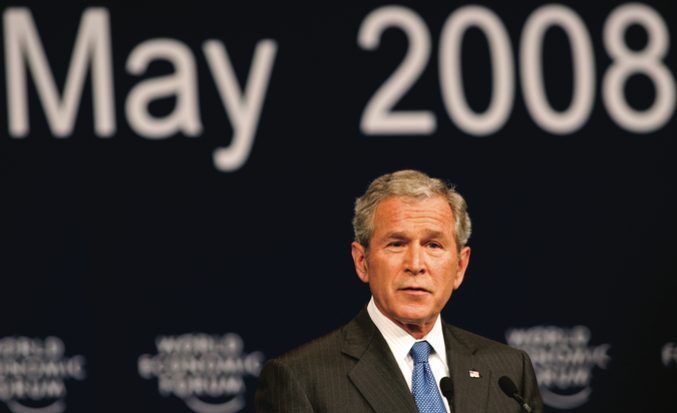
From the first day, the Forum looked like it was going to be consumed with the Israeli-Palestinian peace process. Fresh from witnessing the 60th anniversary celebrations in Israel, U.S. President George Bush immediately went on the offensive, praising countries around the world like Poland, the Philippines, Korea, Chile and Indonesia for their ability to overcome tyrannical regimes and become thriving democracies. He also praised the achievements of many countries in the Middle East for opening up their markets, practicing free trade, and giving women an equal voice.

But his overall message was that there was still much that needed to be done, particularly when it came to political reforms and giving the voices of opposition the freedom to speak. For the most part, the first half of his speech was received positively. However, when he went on to address the Palestinian-Israeli peace process and terrorism there was nothing new, just more of the same well-rehearsed rhetoric he has repeated so many times in the past. He made his usual reference to the leaderships of both Iran and Syria referring to them as “spoilers”. Both Egypt’s President Hosni Mubarak and King Abdullah of Jordan echoed Bush’s call for a comprehensive peace deal leading me to believe this would be the overriding theme of the forum.

However, away from the big political speeches the forum was taking on another dimension, that of the lessons which can be learned from the future. It was refreshing to hear discussions on what to do about the rising cost of oil and the effects it has on the region and beyond. Also, there was this underlining current of wanting change and looking to renewable clean energy as an alternative in the near future. Even business representatives from the Gulf countries, whose booming economies are fueled by the high cost of energy, were positive in their approach to seeking out alternative, cleaner sources of energy.

Another topic that dominated many of the discussions was education. The idea that still too many young are left behind due to lack of access to decent schooling was at the forefront of many of the seminars. And the notion that both business leaders and politicians must work together to insure that the skills they learn today will match the jobs that will be needed in the future was one of the positive conclusions of the Forum. In the closing session, a number of students were brought in to sit on the panel with the big guns including Schwab, Egyptian Prime Minister Ahmed Nazif, Wikipedia founder Jimmy Wales, and female Member of the Japanese House of Representatives Yuriko Koike. The move to include students with such high-profile leaders was a sign of the changing times and the pressing need to listen to what the next generation has to say.
During the closing session Schwab made sure to include the entire panel in the discussion. When he asked Amira Abdel-Aziz, a masters student at Cairo University, to comment she turned to her own Prime Minister and said, “The relationship between government and people has to change … We have to look at the people as the highest authority.”

Norbert Schiller is a Dubai-based photo-journalist and writer.


June 1, 2008 0 comments
0 FacebookTwitterPinterestEmail
  • 1
  • …
  • 526
  • 527
  • 528
  • 529
  • 530
  • …
  • 696

Latest Cover

About us

Since its first edition emerged on the newsstands in 1999, Executive Magazine has been dedicated to providing its readers with the most up-to-date local and regional business news. Executive is a monthly business magazine that offers readers in-depth analyses on the Lebanese world of commerce, covering all the major sectors – from banking, finance, and insurance to technology, tourism, hospitality, media, and retail.

  • Donate
  • Our Purpose
  • Contact Us

Sign up for our newsletter

    • Facebook
    • Twitter
    • Instagram
    • Linkedin
    • Youtube
    Executive Magazine
    • ISSUES
      • Current Issue
      • Past issues
    • BUSINESS
    • ECONOMICS & POLICY
    • OPINION
    • SPECIAL REPORTS
    • EXECUTIVE TALKS
    • MOVEMENTS
      • Change the image
      • Cannes lions
      • Transparency & accountability
      • ECONOMIC ROADMAP
      • Say No to Corruption
      • The Lebanon media development initiative
      • LPSN Policy Asks
      • Advocating the preservation of deposits
    • JOIN US
      • Join our movement
      • Attend our events
      • Receive updates
      • Connect with us
    • DONATE