• Donate
  • Our Purpose
  • Contact Us
Executive Magazine
  • ISSUES
    • Current Issue
    • Past issues
  • BUSINESS
  • ECONOMICS & POLICY
  • OPINION
  • SPECIAL REPORTS
  • EXECUTIVE TALKS
  • MOVEMENTS
    • Change the image
    • Cannes lions
    • Transparency & accountability
    • ECONOMIC ROADMAP
    • Say No to Corruption
    • The Lebanon media development initiative
    • LPSN Policy Asks
    • Advocating the preservation of deposits
  • JOIN US
    • Join our movement
    • Attend our events
    • Receive updates
    • Connect with us
  • DONATE
Comment

Wolfowitz at the exit door?

by Claude Salhani May 1, 2007
written by Claude Salhani

So far this has not been a good year for President Bush.First, his plan to pacify Iraq by “surging” more Americantroops appears to have backfired. Since the surge beganIraqis have been dying in far greater numbers than everbefore, and terrorist bombings are claiming nearly 120 livesa day. And, U.S. casualties are increasing, adding pressurein Washington for an early troop pullout.

But if Bush faces a tough time on his handling of foreignpolicies, he now has serious problems at home as well. Afterloosing the majority in both houses of Congress to theDemocrats last November, the president has had anotherawkward moment vis a vis Paul Wolfowitz his choice to runthe World Bank.

Wolfowitz was supposed to fight corruption and alleviatepoverty. To make the task easier, “Wolfie,” as he is know tothose who like him, as well as to those who don’t, was givena yearly salary of $400,000—tax free—and an expense accountto match the status of the job.

As World Bank president, Wolfowitz oversees some 10,000employees around the world. Among them was, ratherawkwardly, his girlfriend, Shaha Riza. Wolfowitz, appearedto be playing by the book. In order to avoid a conflict ofinterest, when he took up his new job it was decidedinternally that she be moved to the US State Department,along with a promotion and a hefty pay rise—due to the factshe was being professionally inconvenienced by the move asit derailed her World Bank career path.

Appointed to the job by President George W. Bush in the formof a golden parachute after leaving the Rumsfeld Pentagon,Wolfowitz, a neoconservative who played a major role inconvincing the Bush administration to go to war in Iraq,stated he would apply a zero tolerance policy regardingcorruption. Now he was being accused of finding ahigh-paying job for his girlfriend.

To make matters worse, the scandal reached a climax as theBank was holding its yearly spring session in Washingtonwith the participation of finance and foreign ministers,central bank directors and financial gurus from around theworld. As the scandal gathered steam, the World Bank’s 24-member board said that the situation regarding the fate ofthe former US deputy defense chief should be dealt with,"urgently, effectively and in an orderly manner."

Calls for Wolfowitz’s resignation began to trickle in withsome finance ministers saying he should step downimmediately. But the US, which appoints the bank’s head,said it still supports Wolfowitz, who they claim had nothingto do with her new appointment. Riza, they argue, wasappointed by a World Bank ethics committee (Wolfie hadpreviously excused himself from all matters pertaining tohis companion). When she was transferred to the StateDepartment she was given the mid-range salary for her newlevel was based on the bank’s existing pay scales.

Dana Perino, a White House spokeswoman, said that PresidentGeorge W. Bush "has confidence in Paul Wolfowitz." Wolfowitzmeanwhile was booed at a meeting with World Bank staff.

By mid April Wolfowitz was told directly by one of his twodeputies, Graeme Wheeler from New Zealand, to step down at asession attended by senior staff members, according to somenews reports. The Bank’s executive board, the Bank’sgovernor as well as a number of European shareholders becameeager to see him go. Senior managers within the bank seemedsplit however, some backing Wolfowitz, others calling forhis resignation.

One of the bank’s main functions is to fight poverty aroundthe world. Yet by the Bank’s own admission, there are stillmore than 1 billion people living on less than $1 a day, and2.5 billion, or 40 percent of the world population,subsisting on less than $2 a day. Wolfowitz’s critics—ofwhich he has many—say that since assuming his new functionsat the Bank he has run the institution “much like a Chicagoward boss or mayor.” He has been said to resort to employ“patronage and intimidation” tactics.

When he moved to the World Bank from the Department ofDefense Wolfowitz took along his political acolytes,upsetting scores of long-time bank senior personnel.

Now there is growing fear in the Republican Party that adragged out “Wolfie-gate” will not help the GOP at a timewhen a vital presidential election is looming just off thehorizon. Many are beginning to echo what World Bankemployees have been saying: it is time for Wolfowitz to go.

Claude Salhani is an international editor and political analyst at United Press International (UPI)


May 1, 2007 0 comments
0 FacebookTwitterPinterestEmail
Talking To

Inside Intel‘s brain: A talk with the boss

by Executive Staff May 1, 2007
written by Executive Staff

As part of Intel’s efforts to promote the use oftechnology with communities around the world and as arepresentative of the “Partnership for Lebanon,” IntelChairman Craig Barrett visited Lebanon last month. He alsospoke to Executive

How does the American Lebanese partnership andthe Berytech fund you contributed to, fit into the UnitedNations’ Global alliance for ICT you currently chair?

The UN Global Alliance has the same objectives as thePartnership for Lebanon, which aims to improve education,healthcare, economic development and the interaction betweengovernments and citizens. The partnership is obviouslyinvolved in Lebanon because of the destruction that resultedlast year from the conflict between Israel and Hizbullah. Weare not taking any sides on this issue, our concern is onlyfor the individual Lebanese citizen with the aim ofimproving his situation. On a much larger scale, the UNAlliance oversees what can be done to advance the status ofcitizens from emerging countries around the world. Theglobal goal is very similar to the Partnership’s one. As forthe Berytech fund, the issue of economic development is alsopart of the Partnership’s objectives and the UN GlobalAlliance. Economic development can come in various flavors:foreign investment, organic growth, economy, orentrepreneurial activity, in this last regard, Lebanonoffers a long cultural and societal history. The Berytechactivity aims to stimulate and promote economic growth,using education and potential young entrepreneurs. Berytechis unique in the sense that it is in an incubator: it takesideas, before they’re formed into business plans and givesthem a chance to grow and nurture. The investment inBerytech, a purely Intel venture, is totally consistent withthe partnership’s goals.

You’ve declared to the American congress that UScompetitiveness can only improve through education and R&D.Where do you see America standing in the economicenvironment in a few years, especially now that emergingcountries are slowly growing and siphoning off jobs?

The challenge the USA faces lies in the worldwidecompetition for educated workers and new ideas. It is thereason why so many of us lobby our own government for moreR&D and progress in education, especially in the areas ofmath and science. We are very concerned by the fact that ifthe US continue on their current course, it would faceserious problems in the future from a competitivestandpoint. We have proposed various efforts such as theincrease in research investment and improving the fields ofmath and science, which are both incredibly critical to thefuture of competitiveness.

You’ve said that “companies can’t save their wayout of a recession or even prosperity. Instead, they have toinvest in innovative products and technologies.” What isIntel doing in this respect?

If you look at our business at the beginning and the endof any year, separated only by a twelve-month period, about90% of our revenue in December is generated by products thatwere not available on the market in January. Unless you havea development machine that can create new products, androutinely achieve technology leadership, you cannot besuccessful. So when I say “you cannot save your way out of arecession,” it means that if you slow down the developmentmachine, trying to improve financial performance by onlycutting back on investments, you ultimately fail. If youlook at Intel’s general trend over its entire history, R&Dspending always tends to increase. We spend from $5.5 to $6billion every year on research and development, which is afairly large amount, larger by any country’s means.

E In a world where networking, computing andcommunications are converging even more, how is thisaffecting Intel’s overall vision and strategy?

The convergence of computing and communications is verycompatible with Intel’s philosophy and direction. Ascomputing, communication and rich content come together,more computing power to handle data is required. The trendis consistent with Intel’s generic approach, focusing onmicroprocessor power, on Moore’s law, continually improvingcomputing, generation after generation after generation. Idon’t see any disconnection between such a convergence andIntel’s direction.

As the economic environment evolves, Intel faceslower margins and increased competition from countries suchas China or India. How do you see the trend going and whatsteps is Intel taking to rise up to the challenge?

It is a rather interesting fact that people have beenwriting about Intel facing lower margins for years andyears. However, I am not sure the proposition is accurate.We have just announced, two or three days ago, that weexpect margins to increase for the second half of the year.For the past twenty years, margins have fluctuated betweenthe low and high fifty percent range. I also believe our CFOforecasted this year’s margins for the mid-fifties. Oursuccess is based on our leadership technology in the marketplace, providing us with a higher return on investment and ahigher margin on product. The challenge is to maintain ourmarket leadership position, which determines what marginswill look like. There is no question that the averageselling price for microprocessors has decreased over theyears, while our production machine is getting moreefficient, thus taking the cost down. As costs follow thefall in product prices, margin levels stay roughly constant.

How long will it take before we see seriouscompetition from countries like China and India in themicroprocessor industry? How does this affect Intel’s futureplans?

Intel has faced competition in the micro-processing area,from Europe, US, Japanese as well as Chinese companies.Competition is not something new to us, we respond to it byavoiding standstill, moving the technology forward instead,at a very rapid pace. This requires a very large investmentin R&D, which companies need to match if they want tocompete with us in the next generation of products. It isnot about figuring out how to make last generation productsat cheaper prices, but rather how to produce next generationtechnologies, which is what people in the market place want.I suspect we will continue to face competition in the nexttwenty years like we’ve done before, but the challenge forus remains the same.

Intel has long thrived by concentrating on PCmicroprocessors. Now Intel is trying to play the same rolein various fields such as consumer electronics, wirelesscommunications, and health care. What prompted the decisionto diversify your product base and which direction do yousee Intel taking?

The healthcare industry has not made very effective use ofcomputing technologies. It is a very large market withimportant opportunities for the sorts of products Intelmanufactures. In consumer electronics, the opportunityresides again in the convergence of computing,communications and content. The fact that computers havebeen built historically using Intel architecture, as digitalcontent becomes more important, consumer electronics, alsofocused on content, will become more computer-like. There isa definite opportunity to move our architecture intoconsumer electronics applications. This convergence ofcomputing, communications and content allows us to grow fromcomputers to consumer electronics devices.

How does this diversification affect the waychips are produced? Is it affecting collaboration withincompany teams as well as alliances with other marketplayers?

It actually expands the spectrum of companies you need todeal with. Historically, Intel always dealt with thecomputer industry, with large companies such as Dell,Packard and others. But as the convergence of computing,communication and content further increases, we end updealing more and more with consumer electronics and contentcompanies, we previously, were not much involved with. Weare still engaged in our standard computer business, towhich wireless communication capability and content are alsointegrated. These three elements coming together imply thatour products look less and less like standard computingplatforms, assimilating communication and contentinitiatives.

How difficult is it to brand an “ingredientproduct” such as Intel and convince customers to requireit?

You hire some very clever marketing people who create abrand like the “Intel Inside” branding campaign, the mostsuccessful “ingredient branding” campaign the world has everseen. We’ve been able to achieve this because of ourleadership position in the marketplace and used it toexpress the importance of our technology through aningredient branding campaign. If we had lacked leadershipposition from a technology standpoint, it would be verydifficult for us to convince anyone of the “ingredient’s”value. We were thus able to engineer a brand around ourpreeminent position in technology. Today, people are awarethat microprocessors are the PCs brains; everyone wants thesmartest brain and they want Intel. You need therefore bothgood technology and a very smart marketing person whosename, by the way, is Dennis Carter, to recognize this andconvince others to pursue it.

What is your view on the evolution of theinformation technology in the Arab world where, in somecountries, infrastructure is still nascent and monopoliesrun high?

There are excellent opportunities in the Arabic-speakingworld in this regard. Countries recognize the need for smartpeople and smart ideas as well as good infrastructure, andpart of this infrastructure relies on computing andcommunication. Many economies have weak communication orinefficient and extremely expensive infrastructures, such asin Lebanon, because of government control or actions on thesector. Ultimately those infrastructures need to become morecompetitive. There is great opportunity for investment,creativity and technology, which is what companies likeIntel are all about.

How do you picture the technology world in 15 years?

Fifteen years is such a long time in our industry, itmakes it very difficult to tell. The internet was born andgrew dramatically in the space of ten years. Digital camerasappeared, music also became digital, its delivery movingfrom a CD form to an internet feed. However, what is easy toproject is that there will be definitely huge changes andcompanies which are flexible and adaptable will be mostsuccessful in such a time frame. As an example, if you wereoperating like Microsoft in the software business ten yearsago, you could never have forecasted Google posing such abig challenge in the future. Google was born ten years agoin a university; it was not a product, not a business, butonly an idea. The beauty of our industry, its excitement,springs from the fact that concepts, often created by oneperson, can change the face of the whole sector. This meansthat any company wanting to be successful needs to keep itseyes wide opened continually for new ideas. This reasoningmotivates Intel’s involvement in so many joint researchprojects with universities and venture capital—the fundingof startup companies—and allows it to stay close to whatgoes on in the basic research and product worlds. As my bossAndy Grove used to say, only the paranoid survive,otherwise, one runs the risk of being defeated by newtechnologies.

May 1, 2007 0 comments
0 FacebookTwitterPinterestEmail
Capitalist Culture

Like everywhere, Money talks in Lebanon

by Michael Young May 1, 2007
written by Michael Young

Four months into the opposition’s descent on the Soliderearea in protest, it is increasingly plain that the effortwas a remarkable success. No, the Seniora government is notabout to fall, nor has the Hariri tribunal been permanentlyderailed; rather, the opposition has scored a dazzlingvictory against businesses in the downtown area. Most havebeen knocked out cold financially, while the rest arepreparing to throw in the towel.

This may seem a tendentious reading. Opposition supporterswould respond that neither Hizbullah nor the Aounistmovement ever really intended to push the Solidere merchantsand restaurants into the street. Most businesses are indeedthe victims of a political confrontation that shows no signsof abating. However, one thing is undeniable: oppositionparties have a much tougher climb than the majority does inproving that they are truly concerned about Lebanon’seconomic well-being; or even that they have a cohesive planto address the country’s financial woes. Three episodes inparticular illustrate the opposition’s problems.

In one episode, Solidere businesses not long ago askedMichel Aoun to take measures to lower the pressure on theirlivelihoods. This would have involved removing tents fromsome parts of the downtown area, to free up access to theirbusinesses. Aoun did not reject the idea. However, severalweeks later nothing has been done. This has only showed thatthe opposition remains reluctant to lose face by reducingits presence in Solidere, even though it couldadvantageously sell a downgrading of its tent city as proofof its interest in the fate of those closing down.

The second episode was the opposition’s decision on January23 to block roads throughout Lebanon, but more particularlyto block the airport road and prevent Prime Minister Fuadal-Seniora from traveling to the Paris-III economicconference. While the opposition parties publicly declaredtheir support for what the conference was trying to achieve,they also understood it would give the government greatcredibility at a time when they were trying to force Senioraout of office. That’s why the expressions of support endedup sounding hollow, as opposition parties placed partisanpolitics before that of trying to create an impression ofunity at home that would have enhanced Lebanon’s chances ofgetting funds.

A third episode was the speech of Hizbullah’s secretarygeneral, Hassan Nasrallah, on April 8. In his address,Nasrallah wondered where the Paris-III pledges of some $7billion were, and lamented that donors had imposedconditions to loan Lebanon money. “Even the economy has beeninternationalized,” Nasrallah observed. He went on to pointout that Hizbullah would be willing to let the situationremain as is for another two years, until Parliament’smandate expired. While he admitted that the opposition wasnot happy with the situation, it was better than civil war.

Nasrallah, even if he is sincere in wanting to avoid a newwar between the Lebanese, will have hardly convinced anyonethat his strategy shows concern for economic realities. Twomore years of stalemate may not only devastate economicconfidence, it would make much more unlikely the release ofmoney pledged in Paris. The Hizbullah leader askedironically where the Paris money had gone, but he leftunmentioned that the dispute between the majority and theopposition—a dispute for which Hizbullah and the Aounistsare partly responsible—is the cause for the reluctance amongsome countries to pay up. Nor will Nasrallah have reassuredeconomists that his criticism was legitimate when hecomplained of the conditions set by foreign donors to helpthe Lebanese economy. Not all aid money can be delivered insuitcases, and for Lebanon to first meet internationalconditions in order to earn the right to receive foreignloans seems so obvious as to be a moot point.

Each of these examples was significant in that theopposition has failed to convincingly show it has aneconomic program that would allow it to take power alone,without March 14. The parliamentary majority, for all itsshortcoming, retains international financial confidence,while the opposition simply does not. Just as important, themajority seems more or less united around the Senioragovernment’s economic program (even if it is open tocriticism), while there are fundamental differences betweenthe economic preferences of the Aounists and those of Hizbullah.

Forgetting politics for the moment, the existential fightbeing waged by both sides in Lebanon today detracts from thefact that when it comes to economics, their continueddivisions can only lead to collective suicide. The majoritycannot pass its economic program without a dialogue with the opposition; but the opposition needs to clarify its own economic views before any sort of dialogue has a realistic chance of succeeding.

Michael Young

May 1, 2007 0 comments
0 FacebookTwitterPinterestEmail
Banking & FinanceBy Invitation

GCC governments hope to boost stock listings

by Imad Ghandour May 1, 2007
written by Imad Ghandour

The number of listed securities in the GCC is a flaw that the local governments have been trying to correct. Hence, there is a general consensus amongst regulators that getting more companies into the public market is a “good thing.” Their end goal is creating deeper markets with more securities and better diversification, ensuring lower market volatility, decreasing valuations to more reasonable levels, and spreading the wealth generated from economic growth and privatization to the general population.

Thus, GCC regulators have allowed more than $16 billion worth of IPOs to take place since 2004, and are examining the applications of an additional 90 companies. Of course, timing has been an issue, and some regulators have opted to delay some IPOs so as not to exacerbate the downward pressures already in play.

However, GCC investors (both retail and institutional) are becoming more discerning. Today, the IPO story has to be solid, and has to be one of growth and strategic focus. Management track record is essential for investors to buy into the future. Size is also an issue, as small IPOs may have difficulty in registering on the radar screen of investors and regulators alike.

Initially, the role of private equity funds was limited to acquiring minority equity stakes in companies just before going public. As part of circumventing the legal restrictions in the outdated listing process, funds would finance the establishment of a green field company that will acquire the operating company at a price closer to its true value, thus evade using the book value approach adopted by many regulators.

It became quickly apparent that funds can assume a bigger role in the preparation for the listing. Investors were more comfortable with a fund entering and ensuring that everything is in order and transparent. Funds would enter at a discount, and put their seal of approval that the company is ready for an IPO.

Nowadays, companies aspiring to be listed are faced with even a bigger challenge, and investors have raised the bar even further. In addition to ensuring proper corporate governance and proper financial accounting, private equity players are sought after as a strategic active investors that may propel the company to the next level by investing “smart” money. Strategic advise, business development, and financial restructuring are few of the services expected from the private equity funds. Top tier funds go as far as providing IT, HR, and operational consultancy. The latest research by KPMG has confirmed that “active” private equity funds have been rewarded with higher return on their investment.

As a result, PE-backed companies are proving to attract significant interest from investors. Maritime Industrial Services, the leading contractor for off-shore rigs, has been backed by Gulf Capital and two other PE funds, and is now preparing to go public on the Oslo Stock Exchange. The PE firms have brought institutionalization to MIS, and prepared its management to deal with the requirements for going public by first dealing with a limited number of active investors. Moreover, Gulf Capital has actively worked with MIS management on several strategic initiatives that have significantly improved the operation of the company.

This trend is set to continue as private equity increases its role in the M&A activity in the region. Whether it is the floatation of a privatized state utilities or a family business, the active involvement of PE funds pre-IPO will better prepare companies to deal with public equity market.

IMAD GHANDOUR, Principal-Gulf Capital. Head of Information & Statistics Committee-GVCA

May 1, 2007 0 comments
0 FacebookTwitterPinterestEmail
Banking & Finance

Long in the shadow of Islamic banking, Islamic trade finance plan start to grow

by Executive Staff May 1, 2007
written by Executive Staff

Although still small in comparison to the conventional global banking sector, Islamic Banking (IB) has nevertheless grown so impressively in recent years that it now seems more like a critical driver for the industry as a whole than a niche market reserved only for a small slice of the map.


Indeed, as the General Council for Islamic Banks and Financial Institutions reported in early 2007, world-wide assets for IBs and Islamic Financial Institutions (IFI) now stand at over $260 billion, with financial investments totaling more than $400 billion. Year on year growth rates for the sector over the past seven years have averaged almost 15% helping to bring the total number of IBs and IFIs (IBFIs) to 267 in 2006, up from 176 in 1997. Islamic equity funds also now exceed $300 billion in value (growing an average of 25% annually over the past seven years), while Islamic sovereign and corporate sukuks (instruments similar to conventional bonds) have reached $50 billion.

One recent Standard & Poor’s (S&P) review, though, has provided particular fodder for market watchers eager to claim new markets: the overall sector could be worth as much as $4 trillion if it were fully exploited. In fact, according to one prominent IB, Al Baraka Bank, the Islamic share of banking activities specifically in the next decade is expected to rise to half of all bank activities in the Arab world. That’s largely because, according to one recent conference presentation by Nasser Saidi, chief economist of the Dubai International Financial Center, only about 20% of the Muslim population in the oil-rich Gulf Cooperation Council (GCC) countries buy shariah-compliant financial products currently.

According to S&P, the figure is even less, just 10%, if one includes the banking practices of the entire worldwide Muslim population. Which is to say nothing of the percentage of companies and wealthy individuals in the Middle East and Southeast Asia who rely on conventional banking and finance instruments. Or the fact that two-thirds of all IB users in  Malaysia, the main hub of the sector, are not even Muslim.

Islamic Trade Finance

As far as Islamic Trade Finance (ITF) is concerned, its share of global Trade Finance activity and IBFI activity overall is of an even smaller order, although no consensus estimate exists.

In fact, partially because the major Western players have seen the boundary-pushing Islamic Project Finance (IPF) arena as both more profitable and higher-profile (involving the use of options and derivatives in several recent cases), some institutions which nevertheless engage in substantial ITF activity tend not to want to highlight such activities.

As one major German-based financial institution put it,“We only take a reactive approach to such [trade-based] transactions as opposed to a proactive one.”

In other words, if a trade deal comes, then we might just take it. But we don’t go out looking for them.

Do such responses mean that some of the majors might be missing the boat when it comes to the ITF market?

Perhaps. But for IBFIs that are through-and-through shariah-compliant—i.e., not just with an Islamic window or a segregated branch—ITF is critically important, and should be even more so in the future.

“There is a massive amount of short term liquidity in Islamic institutions that needs to be invested in something,” explained Michael Gassner, managing director of Michael Gassner Consultancy. “It is either trade or [project finance] in companies. Trade finance, by its short terms nature, meets this need perfectly. It involves real assets not nominal ones [one key for being shariah-compliant] so this can really be done well.”

ITF Instruments

Doing shariah-compliant trade finance well, however,

generally involves costs and operations above and beyond

traditional trade finance, which means that ITF is both more

complicated and potentially less profitable.

Thus, although many of the risk mitigation tools used in

both structured trade and project finance have strong

similarities with various tools that have evolved in Islamic

finance, the supply side, or the instruments made available

by IBFIs, tend to be supported more by a desire on the part

of institutions to propose Islamic financing to

clients—a move that can then translate into a

competitive edge overall.

On the demand side, according to one 2006 UN Trade and

Development report, “those that are able to tap into

Islamic financing markets can obtain relatively low-cost

capital.” Of course, this is not always true. But more

than a relative cost saving, a growing number of clients

simply want to ensure a shariah-compliant transaction.

In that case, several instruments are available for

structuring trade deals. All must, however, fall in line

with a number of basic Islamic precepts that fundamentally

revolve around the necessity of taking and sharing risk

through the possession of real assets.

Although interest taking is therefore prohibited first and

foremost in favor of asset-backed, partnership arrangements,

this particular element is not the only one that makes a

deal shariah-compliant.

Islam also prohibits trading excessive financial risk

(gharar), with such activities regarded as gambling.

Additionally shariah prohibits investing in businesses that

are considered haram—those that sell alcohol or pork,

or businesses that are engaged in gambling or produce

un-Islamic media.

As a result, it is generally accepted (generally, because

there is no single interpretation of what is permitted, and,

in any case, each IBFI has its own shariah board), that

deals are only undertaken with a business whose interest

income is less than 9% of total income and/or who holds a

ratio of debt to total assets lower than 33% of total

assets.

With these prohibitions and benchmarks as a basic

foundation, four instruments for financing trade are

employed in the Islamic market: murabaha, bai al salaam,

musharaka and istisna. According to the recent book,

“An Introduction to Islamic Finance: Theory and

Practice” by World Bank official Zamir Iqbal and IMF

Executive Director Abbas Mirakhor, close to 90% of all

Islamic trade financing is currently based on murabaha, with

more than half of the assets of some Islamic banks invested

in murabaha transactions.

Challenges and Horizons

All four instruments pose unique challenges to both IBFIs

as well as conventional BFIs who wish to enter the Islamic

Trade Finance marketplace. As Sayyed Alwi bin Mohamed

Sultan, senior financial analyst at the Accounting &

Auditing Organization for Islamic Financial Institutions,

said: “There are lots of risks. Market risks, credit

risks, operational risks. The same risks any conventional

bank or financial institution may face and over and above

that [you also face] shariah compliance which is another

risk that Islamic banks have to address.”

One particular problem native to all four instruments is

that the mere presence of sufficient collateral is not

sufficient for a transaction. In contrast, an extensive

evaluation of a borrower’s business is required,

which, as the UN report points out, “can slow down

financing decisions, and disqualify borrowers without much

of a track record, thereby stifling economic growth.”

Added to this is the problem of how to give the

flexibility of variable interest rates, since financing is

generally made on a basis equivalent to fixed interest

rates. As one industry report recently said: “It is

not clear whether borrowers can swap out of such a position,

but if not, fixed interest rates (in an environment where

most companies have the possibility to actively influence

the rates they are paying) may seem at times somewhat

unattractive.”

Nevertheless, “Islamic trade finance is our bread

and butter,” said Yakub Bobat, global head of

commercial banking at HSBC Amanah. “It is an efficient

contributor to our overall Islamic finance activities and it

is a key driver of the Islamic banking pie as a

whole.”

While that appears to be the general sentiment among those

involved in ITF, the truth is that the sector will only

become an indispensable driver of growth if it is matched up

with the far more ambitious tools now being pioneered by

Islamic project finance.

“Frankly, the industry needs to move away from

commodity murabaha,” added Bobat. “Historically

there has been a lack of a comprehensive product suite, but

this is fast developing [and now] you have rollouts across

markets.

“You will see,” he predicted, with apparent

enthusiasm. “The industry gaining critical

mass.”

May 1, 2007 0 comments
0 FacebookTwitterPinterestEmail
Comment

The so-called ‘peace process’

by Lee Smith May 1, 2007
written by Lee Smith

Here in Washington, the winners of the 2006 mid-termelections had just started to enjoy their spoils when the2008 presidential campaign already started to heat up. Nosooner had Nancy Pelosi finished her tour of the Hamadeyasouq than the Clinton campaign decided to make Syria part ofthe campaign platform.

See, former President Bill Clinton used to say that themajor impediment he faced in solving the Israeli-Arabdispute was Yasser Arafat. But now with Hilary on thecampaign trail, that’s all in the past. Peace in the MiddleEast is easy, as long as you have the right person in theWhite House—and a proper knowledge of history. Clinton saysthe peace process was derailed for one reason alone—thebullet that killed Yitzhak Rabin.

“The assassination of Rabin killed the whole process,”Clinton told the London-based pan-Arab daily, Ash-SharqAl-Awsat. “This one bullet not only killed Yitzhak Rabin butthe whole process that we were working on.”

That’s right—it was a Jewish extremist who ruined Oslo.Never mind the second intifada and Hamas’s genocidalcampaign against Jews. And Chairman Arafat had nothing to dowith sabotaging the peace process. If it weren’t for thatone Jewish bullet we even would have had peace betweenIsrael and Syria. And we still can—“It will take 35 minutesto resolve the problem between Israel and Syria,” saysClinton. 35 minutes! Wow—I wonder which Americanpresidential candidate could pull that stunt off?

Ah, peace. It is true that the “P word” is certain to strikea Pavlovian chord among the Americans, who are particularlyprone to Middle Eastern fantasies, but it’s not just WhiteHouse hopefuls putting a tired Middle Eastern nag throughher pointless paces. Consider the curious case of Ibrahim“Abe” Suleiman, a Syrian-born naturalized American citizenfor close to half a century now. In April, Suleiman traveledto the Knesset to explain how an Israeli-Syrian peace dealwas possible within six months. Ok, that time frame isconsiderably longer than a half hour and change, but giventhat the Israelis and Syrians both think Suleiman’s talkingout of his hat, six months is nothing short of miraculous.

The US press has followed the case with interest, albeitconfusedly so. For instance, there’s the New York Times,which for well over half a year now has waged a relentlesscampaign demanding the Bush administration “engage”Damascus. The space they’ve devoted to l’affair Suleiman hasbeen for all practical purposes to explain that Syria’sspecial envoy seems to represent no official position inDamascus and has found no confidence in Jerusalem. In otherwords, it is a story about a non-story.

On the other hand, the anti-Syrian Kuwaiti daily al-Siyassahhas reported that Suleiman is the brother of former regimeaffiliate Bajhat Suleiman, once believed to be involved inthe assassination of Rafiq al-Hariri—a fact that wouldsuggest that “Abe” is indeed well connected in Damascus.

However, much more troubling than any genuine relationshipSuleiman may have to the Asad regime is the prospect thathis role as mediator will generate its own momentum andcause chaos throughout the region.

We have already discussed why Washington is apt to embraceeven the most dubious prophet of peace and concord, butother regional interests have their own reasons as well.

Israeli officials are no doubt looking a little more than ayear into the future and wondering whether a possibleDemocrat in the White House will demand concessions fromJerusalem that the Bush administration did not. In thatcase, it would be wise for Israel to keep an apparentlysincere fool like Suleiman close at hand rather than sufferthe vicious Arabist inanities of, say, Walid Moallem orFarouq al-Shara. And even if the new White House is asfriendly to Israel as the present one, the Jewish state hasits own internal politics to worry about. However improbablepeace may seem, Olmert or Netanyahu or whoever winds up inthe running for Prime Minister is going to need some sort ofroad map or peace process to keep voters interested. Whoknows but that the Syria track may seem more appealing thana deal with the Hamas-controlled PA.

Damascus of course would like nothing more than to be tiedup in a peace process—while it also threatens war againstIsrael to liberate the Golan, a prospect even more fantasticthan Clinton’s 35 minutes to peace. The Asad regime isterrified of the international tribunal charged with handingdown indictments in the Hariri murder. So far, Damascus hasallegedly assassinated Lebanese citizens and backed a waragainst Israel in its attempts to forestall the tribunal,but the train is steadily and surely approaching thestation. With so much riding on a “peace process,” no matterhow phony, who would dare punish Damascus for the blood ithas shed not just in Lebanon, but throughout the region? Andafter all, isn’t that how the regime has been selling itscase to the international community for some time now? See,we don’t really want to kill people. We want to be part ofthe rest of the world, we want to come in from the cold, wewant a deal. And isn’t it a shame that until we get what wewant we will have to keep killing people—and just so wedon’t have to keep killing people?

Lee Smith is a Hudson Institute visiting fellow and reporter on Middle East affairs.


May 1, 2007 0 comments
0 FacebookTwitterPinterestEmail
Lebanon

Retailors join forces

by Executive Staff April 12, 2007
written by Executive Staff

Major Lebanese businesses, such as Aïshti, Bank Audi, ABC, Patchi, MEA, BankMed, InterContinental Phoenicia, Virgin Megastore, Global Refund and CityMall have joined forces in a new campaign dubbed “Bhebak Bil Rabih,” (I Love You in Spring.) Promoting Lebanon as a tourist and shopping destination in a conference held on March 1, business owners highlighted the activities planned, including fashion shows, festivals, prizes, car giveaways and more. Participants took, however, a stern stance against both the Lebanese government and politicians, who were taxed with irresponsibility for their failure to solve the ongoing political deadlock paralyzing the BCD (Beirut central district) since the beginning of December. 

“In this year alone, we have witnessed a 70% drop in activity. We’re currently trying to compile loss estimates, while our lawyers study different options, including a possible lawsuit,” said Tony Salameh, chairman of the Aïshti department stores. “A committee mainly responsible for looking into rental, electricity and tax expenses with a possible waiver of companies’ payments will be also formed.”

Michel Ferneyni, owner of La Posta, said Lebanon’s political situation presented an unfathomable paradox that started first with the “ongoing dialogue” resulting in the closure of the BCD, followed by “pacific demonstrations,” which crippled the country’s economy. According to participants, to date, over 80 companies have closed down, most of them permanently. Rumors also circulated about the Habtoor Hotel being put up for sale.

Paul Ariss, president of the Syndicate of Restaurant Owners, who met recently with leaders from all political factions, announced that the prime minister’s office had formed a committee, including representatives from the economy, tourism and finance ministries as well as leaders of industry associations to look into possible solutions. In addition, he asked the government to subsidize no interest, medium and long-term loans for existing businesses.

“The greatest damage done is not merely to Lebanon’s economy, but to its image as well, as the people are increasingly losing faith in their country,” concluded Ferneyni. “Many employees, even those with a secure job in Lebanon, are opting for a career abroad, and will never be coming back.” 

April 12, 2007 0 comments
0 FacebookTwitterPinterestEmail
Lebanon

Radio Orient goes global

by Executive Staff April 12, 2007
written by Executive Staff

Radio Orient, aka Izaat Al Shark, has become the first Arabic language radio station broadcasting worldwide. In its January issue, Forbes included the station, which is owned by Future TV, as number 17 on its list of the top 40 brands in Middle East. This month, in order to take advantage of its new global reach and maximize its coverage, the station is revamping its grid of programs, bolstered by three major shows as well as a prime entertainment program called “With a Stars.”

Available all over the MENA region through its internet and satellite networks, the radio station is using local channels to retransmit its programs. “In some countries they’re even retransmitted in full,” said Elie Rahme, manager of Radio Orient in Lebanon. The program grid has been modified to take advantage of its new global coverage, including the morning show (airing during peak drive time in Australia), the afternoon show (broadcast in the morning in the US), and the night show. The program “With a Star” features a different Arab star every week, with giveaway prizes that have participants calling in from the all over the world.

Although Rahme did not reveal international market penetration figures, he stated that the international audience participation to the station’s various programs is substantial. “The fact that people call from the United States, Iraq, Australia or Africa provides us with a clear idea of the station’s global reach,” he explained. 

Radio Orient is supported by a staff of 17 employees based in Lebanon, with the sound operators and editors shared with Future TV. The joint features of the TV and radio stations explain the unified overall marketing approach, however, it should be pointed out that they do not share advertisement booking deals. “People advertising with Future TV will not necessarily use our radio network, because each medium achieves a different type of exposure,” explained Fayez Bizri, Future TV’s financial manager.

According to Bizri, Radio Orient complements Future TV’s network by reaching beyond the traditional televised medium. “Whether they’re at work or driving in their cars, most people have access to a radio. This exposure will likely increase in countries where driving distances are longer,” says Bizri.

When asked about the cost of the worldwide reach of Radio Orient, Bizri did not disclose any figures, saying, “It is difficult to tabulate leasing, licensing and marketing expenses involved in the process.” He did state, however, that the most advanced technology had been used to place the radio station on the satellite system.

Further bolstering Radio Orient’s appeal is the growth of Future TV’s network. “The TV station expansion plan includes the addition of a 24-hour news channel – scheduled to air in April or June – which will definitely benefit Radio Orient by providing up-to-the-minute reporting,” said Rahme.

During April, Future TV will witness another major overhaul besides its new expansion plan and program grid, when current Chairman Nadim Munla will be replaced by BankMed executive, Samir Hammoud.

April 12, 2007 0 comments
0 FacebookTwitterPinterestEmail
Financial Indicators

Global economic data

by Executive Staff April 12, 2007
written by Executive Staff

Obesity

Percentage of population aged 15 and above with a MBI greater than 30, 2003 or latest available year

Source: OECD

More than 50% of adults are now defined as either being overweight or obese in no less than 10 OECD countries: the United States, Mexico, the United Kingdom, Australia, the Slovak Republic, Greece, New Zealand, Hungary, Luxembourg and the Czech Republic. By comparison, overweight and obesity rates are much lower in the OECD’s two Asian countries (Japan and Korea) and in some European countries (France and Switzerland), although overweight and obesity rates are also increasing in these countries. Focusing only on obesity, the prevalence of obesity among adults varies from a low of 3% in Japan and Korea to a high of 31% in the United States.

Based on consistent measures of obesity over time, the rate of obesity has more than doubled over the past twenty years in the United States, while it has almost tripled in Australia and more than tripled in the United Kingdom. The obesity rate in many Western European countries has also increased substantially over the past decade.

Gender differences are striking. Over all countries, more men are overweight than women, but in just over half of OECD countries, more women are obese than men. Taking overweight and obesity together, the rate for women exceeds that for men in only two countries—Mexico and Turkey.

Forest

Forest and other wooded land

As a percentage of land area, latest available year

Source: OECD

The percentage of land covered by forest and other wooded land varies widely from country to country: from shares of over 60% in Finland, Sweden, Japan and Korea to 10% or less in the United Kingdom, the Netherlands, Ireland and Iceland.

Long time series are required to capture changes in forest areas. Increases are generally due to active government policies of land afforestation while decreases may be caused by fires, clear-felling of forests without replanting, and conversion of forest land to residential, agricultural and other uses.

The area of forests and wooded land has remained stable or has slightly increased at national level in most OECD countries and has remained stable in the OECD as a whole. However, forest areas have been decreasing at the world level due in part to continued deforestation in tropical countries.

Tsunami aid

DAC member country responses to the tsunami disaster

Millions of US dollars

Source: OECD

The unprecedented humanitarian response to the Indian Ocean tsunami prompted governments, international organizations, private individuals, charities and companies to pledge $13.6 billion to the affected countries. Of that, $5.3 billion was from OECD member governments, and a further amount from private citizens in OECD countries.

Donor governments and the European Commission have committed $1.7 billion to emergency aid and $1.9 billion to longer-term reconstruction projects, to be spent by 2009. More than 90% of the emergency aid—nearly $1.6 billion—was spent in the nine months immediately following the disaster. For reconstruction, $473 million has been spent, leaving $1.4 billion committed and in the pipeline for spending over the coming years.

Together, Indonesia and Sri Lanka have received more than 60% of the funds committed so far.

Government debt

General government gross financial liabilities

As a percentage of GDP

Source: OECD

From 1990 to 1996, government gross financial liabilities were rising in most countries. Since then, government debt has been decreasing as a percentage of GDP in many of the 27 countries in the table. There are, however, exceptions: government debt ratios continued to increase particularly fast in Japan and Korea and significantly in France, Germany and Greece. Korea’s government debt ratio rose by over 7% per year from 1990 to 2003, but this is measured from a very low initial rate and by 2003, Korea’s government debt ratio was still among the lowest in the OECD.

In 2004, government debt ratios exceeded 100% in Greece, Italy and Japan and was close to 100% in Belgium. Most countries were in a band between 40% and 70%, with three countries reporting debt ratios of under 20%—Luxembourg, Korea and Australia.

April 12, 2007 0 comments
0 FacebookTwitterPinterestEmail
Financial Indicators

Regional equity markets

by Executive Staff April 12, 2007
written by Executive Staff

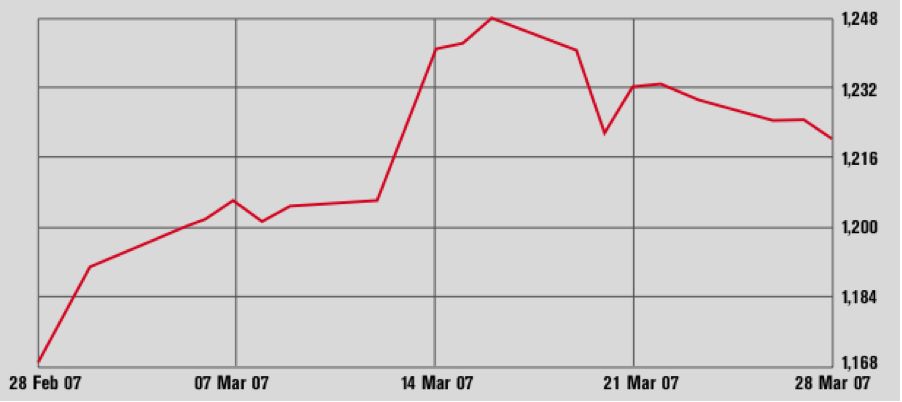
Beirut SE: Blom  (1 month)

Current Year High: 1,625.45  Current Year Low: 1,168.36

Between Feb. 28 and March 16, the BSE saw a spike in hope, as much as spikes go in a coma. The index moved from a year low of 1,168.36 points in late February to 1,248 points on March 16, basically driven up by talks between the opposing sides in the Lebanese political quagmire. As the voices announcing impending solutions faded, so did the traders’ enthusiasm and the third week pushed the BSI lower, to 1,224.19 points on March 26. Research, which Dubai-based investment bank Shuaa conducted on Audi Saradar banking group and concluded with a Neutral recommendation, led Audi to shoot back and claim that the fair value of its stock is significantly better than the $61.09 calculated by Shuaa. Audi shares closed at $63 on Mar 26.

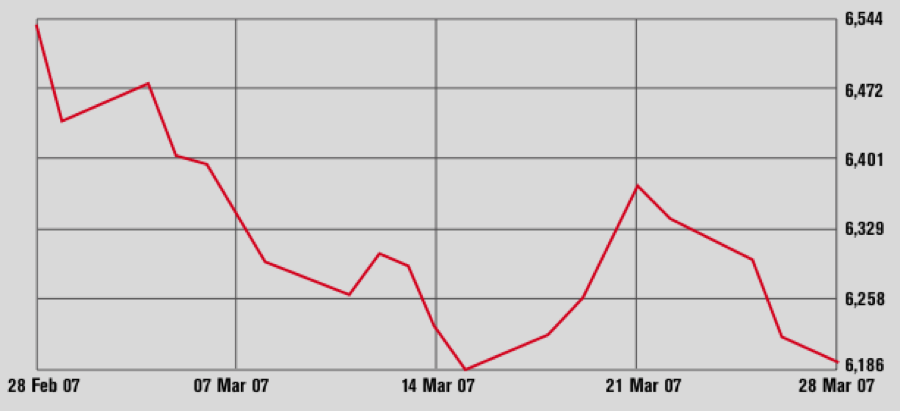
Amman SE  (1 month)

Current Year High: 7,407.15  Current Year Low: 5,267.27

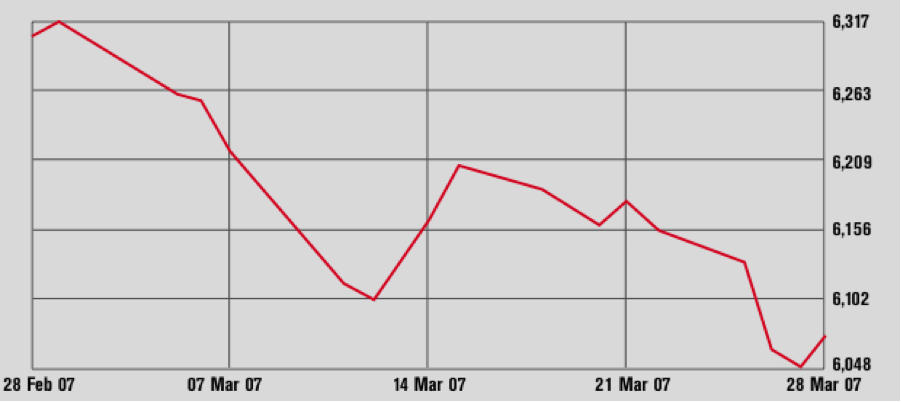
The Amman Stock Exchange moved sideways in a range above 6,200 points to close at 6,219.51 points on Mar 26. Arab Bank made headlines, beginning with having to deny a story in a US newspaper that warmed up allegations from a lawsuit that the bank had been used to finance “terrorism.” Later in March, the bank said it halted negotiations on a share sale to a strategic investor thought to be Emaar Properties, and the Jordanian government was said to be increasing its shareholding in Arab Bank in order to keep the Hariri family shareholders from buying up a controlling stake. The stock saw some lively trading in March, with a downward drift. Real estate firm Taameer Jordan was one of the main volume movers toward the end of March. Its share price regained in the second half of the month what it had given in the first half.    

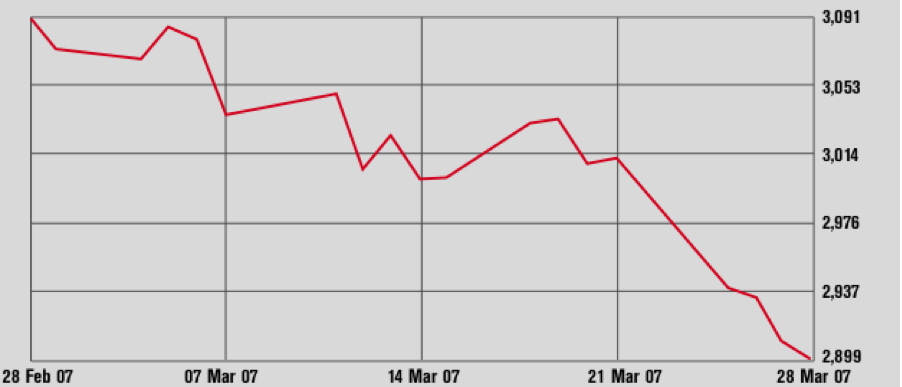
Abu Dhabi SM  (1 month)

Current Year High: 4,648.80  Current Year Low: 2,899.43

The Abu Dhabi Securities Market could not sustain the gains it had made in late February when it clawed its way above 3,000 points. The index dropped by 4% between March 1 and its close of 2,939 on March 25. At the end of the month, property and energy stocks were on the sunny side of the ADSM while banking values were selling. National Bank of Abu Dhabi, which issued 40% cash dividend and 30% bonus shares on March 22, traded down by 11% in the week between March 19-26. Banking news from neighboring Dubai with its impending merger between Emirates Bank and National Bank of Dubai mean the NBAD will, upon completion of the merger, lose its claim to being the biggest bank in the UAE.

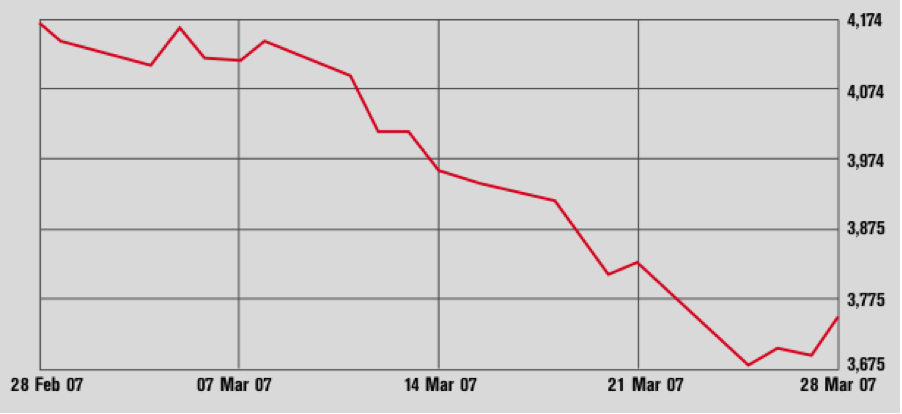
Dubai FM  (1 month)

Current Year High: 6,987.91  Current Year Low: 3,675.93

The DFM had a bad month in March, as its index weakened by almost 13% to a new year low of 3,675.93 points on March 25, from 4,207.51 points on Feb. 25. The DFM’s own shares started trading. Emaar, which pleased some analysts with a lower than expected dividend of 20% but disappointed stock owners with the move, traded down and was pushed even to a 12-month low of AED 10.60 on March 25 after Dubai Holding said it will acquire 28% in Emaar through a land-for-shares deal. Shuaa Capital bought back 3 million shares and the stock jumped 10.8% on a single day with high trading volume before sliding again.

Kuwait SE  (1 month)

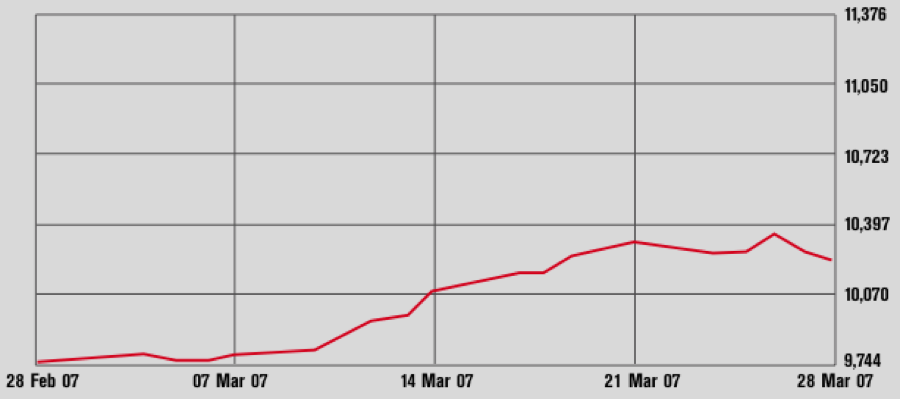
Current Year High: 10,812.30            Current Year Low: 9,164.30

The Kuwait Stock Exchange had a period of growth as its index strengthened by almost 6% to 10,341.3 points on March 26 from 9,769.2 points on Feb. 27. Telecommunications events supplied major influences on the KSE. In the beginning of the month, the share price of Kipco got a boost from the company’s extraordinary profit from selling shares in Kuwaiti mobile operator Wataniya to Qatar’s Qtel. Shares of MTC, the leading telco in Kuwait, advanced 15% to KWD 3.20 on Mar 26, from KWD 2.79 on Feb. 28. At the end of March, MTC emerged as highest bidder in the contest for Saudi Arabia’s third mobile phone license.

Saudi Arabia SE  (1 month)

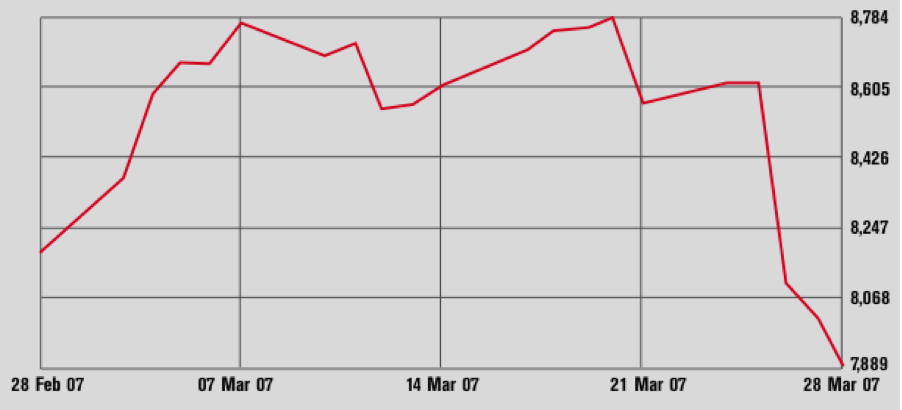
Current Year High: 17,730.96            Current Year Low: 6,916.85

The Saudi Stock Exchange ended a month of modest gains and sideways movements with a splash of cold water. The TASI lost 522 points, or just over 6%, on March 26 in its worst one-day drop since falling 6.3% on July 19 of last year. Sell-offs on March 26 included blue chip companies and leading banks such as Sabic, Al Rajhi Bank, SEC, and the two telcos. For the month, the market moved from 8,356.48 points on Feb. 27 to 8,098.36 points on the evening of March 26. Insurance industry IPOs came in a bundle of five simultaneous subscription offerings worth combined SAR 266 million. The Saudi government created a new $320 million company to operate the SSE, with a long-term view of taking the bourse public. 

Muscat SM  (1 month)

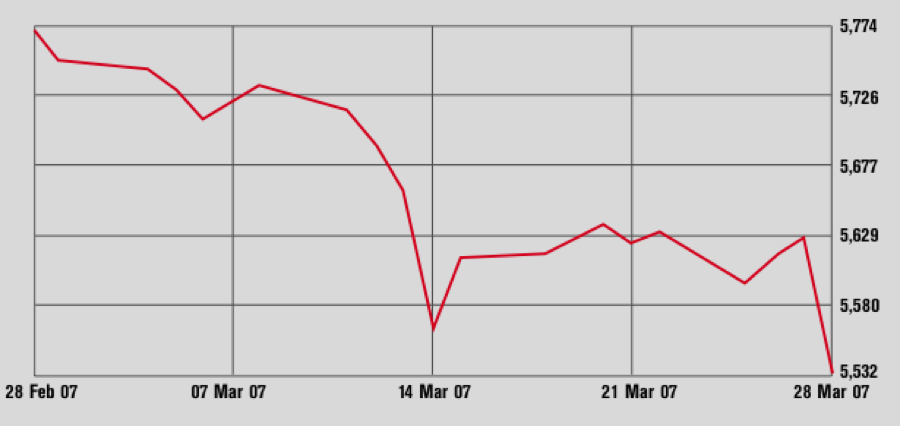
Current Year High: 5,956.46  Current Year Low: 4,657.16

After a slide in February to 5,781.1 points on Feb 26, the Muscat Securities Market went down by 216.73 points, or 3.7%, between Feb. 26 and March 14 before regaining some ground to close at 5616.24 on March 26. The sultanate’s primary market raised new expectations as four companies announced IPO plans. Besides engineering firm Galfar’s OMR 60 million flotation, Oman Merchant Bank and government-owned investment firm Takamul (in May) and Oman Oil Marketing Company are the IPO candidates for 2007. Additionally, Al Omaniya Financial Services will float a two-year OMR 8 million convertible bond.

Bahrain SE  (1 month)

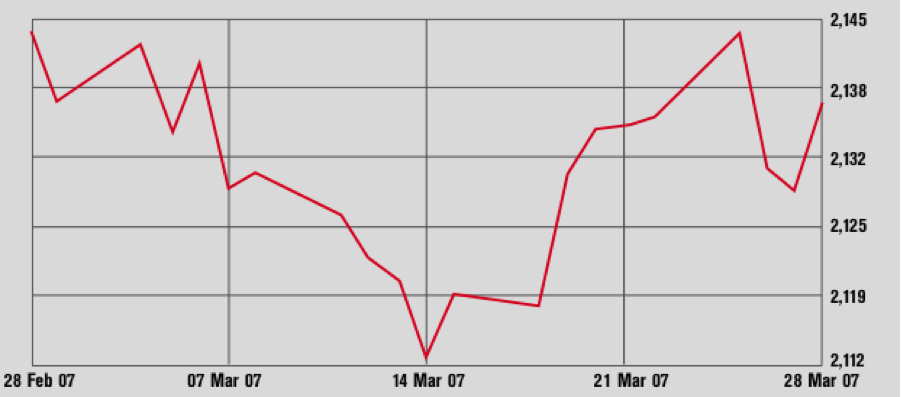
Current Year High: 2,251.15  Current Year Low: 1,996.68

The Bahrain Stock Exchange closed at 2,130.71 points on March 26, down by 0.6% when compared with its level on Feb. 27. The index had dipped lower in the middle of the month but things appeared uneventful and volumes were once again low. Esterad Investment Company moved up 12% in the second half of March and Nass Corp saw some volume toward the end of the month. Mobile phone operator Batelco announced the purchase of 20% in Yemeni network SabaFon for $144 million.

Doha SM: Qatar  (1 month)

Current Year High: 9,878.10  Current Year Low: 5,825.80

The downward movement of the Doha Securities Market slowed but did not cease and the DSM index slipped 3.5% to 6,060.16 points on March 26 from 6,277.1 points on Feb. 27. This performance put the DSM again as the GCC’s largest underperformer for the year-to-date with a drop of 15% since Jan. 1. After dividend events, banking stocks such as Ahli and Commercialbank paced the market’s downward trend in the later part of the month. Qtel, which initiated the purchase of 51% in Kuwait’s Wataniya telecom, stabilized toward the end of the month. Nakilat continued its rise that started in February and gained 18% in March. DSM market authorities suspended a brokerage for one month for violating regulations.

Tunis SE  (1 month)

Current Year High: 2,712.33  Current Year Low: 1,861.15

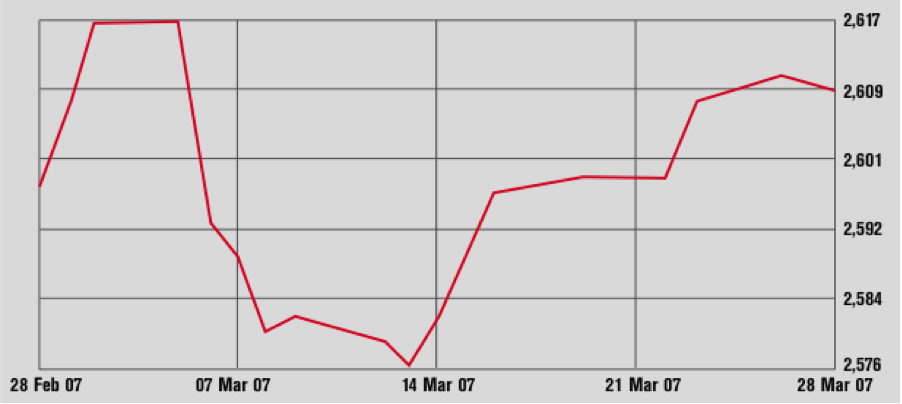
The Tunisian Stock Exchange in March traded sideways on a high plateau and the Tunindex closed at 2,610.14 points on March 26, about 100 points below its year high from Feb. 9. Tunis International Bank participated as lenders in a 55 million euros project finance facility for a new residential project in Libya, the first such finance arrangement in Libya’s real estate sector.

Casablanca SE All Shares  (1 month)

Current Year High: 11,552.97            Current Year Low: 6,563.27

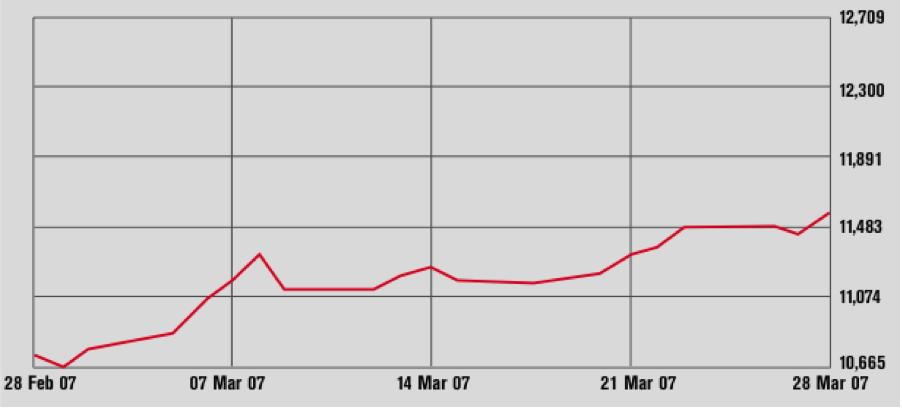
The Moroccan exchange broke through the 11,000 points line in early March and scaled further index gains to close at 11,478.87 points on March 26 in continuation of its rise which brought its gain for the year to date to a tidy 21%. Morocco’s central bank said it expects commercial banks in the country to be compliant with Basel II rules by this summer. With ongoing reforms, the central bank also hinted that a loosening of restrictions on investing in foreign bourses might be on the books, which might take steam out of the Casablanca Exchange and its extended rally.

Cairo SE: Hermes  (1 month)

Current Year High: 65,135.08            Current Year Low: 41,965.37

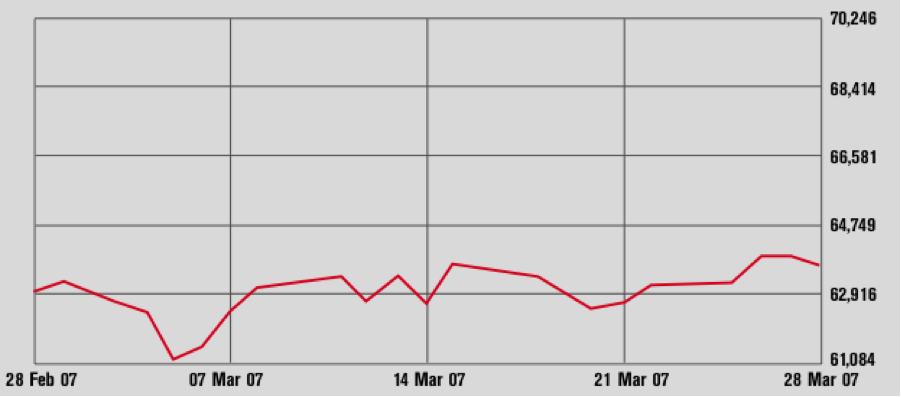
The Cairo and Alexandria Stock Exchanges entered the month with a week of downward motion to the 61,000 points level but the index moved back up and closed at 63,859.80 points on March 26. While Telecom Egypt shares made some gains in late March on news of higher 2006 results and a very faint outlook of a secondary 20% flotation in a few years’ time, Orascom Telecom Holding received three regulatory decisions against its MobiNil affiliate and got disqualified from bidding for the third Saudi mobile license, with rumors going wild on the reasons. Al-Watany Bank found several suitors interested in buying a strategic stake. Emaar Properties subsidiary Emaar Misr said it would file a complaint over a CASE decision refusing to list its shares.  

April 12, 2007 0 comments
0 FacebookTwitterPinterestEmail
  • 1
  • …
  • 585
  • 586
  • 587
  • 588
  • 589
  • …
  • 686

Latest Cover

About us

Since its first edition emerged on the newsstands in 1999, Executive Magazine has been dedicated to providing its readers with the most up-to-date local and regional business news. Executive is a monthly business magazine that offers readers in-depth analyses on the Lebanese world of commerce, covering all the major sectors – from banking, finance, and insurance to technology, tourism, hospitality, media, and retail.

  • Donate
  • Our Purpose
  • Contact Us

Sign up for our newsletter

    • Facebook
    • Twitter
    • Instagram
    • Linkedin
    • Youtube
    Executive Magazine
    • ISSUES
      • Current Issue
      • Past issues
    • BUSINESS
    • ECONOMICS & POLICY
    • OPINION
    • SPECIAL REPORTS
    • EXECUTIVE TALKS
    • MOVEMENTS
      • Change the image
      • Cannes lions
      • Transparency & accountability
      • ECONOMIC ROADMAP
      • Say No to Corruption
      • The Lebanon media development initiative
      • LPSN Policy Asks
      • Advocating the preservation of deposits
    • JOIN US
      • Join our movement
      • Attend our events
      • Receive updates
      • Connect with us
    • DONATE