• Donate
  • Our Purpose
  • Contact Us
Executive Magazine
  • ISSUES
    • Current Issue
    • Past issues
  • BUSINESS
  • ECONOMICS & POLICY
  • OPINION
  • SPECIAL REPORTS
  • EXECUTIVE TALKS
  • MOVEMENTS
    • Change the image
    • Cannes lions
    • Transparency & accountability
    • ECONOMIC ROADMAP
    • Say No to Corruption
    • The Lebanon media development initiative
    • LPSN Policy Asks
    • Advocating the preservation of deposits
  • JOIN US
    • Join our movement
    • Attend our events
    • Receive updates
    • Connect with us
  • DONATE
Executive Tools

Why equity capital is good for you

by Nagy Rizk April 1, 2007
written by Nagy Rizk

You are owner of a small or medium (Lebanese)enterprise (SME) and you are facing one or more of the following situations:

• What you sell (products or services) have high potential but you have limited resources to grow (both human and financial);

• You are doing fine, but cannot afford the extra efforts needed;

• You have used all your capacity to raise debt and you are looking for alternative financing options;

• You need to open to new distribution channels on the local or regional/international market;

• You need to build a solid infrastructure to maintain and protect your edge;

• You want to grow but are concerned with the risk implications.

Your bank/friends/colleagues have recommended you to bring in investors in order to move forward. But the search is hard. You have checked around and some (distant)connection is offering to bring in investors on board to check out your business:

• But you have either to make the trip to meet with them, probably in the Gulf nowadays (taking expenses from more urgent or relevant items) or stay on hold, waiting for their next visit to Lebanon.

• The timing may be wrong: Lebanese SMEs could be a hard sell with the current market conditions on uncertainty and instability. Buyers assume you are desperate and ask for a bargain. You are tempted to wait.

• But the feeling of urgency is clear: unless you move immediately, you may lose a unique opportunity. The market is growing and you do not want to miss the train.

• You do not know what to expect and how to deal with the“mighty investor.” A savior, a foe or just a partner? You are in for a long ride: long wait, long process, and uncertain outcome.

You are also concerned about loss of control of your business to the new investor, the reporting constraints, and the loss of independence. You are already missing your comfortable space, not having to report to anyone. Why would you want to bring in strangers?

Many questions are crossing and clashing into your mind.You are tempted to put things on hold, then to do something,then to wait and see. You are turning in circles. You wish you could have a clearer picture; you wish you could makethe wise choices at low cost; you wish you could be lucky and find the perfect fit.

You have a very heavy responsibility: You want to take your company to the next phase, efficiently and cost effectively. But the tasks ahead are too tedious and tricky.

Private equity funds for development are the pools of capital invested by private equity firms. The fund obtains capital commitments from certain qualified investors such as financial institutions and wealthy individuals to invest a specified amount in the equity of existing businesses.Private equity funds buy in equity against stakes in the business. They check out the business, they evaluate the business during the due diligence exercise, draw a road map on how to invest in the business, set the development objectives, and how to exit within a limited period. Along the way they make sure their investment is well-treated and they get returns that live up to the promises.

The Lebanese market may not be too familiar with equity capital funding for historical and structural reasons. But recently, there have been many success stories and positive experiences of value-creation and mutually beneficial partnerships. Of course, there have also been reports of some horror stories and bad experiences.

So, should you consider equity funding for your business?Is equity funding right for you?

10 good reasons to consider equity capital funding:

1- Risk sharing is a good tradeoff

Loans for business—especially the subsidized ones currently offered on the Lebanese market—are very attractive. You probably have used your limit. And when you take a loan, no one shares the risk with you. You have to pay it all back yourself, whatever the circumstances. You are on your own, dealing with risks of uncertainty, instability, and market downturn. The equity capital investor is aware of all the painful realities of the business life. He has integrated them in his analysis andvaluation. He is sharing the risks with you. And he will be doing his best to minimize and mitigate them. It is good to have a partner.

2- Dealing with the professionals always pays off

You are dealing with professionals all the way: their valuation of your company is rational, documented and integrating all the relevant factors. Negotiations are clear and streamlined. You will not be wasting time and resources dealing with amateurs or unsophisticated potential partners.The professional equity fund managers have very clearly defined rules and organizational structure. You are pretty safe.

3- Clearly defined process

Whenever you reach an agreement, all the important issues will be addressed and clarified. Many scenarios will be anticipated. No improvisation or rule-bending along the way.No bad surprises around the corner.

4- You are not losing control of your business

Your new partners want you to succeed. They want you to continue doing what you are best at doing. When necessary, they are willing to bring in the missing skills for a healthy growth. They would not mind minimizing their intervention. They are not into micro-management (unless necessary). They invest in people and your ability to deliver.

5- Credibility for your business

When the professional equity investors get in, they examine your business. If they like it, they let you know it. They see a potential for growth and value creation. They show faith in you. They give you a validation stamp.Credibility is fundamental to accelerate your entry into anew market, reduce your sales cycle, recruit new talents, and negotiate better funding terms and business deals. Youhave already won a solid vote. Your business is bankable.

6- Articulated strategy for your business

Professional equity investors look at your business, ask questions, and articulate all the necessary details including strategy for positioning, development, and growth.They share with you their vision, perspective, and experience. Your equity partner sees the value in your business and its potential, and gives you a fair assessment, and like the other board members will look at the big picture and thinking outside the box. You see the road ahead clearly. You know where you are going and how far and how fast you should get there. Motivation and clear objectives are good drivers.

7- Monetization of your business

You used to run the business, and whenever you needed loans or funds, you would have to offer personal guarantees or start a painful seduction dance to prove the value of your business. Once an equity fund has invested in your business, it is an easier sell to convince the market at large of the starting valuation. More leverage possibilities for the business or for your own shares for a second round.Well done.

8- One Agenda, clear objectives

The equity fund will get on board with the clear objective of creating value—aggressively if possible—build an attractive item, sell it out, make profits, and move on. The equity fund investor does not target to take over your business or to run it indefinitely. The rules of the game are clearly defined from the beginning. No change in the agenda along the way. No need to watch your back. You can focus on your business.

9- Your business is on the map

The equity capital professionals have come on board. They have created value. Time for them to move out. They offer their shares to potential buyers (insiders or outsiders).The buyers take notice of your value, your competitive edge, and your potential in their own portfolio. You are more visible. And that is good for business.

10- Bottom line

If every thing goes right on track, if you succeed in attracting a professional equity investor to your business, you will benefit from a very good learning experience, get help creating value for your business, and build a more sustainable business. Your future has improved, significantly.

If you feel you can make the cut and get an equity investor to take notice, prepare yourself thoroughly.Increasingly, many players are will be looking for opportunities on the Lebanese equity market. They say there is a lot of untapped value and high potential.

Having said all that, there will be situations where you will not need equity financing: If your business has very low risk, is not facing challenges for growth and survival or if you do not need to sell out for cash, then you do not need to share your benefits with outsiders with limited potential for added value. Just keep on doing what you have been doing, the good old-fashioned way.

Nagy Rizk Fund Manager The Building Block Equity fund [email protected]

April 1, 2007 0 comments
0 FacebookTwitterPinterestEmail
Comment

Gulf airlines: Ego-trips or essential?

by Alex Warren April 1, 2007
written by Alex Warren

Is an industry, aviation has always attracted the wealthy.Tycoons rarely resist the chance to have their own airline, as Howard Hughes, Aristotle Onassis or Richard Branson are enough to prove, whilst virtually every country in the world proudly flies a national flag carrier, even if it makes a loss in doing so.

Little surprise, then, to observe the billions of dollars being poured by Gulf states into the expansion of airline sand airports. Thanks largely to this investment, the MiddleEast is now easily the fastest growing region in the world in terms of air traffic, which in 2006 rose by 16% compared to a global average of 5.1%.

But aren’t there just too many fish swimming in too small a pond? Despite the small size of the domestic market in theGulf, there are now at least eight airlines operating fromKuwait, the UAE, Bahrain, Qatar and Oman alone, with more set to arrive.

Older players like Emirates continue to expand, marketing themselves ever more aggressively in new markets like the US or the far East. Meanwhile, the original stakeholders ofGulf Air—the governments of Abu Dhabi, Bahrain, Qatar andOman—have gradually pulled out of the partnership to create new airlines.

Abu Dhabi launched its own carrier, Etihad, in 2005, whilstDoha has spent extravagantly on expanding Qatar Airways in the past few years. Low-cost carriers have also entered the market, and with great success. After its launch in 2003,Sharjah-based Air Arabia chalked up a $27.5 million profit in 2006 and offered a $700 million IPO last month. Jazeera Airways, a privately-owned Kuwaiti airline which began flying no-frills flights in 2005, already goes to 20destinations and says it also wants to list stocks.

Even more new airlines are on the way, including a fourthUAE carrier, the delayed RAK Airways, which will operate from the northern emirate of Ras al-Khaimah. Across the border, meanwhile, Saudi Arabia has said it will issue licenses for two low-cost domestic carriers in theKingdom.

On the surface of it, the preponderance of upstarts in such a tiny geographical area would seem to be nothing but an ego-trip, a publicity stunt designed to get names on the map and planes around the world. Yet whilst an element of that might be hard to deny, this lavish expense on aviation forms part of a longer-term, and fairly sensible, economic strategy for many of these countries.

Thus far, the growth of all these airlines can be attributed to a number of contributory factors. Most important is the wider economic boom in the region: the massive influx of immigrants to the Gulf, whether middle-managers from Europe or legions of construction workers from the subcontinent, has filled hundreds of thousands of plane seats, whilst long-haul tourism is developing quickly in places like Dubai and Oman.

Second, most airlines rely heavily on the so-called hub and spoke model for their business, bringing passengers in from a large number of cities around the world, connecting the mat the airport and then flying them out to their final destination. In some cases, like Qatar and Abu Dhabi, these kind of transit passengers make up more than 70% of total traffic.

With that in mind, it helps greatly that the Gulf lies between large centers of population with underdeveloped international airlines, namely Iran, the Indian subcontinent and Africa, as well as being a natural halfway point betweenEurope and the Far East.

The airlines can also benefit from airport investments whose size and cost seem to make no commercial sense. Over $40billion is earmarked for airports in the Gulf over the next10 years, with Dubai building what will be the largest airport in the world and Abu Dhabi, Qatar, Oman and Kuwait all spending combined billions on new infrastructure to support aviation growth.

Lastly, many suspect that these airlines are given an unfair leg-up from their government patrons. Some European carrier shave queried whether the Gulf airlines receive hidden subsidies, have access to cheap rates of borrowing or benefit from a privileged position at their hub airports—which are also owned by the state.

Whatever the case, though, this is missing the point. Even if they’re doing well now, these airlines don’t really need to make money in the short-term. Qatar Airways, for instance, doesn’t even expect to turn over a profit until2012. Instead, they should be seen as elements of a wider investment plan—which includes tourism, ports, media and finance—to sustain Gulf economies once the oil and gas dry up.

Many argue that everything epitomized by the Gulf boom is built on hydrocarbons and hyperbole. That may be true. But for now, there is more than enough money being spent to ensure that by the time economic growth slows down, the new arrivals become fewer and energy resources dwindle, these carriers will have been able to establish a global marketshare that will both sustain their businesses and, more importantly, keep bringing people into and through theGulf.

Perhaps not all of them will manage to be successful in the long-term, but there is at least some justification—apart from national pride—for so many apparently nonsensical airlines in such a small area.

ALEX WARREN is a freelance journalist based in Dubai

April 1, 2007 0 comments
0 FacebookTwitterPinterestEmail
Capitalist Culture

The battle for downtown: Solidere symbolizes much

by Michael Young April 1, 2007
written by Michael Young

Little has excited the Lebanese in recent months, thoughmuch has contributed to their anxiety. However, it was onenews item in February that seemed to hit public moralehardest. From an initial figure of around 250 establishmentsin the downtown area, we learned that around 80 had closeddue to the ongoing sit-in by opposition supporters. A 30%closure rate in three months is ominous by any standard.

A few years ago, I was chatting with the late SamirKassir, when he remarked about an odd habit he had noticedin the Solidere area, particularly its mostly emptynorthernmost quadrant: drivers stopped at red lights, thoughthere was little traffic, and even fewer pedestrians, tomandate such discipline. Why were Lebanese who would havebarreled through red lights in any another part of Beirut solaw-abiding?

Kassir wasn’t sure, but he was toying with the idea thatdrivers were somehow intimidated by Solidere’s modernity.Here was an area of town that imposed esteem, he speculated,that commanded respect.

Was that the case? Maybe it was, maybe it wasn’t, but onething is certain: very few Lebanese fail these days tomention the deep resentment they feel at what has happenedto the downtown area; and the vast majority of them reactnot from a political standpoint, but from the standpoint ofpeople proud of a part of town that had symbolized Lebanon’sbest qualities and its genuine emergence from civil warafter 1990.

This is not the place to discuss the opposition’smotivations in suffocating the downtown area. However, itmakes sense to ask why an action directed against thegovernment has ended up punishing the private sector. Partof the reason—and there are numerous examples of oppositionprotesters arguing precisely this line—is that thegovernment and Solidere have been regarded as synonymous byprotesters. Certainly, the company’s close and ongoingassociation with the state; certainly, too, the hazy barrierbetween what belongs to Solidere and what belongs to theHariri family, have helped reinforce this conviction.However, that doesn’t make it any less fallacious. Inturning Solidere into a hostage to politics, the oppositionhas, intentionally or not, widened its dispute so that it isnow one directed against the Lebanese economy, and moreparticularly against the better outgrowths of free-marketcapitalism.

Downtown once again a battlezone

It doesn’t take much to capture the symbolism of themoment—on either side of the political spectrum. For themajority, a part of town that for a long time embodiedLebanon’s ability to transgress war, has again become afront line in a domestic crisis. Where the late Rafik Haririsought, perhaps excessively, to banish war from the downtownarea (recall that a war memorial planned for the city centerwas, instead, trucked off to the Defense Ministry inYarzeh), those contesting Hariri’s legacy have never broughtLebanon closer to civil war. To borrow from sociologistSamir Khalaf, the reclaimed heart of Beirut may soon be incardiac arrest.

The narrative of the other side is no less evocative, andunconditional. Hariri’s Beirut, because of its exclusivity,was never a valid Lebanese symbol. It was perhaps a symbolof the bourgeoisie and entrepreneurial skill, but one whoseimpact most Lebanese never felt. Far from being therepresentation of a Beirut at peace, it personified acallous, unjust city. How could there be true harmony andserenity if a part of the population was not invited topartake of its postwar pleasures?

Whatever one thinks of either argument, neither reallyaddresses the much more mundane matter that cities are, inone way or another, reclaimed by businesses. Ideas count fora great deal, urban policies and politics the same, butultimately it is money that keeps cities going, and anability to use that money to develop. And neither narrative,as it has played out today, is satisfactorily keeping themoney circulating, even if the Hariri vision was always muchfriendlier to businesses.

Those who saw the Solidere area as the symbol of aresurrected Beirut never paused to wonder whether it wasalso an island that had merely kept Lebanon’s divisionsoutside its boundaries. Why does this matter? Because noprosperous free market can last if it is built on shakyfoundations nationally. If Lebanon is to thrive, then itsdifferent political forces will have to agree to a commonvision for the country’s economic future. The Lebanese arenot there yet. The downtown area may have epitomized postwarpeace, but not everyone bought into this, and that’s afailing that can be put at the door of the policymakers.

On the other side, the opposition seems to have little senseof the advantages of the free market, which doesn’tdifferentiate between political forces. If Solidere loses,so does Lebanon’s economy, and so do all Lebanese. Povertyand unemployment play no favorites. That’s why both sideshave a duty: the opposition should end to its protests inthe downtown area; and the government should oversee aprocess leading to a national consensus on Lebanon’ssocial-economic priorities, by spreading that concernoutside the boundaries of a contested Solidere.

April 1, 2007 0 comments
0 FacebookTwitterPinterestEmail
Comment

Lebanon: Privatization and its fiscal implications

by Mounir Rached April 1, 2007
written by Mounir Rached

The Lebanese government has proudly outlined itsprivatization program in the recovery paper presented toParis III donors, underscoring its crucial role in promotinggrowth, reducing public debt and fiscal deficits. The focusis on the most profitable privatization, the mobile sector,while electricity, the most destitute, is deferred to anundetermined future date.

Contrary to the general perception, these so-calleddinosaurs—or the non-financial public enterprise sector, togive it the boffin name—actually make money for thegovernment in the form of revenues from no-tax revenuetransfers to the treasury and VAT. Income transfers totaledLL8.2 trillion ($5.5 billion) during 2000-2006, mostly fromthe telecom sector. VAT contributions are not separatelycalculated but, at 10% since 2002, should have added sizableamounts to government coffers. EDL contribution has beenlimited only to VAT, due to its perennial losses.

During the same period, government expenditure, in the formof transfers to PES, to EDL in particular, amounted to LL3.5trillion ($2.3 billion). Even without taking VAT intoaccount, the net receipts accruing to the treasury during2000-2006 reached $ 3.2 billion ($5.5 less $2.3 billion).Thus, PES has had a mitigating effect on public finances.

This is not to say that this state of affairs should beapplauded, as the sector has been plagued by a combinationof poor quality, high operating costs and slowing growth,prompting consumers and businesses to call for its drasticreform. EDL alone has been suffering losses close to 40% ofits power generation and MEA (which is much better managed)has yet to make recurrent profits.

High revenues from PES, 28% of the total in 2006, are due tothe high rates (over pricing/taxing). Mobile telephonecompanies charge $0.13 per minute, compared to internationalrates of $0.4-0.5, while EDL’s rates are also high byinternational standards. Public sector privatization wouldlead to a restructuring of revenues in favor of tax receiptsand both would be expected to rise with a growing economy.

A third lump sum source of income would accrue from sale ofexisting PES assets and from licensing. The prime candidatesare telecommunications, electricity and Middle EastAirlines. Licensing, particularly the telecom sector, isexpected to generate most receipts. (The net worth of MTCTouch and Alfa, the two government-owned mobile companies,are not believed to exceed $100 million, as most of theirassets date back to 1994. EDL and Ogero have yet to beaudited, and MEA is burdened with debt.)

According to government sources, mobile licensing couldbring in $2.5-$3.5 billion per license. Two additionallicenses should bring in the same amount. Such high feeswill only be recuperated through high service charges—mobile or kilowatt use—and this will probably have astifling instead of rejuvenating impact on the economy.

An internationally competitive price should guide thedetermination of licensing value. The overriding objectiveof the privatization drive should not be to extract thehighest possible revenue (from sale of assets and licensing)in order to reduce public debt, but rather to provide themost efficient and competitive service to contribute togrowth and eventually enhance government revenue.

A simple proportional adjustment, for instance, in mobilelicensing proceeds, to reflect a reduction in its servicecharge to an international level (to 4 cents from 13 centsat present) could bring down a license value by severalfolds to few hundred million dollars—and rates would stillbe higher than what many countries, determined to providecompetitive service, charge. Furthermore, a priority inprivatization should be to concurrently address the leastprofitable enterprises. Sinking more funds in EDL beforeprivatization could defeat the purpose of reform.

In reality, only reaching a fiscal surplus will reduce debt.Privatization proceeds alone won’t cover cumulative publicfinance deficits—estimated at $11.8 billion—through 2011(see Executive March 2007). Proper accounting stipulatesthat privatization receipts be classified as a fiscalfinancing item, making the that law stipulates theirallocation to debt reduction redundant. The governmentshould focus on improving its public finances throughrecurrent receipts and continued streamlining ofexpenditure, and by seeking to raise the grant element andfiscal support of donors’ pledges. To use privatization as atool to reduce debt and fiscal deficits is a misguidedapproach to reform.

DR. MOUNIR RACHED is a senior IMF economist, and a founding member of the Lebanese Economic Association. The views in this article are those of the author and don’t represent those of the IMF

April 1, 2007 0 comments
0 FacebookTwitterPinterestEmail
Editorial

The new realpolitik

by Yasser Akkaoui April 1, 2007
written by Yasser Akkaoui

And so to another Arab summit. There was a time when the Arab street would shrug and say “so what?” The most we hoped for was that our leaders would not embarrass us, especially those who used the occasion to showboat and who would leave any feelings of national duty—assuming they had any in the first place—at home.

2002 changed all that. Saudi Arabia, already beginning to feel they had a new, more robust role to play in the region, put forward a peace plan that gave a patina of credibility to an occasion whose high point used to be the arrival of President Khadafy’s female bodyguards. The plan was rejected by the Israelis but five years on, we detect a political change in the wind and the initiative, while not embraced, has not been rejected out of hand.

There are reasons for this. There is Iraq; Saudi Arabia has a new king and new wealth through oil, capital markets and real estate. Because of the terrible outcome of the Iraq war and the American need for regional chums, the Saudis today are closer to the Americans and no doubt feel that the way forward in regaining Arab prestige and dignity, not to mention being taken more seriously by the international community, is through leveraging economic success and consolidating alliances. It is the new regional realpolitik.

That the Arabs are re-submitting a peace plan also restores another important dynamic: Arabs are reclaiming ownership of Arab issues. Palestine is an Arab problem not an Iranian problem and Saudi Arabia, along with the other gulf powerhouses, Qatar, UAE and Kuwait and Jordan can make a difference. They are credible nations that have made economic growth a priority.

And finally we have Syria, the current enfant terrible of the region and a country on whom the international jury is still out. Should the world cozy-up to Damascus or watch the regime wither on the bow? Here Saudi Arabia can also help. As we pointed out in our last issue, Saudi businessmen are already investing in Syria; the next step should be to warn Damascus of the dangers of isolation and the price it may have to pay for its outrageous insolence in Lebanon. It should also remind the regime that the international community will not tolerate its bull-headed belligerence forever.

But can Syria ever be a positive force for good in the region under the current regime?

Sadly, as history has demonstrated, it has yet to prove it can.

April 1, 2007 0 comments
0 FacebookTwitterPinterestEmail
Comment

Formerly a haven of small-town trust, UAE sees rise in crime

by Norbert Schiller April 1, 2007
written by Norbert Schiller

I recently stepped out of my apartment in Sharjah and absentmindedly forgot to lock the door behind me. I have always lived in places where doors lock automatically. I wasn’t gone for very long, but long enough for someone to enter and rifle through all the drawers and take any money that was lying loose. Fortunately, the burglar only got away a bunch of spare change left on a table and both my children’s wallets

We live in a big complex—33 floors with over 100apartments—lived in by relatively well-to-do, conservative expatriate families from the Arab world and Indian sub-continent. I thought the building was secure, but what surprised me the most was that someone would risk being caught in a country that comes down hard on crime. I’m sure that after serving the sentence, the perpetrator (if he were a foreigner) would never be let back into the country again—a serious consideration when so many guest workers are dependent on the Emirates for their livelihood.

Twenty years ago, when I lived here before, there was virtually no crime. There were times where I would be in a rush to get to the bank before it closed and I would unconsciously leave the car doors unlocked with thousands of dollars worth of camera equipment lying on the back seat.Back then, the cops were everywhere. They were bored—it was a time when a small dent on the side of your car would warrant a fine—and we had to be on the lookout. Now, with so many cars on the roads, police have their hands full with real traffic problems. Gone are the days of cruising for dents, or burglars for that matter.

Part of the problem is that the UAE, and in particularDubai, is growing at such an alarming rate that the locals represent less than 20% of the population. Background checks on cheap immigrant workers—from Pakistan, India, andBangladesh—are not as thorough as before. Once inside, if a person then wants to quit his job, it’s harder to keep track of them. They can just disappear, blending into the migrant population. Then there is the criminal element—the pimps, the drug dealers and the human traffickers. Crime breeds crime.

Near my home, they recently opened a Carrefour mega-market. To get there, I need to cross a few streets, one of which is a busy highway. In order to make it safe for pedestrians, an underpass was built; a very good idea in a country where so many pedestrians are lost to traffic accidents each year. However, I was shocked to see women with babies at either end of the pedestrian underpass—In the years before, I had never seen a single beggar. Begging is against the law and punishable by prison and deportation.And then if you think about it, why would anyone have a need to beg in a country that is so prosperous with a foolproof system? Emiratis are looked after, while foreigners are hereto work and therefore have a sponsor that looks after them.

Like Beirut and Cairo, the beggars are not begging for their own well-being; rather they are taken advantage of to make money for small time gangs that protect them in return for a cut of the proceeds. It appears the underworld is moving in.

The bottom line is that as Dubai and all the otherEmirates grow, the small-town feel that once made living here so attractive is all but disappearing; now suddenly, the Emirates are beginning to suffer from the big time problems that plague large cities around the world. Now the talk at dinner parties never drifts too far from the subject of crime—not the lack of it, as was the case in the ’80s.And even though the authorities do not publish figures, it is obvious that crime is on the rise. Everyone seems to have a horror story to tell, from gang rape to petty theft. Even the locals have been arrested and convicted of crimes, ranging from theft to murder. Dubai, it seems, offers more than just tourism and duty free shopping.

Maybe I protest too much. Maybe I’m just getting old. Yes, the UAE is still one of the safest places on earth to live.But my question is—for how much longer?

NORBERT SCHILLER is a photo editor and photographer at large with United Press International (UPI)

April 1, 2007 0 comments
0 FacebookTwitterPinterestEmail
Comment

Arab states ignore climate change

by Fouad Hamdan April 1, 2007
written by Fouad Hamdan

“Climate change? What climate change?” These are the twoquestions I often hear when I mention this issue to Arabofficials. If I insist, they get irritated and change thesubject. Others try to play it smart and argue like some USoil corporates, claiming current climate changes are naturalphenomena and not connected to any human activity. Thisdefensive approach is understandable in a region that hasenough political and economic problems, ranging from thePalestinian-Israeli conflict to civil wars in Iraq andSudan, huge discrepancies between poor and rich in mostsocieties and visible pollution in the air of cities as wellas along rivers and coastlines.

But the longer Arab leaders ignore the issue of climatechange, the higher the price Arab societies will pay in thefuture. And this price will be paid with money and humanlives. Sadly, environmental protection is not high on theagenda of Arab governments, the 2005 EnvironmentalSustainability Index found out. Its scores, given to 146countries, are attributed to substantial natural resourceendowments, low population density, and successfulmanagement of environment and development issues. Finlandranked first, followed by Norway, Uruguay, Sweden andIceland. The index put Iraq at 143, Kuwait at 138, SaudiArabia at 136, Lebanon at 129 and the UAE at 110. The threebest Arab states were Tunisia (55), Oman (83) and Jordan(84). Israel landed at 62.

But what strikes me most is the lack of knowledge among Arabdecision-makers about the main causes of climate change, andwhat could be done to stop it. A United Nations scientificpanel agrees that climate change is one of the biggestthreats facing our planet. The main reason is the globalrapid growth in energy production and consumption since the1950s—by burning fossil fuels like coal, gas and oil.Intensive agriculture and the cutting of forests also emitscarbon dioxide (CO2) emissions that heat up the Earth. Theresult is more devastating freak weather events such asflash floods, storms, heat waves, mudslides or droughts.This greenhouse effect also leads to the melting of icepacksin the North and South poles, causing sea levels to rise.

We are heading into global average temperature increases of2 to 3 C°, with rising sea levels wiping countries off themap. Developing nations will be hit first and worst.Meanwhile, the World Health Organization said 150,000 peopledie every year as a result of climate change. In theMediterranean region, climate change has started toundermine efforts for sustainable development.

Last January, the European Union published a report dealingwith the disasters that will take place along the northernshores of the Mediterranean. Assuming a global 3 C° rise,the basin would face crippling shortages of both water andtourists by 2050, and tens of thousands will die of heat insouthern Europe. The annual migration of rich northernEuropeans to the south could stop—with dramatic consequencesfor the economies of Spain, Greece and Italy. If southernEurope will be hit so badly, one can imagine the economicand health impacts climate change will have on the Maghrebstates, Egypt, Palestine/Israel, Lebanon and Syria.

Cairo is among the 22 cities that the UK government’s recentStern report tipped to face increasing risks of coastalsurges and flooding, as the Earth warms by about 3° from the2050s. Floods from rising sea levels could displace up to200 million people worldwide. For Egypt, this means that theNile Delta is under threat.

Arab states need to face that climate change is alreadyhitting them and that they must deal with it. No one issaying that oil and gas should be left untouchedunderground. But to help avert the crisis, a serious globalcut of CO2 emissions should go hand in hand with much lessoil, gas and coal burnt. This does not have to mean aneconomic disaster for Arab oil-producing countries. It couldbe a historic chance to produce hydrogen in a sustainableway with solar power.

Let us imagine all over the Arab world, millions of squarekilometers of solar panels producing hydrogen. This wouldcreate a hydrogen economy, in which energy is stored andtransported by pipelines or tankers. When burning hydrogenin heating systems, energy plants, vehicles or aircraft theexhaust pipes and chimneys will only release water in theatmosphere. Such an energy revolution needs decades ofmassive investments in this technology and in a new globalinfrastructure. Under this strategy, oil countries wouldslowly reduce their oil output while exporting more and morehydrogen. Oil reserves would last longer.

One would assume that hydrogen would be difficult to sell inthe Gulf, the world’s main source of oil. But this isanything but paradoxical. It is a matter of survival,because the cry for sustainability is becoming increasinglyurgent. From Morocco to Iraq and from Syria to Yemen, largeunpopulated and desert areas could be used to producehydrogen from solar energy. Clean hydrogen made there could both save the planet and secure the economic survival of theArab world in the post-oil era.

FOUAD HAMDAN set up Greenpeace in Lebanon in 1994-1999. He is now executive director of Friends of the Earth Europe, a campaign and lobby organization in Brussels influencing the environmental policies of the European Union. He wrote this article for EXECUTIVE.

April 1, 2007 0 comments
0 FacebookTwitterPinterestEmail
Comment

“Month of Mayhem” in Iraq

by Michael Holmes April 1, 2007
written by Michael Holmes

This was my eighth visit to Baghdad—in many ways, Baghdad feels like a second home, which I’m not sure is a healthy sentiment—my first being as the war wound down in 2003. I cringed a little when told the documentary would be called“Month of Mayhem.” It proved to be a more than apt title.The previous seven “tours” had allowed me to witness a steady deterioration in the level of security and services—despite my hopes, it was always, always worse. AndI knew this trip would likely be no different. It really becomes a matter of how bad it’s going to be. Before leaving the airport—before leaving home, for that matter—I know there will be bodies, and there will be bombs—it is only a question of who and how many.

A bloody time for Baghdad

As it turned out, this visit would see one of the bloodiest periods since the war began.

Within 10 minutes of reaching the bureau, I was live on air reporting on the battle for Haifa Street, as US andIraqi forces fought Sunni insurgents and al Qaeda elements not more than a mile or so from our office. All day, the air was rent by the sounds of small arms fire, heavy caliber machine gun fire, and missiles fired from the Apache helicopters that swooped low over our heads.

CNN’s Arwa Damon being in town ended up being a boon for me. She was embedded with a Stryker Unit and this allowed me to largely escape the routine of “live shots” from the bureau and embed with the military for much longer than usually possible on a five-week assignment. Embedding with the military has become the safest way of reporting, not just on the war, but on Iraqi civilians. It’s about the only way we can safely meet with ordinary residents, talk to them on and off camera and get first hand accounts of the awful tribulations they endure.

This was a month of massive bombs at universities and market places, of more and more bodies dumped in the streets, hands bound and shot after being tortured in almost inconceivable ways, including the use of electric drills. It was a month when what the US called its “troop surge” began, when the “Baghdad Security Plan” got underway, when the first Joint Security Stations were being set up.

The severity of the security situation is well illustrated by the embed in Adhamiya, an area about six miles from our bureau, but considered by our security advisors too dangerous to drive. Roadside bombs and ambushes are common.

Each time I return, there seems to be a new “worry” among the troops. This time it was the increased sniper activityand the growing threat of EFPs, or explosively formedprojectiles. These are savage weapons—“shaped” charges thatfire out a ball of molten copper, or similar metal. RegularIEDs were described to me by one soldier as “like a shotgunblast.”

“EFPs are like an armor piercing bullet aimed at your head,”he said.

A month of laughter and tears

I met another soldier who’d been “blown up” as he put it, four times, by IEDs, and wounded three. It was his first day back after his latest medical leave, and he was the driver in my humvee. Another soldier told me about an EFP that hit a humvee he was driving. It went through the right rear window of the vehicle, decapitated the soldier sitting there, took the legs off the gunner in the middle, took the head off the soldier in the left rear seat and continued out the window.

And this happened to an “up-armored” humvee.

During that month, we laughed in our bureau—you have to laugh—we had a party or two with our competitors inside ourcompound, we flew in helicopters, drove in Strykers and humvees and Bradleys. And we saw incredible suffering and loss. I left feeling that some positive things were being put into effect. And a stronger feeling that most of those things were about two or three years too late.

I’ll go back, later this year. Because I need to. BecauseI feel honored in many ways to, as a journalist, have the opportunity to cover this story up close. Because, like most of us who come—many for much longer periods than I do—I care.

MICHAEL HOLMES is a co-anchor for CNN International’s rolling newscast ‘Your World Today’

April 1, 2007 0 comments
0 FacebookTwitterPinterestEmail
Financial Indicators

Global economic data

by Executive Staff March 22, 2007
written by Executive Staff

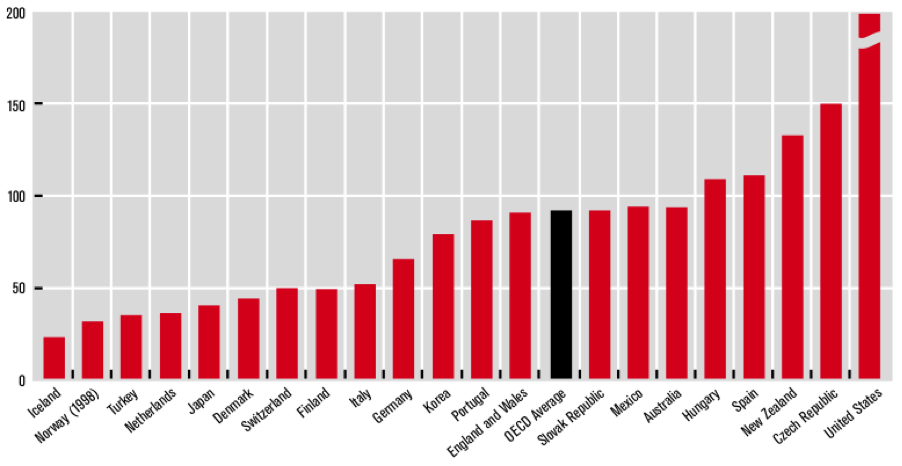
Prison population

Convicted adults admitted to prisons

Number per 100,000 population

Since the 1970s, OECD countries have experienced steady increases in prison population, with the exception of Finland where the rate has continued to decline. Over the last 10 years, Portugal has recorded one of the largest increases together with Spain among European countries. However, levels in both countries remain far below the United States, where the prison population has witnessed a huge jump that bears no historical comparison, with a population in 2000 four times as high as in the early 1970s. Differences across countries have, surprisingly, only little to do with the prevalence and development of crimes but more likely to do with political factors and responses to the increasing belief in certain countries that prison is preferable to other alternatives. When comparing prison populations in 2000, the United States again stands far above the norm with an incarceration rate five times as high as the OECD average and three times larger than the Czech Republic, ranking second. More than 1.2 million convicted American adults are in jail (a little less than 2 million when pre-trial and non-guilty offenders are included), and this may have a significant distorting role on the labor market for young males. Rising prison populations, unless fully resourced, generally reduce the effectiveness of criminal re-education. Upward trends can pull down the staff-prisoner ratio, a key component for achieving effective prevention of re-offending and promoting reintegration in the community. Moreover, prison overcrowding tends to exacerbate already high levels of tensions and violence, raising the risks of self-injury, suicide and sexually transmitted diseases including HIV/AIDS. Overcrowded prisons are also more likely to act as “universities of crime.”

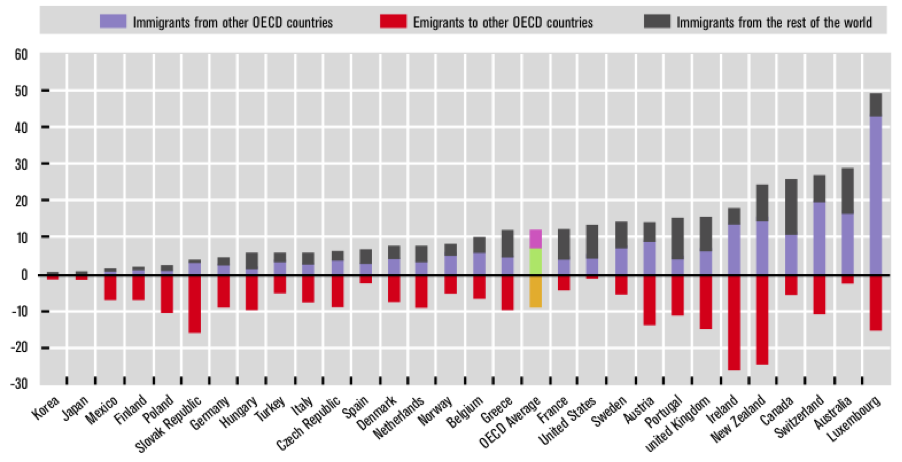
Migration of the highly educated

Foreign-born persons with tertiary education

As a percentage of all residents with tertiary education

In the total OECD area, about 4% of persons with tertiary education are immigrants from other OECD countries. Those from non-OECD countries account for about 6% of all current residents with tertiary attainment. Net stocks of foreign-born persons with tertiary attainment are highest in the traditional “settlement” countries of Australia, Canada and the United States, but also in Luxembourg and Switzerland. Other countries with a large excess of foreign-born persons with tertiary attainment relative to their nationals living in other OECD countries include Sweden and France (8-9%). On the other hand, countries having a large percentage of tertiary-educated former residents living in other OECD countries include Ireland and New Zealand (at close to 25%); Austria, Switzerland, the United Kingdom, Luxembourg, Poland, Portugal and the Slovak Republic (all at more than 10%); and the Czech Republic, Germany and the Netherlands (at close to 9%).

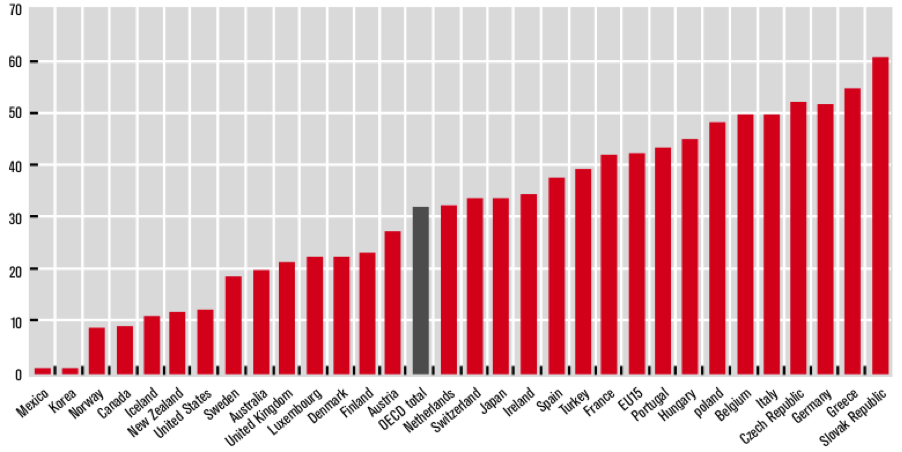
Long-term unemployment

Persons unemployed for 12 months or more as a percentage of total unemployed, 2004*

In 2004, rates of long-term unemployment varied from 10% or less in Canada, Korea, Mexico and Norway to 50% or more in the Czech Republic, Germany, Greece and the Slovak Republic. Lower rates of long-term unemployment are generally found in countries that have enjoyed relatively high rates of economic growth in recent years. There appears to be a two-way causal relationship here. On the one hand, jobs are easier to find in a fast growing economy and, on the other, economies may grow faster by making unemployment an unattractive proposition. Over the period shown in the table, long-term unemployment rates have been relatively stable for the OECD as a whole, but there have been some sharp rises in several countries and equally sharp falls in others. Rates of long-term unemployment have more than doubled in the Czech Republic, Hungary, Finland and the United States (albeit from low levels) and have also risen sharply in Iceland (although from very low levels), Japan and Switzerland. On the other hand, there have been large falls in the long-term unemployment rates in Belgium, Ireland, Italy, Luxembourg, Netherlands and Spain. It is noticeable that, since 1990, the share of long-term unemployed has halved in Korea, Norway, Luxembourg, Ireland and New Zealand.

*Latest available figures

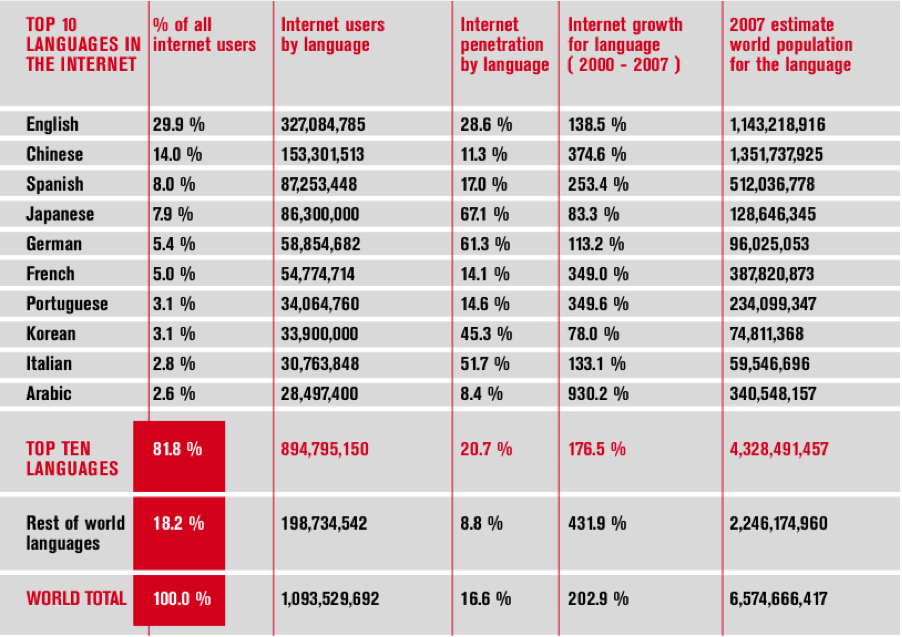
Languages on the Web

Top 10 languages used in the Web

( Number of internet users by language )

There are 87,253,448 Spanish speaking people using the internet, representing 8.0% of all the Internet users in the world. Out of the estimated 512,036,778 world population that speaks Spanish, only 17.0 % use the internet. The number of Spanish speaking internet users has grown 253.4 % in the last six years (2000-2007). Arabic speakers saw the largest growth—930.2%—although they still has the fewest speakers online (2.6%) and least penetration among speakers (8.4%).

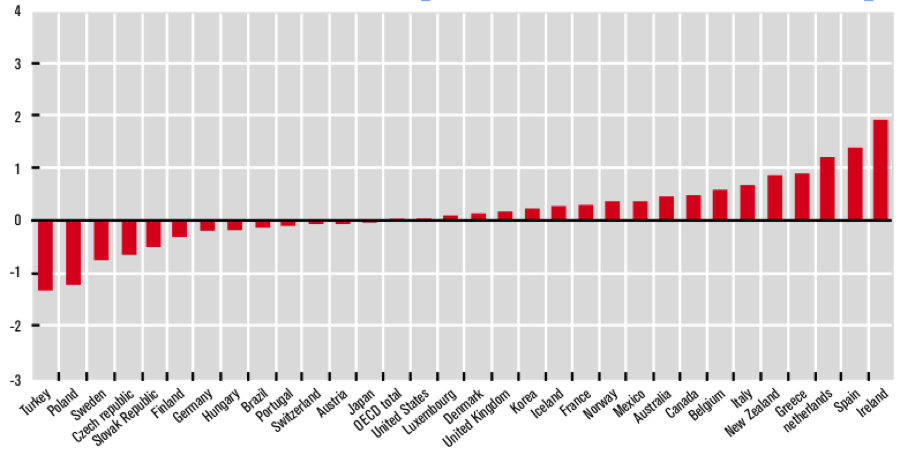
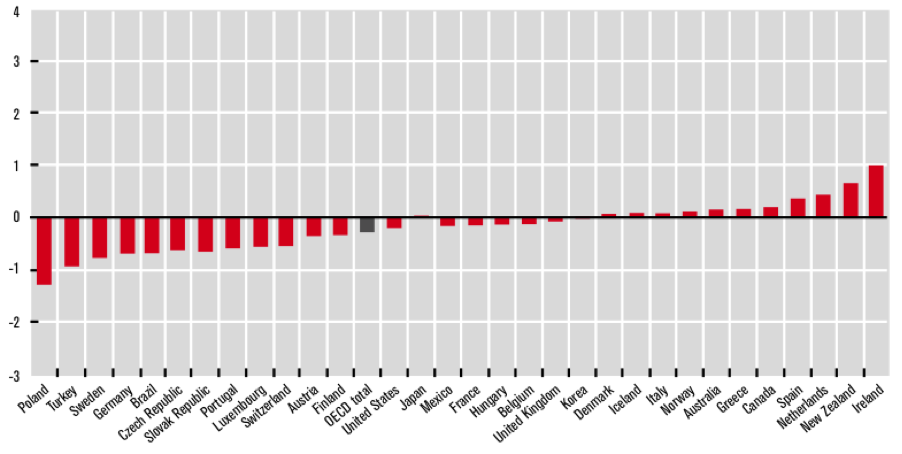
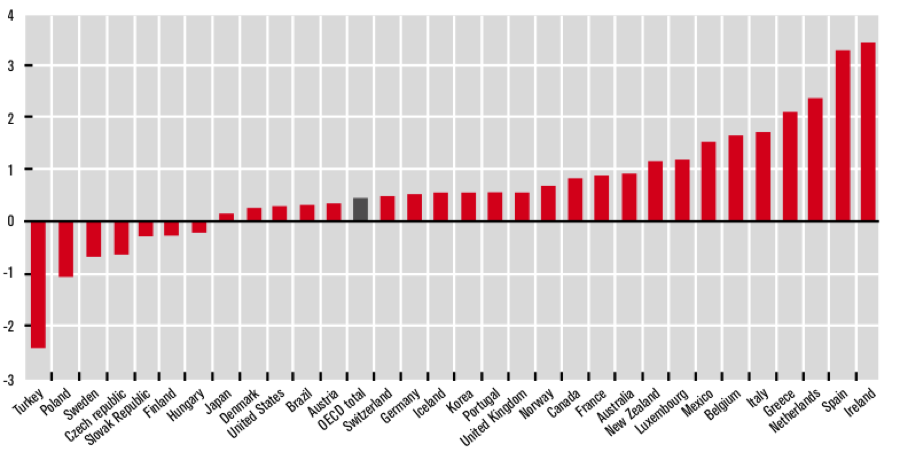
Employment rates by gender

Employment rates: total

Average annual growth in percentage, 1991-2004 or latest available year

Employment rates: men

Average annual growth in percentage, 1991-2004 or latest available year

Employment rates: women

Average annual growth in percentage, 1991-2004 or latest available year

All OECD countries use the ILO Guidelines for measuring employment, but the operational definitions used in national labor force surveys vary slightly in Iceland, Mexico and Turkey. Employment levels are also likely to be affected by changes in the survey design and/or the survey conduct, but employment rates are likely to be fairly consistent over time. For the denominators—the population in each age group—the data are taken from labor force surveys. Over the period shown in the tables, total employment rates (men and women) have fallen in 13 countries and risen in 17. Particularly large falls were recorded in Turkey, Poland, Sweden, Czech Republic and Slovak Republic and particularly large increases occurred in Ireland, Spain and the Netherlands. Growth in employment rates was very different for men and women. Employment rates for men decreased in 19 countries during the period with an annual fall of more than 0.5% in Poland, Turkey, Sweden and Germany. For women, on the other hand, employment rates grew in 23 countries with increases of 1% per year or more recorded for Ireland, Spain, Netherlands, Greece, Italy, Belgium, Mexico, Luxembourg and New Zealand. Clearly, these differences in the growth of employment rates are leading to convergence in the rates for women and men although differences remain large in many countries.

March 22, 2007 0 comments
0 FacebookTwitterPinterestEmail
Financial Indicators

Regional equity markets

by Executive Staff March 22, 2007
written by Executive Staff

Beirut SE: Blom  (1 month)

Current Year High: 1,713.79  Current Year Low: 1,168.85

The BSE short seems inauspicious to inspire trading volumes these days, but the Beirut Stock Exchange undercut the Bahraini bourse in matters of confidence last month. After no more then a hiccup of an improvement to 1,208.57 points on January 26, the day after Lebanon was promised $7.6 billion in international funding, the Blom Stock Index went lower and lower to close at 1,171.47 on February 23. Solidere slumbered in the troughs while BLOM Bank did a bit better than its sector peers. Traders said they did not want to be quoted with comments on the whole market performance, because “nothing is happening, it is the same shit every day.”

Amman SE  (1 month)

Current Year High: 7,584.32  Current Year Low: 5,267.27

The Amman Stock Exchange continued a surprisingly strong show of growth to close at 6,467.63 points on February 25, representing a 17.2% improvement in the index for the year-to-date in the best two-month performance for any regional market at the start of 2007. On the month, the ASE index climbed by around 480 points since January 28. Top market power Arab Bank was strong in volume and share price development to JOD 27.50; it is now up by JOD 6.20 since the start of 2007. Select real estate stocks saw good volume, including Taameer Jordan and Arab East for Real Estate Investment. The share price of the latter advanced by 25% in the course of one month. Upstart Jordanian television station ATV said it wants to become the first station in the region to go on the bourse. 

Abu Dhabi SM  (1 month)

Current Year High: 4,648.80  Current Year Low: 2,925.03

The Abu Dhabi Securities Market had a U-shaped trajectory in February, with a hanging chad at the end. Starting at 3040.50 points on January 28, the ADSM index fell by over 90 points by February 1. It remained below the 3,000 line until it jumped to 3,035.12 points on the 20th of the month but retreated again to a close of 3,004.03 on February 25. Energy sector company Dana Gas saw strong trading volume and one of the interesting movers was oil sector company Aabar Petroleum, with a 44% rise to AED 2.21 in the latter part of the month. Some market traders thought that the rise was initiated by a case of mistaken identity, because a Kuwaiti company with similar call sign had been awarded a government contract in Kuwait. However, Aabar also had news of its own, with a new contract and production increases in Thailand.

Dubai FM  (1 month)

Current Year High: 6,731.63  Current Year Low: 3,997.29

The Dubai Financial Market moved with no clear direction in the range between 4,314 and 4,120 points. The start of the month saw the index drop by nearly 200 points but after some up and down, the market closed at 4.207.51 points on February 25. Earnings seasons added some spice to a not overly exciting month. After announcing 35% year-on-year higher net profits for 2006, market heavyweight Emaar Properties saw a spike in volume but the stock never moved far from AED 13 throughout the month. Investment bank Shuaa Capital share prices pointed downward in February, but the stock did not appear to suffer heavily from allegations by magazine Trends Arabies that the company had manipulated a Kuwaiti stock deal in 2005. Shuaa denied the allegations.

Kuwait SE  (1 month)

Current Year High: 11,542.90            Current Year Low: 9,164.30

The Kuwait Stock Exchange was one of three GCC bourses that traded lower in the fourth week of February than at the start of the year, with Bahrain and Qatar being the other two. The KSE rebounded from a month-low of 9,584.5 points on February 10 but closed not higher than 9,726.40 points on February 21. One of the market’s gainers was telecoms firm MTC, which released strong results on February 19. With most gains before the results announcement, MTC’s stock appreciated by 17% between the start of the month and February 21. Holding firm Kipco made news by saying late in the month that it is leading a consortium tasked with selling 51% of telecoms firm Wataniya. Share prices of Kipco and Wataniya are expected to benefit from the move.  

Saudi Arabia SE  (1 month)

Current Year High: 19,502.65            Current Year Low: 6,916.85

The Saudi Stock Exchange gently traversed the entire 7,000 points realm in February and reported in at 8,385.45 points on February 25. Dipping only slightly on profit taking early in the month, the Tadawul index over the period improved by 21% from 6,916.85 points on January 29. The big thing in the market for this month, and probably a few more times in the coming months, is insurance. Initial public offerings of insurers Medgulf and Malath were oversubscribed by healthy margins. Being the first two insurance IPOs in a lineup of recently licensed providers, the flotations will be followed by others and add a new dimension to the SSE.

Muscat SM  (1 month)

Current Year High: 5,956.46  Current Year Low: 4,657.16

The Muscat Securities Market closed at 5,780.39 points on February 25, up some 11 points when compared with January 28. Sailing southward in the first half of the month, the index turned back north after February 11. Flag carrier Oman Air was suspended from trading for most of February pending a capital restructuring. The sultanate’s government plans to infuse new capital into the firm, which would increase the government’s stake from 33 to 84%. Brokers on the MSM said that the shareholding of GCC investors in Omani listed companies at the end of January 2007 was substantially higher than a year earlier. GCC investors owned a total of 14% of MSM-listed stocks, up from 10% in January 2006. Shareholding by non-GCC investors remained basically unchanged at 6.5%.

Bahrain SE  (1 month)

Current Year High: 2,265.58  Current Year Low: 1,996.68

The Bahrain Stock Exchange closed February 25 at 2,160.65 points, down some 21 points compared with its close on January 28. Gulf Finance House, Nass Corporation, and Ahli United Bank were among the most active stocks in the muted market. Gulf Finance House announced a mixed cash and shares dividend of 75% after its 2006 results came with a 51% higher net profit of $212 million. The stock’s price dropped by $0.20 in the days after the announcement and closed at $2.03 on February 25. The BSE board issued a warning to one and a reprimand to another listed company for violating guidelines against insider trading and not following disclosure standards.

Doha SM: Qatar  (1 month)

Current Year High: 9,878.10  Current Year Low: 5,825.80

The Doha Securities Market had the roughest ride of all GCC markets last month, closing at 6,237.51 points on February 25, down from 6,781.08 points on January 28 and more than 12.5% down since the start of 2007. Industries Qatar climbed in the second half of the month and saw high trading volume on announcing a 50% cash dividend. Shipping company Nakilat with its capital call was also among the most active stocks; the company also announced new construction orders for six LNG vessels. In the second half of the month, government and central bank officials tried talking confidence into the market by highlighting the strong growth of the Qatari economy in 2006 and the good performance of the banking sector.

Tunis SE  (1 month)

Current Year High: 2,712.33  Current Year Low: 1,732.72

Like its colleague in Casablanca, the Tunindex conquered a new historic pinnacle in February, reaching 2,712.33 points on February 9. It slipped back by a bit over 100 points in the following week but then returned to growth, closing at 2,646.75 on February 23. The bourse is 13.54% up since the start of 2007; its market capitalization is closing in on the $5 billion mark but on our record date of February 23 it is not quite there yet, reporting $4.907 billion. The new market cap leader is drinks maker SFBT after a steep rise in its share price between the start of 2007 and mid February. Its market cap was $575 million on February 23, compared with $569.5 million for Banque de Tunisie whose stock in February retreated from historic highs in the TND 104 range and closed at TND 99.20 on February 23. 

Casablanca SE All Shares  (1 month)

Current Year High: 11,207.82            Current Year Low: 6,563.27

The Casablanca All Shares Index went up by 1,000 points in the first part of February, to scale a new record of 11,201.82 points on February 19. From that peak, however, it retreated back to 10,518.13 points at its close on February 23. It is too early to say if the market is turning. It is still up by more than 10% since the start of the year, but one reminisces about the experience of the Saudi market exactly 12 months ago. On February 23, the Casablanca Exchange saw 23 stocks go up and 29 stocks go down, with 4 unchanged.

Cairo SE: Hermes  (1 month)

Current Year High: 64,978.48            Current Year Low: 41,965.37

In the measurement of the Hermes Index, the Cairo and Alexandria Exchanges moved up nicely from 57,013.49 points on January 29 to 64,655.63 on February 25. Viewed together with the uptrend of the Saudi Stock Exchange, the 13% rise of CASE made February a gainful month for the region’s leading bourses by market size and by number of listed companies. Orascom Telecom Holding (OTH) and its chairman Naguib Sawiris were the Egyptian market’s international newsmakers last month, as OTH bid for Saudi Arabia’s third mobile license and as Sawiris-owned Weather Investments bought Greek operator TIM Hellas. The OTH share price chased new records in February and closed 19% higher at EGP 440 on February 25 when compared with its quotation on January 28.

March 22, 2007 0 comments
0 FacebookTwitterPinterestEmail
  • 1
  • …
  • 589
  • 590
  • 591
  • 592
  • 593
  • …
  • 686

Latest Cover

About us

Since its first edition emerged on the newsstands in 1999, Executive Magazine has been dedicated to providing its readers with the most up-to-date local and regional business news. Executive is a monthly business magazine that offers readers in-depth analyses on the Lebanese world of commerce, covering all the major sectors – from banking, finance, and insurance to technology, tourism, hospitality, media, and retail.

  • Donate
  • Our Purpose
  • Contact Us

Sign up for our newsletter

    • Facebook
    • Twitter
    • Instagram
    • Linkedin
    • Youtube
    Executive Magazine
    • ISSUES
      • Current Issue
      • Past issues
    • BUSINESS
    • ECONOMICS & POLICY
    • OPINION
    • SPECIAL REPORTS
    • EXECUTIVE TALKS
    • MOVEMENTS
      • Change the image
      • Cannes lions
      • Transparency & accountability
      • ECONOMIC ROADMAP
      • Say No to Corruption
      • The Lebanon media development initiative
      • LPSN Policy Asks
      • Advocating the preservation of deposits
    • JOIN US
      • Join our movement
      • Attend our events
      • Receive updates
      • Connect with us
    • DONATE