• Donate
  • Our Purpose
  • Contact Us
Executive Magazine
  • ISSUES
    • Current Issue
    • Past issues
  • BUSINESS
  • ECONOMICS & POLICY
  • OPINION
  • SPECIAL REPORTS
  • EXECUTIVE TALKS
  • MOVEMENTS
    • Change the image
    • Cannes lions
    • Transparency & accountability
    • ECONOMIC ROADMAP
    • Say No to Corruption
    • The Lebanon media development initiative
    • LPSN Policy Asks
    • Advocating the preservation of deposits
  • JOIN US
    • Join our movement
    • Attend our events
    • Receive updates
    • Connect with us
  • DONATE
Levant

2006 a good year for Jordan’s ad sector: One-third rise in spending

by Executive Staff March 12, 2007
written by Executive Staff

Jordan’s advertising sector has recorded its best-ever year, driven in part by competition in the booming telecommunications sector.

In 2006, $215 million was spent on advertising, a 33% rise on the previous year’s figure of $162 million. While, in regional terms, Jordan’s advertising industry is still a relatively small player, accounting for just 3% of the Middle East’s total expenditure, it has registered strong growth for all but one of the past six years and has expanded to embrace all mediums.

The largest single advertiser in Jordan last year was the telecommunications sector, which spent $31.4 million to promote its services to the public. With four mobile phone companies now operating in the tight Jordanian market, competition is fierce and an appealing advertising campaign can be crucial to attracting new customers and wooing others away from rivals.

According to Mustapha Tabba, the newly-appointed president of the Jordanian chapter of the International Advertising Association, the battle between the big three telecommunications companies, Fastlink, MobileCom and Umniah, has been a prime factor in boosting advertising expenditure.

Banking, entertainment sectors big spenders

Other big spenders in advertising last year were the banking and finance sector, which contributed $23 million, the service industry, which spent $18.7 million and the entertainment and leisure sector, which accounted for $16.8 million.

“The marketing and communications industry is now widely considered to be one of the key sectors driving economic growth in the country and the region as a whole,” said Tabba. “For Jordan and our industry, the future looks very bright. We expect 2007 to carry on the same trend of high growth levels.”

In the past, the sector had come under fire for the low quality of many of its products, both in the levels of creativity and technical standards. However, the situation is changing.

The rapid development of Jordan’s information and technology industry, strongly promoted by the government, has found skilled designers coming up through the ranks to provide the technical know-how to turn the creative concepts of writers into reality.

Increased exposure to regional and international production standards, combined with the entry into the Jordanian advertising sector of some of the heavyweights of the global industry, including Saatchi & Saatchi, Young & Rubicam, BBDO and Ogilvy & Mather, has seen a lifting of quality.

Another factor is client demand for better advertisements, along with vastly increased budgets being made available to agencies.

According to Sharif Abukhadra, chairman of The Holding Group, which includes one of the country’s leading advertising agencies, TEAM Young & Rubicam, the industry is reaching new heights.

“The standard of creativity continues to rise in Jordan,” he said after TEAM Young & Rubicam took the top two prizes in the Jordan section of the international Pikasso d’Or Awards, presented on February 12.

Currently, daily newspapers draw the lion’s share of advertising expenditure, 77% of the national total, with weeklies, television, billboards, radio and monthly magazines combining to split the remainder.

However, television’s slice of the pie is predicted to increase with the opening up of the market to private operators, while the long-favored outdoor advertising segment is expected to take a hit after the Amman municipality passed new regulations to reduce the placing of billboards on buildings in the capital.

Under the new regulations, announced at the end of January, many of the billboards that now adorn Amman’s buildings will have to be removed by March.

Outdoor advertising comprises only a small percentage of total expenditures and, in any case, analysts believe most of the money spent on billboards will be redirected to other forms of promotion.

March 12, 2007 0 comments
0 FacebookTwitterPinterestEmail
Levant

Turkish export growth set to boom: Raft of FTAs to fuel growth

by Executive Staff March 12, 2007
written by Executive Staff

This year is expected to see considerable growth in Turkish exports. While the government has made bold growth projections on the outflow of Turkish goods, exporters remain concerned about a number of obstacles that hinder trade.

“We have set our year-end target at $100 billion,” said State Minister for Foreign Trade Kursad Tuzmen in a recent statement to the press. This is an impressive spike given that Turkey earned $86 billion in 2006, with 2009 expected to fetch as much as $125 billion, based on a report prepared by the Turkish Exporters’ Assembly. Germany, Britain and Italy take the lion’s share of Turkish products, which translate into $9.7 billion, $6.8 billion and $6.7 billion worth of goods respectively.

Diversification of exports constitutes one plank in the government initiative to achieving sustainable performance and increase Turkey’s share in world trade. Manufactured goods dominate exports, followed by agricultural goods and mining. According to official figures from the end of 2005, these three areas represented 84.8%, 13.2% and 2.1% of exports respectively. Textiles and ready-made-clothing currently stands at 22-23% of total exports, amounting to $5-6 billion. A shift in the composition of industrial exports towards more sophisticated, capital intensive and high-value-added sectors continues, with electrical machinery and transportation equipment on the rise. The white goods sector alone registered a 34% rise in exports in 2006. Chemicals, machinery and office equipment also continue to grow.

Turkey commits to trade ties

Turkey’s commitment to strengthen trade with regional and neighboring states, as well as with Africa, Asia and the US, will also play an indispensable role in ensuring significant export growth. Free Trade Agreements (FTAs) with Morocco, Tunisia, Egypt, Syria and Palestine have been notable in this regard. The much-heralded FTA with Egypt came into force in February, while that with Syria went online in January. The Turkish parliament is expected to ratify the trade agreement that was signed with Albania in December some time around May.

The Turks in the meantime continue negotiating free trade deals with Algeria, Mexico, Brazil, South Africa, Chile, Venezuela, Uruguay, Paraguay and Argentina. Closer to home, Turkey is also working on FTAs with Lebanon, Jordan, the UAE, Bahrain, Saudi Arabia, Oman, Qatar, Kuwait and the Faroe Islands. The Foreign Trade Undersecretariat (DTM) is scheduled to initiate FTAs with Georgia, Montenegro, Kosovo and Serbia in the first half of 2007.

Overvalued lira not helping matters

Still, Turkish exporters refer to a number of trade-related hurdles. An over-valued currency has hardly helped maximize Turkey’s export potential, as reflected in the country’s trade balance. The foreign trade deficit increased by 25.4% year-on-year between January and November 2005 and 2006, reaching $48.7 billion. Delays at Customs holding up trucks transporting perishable goods across to neighboring states are also bad for business. The inconsistent application of rules at Customs offices, combined with the short duration of the Schengen visas granted to Turkish truckers (currently 45 days) contribute to concern, as both cost time and money.

Meanwhile, the trade deficit remains a pressing issue for the government. Imports of capital and intermediate goods, high oil and raw material prices in 2006, along with substantial growth in private sector investments, have all weighed down on balances. Increasing exports is not only important for balancing the scales in trade, but is also part of the formula to raise national income per capita and reduce unemployment, which was placed at 9.3% between September and November 2006.

March 12, 2007 0 comments
0 FacebookTwitterPinterestEmail
Levant

Syria looks to increase Indian trade: Delhi the No. 3 foreign investor

by Executive Staff March 9, 2007
written by Executive Staff

Having enjoyed considerable and profitable success with both Iran and China, Syria is now turning its attention to another of the emerging giants of Asia—India.

Like China, India has been increasing its profile in the Middle East, seeking new markets for exports and ramping up investments so as to gain a stake in the energy sector and to open trade doors. India’s booming information technology (IT) industry is also looking to the region, where countries such as Syria are just entering the next stage of the technology and communications revolution.

In 2006, India was one of the largest non-Arab investors in Syria. Though well behind front-runner Iran, which accounted for half of the $800 million of investments from non-Arab nations, India came in a respectable third with $84 million, just behind neighbor and rival China, which contributed $100 million to the total.

India’s contribution to Syrian foreign investment looks even more healthy when it is considered that fourth-ranked Germany directed just $24 million, while total European investments added up to $155 million.

Small-scale investments to date

Most of the Indian investments in Syria to date have been relatively small scale, mainly in the energy sector. However, this is something Damascus is seeking to change.

In mid-January, Fouad Issa al-Jouni, the Syrian industry minister, was in the Indian city of Bangalore to tout his country’s investment potential. Taking part in the annual Partnership Summit staged by the Confederation of Indian Industry, he said his country had much to offer Indian investors.

Syria is a good option for investment with its unique geographical location, diversified economy, ongoing trade liberalization process and good infrastructure base, al-Jouni said.

Al-Jouni also said that his visit would allow him and members of the accompanying delegation of Syrian businessmen to get acquainted with the latest technological and economic developments in India, and to promote Syria’s major industrial advancement and available investment potential.

Another prominent figure to recently give a sales pitch for Syria was India’s ambassador to Damascus, G. Mukhopadhyaya. Addressing the Federation of Andhra Pradesh Chamber of Commerce and Industry in the Indian city of Hyderabad on January 9, the ambassador described Syria as an untapped market for investors.

Immense potential for India in Syria

Saying that there had been a major liberalization of the Syrian banking and finance sectors, Mukhopadhyaya said these offered good business opportunities.

There was also immense business potential for Indian businesspeople in the country’s pharmaceutical sector, railways, information technology, education, tourism, construction, agro-processing, textiles and textile machinery industries.

Another move to deepen cooperation came on December 18, 2006, when the Federation of Syrian Chambers of Commerce signed a memorandum of understanding with the Indian Merchants’ Chamber outlining plans for cooperation and promotion of bilateral business relations between the two groups.

March 9, 2007 0 comments
0 FacebookTwitterPinterestEmail
Media Special

Rewarding creativity Regional ad awards handed out in Lebanon – Q&A

by Executive Staff March 1, 2007
written by Executive Staff

Christian Cappe, CEO of the MENA Cristal Awards, president of the 2C Associés and general director of the Meribel Festival de la Publicité, struggled with local political developments to bring the awards show to Lebanon. But the organizers’ tenacity came through, and the ceremony honored the region’s best and more creative minds. Executive caught up with Cappe while he was in Lebanon.

E Describe your involvement with the MENA Cristal awards and the Meribel Festival. What inspired you to create a festival in the MENA region?

The Meribel Ad Festival was created in 2001 and for its first “edition” welcomed 300 delegates. In 2006, we received 850 delegates. This means the staff and I do our best to promote the event, searching new ideas on development and supporting networking between advertisers, clients and producers.

The MENA Cristal Awards was launched in 2005 with the aim of introducing an ambitious competition unprecedented in the Middle East and North Africa, the aim of which was to celebrate creativity in the region. Recreating the success of the Meribel Ad Festival in Europe, the MENA Cristal rewards the best works of the region with the famous “Cristal.” I really believe in this industry and my involvement is total.

E How would you describe the creative and advertising scene in the Middle East?

As Jacques Séguéla, vice president and worldwide chief creative officer of Havas Group and president of the MENA Jury said during the closing ceremony, “the level of creativity in the Middle East was very high this year, and comparable with what we can see in Europe at the moment.” It means that the standard of creativity in the area is improving faster but always keeping what is essential in the cultural identity.

E Do you see a large difference in style, caliber, etc. between entries for MENA Cristal and Meribel? Are there any regional trends that you find particularly interesting?

There is not such a difference between both events in terms of creativity and originality. The MENA region is emerging and proving to the world its capability and credibility in the industry. All the regional trends are being used in an intelligent and original way.

E Were there any entries you found particularly striking?

As organizers, we emphasize advertising and we must respect the necessary neutrality. Only the jury can judge creativity. Jacques Séguéla himself proposed to reward “Nedjma Couverture,” saying that this concept was the future: Interactivity between consumers and clients. So, the creative jury rewarded creativity, in particular the wonderful “Animals” by Saatchi & Saatchi Levant Beirut for the Ministry of Social Affairs, which won the Grand Cristal in the Film Cristal competition.

On the other hand, the Production Jury rewarded the excellence of the production of “In Games” by Grey Worldwide Beirut and City Films for the Asian Games Organizing Committee. This production was comparable to the very highest international standards.

E Did you face any problems in holding the awards in Lebanon, due to the current situation?

To be honest, of course. One of our biggest fears was the cancellation of lots of the delegates but this did not happen; in fact the response was fantastic. We could feel something indescribable. You have to live these emotions to understand. It was a hard mission but with the incredible support of the people from Lebanon and the region, we finally decided to carry on and hold it, whatever happened. I think it was the good decision. In addition, lots of the CEOs, chairmen, COOs of the biggest networks, big clients and producers were in Mzaar Kfardebian. They were happy to support the event and were amazed by the great atmosphere, the high-standard of the conferences and the quality of the winners. If I had to redo it, I would do it immediately.

E The Meribel Ad Festival is held every year in the same location in the French Alps. Will the MENA Cristal awards also adopt a permanent home? Would Lebanon be a likely candidate?

I would like to say yes. The locale of Mzaar Kfardebian is great and I do really hope the political situation will allow us to organize the next one in Lebanon. To be honest, it was quite complicated to do it this year, but the ski resort concept is magical and I am confident in the future. I believe in the MENA Cristal Awards and I believe in Lebanon.

E How have the MENA Cristal awards changed from the first
to second edition? What are some of your goals for next year,
or five years from now?

We consulted with the agencies, clients, production houses and the media to improve the quality from the first ad festival of the MENA region. The result was more competitions: Film Cristal, Outdoor Cristal, Magazine Cristal, Daily Press Cristal, Radio Cristal, Pluri Media Cristal, Cyber Cristal, and Marketing Services Cristal as well as the International Production Cristal to celebrate the work of production houses and technical industries. Our efforts were appreciated and we had the full support of those professionals who want to be involved in this initiative and who want us to develop this competition.

Furthermore, the year the MENA Jury was bigger, with 16 members representing important advertising networks and companies in the MENA area, and headed by Jacques Séguéla, a European with huge experience. For the sake of credibility and transparency, the votes cast in secret and even the jury didn’t know the winners until the ceremonies awards in Mzaar Kfardebian.

E Would you consider this year’s edition to have been a success?

Without hesitation, yes! We were the first ad festival of the year in the MENA region and we had transparency, a quality jury, great winners and exciting peripheral events. Also the fact that we [Séguéla, Dani Richa, President of the IAA Lebanon Chapter and Cappe] were received by Emile Lahoud, president of the republic and Fuad Seniora, prime minister, was a huge honor and great recognition for us.

March 1, 2007 0 comments
0 FacebookTwitterPinterestEmail
Editorial

Keeping the baby and the Baath water

by Yasser Akkaoui March 1, 2007
written by Yasser Akkaoui

In 2005, the US and its allies, would have liked, by putting as much pressure on Bashar Al Assad, an internally-inspired regime change in Syria. Part of this strategy was the passing of UN resolution 1559, the architects of which were France, Saudi Arabia, the US and, exerting as much influence as they could, their allies in Lebanon.

But then Hariri was killed and Lebanon was (and still is) subjected to a sporadic campaign of instability and violence, creating uncertainty and confusion among its people.

Plan A therefore went the way of the St. Georges blast and the consensus was that a coalition of the willing, including Saudi Arabia, was drafting a Plan B to seemlessly remove the Baathists with little chance of an Iraq-style scenario developing.

But are they? While many see Syria only as a pariah state that has traditionally helped terrorists and extremists of every stripe set up an office here or launch an operation there, it might surprise many to learn that the regime has embarked full-throttle on a program of economic, judicial, banking and commercial reform.

One of the lesser members of the axis of evil has in fact styled itself as an axis of major investment. Banking licenses—both commercial and Islamic—are being issued with relative abandon and capital markets created. Real estate development is charging ahead with the likes of Emmar and Damac pouring money into mega-projects in the capital Damascus and elsewhere in Syria. Even adventurous Europeans are speculating on Damascene properties.

Yes, business plans for Syria are finding access to capital. Today’s investor community is simply not satisfied with a 10-15% return. The regional developer, financier or speculator will settle for nothing less than 25%, and it’s places like Syria—and Sudan and Kurdistan for that matter—that offer this.

Perhaps Bashar al-Assad believes that a growing economy with heavy regional investment may just be his get-out-of- jail-free card, or perhaps the investors are simply looking to get in on the ground floor with government incentives still on offer. They know their time will come, whoever is in power.

Either way, the money—and the promise of more— appears to be keeping the younger Assad afloat in some fairly choppy seas.

March 1, 2007 0 comments
0 FacebookTwitterPinterestEmail
Consumer Society

Ikea franchise unlikely in Lebanon

by Executive Staff March 1, 2007
written by Executive Staff

Ikea has more than 250 stores in 34 countries, with over 310 million people visiting the low-cost home products retailer every year.

In Britain, according to one estimate, almost twice as many people visit an Ikea store on Sundays as attend church.

Not one percentile of Ikea’s annual visitor figures is likely to come from Lebanon anytime soon however, or indeed are Lebanese likely to read one of the 130 million copies of Ikea’s catalogue that were distributed last year. Neither is attendance at Lebanese places of worship likely to be rivaled by people opting to unpack and reassemble one of Ikea’s DIY wardrobes.

But why not? After all, the Swedish-created Ikea has had a presence in the Middle East since 1983 in Saudi Arabia, Kuwait in 1984, Dubai in 1991, and in Israel since 2001. In all locations the store has been a veritable hit, with enough demand in the UAE open a store in Abu Dhabi.

“We would love to be all over the world, and are growing with 20 new stores yearly,” said Charlotte Lindgren, Ikea’s corporate PR and media relations officer.

Stores are opening in China, two a year in Russia, and Japan is Ikea’s latest market.

So what’s wrong with Lebanon as a new store location? Firstly, it costs around $100 million to open one of Ikea’s aircraft hanger size stores, according to Lindgren, and involves a great deal of investment from not only Ikea but also franchisees—a price tag that would be equivalent to some of Lebanon’s larger shopping malls.

And secondly, just like there are no stores in South America or Africa, Lebanon arguably lacks enough people with the appropriate purchasing power necessary to make an Ikea store viable. Products would also have to be imported from Europe, and with the high rate of the euro right now could dampen Ikea’s competitiveness.

Equally, Lebanon does not have the expatriate population of the Gulf that needs to furnish new apartments on a regular basis as people come and go.

Although there would undoubtedly be a Lebanese market for Ikea’s designs, the Lebanese penchant for more traditional furnishings, such as handmade furniture and the ubiquitous Louis XVI style, would be an additional marketing obstacle.

And let us not even go into the state of the Lebanese economy, the political situation, and all the rest that is keeping foreign investors at an arms length.

But perhaps, and it is a big perhaps, some enterprising Lebanese might figure out a formula that could work here. After all, according to some sources, a Lebanese franchiser in Kaslik was interested several years ago in setting up an Ikea outlet.

The idea clearly remained a pipe dream however, and for the foreseeable future it would seem that Lebanese shoppers are to be confined to the traditional outlets, Khoury Home or BHV to supply furnishing needs.

March 1, 2007 0 comments
0 FacebookTwitterPinterestEmail
Capitalist Culture

The intifada will be televised

by Michael Young March 1, 2007
written by Michael Young

Going back some 30 years, many Lebanese will recall that their civil war, which began in 1975, was mostly understandable to them through three mediums: newspapers, radio, and the more immediate experience of gunmen fighting in their streets. Television was far behind when it came to informing the public, or shaping its views.

There was a great leap forward in the mid-1980s, when the Lebanese Forces created the Lebanese Broadcasting Corporation. The television station not only allowed the militia to control an influential information platform when no one else did; it also (for those days) offered good entertainment, increasing the station’s popularity. It was a brilliant political gambit; but, most importantly, it was a brilliant financial one too. LBC brought much money to the Lebanese Forces, until the Hariri government’s new law on the audio-visual media in 1994 and the arrest of Samir Geagea formally took the station out of the former militia’s orbit.

Images equal political power

The audio-visual media law represented belated recognition of the political power inherent in owning a mass media outlet. The law effectively divvied up of the audio-visual landscape between major political leaders or institutions, who were granted directly or indirectly the means to get their message across. Prime Minister Rafik Hariri had his Future station, while Parliament Speaker Nabih Berri established NBN. Powerful politicians who didn’t own stations of their own invested in existing outlets, or maintained influence over stations owned by family members, such as Michel Murr in the MTV station controlled by his brother. The official Télé-Liban was gradually downgraded, though not eliminated, because President Emile Lahoud wanted his station.

In fact, Lebanon was going through two processes—both revolutionary in the Middle East: its leaders were embracing a potent new political medium, whose power was greatly enhanced by the expansion of Arab satellite broadcasting in the late 1990s; and they were doing so through private ventures. It was hardly ideal capitalism, since the audio-visual media law was oligopolistic, but it was vaguely capitalism nonetheless. And for all its faults, the audio-visual media sector was far more stimulating than what was on display in most other Arab countries.

But it was not democratic. The most remarkable example of television’s political potential came in 2002. In the Metn by-election that followed the death of parliamentarian Albert Mukheiber, MTV played a central role in mobilizing the then-opposition against a candidate backed by Lahoud and by Interior Minister Elias Murr. The election was a family affair, since MTV was used to support the candidacy of Gabriel Murr, against his niece Myrna, who was backed by Michel Murr, at the time Gabriel’s foe. But beyond that, the by-election was a referendum on the power of Syria and its allies in Lebanon. In voting for Gabriel Murr, many Metn voters were really voting against the Syrian-dominated order. MTV played the role of unifier between the diverse groups that formed the opposition coalition.

Taking mass media seriously

Gabriel Murr won the election, but this was reversed under political pressure. Murr’s victory was a red line that could not stand. The government’s harsh backlash showed how seriously it took the incident—or at least that part of the government allied with Lahoud, which saw Myrna Murr’s defeat as a personal affront. MTV was closed down, never to be reopened. There were obvious limits to what free media meant.

During the 2005 “Independence Intifada,” television stations again played a mobilizing function. That said, the old parameters of what was acceptable were basically respected. The audio-visual media were by and large conciliatory, reflecting the calculations of the members of a political class who did not want to break off contacts with each other. It was not until last year, following the summer war between Hizbullah and Israel, that media became more divisive—dangerously so.

The downside of privatization of the audio-visual media is that stations have become weapons in Lebanon’s internecine conflicts. During the rioting on Thursday, January 25, both Hizbullah’s Al-Manar and the pro-Hariri Future station fueled the worsening crisis. The essence of media liberty, no matter how imperfect, is to remain as objective as possible; or at least to avert violence. However, for Lebanon’s stations to become mere propaganda organs is precisely what capitalist culture in media, but also Lebanon’s best instincts of sectarian compromise, are supposed to avoid.

Michael Young

March 1, 2007 0 comments
0 FacebookTwitterPinterestEmail
Lebanon

Bias in the air – Lebanon’s political media

by Executive Staff March 1, 2007
written by Executive Staff

The politics that have become so divisive on the Lebanese streets have reached the nation’s TV screens, prompting Lebanon’s media council chief Abdel-Hadi Mahfouz to blame certain channels for stoking sectarianism and engaging in political insults. “Media institutions are strongly asked to ease tensions and avoid transmitting news that might lead to strife,” he urged.

Lebanon has been plunged into a power struggle for three months now, ever since the Hizbullah-led opposition, mainly comprised of Michel Aoun’s Free Patriotic Movement, pitched their tents in downtown Beirut to call for the overthrow of the pro-Western government of Prime Minister Fuad Seniora.

Over the past five weeks the situation has become increasingly tense, following clashes between pro- and anti-government supporters that have left at least seven dead and 190 wounded. Purchases of automatic weapons have also reportedly risen, and in early February the government seized a cache of arms intended for Hizbullah, raising concerns that the sectarian conflict of Lebanon’s 15-year civil war, which ended in 1990, could return.

The two camps

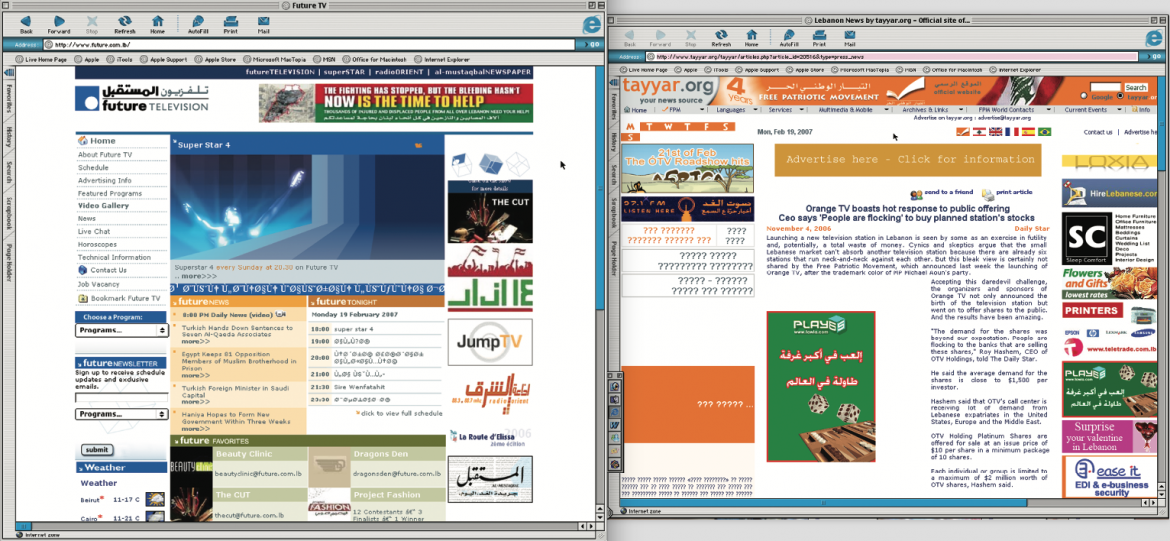
Lebanese TV channels are split between the two respective camps: among major networks, Hizbullah-backed Al Manar TV, the National Broadcasting Network (NBN) and New TV are all pro-opposition, while Future TV and the Lebanese Broadcasting Corporation (LBC) are pro-government.

Although there are more channels critical of the government than pro, in terms of viewership LBC and Future have the lion’s share. The disparity could be minimized, furthermore, if pro-government Murr TV (MTV), which was kicked off the air by the former government in 2002 for criticizing Syria, returns to Lebanese screens.

“Every Lebanese TV channel has a propaganda leaning,” said Habib Battah, managing editor of the Beirut-based Midle East Broadcasters Journal. “Some try to be balanced, but all have their agendas. It’s pretty clear from the content they produce.”

Lebanon’s media has long reflected the country’s political and religious divisions, but sectarianism has become more pronounced following the war between Hizbullah and Israel last year.

“The interesting thing is during the July war the same footage was used on many channels, supporting Hizbullah. So sectarianism has gotten more derisive, more apparent,” said Battah.

Nabil Dajani, a communications professor at the American University of Beirut, agreed that the media are deliberately inflaming sectarianism, but he believes the blame should not lie solely with media outlets.

“You can’t only blame the media—who is behind the media? Politicians. And it’s the government’s fault for allowing the media to get away with it. There is an audiovisual law that prohibits sectarianism, but this government is delinquent and doesn’t step in,” he said.

Propaganda clips

Sectarianism and the trading of political insults are most apparent in news coverage and on talk shows. “An important event or speech will be covered by one set of media, but not by the opposing channels,” observed Battah.

One example was the demonstration on February 14, 2007, attended by hundreds of thousands of Lebanese to mark the second anniversary of the assassination of former Prime Minister Rafik Hariri. Opposition channels gave sparing coverage of the event, while pro-government channels LBC and Future TV gave extensive live coverage. “The media will also use clips taking (political) speeches out of context,” added Battah.

Future TV, owned by Saad Hariri, a member of parliament and the son of the slain former prime minister, and Hizbullah’s Al Manar TV are regarded by Lebanese media observers as particularly sectarian.

“There is intense rivalry between Future and Al Manar, from guests on talk shows to promo propaganda clips,” said Battah.

However, Nadim Munla, chairman and general manager of Future TV, disagreed that the channel is fuelling sectarianism in Lebanon.

“Lebanon is not going through normal times, so to assume or imply international criteria on Lebanese media during abnormal times is unfair,” he said in response to the Media Council’s recent statements. “All of Hassan Nasrallah’s speeches are live on Future, and we have a daily show that sums up all the news channels in Lebanon,” he added.

Moreover, Munla thinks the media council is “hypocritical” to call on TV channels to curb sectarianism, saying the council needs to start with themselves before pointing fingers, as many of its members are involved in the local newspaper market.

“They are political appointees. It is not impartial so I don’t want a lecture on how to do business,” he said.

Nonetheless, he also stated that the media should be at the forefront of change in Lebanon. Indeed, many channels are airing segments aimed at discouraging sectarianism and violence. One such montage on Al Manar showed a clock ticking back from 2007 to 1975, the year the civil war started. Attached to the clock were images from the recent clashes as well as archive footage, ending with the message “Let’s not go back” in Arabic.

A series of adverts encouraging unity around the idea of “I Love Life” have been aired on the pro-government channels, though the organizers of the campaign have stressed that they are an independent civil society gathering. Tensions are not expected to ease any time soon though, with Future TV to launch a 24-hour news channel and Michel Aoun’s party to launch Orange TV (OTV) later this year.

To the Future

Future TV expects to launch its new channel in the next eight to 10 weeks, “unless there are more unseen events,” said Munla.

The new channel is part of a major restructuring at Future, with new content on the entertainment channel and sales directed more at the Gulf region.

“The last pillar of change was to introduce a 24-hour news channel, the main reason being that in the last two years, we allocated more time to cover the news and current affairs,” said Munla.

He said the channel had regularly violated the time allocated to news, which is supposed to be limited to 20% of broadcast time, due to Lebanon’s turbulent politics.

“That affected our viewing base, and adversely affected our entertainment channel, so we will have a 24-hour news channel,” he added.

The new $10 million channel is considered a financial necessity as a result of the July war, with the conflict and the aftermath costing Future over 25% of its project advertising revenue for 2006. By launching the new channel with a state-of-the-art 1,800 m2 studio, Future TV intends to claw back its profits and regional position among the top five networks. Munla said that by the end of the year, Future hopes to return to “pre-recent event levels” and recover its market share by 2008.

News will be primarily Lebanese, but Future will also allocate 20% of coverage to European and Arab affairs, to boost interactivity and understanding between the two regions.

Meanwhile, OTV, the Aounist outlet, is raising funds through a joint stock company open to the public. Starting with a paid-up capital of $2 million, OTV has raised over $10 million via one million $10 shares to establish a terrestrial and satellite channel, and is currently embarking on a regional road show to whip up demand for the remaining shares.

Although OTV claims it will be objective, the channel’s name, recalling the trademark color of Tayyar, and thus the politics of OTV’s mascot, have prompted scepticism among commentators about how neutral it will really be unless there is greater involvement from foreign investors.

Not all bad news

The divergence of opinion on Lebanon’s TV screens may be perceived as fanning the flames of sectarianism and political divergence, but on a practical level, such a kaleidoscope of opinions can also be seen as indicative of a rather healthy, democratic media environment.

“If freedom of expression is measured in how often the opposition is on pro-government stations and vice-versa, we can be considered a highly democratic media industry,” said Munla.

From a certain perspective, Lebanese networks’ relatively open biases may be less dangerous than the illusion of neutrality propagated by channels in other countries. In Lebanon, viewers have the option of getting comprehensive coverage—they just have to watch news broadcasts from both political camps, and remember that the truth lies usually lies somewhere in between.

March 1, 2007 0 comments
0 FacebookTwitterPinterestEmail
Banking & Finance

Earning extra credit A surge in plastic

by Executive Staff March 1, 2007
written by Executive Staff

Plastic is growing in the Middle East with the two leading global brands—Visa (12 million card holders) and MasterCard (undisclosed)—dominating the regional market.

During the 12 months to September 2006, Visa subscribers increased 23%; card sales value rose 22%, while retail sales volume went up 32%. In its results for 2006, MasterCard reported a growth of 46% in issued cards and a 34% increase in value of purchases, to $18 billion, across the South Asia, Middle East and Africa (SAMEA) region.

Denzil Lawson, MasterCard’s general manager for Middle East and Levant, told Executive that as of December 31, 2006, the company’s partner banks had issued 817 million cards for the brand worldwide, an increase of 12.3% over the same period in 2005.

“There is a huge potential for the growth of the payments industry in the region, and we expect that the usage of credit cards will further accelerate as consumers have a greater comfort level about making payments by using their credit cards,” Lawson said.

The United Arab Emirates is a particularly good market for growth in electronic payments. Although it is still a predominantly cash-based society—as are most Middle Eastern countries—it is more mature than others in the GCC in terms of card penetration, acceptance and infrastructure.

But Lawson noted that while the market has shown strong growth, its potential is still relatively untapped with many countries in the region having low card penetration of the banked customer base.

Among recent developments, local governmental bodies in the UAE have shown enthusiasm for automating payments through Visa acceptance—such as the Traffic & Licensing Department, and the Dubai Naturalization and Residency Department E-company.

Dubai eGovernment has teamed up with National Bank of Abu Dhabi (NBAD) to launch a co-branded Visa card that can be used for both eGovernment and day-to-day transactions. The promoters of the service say the new card provides a secure way for both individuals and corporations to conduct e-payment transactions with government departments.

According to MasterCard, the market in the Middle East is receptive to segmentation and this has enabled it to work on some innovative collaborations offering the cardholders card choices and benefits which are meaningful to them.

Ranks of Spending

According to Visa, Saudi Arabia ranks first in Visa card spending in the Middle East followed by the UAE and Kuwait. “GCC cardholders are increasingly taking advantage of the convenience and security of cards for daily shopping,” said Kamran Siddiqi, general manager for Visa International Central and Eastern Europe, Middle East and Africa (CEMEA) in the Middle East.

However, there is a downside. Credit cards can be just too convenient, with many customers forgetting just how punitive card companies can be with late payments. More than one emerging credit market has shown that a rapid rise in credit card market penetration often is followed by serious increases in consumer debt levels and, all too often, defaults.

Credit vs. Debit

The volume of credit card sales in the region is still a drop in the bucket, as MasterCard’s SAMEA turnover of $18 billion demonstrates when compared with the brand’s worldwide transactions, which totaled almost $2 trillion in 2006, generating Gross Dollar Volume (GDV) of $1.9 trillion, an increase of 14.9% over 2005.

“There are is debit card opportunities in Lebanon and Egypt, as well as the opportunity to increase the banked population,” MasterCard’s Lawson said. “Debit cards in the Middle East are predominantly used for ATM transactions. Mature markets see (point-of-sale) growth rates outstripping ATM rates.”

According to statistics provided by Visa International, the ratio of Visa debit card users to credit card users in the GCC is 4 to 1. Statistics also showed that the volume of retail purchase transactions with usage of Visa debit cards is 50% higher than the volume of transactions using credit cards.

That is good news for the card issuers, since credit cards harbor more earnings options and generate better profits to issuers than the debit cards with their remote risk opportunities.

The Visa card business in the UAE has been growing by more than 25% year on year over the last few years, and Visa’s Siddiqi said that by moving away from cash to automated electronic payments, bank deposits are deepened, thereby increasing funds available for commercial loans in the region—a driver of overall economic activity.

“The process also allows for greater transparency and accountability leading to stronger efficiencies and better economic performance,” he said, claiming that Visa’s role is beneficial not only to the financial services sector but also to the economy as a whole. “Recent studies have shown that card payment is a catalyst for economic growth and can help grow a nation’s GDP by 0.5% to 1%,” he added.

Fraud prevention

Although credit card companies are doing all they can to combat illegal activity by introducing chip-and-pin and security numbers, some credit card owners still appear to lose all sense of logic when it comes to giving people confidential information about their cards.

Commenting on fraud, Siddiqi said that Visa takes pride in the fact that the level of fraud associated with Visa card transactions from cards issued in the Middle East is currently one of the lowest in the world.

“This stems from a variety of reasons including the ongoing collective efforts of the industry as a whole. From Visa’s end, we support our member banks with product and technology development and risk management of online payments,” he said, adding that Visa is also actively involved in fraud forums and seminars with both member banks and local enforcement authorities.

“Constant innovation in new technologies such as chip cards also helps to mitigate the level of card fraud risk,” Siddiqi said.

In Lebanon

Economic growth and disposable incomes in the Gulf region are larger than the respective figures in the Levant and North Africa. Between heavily underserved credit card markets such as Egypt or Algeria and the frontrunners in plastic payments in the GCC, Lebanon occupies a position in the middle.

Figures released by Lebanon’s central bank show that the number of credit and debit cards issued at the end of September 2006 reached 1.257 million cards, down 1.9% from the second quarter of 2006, but up 10% on the year.

Banks—especially the retail-focused banks in the top segment of the market such as Audi, Byblos, Fransabank, and Credit Libanais, as well as foreign banks HSBC and Standard Chartered—have ridden the local credit card train in Lebanon for a good while now, building their card programs around the standard parameters of staggered spending limits and special feel-good factors for the wealthiest and most profitable customer groups. But the Lebanese banks have also developed lifestyle cards and co-branded cards that appeal emotionally to air travellers, fashion fans, cigar smokers, compulsive mall goers, or simply central bank employees.

Payment card usage by the resident card holders in Lebanon increased 24.2% to an average monthly amount of $44.4 million in the first nine months of 2006 when compared with the same period in 2005. With an increase of 4.01% to about $850,000 in monthly average, card usage by visitors and non-residents in Lebanon showed much lesser growth last year, hardly surprising in light of the tourism malaise caused by the war last summer.

March 1, 2007 0 comments
0 FacebookTwitterPinterestEmail
Comment

Paris III provides some relief but debt situation still perilous

by Mounir Rached March 1, 2007
written by Mounir Rached

The exuberant Paris III conference provided $7.6 billion in concessional pledging; certainly, a positive outcome as concessional loans—loans with flexible terms for the borrower—are more favorable than market borrowing in terms of debt service cost. The donors pledged $1.3 billion in private sector loans reflecting their concern that the sector has been constrained by stringent high-cost financing. A key issue is how these pledges, when they are realized, will impact government finances.

Taking away the $1.3 billion earmarked for the private sector through the voluntary intermediation of the private domestic banking sector and $750 million in grants, leaves $5.6 billion available for government financing between now and 2011.

Preliminary reports indicate that out of the $5.6 billion, budgetary support (funds not requiring conditionality) is not expected to exceed $1.3 billion. Of remainder of the financing, $4.3 billion will be tied to the donors’ reform package, implying a rise in spending by an equivalent amount to implement the conditions set by donors.

Debt accumulation with Paris III assistance is therefore expected to reach at least $11.8 billion by 2011 to finance the rise in fiscal deficits reflecting the increased capital spending associated with reform (excluding the additional interest payments associated with debt service). As a result, the total debt could rise to $52 billion and the debt ratio to 167% unless a significantly higher growth rate is realized. Alternatively, debt accumulation without Paris III financing was expected to reach $49 billion, 158% of GDP, as a result of cumulative projected deficits over the same period.

Yes, Paris III disbursements may not necessarily mitigate the debt burden and could indeed make it bigger. However, this is still certainly much better than what would be anticipated without the implementation of a reform program, which would see the debt increase to an unsustainable 180%. This highlights the significance of the reform program, and the need for higher grants in the aid package. Privatization and mobile licensing could further enhance the debt outlook through debt write-offs and enhanced growth potential.

Paris III financing, however, provides added benefits: debt maturity structure and debt service will improve in comparison to alternative sources of financing, mainly market borrowing. Further debt diversification by the government—by practically doubling the official debt—would reduce exposure to market pressure, secure better credit rating on international markets and possibly reduce the vulnerability of the banking sector as the government seek recourse to alternative financing.

The tax and expenditure package designed to bring revenue and expenditure to 25% and 27% of GDP respectively by 2011 is also step in the right direction. The higher VAT and higher receipts from Global Income Tax could compensate for the revenue loss resulting from the European Free Trade Agreement (EFTA) sequenced tax reduction—12% annually to be eliminated completely by 2015— on selected imports originating in the EU. However, VAT needs to be streamlined to preclude tax cascading. Most of the gain in expenditure decline could be generated from terminating transfers to EDL, which make up 3.5% of GDP alone.

The tax on interest income earned by residents and non-residents, estimated to raise revenues by 0.5% of GDP, deserves a careful review as it lowers the effective interest rate earned and may lead investors to reconsider keeping their funds in Lebanon.

Other elements in the recovery documents, such as pension reform, are positive and reassuring, but there are governance and accountability concerns in other areas that are themselves issues earmarked for reform. A well-articulated plan with a comprehensive timetable for all reform is needed if a reform plan is to be held up for public accountability.

The main challenge for the government is to proceed rapidly in implementing the proposed reforms with a high priority placed on accountability, governance and transparency. Allowing access and monitoring by independent citizens’ oversight groups is one way to regain public confidence and ensure a credible and effective implementation of reforms.

Dr. Mounir Rached is a senior IMF economist and founding member of the Lebanese Economic Association. The views in this article are those of the author and don’t represent those of the IMF.

March 1, 2007 0 comments
0 FacebookTwitterPinterestEmail
  • 1
  • …
  • 592
  • 593
  • 594
  • 595
  • 596
  • …
  • 687

Latest Cover

About us

Since its first edition emerged on the newsstands in 1999, Executive Magazine has been dedicated to providing its readers with the most up-to-date local and regional business news. Executive is a monthly business magazine that offers readers in-depth analyses on the Lebanese world of commerce, covering all the major sectors – from banking, finance, and insurance to technology, tourism, hospitality, media, and retail.

  • Donate
  • Our Purpose
  • Contact Us

Sign up for our newsletter

    • Facebook
    • Twitter
    • Instagram
    • Linkedin
    • Youtube
    Executive Magazine
    • ISSUES
      • Current Issue
      • Past issues
    • BUSINESS
    • ECONOMICS & POLICY
    • OPINION
    • SPECIAL REPORTS
    • EXECUTIVE TALKS
    • MOVEMENTS
      • Change the image
      • Cannes lions
      • Transparency & accountability
      • ECONOMIC ROADMAP
      • Say No to Corruption
      • The Lebanon media development initiative
      • LPSN Policy Asks
      • Advocating the preservation of deposits
    • JOIN US
      • Join our movement
      • Attend our events
      • Receive updates
      • Connect with us
    • DONATE