• Donate
  • Our Purpose
  • Contact Us
Executive Magazine
  • ISSUES
    • Current Issue
    • Past issues
  • BUSINESS
  • ECONOMICS & POLICY
  • OPINION
  • SPECIAL REPORTS
  • EXECUTIVE TALKS
  • MOVEMENTS
    • Change the image
    • Cannes lions
    • Transparency & accountability
    • ECONOMIC ROADMAP
    • Say No to Corruption
    • The Lebanon media development initiative
    • LPSN Policy Asks
    • Advocating the preservation of deposits
  • JOIN US
    • Join our movement
    • Attend our events
    • Receive updates
    • Connect with us
  • DONATE
Levant

Turkey fishing for property buyers Home-seekers not biting

by Executive Staff January 2, 2007
written by Executive Staff

The number of real estate ads that leap out at you from Turkey’s weekend press testifies to the large supply of quality housing available in Istanbul these days. However, while real estate developers are looking for would-be consumers to take the bait, home-seekers are reluctant to bite.

Housing developers and construction companies point to a slowdown in the market. “Last year was an exceptional period, with a boom in housing sales,” said Teoman Metehan, CEO of Teknik Yapi, a leading construction and residential development company. “This year, there is difficulty in financing projects. In 2005, demand outstripped supply in up-market housing. Now, Turkey’s home-seekers are more sensitive to the price of real estate and weighing their options more carefully. A proliferation of housing development in Istanbul is providing greater choice for would-be home-owners.”

The housing market also felt the brunt of the spike in interest rates in May and June, encouraging families to delay plans to acquire housing loans, leading to a dip in demand for residential units. Now home-seekers are expected to delay their plans once again until the presidential and parliamentary elections have passed in 2007, and consumers feel confident that an extended period of market stability lies ahead, punctuated most importantly by lower interest rates. For Turkey’s yet-to-be legislated mortgage system to take flight, monthly interest rates need to decline to around 1%, insiders say.

“Monthly interest rates increased from 1.1% up to 2.5% after May,” said Yucel Ersoz, the general manager of real estate investment company Yapi Kredi Koray. “Now, they are around 1.7% to 1.8%, which is detrimental to home buying.”

Wishful thinking

Some home-seekers are also hoping for a reduction in real estate prices. A futile wish, observers say. “I don’t see a massive reduction in prices primarily because land is limited,” said Metehan, referring to the struggle of property-searchers to find attractive apartments close to downtown Istanbul. “In such up-market areas as Levent or Etiler, a 120m2 apartment in a 15 to 20 year old building would go for roughly $120,000 to $150,000 in 2000/01, with the same apartment fetching an estimated $250,000 today,” said an industrial insider. At that price, the flat may even require some refinishing and further decoration.

Real estate developers themselves are having increasing difficulty finding plots to develop close enough to the city center. This has not stopped companies from providing homebuyers with a helping hand to reduce the cost of acquiring property. “The vast majority of developers are subsidizing interest rates on loans to provide more favorable borrowing conditions. This is equivalent to a discount, in some cases as much as 20% to 30%,” said Ersoz.

Market analysts say that real estate developers offer these discount rates to register sales even for a smaller profit margin. Such is their desire to liquidate their investments and register a return.

Still, there is cause for optimism for firms in the business. Though construction companies and real estate developers are struggling for a share of the pie in the upper end of the housing market, delayed demand is likely to snowball. Insiders expect demand to be released in 2008 much as it was in 2005 – assuming that interest rates are appropriately low – spurring home-seekers to make new acquisitions.

While Istanbul’s well-heeled property-seekers have no need to hold their breath for the long-anticipated mortgage law, the new legislation will likely play an important role in fuelling a future property boom. The bulk of middle-income earners, who are forced to save, will be the main beneficiaries. Important is the fact that mortgage lending in Turkey counts for as little as 4% of GDP, representing some contrast to 55% for the US and 39% in the Eurozone. With an estimated 600,000 new home-seekers emerging every year, there is little doubt that Turkey’s real estate market has great potential.
January 2, 2007 0 comments
0 FacebookTwitterPinterestEmail
Levant

Opportunity knocks Jordan’s ICT sector booms

by Executive Staff January 2, 2007
written by Executive Staff

Jordan is looking to position itself as the region’s center of information and communications technology (ICT).

In recent years, the ICT sector has taken on an important dimension in the Jordanian economy. The sector is growing by 50% annually; the income it generates represents roughly 10% of GDP and it employs more than 6,000 people. ICT has also benefited from the government’s push to support its development, through easing investment requirements in the industry, enhancing education in information technology and, most importantly from the point of view of overseas ICT firms, passing legislation to protect intellectual property rights.

Since 1999, with the prompting of King Abdullah, the government initiated a campaign to energize the ICT sector in Jordan. Within this period, revenue has jumped from $60 million to more than $500 million, while last year it saw $90 million of direct foreign investment flow in, up from just $3 million six years earlier.

The booming ICT market has opened many new opportunities. Many software developers or designers of equipment have established companies, while many of the industry’s big names, such as Microsoft, Intel, Cisco Systems and France Telecom have also invested in the country.

Amman takes every opportunity to promote its increasing ICT industry and tries to attract overseas investment. The most recent example of this was the fourth ICT Forum, held on December 6 and 7, which focused on Jordan’s position in the region’s ICT sector and its potential for growth.

Pushing forward

Citing both King Abdullah’s ambitious challenge to the government and the private sector, and Jordan’s commitment to building on the sector, Gerri Elliot, the corporate vice president of Microsoft’s Worldwide Public Sector organization, said that Jordan is unique in the way it uses ICT.

“Jordan has the opportunity to become the technological breadbasket of the Middle East,” Elliot said, though he warned the global economy does not wait for anyone.

As part of the push to place Jordan at the heart of the region’s ICT market, the Princess Sumaya University for Technology (PSUT) is establishing a business college, which will work with the university’s ICT business incubator, iPARK, to train professionals and promote entrepreneurial creativity.

“The college, which will be set up in partnership with the Royal Scientific Society, Jordan Telecom, the Higher Council of Science and Technology and the ministry of planning and international cooperation, will enhance PSUT’s focus on academic, research and business-related activities,” said Princess Sumaya, the chairperson of the university’s board of trustees.

Jordan has also been taking its ICT promotion campaign on the road. While on a visit to India in early December, King Abdullah touted Jordan’s ICT potential to Indian business leaders. He stressed that as one of his country’s leading trade partners, India should look closely at investing in joint ICT ventures in Jordan, thus gaining access to international markets via Amman’s free trade agreements with countries, such as the US.

According to Jordanian ICT expert Zeid Nasser, the next stage in Jordan’s ICT revolution is expected to see well-established local firms hook up with regional or international partners.

“It is only natural that after several years of rapid growth, leading players in relatively maturing markets will look to consolidate their positions by partnering up with firms that will provide a competitive edge in the marketplace,” he said in an interview with the local press.

At the community level, the kingdom is working to expand a network of information access centers, mainly bases in poorer regions, to allow Jordanians to acquire ICT skills. Known as Knowledge Stations, the initiative was launched in 2003, and aims at allowing communities to use ICT in their daily lives and to link into the government electronic information system. The initial pilot stations proved so successful that more than 75 centers have been established.

January 2, 2007 0 comments
0 FacebookTwitterPinterestEmail
Levant

Syria: the gloves come off

by Executive Staff January 2, 2007
written by Executive Staff

Syria is looking to build on its already extensive textile sector in an effort to become an increasingly global player in raw materials and processed products.

However, Syria faces numerous difficulties both at home and abroad to lift its cotton production and processed materials output and quality, with massive investments needed to bring them up to international standards and make them competitive in the cut-throat world market.

Syria’s textile and apparel sector accounts for 30% of the country’s industrial employment. While figures for employment levels in the primary production of the main raw material, cotton, are seasonal, they do represent a sizeable proportion of the 25% of those engaged in agriculture.

The government has been pouring money into the cotton and processed materials sectors, improving irrigation for primary producers and spending on new plants to enhance milling, weaving and apparel production.

These efforts have met with some success, with the production of unprocessed cotton seed breaking the one million ton mark, giving 350,000 tons of cotton lint for processing, with the number of ready-made garments turned out topping 55 million, up from 35 million in 2000.

However, downstream industries still suffer from a lack of investment, with local spinning and weaving facilities only able to process 150,000 tons, the balance available for export. This lack of processing capacity has prompted the government to cut back on planting for the coming season, reducing seed cotton production to 900,000 tons for the 2007 harvest.

Gloves come off

The cotton sector has long been given a high level of government protection, with the importation of raw cotton, yarn and fabrics banned except in special cases. At the end of 2005, under international pressure, Damascus agreed to allow imports of cotton-based clothing, though with a near prohibitive 47.5% tariff. Over the past few years, there have been accusations that Syria has been dumping both processed textile products and cotton onto the global market at below cost in order to increase sales and support the industry at home.

Given that the government looks upon the cotton and textile industries as being of strategic importance to the country, the sectors have seen fewer developments in the economic reform program, with most elements, barring the ready to wear segment, still dominated by the state.

However, this too may be set to change. There have been a number of reports in the state-owned media highlighting losses and the drain on the budget. Similar reports have in the past flagged reforms in other sectors of the economy, meaning there could be a shake-up on the way for the textile industry.

The drive by Damascus to modernize and expand the sector, however, may be too late, given that most of the brakes have been taken off China’s massive apparel juggernaut. Clothing and textile producers around the world have been feeling the pressure of competition from cheap Chinese exports after the lowering of trade restrictions.

Stiff competition

Closer to home, Syria has to compete with the well-developed Turkish and Egyptian clothing and fabric production sectors, both of which have built up extensive links in existing markets in Europe and the US, and have modernized their facilities to meet the most up to date trends. Both the growing strength of China in the world’s markets and competition in the country’s neighborhood may explain the reluctance of overseas investors to put money into Syria’s textile industry.

Even with the concerted efforts of the state, Syria managed to boost its export revenue from yarn and cloth by only $2 million in 2005, bringing in a total of $96 million for the year.

However, according to Jamal al-Omar, the director-general of the Syrian Textile Industries’ Establishment, domestic sales showed a significant increase, coming in at $385 million, a 14.5% improvement on the previous year’s figures.

More significantly, al-Omar said that the industry as a whole had managed to turn a profit this year, for the first time in its history, though he added that further support would be required to allow it to compete in overseas markets.

January 2, 2007 0 comments
0 FacebookTwitterPinterestEmail
Comment

War is not the answer

by Claude Salhani January 1, 2007
written by Claude Salhani

When the current political impasse is resolved and the ongoing restoration of Beirut resumes, the Lebanese government – whichever one ends up being in charge – should turn a cluster of the most distressed remaining buildings from the 1975-1990 civil war into a living museum. To hell with the cost.

Somewhere along the Sodeco-Monot axis would be perfect. It would not require much to get such a project underway. Expropriation and some yellow tape, the kind used by police forces around the world to cordon off crime scenes. Come to think of it, yellow tape with the words “crime scene – do not cross” would be ideal to mark part of what was one of the biggest crimes committed in Lebanon’s brief history.

The Ministry of Education should then make it mandatory for all school children from the earliest grades through to baccalaureate to visit the “Civil War Museum” once every year. These visits should be accompanied by a detailed narrative explaining how the country suffered during a war that left much of Lebanon in a state not very dissimilar to the museum.

The object of such an exercise would be to impound into the minds of the Lebanese from an early age just how senseless the war was – and is – and in so doing hopefully plant the seeds among future generations that, as the song goes, war is not the answer.

But, it’s a message that is finding few takers. First there was last summer’s Israeli-Hizbullah war. In its vapor trail we have seen the rising tensions between the Shiites of Hizbullah and Amal and their Christian allies led by retired General Michel Aoun’s Free Patriotic Movement and the Franjieh-led Northern Alliance on the one hand, and the supporters of former Prime Minister Rafik Hariri – the multi-ethnic March 14 movement – on the other. Lebanon finds itself once again in the midst of a dangerous political crisis, the worst since the end of the 1975 civil war. The assassination of 34 year-old Minister of Industry Pierre Gemayel and the simmering street violence also revives the specter of 1975.

(Memo to the Aounists: I am aware that Aoun is not an “ally” of Hizbullah, and that he only has an MOU – a memorandum of understanding – with the organization. But given the fact that the two groups are united in their opposition to Fouad Seniora’s government, it makes him, well … an ally.)

But war won’t happen. It can’t happen. I, like many Lebanese, was there in 1975. I saw Lebanon destroyed one block at a time, one village at a time. It was the work of a people gone mad, a time when logic was replaced by hatred and fear. It was a time when snipers gunned down innocent men, women and even children simply because they lived on the wrong side of town.

The delicate mosaic that comprises the Lebanese political landscape has much changed since 1975 when the divide was clearly between the mostly Muslim west and the Christians in the east. The global landscape is also different. The cold war is over.

In April 1975 the Christian side was exclusively Christian. The other side, typically referred to as Muslim – but which also included Christians – included leftists, communists, Marxists and Palestinian groups. Today, the schism dividing Lebanese society is more political than sectarian, although traditions are hard to abandon and Lebanese political parties remain mostly ethno-religious. There are Christians and Muslims on both sides, the most notable anomaly is the Christian general (retired.) Aoun, who is MOU-ed to the Shiites of Hizbullah.

The hefty Palestinian resistance as a serious military and political force has also disappeared. Many argue that they have been replaced by Hizbullah as the nation’s catalyst for war, but hopes that Hizbullah’s much vaunted discipline will prevail.

Finally, the Christian militias, who called on both Syria and Israel for assistance when outnumbered and out-gunned by the Muslim-leftist alliance, can no longer call on either country.

One would hope that the Lebanese who were there have no stomach for a second round. We now that know there were no winners then, just as we understand there can be no winners now.
Claude Salhani is an international editor and political analyst at United Press International (UPI)

January 1, 2007 0 comments
0 FacebookTwitterPinterestEmail
Comment

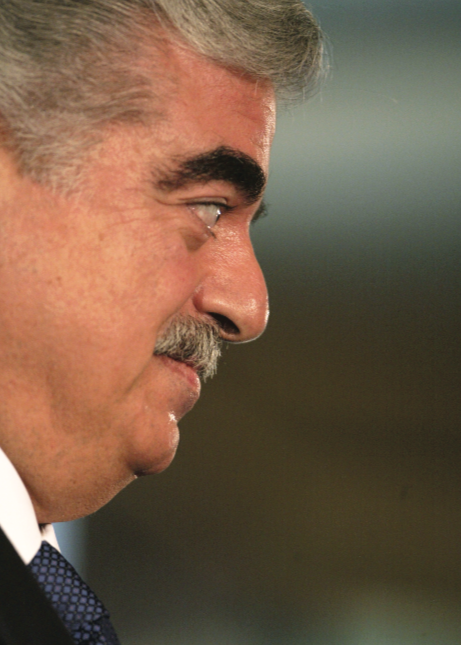
Hariri’s legacy continues

by Nicholas Blanford January 1, 2007
written by Nicholas Blanford

There were few more poignant and telling indicators of the impasse that has befallen Lebanon in the past two years since Rafik Hariri’s assassination than the shuttered shops, restaurants and cafés and empty cobble-stoned streets of the downtown district during this holiday season.

The Solidere-run city center was regarded as the jewel in Hariri’s reconstruction crown, the fulfillment of the former prime minister’s long-standing ambition to restore Beirut’s pre-civil war image as a financial and services entrepot for the Middle East.

But, the legacy Hariri unintentionally bequeathed the nation through his untimely death is not one of a flourishing economy based on tourism and services, but to turn Beirut into the nexus of an ongoing tussle for control of the Middle East, pitting Iran and its allies against the West and its regional partners.

It was clear within hours of the St Valentine’s Day truck bomb that killed Hariri and 22 others in 2005, that Lebanon had been struck by a political earthquake, the shockwaves of which would linger and travel far. His death triggered the mass rallies of the Beirut spring, a cathartic eruption of anger and outrage that led to Syria’s disengagement two months later. The demise of Pax Syriana also meant that Lebanon’s quarreling politicians could no longer resort to the Damascene arbiter, but would have to resolve their own differences.

That inevitably led to deadlock over key issues such as disarming Hizbullah or removing President Emile Lahoud from office. With the Syrians gone, foreign and domestic opponents of Hizbullah redoubled their efforts to have the party disarmed. But, Hizbullah dug in its heels and the party’s new found ally, Nabih Berri, initiated a series of largely futile national dialogue sessions, while Lebanese society became increasingly polarized along sectarian lines.

In the months before his death, Hariri had worked hard on securing a compromise with Sayyed Hassan Nasrallah, Hizbullah’s leader, over the group’s weapons. As long as there was no peace with Israel, Hariri would deflect international pressure to disarm Hizbullah, and in exchange Nasrallah would forego any rash actions that could drag Lebanon into a war with Israel. Hariri understood that Hizbullah was strong enough to resist disarming by force or political persuasion. But he hoped that over time as Hizbullah became more firmly enmeshed in Lebanese politics, it would find that its priority lay with the interests of its Shiite constituents and would no longer heed the siren call of Iran’s clerical rulers.

Hariri’s murder shattered that compromise, however, and although his son Saad attempted to kindle the same warm relationship that his father had enjoyed with Nasrallah, high stakes politics intervened.

While the fate of Hizbullah’s arms was of direct interest to Iran, the United Nations commission tracking Hariri’s killers appeared to pose an existential threat to Syria’s rulers. The commission – the first set up by the UN to investigate a political murder – owes its existence chiefly to the US recognizing that the probe had the potential to bring about a regime change in Damascus with nary a protest from the international community.

The initial progress reports suggested that high-level Syrian officials and their Lebanese allies were behind Hariri’s murder and subsequent reports, although less forthcoming, have indicated no significant change of direction.

The stakes are high. The commission’s mandate expires in June and last month the chief investigator said that the probe was reaching a “sensitive stage”. If indictments are issued against senior Syrian figures it could spell the end of the Assad regime. The administration of US President George W. Bush, contending with disaster in Iraq and uninterested in pushing Israel to resume the Middle East peace process, appears to have recognized the importance of Lebanon in shaping the future direction of the region. The Iraq Survey Group’s recommendation to engage with Iran and Syria is being ignored by the White House. Bush appears to be betting on the UN commission accusing senior Syrian officials to help cripple the recalcitrant regime in Damascus, thus saving him the ignominy of having to approach Assad to help sort out Iraq.

If Assad’s top security lieutenants are indicted and the regime falls as a result, with a new Western-friendly administration taking over, it will have serious repercussions for Iran and Hizbullah, Syria’s principal allies in the anti-Western alliance. Syria plays a crucial role as Iran’s only Arab ally and as the geo-strategic linchpin connecting Iran to its Lebanese protégé, Hizbullah.

The anti-Western alliance will inevitably collapse into its constituent parts without the glue binding them that is Syria. Hizbullah will find itself isolated and struggling to resist calls to disarm, and Iran’s ability to project itself on the Arab-Israeli conflict will be weakened. Iraq and the Palestinians will also feel the effect of a change of regime in Iraq.

The events of this year may yet prove that in death Hariri will have had a far greater impact on the Middle East than he ever could have had in life.
 

Nicholas Blanford is a Beirut-based journalist and author of Killing Mr Lebanon: The Assassination of Rafik Al Harriri and its Impact on the Middle East

January 1, 2007 0 comments
0 FacebookTwitterPinterestEmail
Comment

Learning a thing or two from Qatar

by Norbert Schiller January 1, 2007
written by Norbert Schiller

Twenty years ago, I arrived at an airport in the middle of a desert peninsula in the Persian Gulf. The arrival hall was basic, not one to remember, and the duty free consisted of one room with items piled up on the floor. The passport control officers were unfriendly and the customs agents scrutinized every item of luggage. As I remember, there were only one or two decent hotels and little traffic on the road.

Qatar was engaged in a wasteful, low-intensity war with Bahrain over a few patches of sand in the sea. My first thought was why the Qataris can’t learn a thing or two from Dubai, which was in the birth pangs of a historic economic revolution.

Ten years later, I arrived in Qatar again, this time invited by the ministry of tourism to attend the country’s first ever tourism festival. I was met at the airport by a polite representative from the company hired to showcase Qatar’s tourism potential. The streets were new and had been planted with trees to break the monotony of the desert landscape. The group included a German designer with a posse of stunning Polish models. He told me that this is the new frontier in fashion. “I’m here to get into the market before anyone else,” he confided. I was still not convinced.

A decade later, Qatar launched its latest campaign, one that was seen on television stations around the globe: “Proud Sponsors of the 15th Asian Games … The Games of Your Life.” One would have had to be living in a monastery not to have seen it. I was surprised and impressed by Qatar’s aggressive approach. Then came the phone call asking me to cover the games. Qatar and I were hooking up again.

At the end of November, I once again landed in Doha and like everyone involved with the games – athletes, organizers and journalists – was ushered into a private terminal, greeted by a member of the games’ organizing committee. I was given accreditation, put on a bus and shuttled to an apartment complex, which would be my home for the next 15 days. I was also given meal cards, a locker key and a bagful of souvenirs. Buses to the various sporting venues ran like Swiss (or Japanese) watches and as a photographer, my access to each event was planned with precision.

Never in all my 25 years of covering the Middle East and Africa as a photographer had I seen such meticulous organization. The Qatari’s had retained the international know-how of the people who brought us the Sydney Olympics to ensure these games were the best ever.

Twenty years ago, or even ten years for that matter, I would have never imagined that Qatar, built on a peninsula of sand, could have pulled-off such an extravaganza. During the 15 days a total of 13,000 athletes from 39 countries competed in 45 disciplines. There were 1,700 journalists – 400 of whom were photographers – on the ground, covering the games. The Qataris had also hired hundreds of Indian computer engineers to patiently attend to our technical needs. They worked quickly and efficiently and did not get flustered. It was yet another example of the professionalism that underscored this event and proof of what can be done with vision.

Granted, Qatar had the money to blow and will have made a loss (attendance at most venues over the 15 days was far from bulging). But what a loss-leader! Yes, there were rumors that tickets were purchased well in advance by the ruler and given to students (schools were closed during the games) and guests so that the stands would look full for the TV cameras. Nevertheless, there was energy and a will to make these games the catalyst and benchmark for future sporting events. It’s no secret that Qatar wants to host the Summer Olympic Games in 2016 – even though it might be a tad hot.

Lebanon, my erstwhile home, has been given the honor of hosting the 2009 Asian Winter Games. It offers yet another opportunity for Lebanon to take center stage and showcase its own diversity. But for the Winter Games to be successful, Lebanon will have to put away its divisions and learn a thing or two about unity and brotherhood by watching how athletes from different countries with different beliefs can come together in competition.

As for Qatar, well it knew where its priorities lay. The barren peninsula has become an example of what the Middle East can achieve. Qatar had demonstrated it is a global player. It had arrived. It made its choice and is beat the drum of economic progress. It has chosen investment over conflict and growth over blinkered ideological stagnation.

And don’t write them off as hosts for a summer Olympics. They will surely find a way around the heat.

Norbert Schiller is a photographer/editor. He covered the 2006 Asian Games for UPI

January 1, 2007 0 comments
0 FacebookTwitterPinterestEmail
Comment

Bush’s Middle East mission

by Lee Smith January 1, 2007
written by Lee Smith

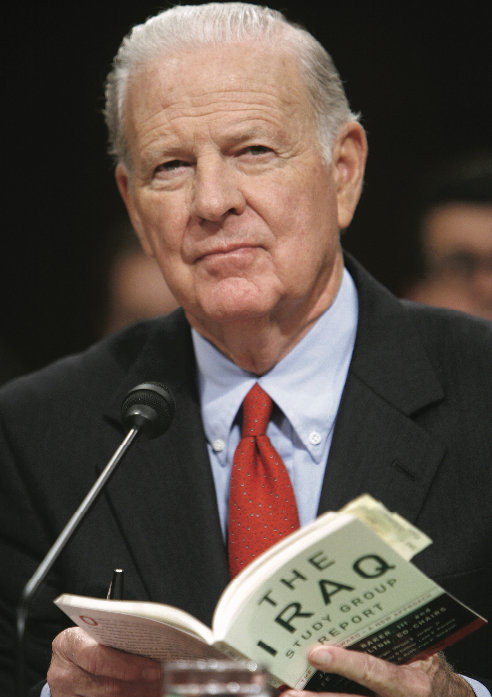
As every upper level manager knows, you bring the consultants in to buy you some peace and quiet with the shareholders while you’re deciding whether the buy-out clause in your contract turns out to be more lucrative than the year-end bonus. So why did George W. Bush, the Harvard Business School-educated CEO of the United States of America, let the consultants get all the headlines? After the mid-term elections, all anyone could talk about in Washington was the Baker-Hamilton Iraq Study Group.

Leaks from the ISG provided the press with plenty of cannon fodder, as conservative publications went on the offensive against Baker, the man who handed Lebanon over to Damascus, and let Saddam stay in power to become the symbol of anti-Americanism in the region. White House critics on the other hand called it the end of the Neoconservative project in the Middle East, a return to a “mature” Middle East policy, managed by the Bush family’s long-time fixer. Savvy insiders wondered if the formation of the bi-partisan group was some clever plan of the president’s to make the Democrats equally culpable for the meltdown in Iraq. And everyone wanted to know if the study was likely to become the blueprint for American foreign policy.

In the end of course, it was all much ado about nothing, as Bush acted like a proper CEO and tossed the report in the garbage. Jim Baker shouldn’t give up his day job, one White House wag remarked, putting an end to weeks of speculation: the President still makes American foreign policy. And yet after the Democrats won both houses of Congress, and polls show an American public increasingly dissatisfied with Bush’s Iraq strategy, the major question still lingers: what is this president’s foreign policy?

Bush’s legacy rests entirely on Iraq. The problem is that it is precisely this large Arab state that is preventing the White House from seeing how much the ground has shifted during the last four years, partly due to Iraq itself, but largely just because the region is always highly volatile.

After September 11 the Americans were mad at the Sunnis, especially Saudi Arabia. It was Riyadh after all who had provided, unwittingly or not, much of the staffing and financing for the largest terror attack in history. Part of the idea then behind the invasion of Iraq was to rearrange the regional balance, thereby empowering the Shia. But four years after the fall of Saddam’s regime, the US’ major problem in the region is not Sunni jihadism, but the Islamic Republic of Iran. Tehran is at war with the US, and is fighting American allies, interests and troops throughout the region.

The key to understanding this new regional alignment of course is not Iraq, but Lebanon. Israel’s war against Hizbullah drew the lines very clearly, and now Jerusalem is reportedly offering the Saudis a chance to re-affirm the casual alliance contracted during this past summer. Ehud Olmert intends to meet with Saudi officials to kick-start the moribund peace process. Does that mean that a comprehensive peace deal between the Israelis and Palestinians is finally in the offing? Of course not. The point of the exercise is to take the Palestinian file away from Hamas’ Iranian and Syrian sponsors and return it to the Sunnis.

So, if Israel and the traditional Sunni regimes have lined up under Washington’s umbrella, why doesn’t the US know it? Because of Iraq. If the White House sides with the Sunnis, the Shia will make it impossible for US troops there. And thus, the White House is caught in a strange bind – it knows that pro-Sunni policies in the rest of the Middle East will affect its standing in Iraq, but cannot yet admit it is impossible to detach Iraq policy from a larger strategic vision.

And it’s not just the administration that’s stuck; the Baker Study Group is the clearest manifestation of this confusion about the region. James Baker is as close to the Saudis as any other living American and the Saudis obviously do not want the US to engage Syria and Iran. And here he is putting forth advice – withdrawal from Iraq to leave the Sunnis at the mercy of the Shia, while “talking” with Iran and Syria – which would undermine an ally whose vital interests, at least in this case, are perfectly in line with Washington’s: to maintain the position of the US in the Persian Gulf.

The fact is that the Bush administration, its critics and enemies have greatly misunderstood the nature of American power. Remember that Osama Bin Laden said the US was a “paper tiger” because it was flushed out of Vietnam, Beirut, Somalia, etc., and hence Bush says he will not “cut and run.” So what is next? To prove to an obscurantist fanatic like Bin Laden that it is the earth that revolves around the sun and not the other way around?

It is easy to see how the US has failed in Iraq, and it is equally easy to forget the degree of difficulty involved. In a matter of months, the US brought down two troublesome Middle Eastern regimes, and only a country as rich and powerful, capricious and arrogant as America could afford to believe it was in the interest of the world to democratize these places as well. That 150,000 US troops and scores of American diplomats could not bring Jefferson to the land of the two rivers describes the limits of a missionary vocation, not power. So, what is the point in saving Iraq if it costs Washington the world – or worse, American hegemony in the Persian Gulf? 

Lee Smith is Hudson Institute visiting fellow and reporter on Middle East affairs

January 1, 2007 0 comments
0 FacebookTwitterPinterestEmail
Consumer Society

Regional retail boom counting on luxury

by Executive Staff January 1, 2007
written by Executive Staff

After several years of sluggish turnover, the global luxury industry roared into life in 2006, with worldwide sales reaching a hefty $150 billion. A testament to the industry’s revival is the number of flagship stores spawning around the globe from such über brands as Louis Vuitton, Chanel, Hermes and Gucci.

By 2010, the Middle East luxury market potential is expected to hit the $100 billion mark as Gucci, Chanel et al make headway into the demand-filled region through local franchisers and retailers. Department stores, including Saks Fifth Avenue and Harvey Nichols, are also opening outlets in the region. In Dubai, Harvey Nichols opened a three storey, 12,500 square-meter store in the Mall of the Emirates, their biggest store outside London. With oil revenues and a growing population, the luxury Arab market has a seemingly insatiable appetite.

Global vision

Enter the Middle East Luxury Group (MELG). Established in 2005, the company is hoping to reap the rewards of this exciting market trend, especially when considering that 40% of all haute couture clients are Arabs. The group, which expects yearly sales of $80 million, believes it is revolutionizing the luxury industry.

“What we are actually providing here is a unified concept in luxury, encompassing everything from clothing to eateries, media and hotel businesses, and we are forcing others to keep up with this trend,” explained Elias Abi Khaled, MELG’s CEO.

The man behind MELG, Bahij Abou Hamzi, who made his name in telecom with his Global and Liban Call services, has so far invested $25 million in Beirut through his company. “The owner’s strong network base gave us contracts with popular brand names,” said Abi Khaled.

MELG’s media arm includes Fashion TV Arabia and Avenue, a fashion magazine that is currently preparing its first issue. The luxury retail activity consists of 13 exclusive brands and multi-brand stores, including Gianfranco Ferre, Vicini, IT, M for Missoni, Exte, and Just Cavalli. The group has also dipped its toes in the hospitality sector with the 109 Café.

“The MELG vision is of a global nature, as we treat the various fashion interrelated activities as one, with complementary functions interacting for the benefit of the whole entity,” explained Abi Khaled, adding that the group intends to expand its line of products and services to eventually include a luxury hotel.

At the moment, MELG employs 150 people and is expected to grow by 100 more within a year, an indication of the group’s aggressive expansion plan. Outlets are scheduled to open in Kuwait, UAE and Bahrain within a year, as well as stores scheduled to open in Qatar, KSA, Egypt and Jordan.

Unique approach

“We avoid franchising for obvious profitability concerns,” says Abi Khaled. “Opening our own points of sales underlines our concern for quality. Each outlet conveys the image of the MELG and we control every aspect of the service.”

Boasting a varied product base within its retail activity, MELG had to face conflicting interests in certain markets, where local exclusivity contracts preempted the company’s representation. As a direct consequence, MELG does not carry a uniformed basket of goods over the region. “Certain brands, including Versace Jeans Couture, Galliano, GF Ferre and Plein Sud, are however available through our multi-brand store,” said Abi Khaled, adding that “within the retail line of activity, outlets are all serviced by the Beirut purchasing platform, as it remains, after all, the fashion capital of the Middle East.”

Abi Khaled believes MELG to be currently among the top five luxury retail companies in the country (the group’s competitors are the El Tayyer group, Villa Moda and Chalhoub) but expects the group to eventually be the only one with an effective regional presence in the Middle East and GCC areas.

“Our goal is to establish a regional identity, which is built through a strong presence in most markets in the Levant and GCC areas,” he said. However, because MELG was first launched in Lebanon, the marketing campaign was kept on hold because of political unrest. “For other countries, one main marketing theme is adopted, which takes into consideration local cultural differences and is adapted to each country individually using TV, print and the group’s monthly fashion magazine, as well as other specialized shows and events.
 

January 1, 2007 0 comments
0 FacebookTwitterPinterestEmail
Editorial

Tailoring a dream

by Yasser Akkaoui January 1, 2007
written by Yasser Akkaoui

Qatar can look on its hosting of the recent Asian games as a job well done. But the Genesis of the nation’s rise to prominence from being a Gulf backwater is predicated on a vision in which it deliberately chose to differentiate itself from its glitzy neighbor Dubai and Singapore, with its thick seam of Asian diligence.

Where would be the value-added in duplicating a wining formula? Qatar finally chose education and excellence among its new set of core values. Sport and the locally-initiated Aspire campaign – launched through the prism of the Asian games – represents the latter of these values, while Doha is now a hub for foreign campuses of some of the finest international names in education like Cornell and Carnegie Mellon.

Elsewhere, the GCC real estate boom is in full swing and stretching its network across the region. This presents new challenges to those developers who are used to creating from scratch in desert expanses – a la the compound culture from which it could be argued this formula sprung. The nations of the Levant and North Africa are going concerns and any mega developments will need to embrace the cultural, social and ethnic mores of these countries. Citizens – like the SIMs in the SimCity computer game – cannot be imported like the eager westerners brought into the GCC.

But let us not forget that as the second anniversary of the assassination of Rafic Hariri draws near, that he was the granddaddy of these mega projects. Hariri, like the visionary gulf rulers, was weaned on the GCC experience and was imbued with the idea of developing a dream that he could export to Lebanon. The Beirut Central District, the Dbaye Marina and the now Rafic Hariri International Airport were the examples he set and now his template is being rolled out across Jordan and the UAE.

That Lebanon has fallen behind is more to do with its erractic political dynamic. The governments of North Africa, not to mention Syria and Jordan, can execute these projects because the central government can directly control their implementation, by fast tracking laws that directly affect the economic good.

Sadly, in the Middle East, you still need absolute power to get absolute results.

January 1, 2007 0 comments
0 FacebookTwitterPinterestEmail
Lebanon

Pioneering Real Estate

by Executive Staff January 1, 2007
written by Executive Staff

As many developers and investors eyed the Lebanese real estate market cautiously at the start of 2007, Bassil Real Estate Developers (BREI) attracted significant local and regional attention for moving forward with new projects despite political uncertainty. Last month, BREI formally unveiled plans for the seventh edition of its luxury Convivium brand, a $15 million venture with leading Kuwaiti asset management and investment banking organization MARKAZ.

The new ‘it’ neighborhood

With a total development area of 12,000m2, Convivium VII, which will be built in the Badaro area of Beirut, marks the brand’s first departure from the Gemaizeh neighborhood, where Convivium I-III are located and IV-VI are at various stages of completion. In fact, BREI was among the first companies to recognize Gemaizeh’s potential: now, as the company shifts its gaze to Badaro, many people are beginning to speculate as to whether BREI might be, once again, ahead of the crowd. Is Badaro Beirut’s next ‘it’ neighborhood?

According to Patrick Geammal, general manager of Ascot Real Estate in Beirut, Badaro’s potential is enormous. “Karim [Bassil, BREI’s CEO ] is a pioneer to have thought of the area. He’s always a pioneer,” noted Geammal, who believes that BREI’s venture will mark the first step in the development of Badaro. Three to five years from now, he predicts, the neighborhood will be on every developer’s list.

Badaro’s potential, explains Geammal, is built on three factors: its geographic location, its relative affordability, and its pleasant tree-lined mixed-use character.

On the first count, Geammal observed that “Badaro has all the geographic components for success: it is the crossway of Beirut. It’s just minutes from Verdun, Hazmieh or downtown. But it’s also right by Ashrafieh.” Proximity to Ashrafieh leads into Badaro’s second cachet: affordability.

As Ashrafieh and Sodeco have become increasingly expensive (and, to put it simply, full – there is little undeveloped land in the area), people have begun to look elsewhere for residential property. At present, prices per square meter in Badaro range from around $800 to $1,300; in Ashrafieh, average prices for new build are around $2,200/ m2. “In the future, Badaro will simply be a continuation of Ashrafieh,” predicted Geammal. “It’s already starting to emerge as an option: people realize they can get a bigger house on a smaller budget. It’s a normal extension of the market.”

In demand

This effect has already been seen in Sioufi, a residential neighborhood on Ashrafieh’s eastern edge that has seen a boom in recent years. However, Geammal believes Badaro will quickly outstrip Sioufi as the best Ashrafieh alternative. While Sioufi is almost exclusively residential, lacking commercial facilities, Badaro is mixed-use, housing residences, offices and numerous shops, banks and restaurants. Badaro also offers something rarely found in Beirut: an abundance of trees and greenery.

“Badaro gives the impression of Rabieh, but it’s just a bridge away from the BCD,” noted Geammal. “It’s a very interesting spot.”

BREI certainly thought so. The Convivium VII project was tentatively drawn up several months before the four plots in Badaro were bought in October 2006. “It’s a great location, and it goes perfectly with our concept. With the Convivium brand, we don’t want to be everywhere – we only consider places that match the brand’s identity, which means a very specific urban environment,” explained Rania Tueini, marketing and communications manager. The two-building residential project, which will be ideally-situated between the museum and the hippodrome, also includes its own 120-meter-long private garden, which Tueini cites as a way of blending the development in with the neighborhood (one of Convivium’s trademarks). So far, response has been positive: BREI policy demands that 20% of units be sold before any project is launched, to confirm sufficient demand. Construction has yet to begin, and Convivium VII was only just announced – but 35% of available units have already been snatched up by eager buyers.

Say you read it here first.


January 1, 2007 0 comments
0 FacebookTwitterPinterestEmail
  • 1
  • …
  • 601
  • 602
  • 603
  • 604
  • 605
  • …
  • 686

Latest Cover

About us

Since its first edition emerged on the newsstands in 1999, Executive Magazine has been dedicated to providing its readers with the most up-to-date local and regional business news. Executive is a monthly business magazine that offers readers in-depth analyses on the Lebanese world of commerce, covering all the major sectors – from banking, finance, and insurance to technology, tourism, hospitality, media, and retail.

  • Donate
  • Our Purpose
  • Contact Us

Sign up for our newsletter

    • Facebook
    • Twitter
    • Instagram
    • Linkedin
    • Youtube
    Executive Magazine
    • ISSUES
      • Current Issue
      • Past issues
    • BUSINESS
    • ECONOMICS & POLICY
    • OPINION
    • SPECIAL REPORTS
    • EXECUTIVE TALKS
    • MOVEMENTS
      • Change the image
      • Cannes lions
      • Transparency & accountability
      • ECONOMIC ROADMAP
      • Say No to Corruption
      • The Lebanon media development initiative
      • LPSN Policy Asks
      • Advocating the preservation of deposits
    • JOIN US
      • Join our movement
      • Attend our events
      • Receive updates
      • Connect with us
    • DONATE