
Sizing up an economic sector where few reliable statistics are available is never an easy task. When it comes to real estate though, it can be an even more frustrating endeavour given that the force of rumour and speculation often drowns out the relative paucity of regularly reported, objective indicators.
“Booming Properties,” “Lebanese Real Estate on the Verge of a Boom” … “Boom Time Underway” – these are the headlines that crown the public consciousness, even after the “operational pause” of the post-February 14 period.
Indeed, over the past year, the local press has seen so much “Boom,” that one could easily get the impression that the real estate market as a whole is, well, booming across the entire country.
While this may be true for luxury residential and tourism projects, when it comes to office space in Beirut, the reality on the ground is far removed from the over-generalized, over-hyped headlines: Office space has been, and still is, the soft underbelly, the (literally) half-empty core of Beirut’s so-called real estate revival.
And it is this fact, above several other competing indicators, which provides yet another powerful indicator of Lebanon’s deeply rooted economic woes.
“The residential market bottomed out two years ago and is in a phase of expansion while the retail sector is at the latter end of bottoming out,” explained Karim Salameh, who heads up Lebanon’s Eagle One real estate investment fund that was the first, and still only such fund to invest in performing (i.e. already tenanted) office space.
“But the commercial real estate market in Lebanon, from the office market perspective, is still bottoming out due to an oversupply and the lack of vibrant economic activity that would fill that supply fast enough.”
According to Raja Makarem, managing partner for the real estate advisor group RAMCO, Salameh’s overall estimation is right on target.
“There is a great demand for residential projects but we do not see the same demand for office space…Really there is very little demand at the time being.”
According to Makarem, even as prices have dropped precipitously since Solidere began offering its large stock of centrally located, modern office space, demand has failed to pick up mainly because of that all too familiar Lebanese bogeyman: Politics.
“You did have a large amount of office space that came onto the market in Solidere, so prices dropped…from $450 per meter squared to sometimes as low as $150 in some of the top locations. But it is the political climate of the country that has prevented international companies from coming here and taking up the office space that does exists. That’s the big problem”
Of course, as with many aspects of Lebanon’s political-economy, such is not the case in other competing environs of the Middle East.
In fact, in mid-June, Reem Al Mahmood, the general manager of the Dubai International Financial Center (DIFC), told the El Etihad newspaper that the Center had already inked tenancy deals with 41 multi-national financial firms, including heavyweights like Bear Sterns, Merrill Lynch, Standard Chartered Bank, Credit Suisse and Barclays Capital.
More to the point: Fifty companies were awaiting licenses to take up space in the 4 million square feet development, (of which 65% is greenery)
While there are the obvious bright spots in Lebanon mainly centered around Solidere – more than 35 banks, 500 firms and a number of notable multinational companies are already located in the BCD – oft-quoted surveys that suggest Beirut is at the head of the high-end office market in the region fail to really capture the underlying dynamic that characterizes the sector as whole in the city.
“In absolute terms,” explained Michael Dunn of Michael Dunn & Co, “We do not have expensive office space. In London, [office] rents cost approximately $1,200 per meter squared per annum compared to Beirut which is at $250.
“Dubai,” he continued, “is almost double the cost of Beirut and I know that Kuwait has recently seen some big growth.”
Of course, even the $250 figure, which does not include the overall occupancy costs of taxes etc, is deceiving since that figure mostly applies to the best Solidere buildings like An Nahar and Atrium and the few other high-end office developments, like Gefinor in Hamra, that have relatively modern infrastructure (mainly parking, a large floor plate, fire control and telecommunications) to attract and retain major anchor tenants.
“In the old commercial centers of Beirut, in Sin e Fil and Hamra for example,” said Makarem, “where you saw quite a bit of migration when Solidere came with its new stock, most of this old stock is now rented as it was before the War.
“This means,” he added pointedly, “that rents are sometimes as low as $20-30 dollars per meter squared per year.
Not surprisingly under the circumstances, few owners see fit to refurbish their old office stock.
And because pre-1992 leases are set in depreciated Lebanese Pounds, many tenants of office space, even if their company is no longer operational, decide to hold onto their leases, paying, in effect, peanuts each year for tenancy rights.
The vicious cycle means that although occupancy rates may be high in Beirut, the true occupancy rate, as measured by tenanted space and not just rented space, is exerting a significant, market-distorting drag on the economy.
“I can assure you that nothing in Lebanon is 90 percent occupied… An [occupancy] figure more like 55 or 60 percent may, may seem appropriate,” said Salahme.
“Some owners of empty buildings are non-Lebanese who are ill advised,” he explained. “But the main problem is that some tenants, in Hamra for example, date back to the 1960s. Because of the structure of the contracts, these buildings are not attractive investments – the yield is low and it is not possible to evict current tenants.”
On top of all this, some building owners also intentionally keep buildings unoccupied in the hopes of holding out for better rents down the line.
Although, on its face, such a strategy might seem ill-advised, according to Salameh there is generally little rush to enter an already depressed marketplace because many owners are free from the pressures of debt financing arrangements
“Ownership of real estate was not traditionally debt financed so there is little pressure by banks and others to rent out a building.
“You know the American adage,” he added, “that time is money? Well that’s not true here. Its an inefficient marketplace that is also not transparent insofar as sharing information about rentals or having mechanisms for trading properties.”
For Diab Chidiac, fund manager at Middle East Capital Group, all of these complications amount to a clear strategic imperative: Steer clear of investing in office space.
“We are staying out of the office market for now… We just don’t see that there is a real demand because of the slowdown in the economy over the last ten years really.
“There is demand in Solidere,” he added, noting the estimated 350,000 plus square meters of office space already built by the company and the 1.58 million square meters of total office space that will eventually be built out across the BCD. “But it is for a limited amount of modern office space; the demand is just not big enough to allow you to do a fund.”
And indeed, even as bank BEMO announces an HQ projects downtown, and prime buildings like Atrium and Starco near 100 percent capacity, the reality is that across the whole of Solidere, the office occupancy rate stands at just 65 percent.
Although, according to Makarem, that figure has risen by about five percent since the last time his company conducted a survey almost a year and a half ago, the old list of major unoccupied sites hasn’t changed significantly in the intervening months. In fact, of the top 25 largest unoccupied buildings in the BCD, at least 18 still remain unoccupied, representing almost 43,000 square meters of space.
So even though many observers were pleasantly surprised when the initial occupancy rate of almost 60 percent in Solidere was first published, looking back now the figure seems to stand as a sobering reminder of just how far the sector, and Lebanon as whole, must go in order to rebuild the country’s economy.
“Multinationals are just not rushing to Beirut,” said one prominent local economist who asked to remain anonymous.
“And, as we all know, we don’t have a modern set of laws and practices governing the sector… we don’t even have a modern set of indicators which are vital for a functioning market. Add to that the significant economic problems that exist here and you can understand why the office market is underperforming.”
A most fundamental characteristic of speculative gain is that it goes away as smoothly as it comes. So whenever it’s very easy to make money, one must be reconciled to the possibility that it can be lost without much effort or notice. Nowhere is this truer today than in the Gulf stock markets. For just over two years, while most global markets have been mired in single digit action and the tensions in Iraq continued, very few would have bet on a massive rise in the fairly underdeveloped markets of the Gulf. Yet, this is exactly what has occurred. The stock markets of the region have witnessed staggering rises, bringing with them a whole slew of new issues. What fueled the rise and what lies ahead?
The simple truth about Gulf stock markets is that oil has gone from below $10 per barrel in the last couple of years of the 20th century to near $60 per barrel today. This has created a tidal wave of petrodollar-driven liquidity in the coffers of Gulf governments. A recent study by Saudi Arabian Monetary Agency (SAMA) reinforces this notion. The premise of the report shows how domestic spending of “high-powered money” (net domestic expenditure from oil revenues) can create liquidity several times its size (the multiplier effect), demonstrating that, in Saudi Arabia, each new oil riyal of government spending has the power to create up to SAR 16.6, or over sixteen times in additional liquidity. Between 2002 and 2004, net government spending totaled approximately SAR 575 billion, which have had the potential to generate new liquidity up to SAR 10 trillion.
When analyzing this precept, it becomes more comprehendible why GCC markets have spearheaded the world in terms of market growth. Liquidity injected into value creating businesses will raise values in the long term but in the short term inflates and accentuates stock prices.
This scenario has been replayed in the UAE, Saudi, and Qatar. But what stands to be the determinant of how market value will adjust lies in the sustainability of earnings growth, which is set to be put to test in the third and forth quarters of 2005.
As the post 9/11 environment dictated less investments abroad and more cash staying in the region, investors, both sophisticates and neophytes, rushed into stocks. Institutions were only happy to oblige by floating a staggering number of companies. It would be too complex to review the suitability of all Initial Public Offerings (IPOs), suffice it to say that not all the companies that went public would have passed the scrutiny in a more mature market, such as Europe.
The move up in the Gulf IPOs started to resemble, in many aspects the Nasdaq mania of the year 2000, prior to the crash. Shares would double and even triple in the days following the float, and soon, everyone wanted in on the action, so much so that central banks in the region have had to step up oversight, as many financial institutions began lending to speculators, often with reckless abandon. During the float of a large telecom company for instance, it is said that a couple of mega banks lent billions to its most exclusive clients so they could “play”. This environment has led to overvalued markets, trading at well above their acceptable valuation parameters, and pricing themselves in what will eventually prove to be unrealistically ambitious expectations.
These expectations were further boosted by solid earnings growth by listed companies of over 40% in 2004 with even more robust figures for the first quarter of 2005. Still, a few shady outfits which have found their way on to the public market are trading at 500 times actual earnings. The UAE market, for instance, has gained 86 per cent so far this year. There are, however, question marks over its sustainability and it has been particularly exacerbated by violations in the primary market. Market observers have described the extent of over subscriptions in the local IPOs as “obscene,” prompting the Central Bank to act with unprecedented toughness.
In the case of the record-breaking Aabar petroleum IPO, the total cost per share was Dh5, out of which only one dirham went to the issuing company while Dh4 each was pocketed by the banks that financed the stock applications. This is quite unnatural by any standards. Although markets are generally irrational, they do have checks and balances that ultimately correct blatantly unnatural tendencies. It seems the time has come for these resistance mechanisms to come into play. There are already signs that the party in the stock market may be winding up. A four-day correction on the UAE stock exchange last month wiped off 13 per cent of the market value in one stretch.
There is almost too much public excitement and participation, and this creates a bubble environment. Many newcomers to the “game” will still crow that there is easy money to be made in the area. This attitude is a sure sign that at least some Gulf stock markets are entering bubble zone. There simply isn’t enough institutional money in the form of pension funds and the like, as is the case in developed markets, to sustain them in the medium-to-long term.
The Gulf markets have two major problems in my opinion. One is that they are too dependent on one commodity: oil. The other is that the fundamentals, especially in Saudi, are well behind the market euphoria. Whereas disposable incomes, on aggregate, are rising in the UAE, they are near $25,000/capita, they are stagnant in other countries. Saudi, in part due to Saddam, has seen its per capita income drop to $10,000. So there is not, as in Europe and Asia a well-developed Equity Culture, it is mainly, for now a speculative arena.
The growth in the Gulf is also too closely tied to oil, and while Saudi Arabia has made great progress in solidifying its non-oil activity, it is still mainly a one horse race. This poses great risks if the global economy, especially China decelerates, and oil crashes back into the $25-30 per barrel range, as stock markets will suffer greatly. The two most obvious factors in play in Gulf markets today, and the two most regularly cited as being the main driving forces behind the three-year rally in stock prices, are high oil prices, and low interest rates. The prolonged incidence of both factors has had a magnified effect on equity markets of the region, and is currently most pronounced in the markets of the UAE and Saudi Arabia.
The two seem to have priced in the permanence of both factors. A marked reversal of either one or both those factors would almost definitely have an adverse effect on the markets. In fact, interest rates today are no longer abnormally low, as they have tripled from their all time lows, and are higher today than their pre-9/11 levels. They are generally expected to gain a further percentage point by current year-end. This fact has yet to be reflected in the two markets. Oil prices on the other remain buoyant, although they have recently come down from their peak in April. The direction that oil prices may take from here is harder to predict, and analysts are mixed in their expectations. If the more pessimistic of them are proven right, then a steep correction may prove inevitable. The medium-term direction of interest rates is a foregone conclusion. Keep your eyes on oil.
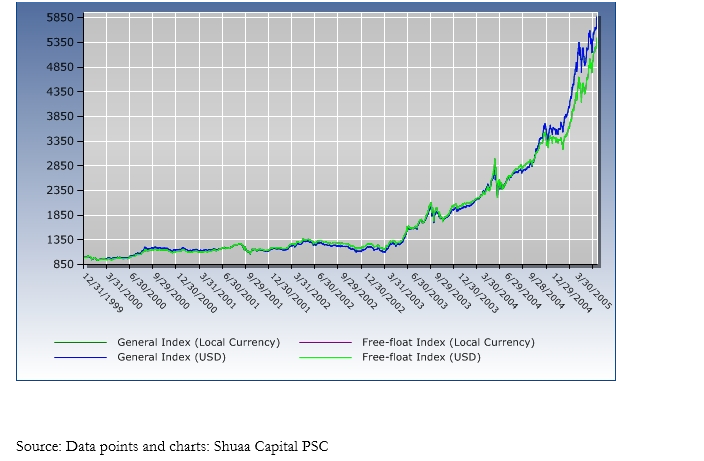
All in all, the easy money has been made, as one can see in thee accompanying tables. Although the gradual development of capital markets will bring great benefits to the entire GCC area, they are currently in boogie-wonderland in terms of both valuation and excess public enthusiasm with a recent issue – are you sitting down? – 800 times over subscribed. There is too much money flowing into too few shares. With Kuwait’s infamous Souk Al Manakh crash and its consequences still not wiped off memory, investors can hardly be at ease with the current exuberance in the market. Watch out.
Returns: Year to Date, and April 2005 alone.
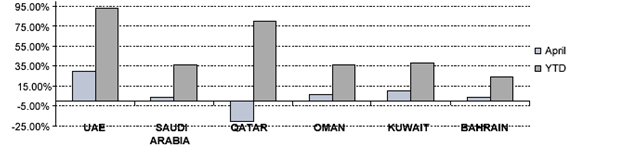
Saudi Arabia alone looks like mania waiting to deflate…

With Lebanon’s parliamentary elections having recently provoked so much controversy for reasons of sectarian representation, little attention has been devoted to how the new Parliament might address urgent economic issues, security, corruption, as well as long-dormant issues directly or indirectly related to development, such as administrative decentralization and a new election law. A preliminary assessment suggests that what might ensue is a mixed bag in terms of economic confidence.
There is a general consensus that the 2000 electoral law will recreate the large parliamentary blocs that existed in the previous Parliament, and will in fact go beyond that in favor, specifically, of the blocs headed by Saadeddine Hariri and Hizbullah, which are bound to expand . Indeed, pro-Hariri parliamentarians will very likely form the largest single group in the legislature, and estimates are that once combined with its allies in the Jumblatt bloc, both will control around 80-90 seats. If nothing else, this will, right from the start, give Hariri and his allies considerable control over the formulation and passage by Parliament of economic policy.
The kingdom comes
There will also be expectations that the Saadeddine Hariri “project”, which Saudi Arabia’s Crown Prince Abdullah was so keen to set afloat in May, will be, indeed must be, accompanied by financial aid, perhaps most spectacularly in the form of cash placements at the Lebanese central bank, as the Saudis previously did. Indeed, beyond politics, Abdullah’s support for Hariri has a pragmatic rationale: to protect the substantial Saudi investments in Lebanon.
However, there are two potential unknowns in such a scenario: the choice of the future prime minister and the fate of President Emile Lahoud. According to people in the Hariri camp, Saadeddine Hariri will sit out the next term as prime minister. One would be entitled to believe this when actually seeing it, since it would look odd indeed for Hariri to be a mere MP while one of his functionaries is the third-highest official in the land, but it does suggest that Najib Mikati may return to office. Mikati may be willing to toe the Hariri line on economic policy. However, the power of office changes people, and how Mikati would behave, if he remains at his post, once the legitimacy of a second term is bestowed on him is uncertain.
A more ominous obstacle will be Lahoud. While the removal of the president is high on the agenda of Saadeddine Hariri and Walid Jumblatt, and perhaps looks increasingly certain by the day, the constitutional procedure allowing this, according to lawyer Chibli Mallat, “is complicated and gives the president the means to delay implementation.” Moreover, with Maronite Patriarch Nasrallah Sfeir uneager, for the moment at least, to sanction Lahoud’s removal, one could conceivably see a variation on the theme existing last year as Lahoud and Rafik Hariri sparred: that of a president who, thanks to his partial control of the Cabinet, turns economic considerations into implements to help him fight for political survival.
Making matters particularly worrisome, this tension between Lahoud on the one hand, and his parliamentary opponents on the other, has the potential to become sectarian, so that Lebanon’s obvious economic priorities vanish into a giant vat of communal disgruntlement. While this is a worst-case scenario, and may well be avoided if some kind of consensus is reached on the president’s future, Lahoud will fight tooth and nail, and that includes using sectarian tensions in his favor, to ensure that he’s not ousted from Baabda.
The party isn’t over
In parallel, economic confidence will be linked to what happens to Hizbullah. The new election law virtually ensures that the party will expand its bloc in Parliament, perhaps to 15 members, giving it substantial leverage over key legislative issues. This and the legitimacy of an electoral victory will steel Hizbullah for an anticipated confrontation with the United Nations.
However, if Hizbullah continues to pursue military operations in the south, investor confidence that previously anticipated a change in what had been the old Syrian order, will take a hit. In order to counter this, Hizbullah will almost certainly seek to maintain contacts with all political groups in Lebanon, to protect itself behind a wall of national consensus. Among the key electoral alliances the party formed was that with the Hariri bloc, and one thing to watch for is whether this will have an impact on how legislation related to economic reform will pass through Parliament. This might prove tough for a party that, in last month’s Executive, went on record as saying it had no serious economic vision.
There are potentially serious contradictions between the economic reform package favored by Rafik Hariri (and presumably by his son) and advocated by international financial institutions – the privatization of public utilities, the layoff of redundant civil servants, cuts in government spending, and the rationalization of revenue collection – and the interests of Hizbullah’s relatively poor electorate, as well as that of its allied Amal movement. How both sides address this in the context of a new government, not to mention a new Parliament, over which it is probable a new speaker will preside (pro-Hariri parliamentarians Mohsen Dalloul and Bassem al-Sabaa are touted as favorites), can only be guessed at this stage. But Hizbullah will have to juggle its desire to build a national consensus around the party with defense of its supporters in the face of far-reaching economic change.
If Lebanon’s poor are anxious about the tightening of economic policy, most Lebanese, poor and rich, are no less disturbed by what the 2000 law will mean for corruption in the future. The clear tendency is to assume that much as certain members of the political elite – whom Michel Aoun has called the “conservatives”, seeking to conserve the system of spoils existing under Syrian tutelage – made a deal on passing the election law, so too will they divvy up the national pie once the voting is over.
Certainly, there is reason to believe that Parliament will prove as ineffective an oversight body as it was during the past 13 years since the 1992 elections. After all, the large blocs, perhaps with the arguable exception of Hizbullah, have been too involved in financial deal-making in the last decade and more to arouse much public confidence. However, three things may change this ambient mood: first, with Syria gone, the previous levels of corruption will almost certainly go down, though whether this means to vaguely “desirable” levels is another question altogether. Second, the Lebanese public, particularly youths, are increasingly impatient with what they perceive as the pervasive dishonesty of the political class. This will have political repercussions in the future, as new political organizations form and new elections loom.
Third, and perhaps most significant today, international financial organizations, particularly the World Bank, have Lebanon squarely on their radar screens, so that abuse, or certain levels of abuse, will necessarily be more difficult to conceal. Much the same goes for the United States, which has promised aid to Lebanon and considers the country a showpiece for peaceful transformation in the Middle East, but which will also be very keen to see how political and economic changes affect such ambitions. If corruption destabilizes the political system, Washington, but also the European Union, will make their displeasure known.
So what can we expect? A Hariri victory should not harm investor confidence in the immediate term.However, this optimism could be fleeting if the new government fails to rapidly introduce needed reform, and if the divisions created by the 2000 law are not bridged very quickly. The probable harmony in Parliament could be used to advance a reform program urgently, but the potential contradictions inside the leading parliamentary blocs, not to mention the fact that Parliament will very likely turn its attention to deciding what happens to Emile Lahoud, means that there will almost surely be obstacles, and a delay, in taking far-reaching economic measures.
For the past three years, especially since the collapse of US tech mania, the world has benefited from a massive credit boom, brought about by the central banks’ easy money policy. While the US Fed has raised interest rates to double what they were a couple of years ago, it is still maintaining low (inflation-adjusted) real interest rates. So low, that in fact, rates on the US Dollar are now at zero.
This environment, coupled with ten years of easy money policy in Japan, has allowed for a new kind of bubble to develop, one which has enabled low-quality corporate and sovereign issuers to have unprecedented access to the credit markets. This liquidity orgy has, among other things, allowed the equity markets to stay afloat, although they appeared to peak in early May, when two major issuers, Ford and GM were downgraded to Junk.
In the two previous years, the spread had been generously dubbed “risk free” and low-quality issuers, such as Lebanon or Turkey, had narrowed to unsustainable levels. As US long rates bottom out and begin to head higher, the implications, especially for emerging economies, will be devastating.
Trouble starts with bonds
The trouble will begin (if it has not done so already) where the good times began: in the US corporate bond market, which until recently had, on the surface, appeared calm. Profits had reached near-record levels, economic growth was strong, implied default rates were low and global demand for corporate bonds seemed insatiable. Over the past several years, corporate investors could hardly go wrong, and spreads have tightened virtually across the board. But risks lurked just under the surface. Today’s more turbulent waters have altered the opportunity and risk in the corporate bond market, making it, according to PIMCO, the worlds largest bond manager, an “adult swim only” zone.
In the past five years, there has been massive growth in credit derivatives, collateralized debt obligations (CDO) and collateralized loan obligations (CLO). The global market of credit default swaps (CDS) has grown nearly five-fold in four years and is expected to be up another 50% by the end of 2006.
All this has allowed corporate investors to gain significant exposure to the credit markets. The use of credit derivatives index (CDX) products, such as CDX IG (125 names) and CDX HVOL (30 names), has given investors greater exposure to credit risk in the corporate bond market through a simple, liquid vehicle, while the diversification of the CDX index products has allowed certain investors to feel more comfortable with credit risk.
The increased use of the CDO market has been driven by the unappetizing low, short-term global interest rates. CDOs could carve out tailored risk exposures, giving corporate investors the ability to take leveraged exposure to the credit markets through junior tranches. As spreads tightened, CDO investors took increasingly more risk in these structured products, comforted by credit ratings based on historical default rates and diversity scores. This trend in leveraged loans followed a similar trend to credit derivatives and CDOs. CLOs and loan issuance have risen due to strong demand for credit risk. This demand was especially robust from European and U.S. banks as well as hedge funds due to low, real short-term interest rates with few alternatives. The tightening in LIBOR spreads for bank paper and the decrease of protective covenants attested to this demand. However the result of the increased use of CDX index products, CDOs and CLOs, means more investors with limited knowledge of the bottom-up analysis needed for picking companies, bonds and structures, find themselves out of their depth. How big is this risk? The $131 billion of structured credit risk in CDO deals done in 2004 actually translates into $350 billion of credit risk on a delta-adjusted basis. As such, structured credit investors in junior tranches of CDOs have significant leveraged exposure to spread widening. In the corporate bond market, single-name issuer CDS spreads tend to widen dramatically as investors and dealers attempt to delta-hedge their credit risk exposure, amplifying the volatility of the market. The problem is that many of these leveraged instruments and structures are also new to the market and as such, large waves could materialize in the future as the underlying models investors use to hedge and dealers use to construct these leveraged credit products have yet to be properly tested in a storm. Of course, these waves and the resulting turbulence could result in opportunities for investors to pick up cheap credit exposure, via the CDS market, in storm-battered solid credits.
The significant change in both the growth and composition of the credit markets has caught the attention of policy makers. Chairman Greenspan, in a May 5, 2005, speech titled Risk Transfer and Financial Stability, noted, “The rapid proliferation of derivatives products inevitably means that some will not have been adequately tested by market stress.” He further commented that “a sudden widening of credit spreads could result in unanticipated losses to investors in some of the newer, more complex structured credit products, and those investors could include some leveraged hedge funds.”
Buired in the hedges
Hedge funds, while not new, have created new conditions in the corporate bond market due to their massive size and frequent trading. They attracted a record $27.4 billion in the first quarter of 2005. In 1990, there were 790 hedge funds with $39 billion in assets under management. Today, there are 7,900 funds with over $1 trillion in assets under management.
Interestingly, hedge funds are the largest users of credit derivatives and CDS. Several of the largest Wall Street firms estimate that 50-60% of their current trading volume in CDS is with hedge funds. These leveraged funds use CDX index products to gain a diversified exposure to credit, thus earning positive carry.
Hedge funds are amplifying the volatility in both the equity and CDX index options and corporate bond market, as these investors rush into and out of the water. In addition, low barriers to entry for the CDX index products have resulted in indiscriminate buying with little relative value thought or bottom-up credit research. As the markets turn, indiscriminate buyers turn quickly to sellers, creating choppy seas but relative value opportunities for those investors anchored by longer-term, top-down macro and bottom-up credit skills. While there are risks under the surface of the ocean, experienced sailors can navigate these waters and find selective treasure. In addition to hedge funds and other investors searching for credit exposure, Wall Street dealers have increased their presence in the market by using CDX index and single-name CDS products to hedge their large inventory of corporate bonds. Over the past several years, Wall Street has been in a “risk taking” mode as credit spread tightening has led to strong profits. As such, dealer inventories have risen sharply.
So far, Wall Street hasn’t been hit with many losses because credit spreads and interest rates have remained relatively low. However, this past month’s widening in credit spreads likely caught some dealers off guard and with too much inventory. As such, corporate bond traders have been told by their bosses and risk managers to reduce credit risk. As traders buy protection to hedge large inventories, credit spreads should widen and CDX index products and CDS on single-name issuers may begin to trade cheap versus intrinsic value. The dealers and hedge funds prefer to use CDX index products to hedge credit exposure due to their liquidity. Due to the large size of current dealer corporate bond inventories, credit spreads will likely be volatile over the next few months as more repositioning takes place. In addition, high yield investors are starting to sell high yield bonds to make room for any potential investment grade “fallen angels” which may be coming their way. This has likely left Wall Street with too many swimmers in the ocean.
So yes, leveraged credit investors and credit derivatives have made waters choppier and potentially more dangerous. However, it is not only what lurks in the water that makes the seas risky for swimming. Changing conditions above the surface can make the seas difficult to maneuver in too. Corporate America has had the wind at its back, in the form of low borrowing rates and a consumer-driven economic expansion, but those tailwinds are turning steadily into headwinds and corporate bond sailors should be prepared to chart a new course.
The recent good health of the corporate sector has been largely influenced by low-interest rates, rising consumer leverage and mortgage equity withdrawals, and a steep yield curve. For the last several years, tax cuts and low short-term rates have provided a huge tailwind for Corporate America. As a result of this record stimulus, profit margins are at 35-year highs.
The fragility of the corporate bond market will no doubt begin to seriously damage Emerging Market bond environment, including the Middle East. Favorable conditions in risky emerging market bonds may have already ended making managing excess deficits an even more precarious exercise. Central bankers and policy makers in the region should take heed. The easy money in bonds is off the table.
Residents in the border town of Majdal Anjar broke a jar the moment the last Syrian soldier left Lebanese soil. It is a local ritual to signify that something has ended once and for all. But while the general atmosphere in the Bekaa is one of great relief and hope for a better future, it will take more than the symbolic breaking of pots to revive a local agro-economy that is plagued by smuggling, lacks government support and has no competitive edge.
“I will double my operation in the Bekaa valley as soon as some form of protectionism is introduced and smuggling is stopped,” said Musa Freji, President of the Tanmia Agricultural Development Company. He was referring to the roughly 25 tons of chicken breast that enter Lebanon, unchecked and unregulated every day. “It’s a huge operation,” he sighed. “In Lebanon the meat is divided in small in black plastic bags of 5 to 15 kilo and transported by small vans to snack bars, restaurants and supermarkets all over the country.”
Retailers make no secret about the reason for buying Syrian chicken. The meat is a dollar a kilo cheaper. The problem is that most Syrian chicken is not raised and slaughtered according to the international standards Tanmia claims to uphold, while the end consumer has no way of verifying production methods and origin of the meat. The problem is a frustrating one for Tanmia, which with 400 staff, is one of the largest investors in the Bekaa. It raises some 10 million chickens, producing roughly16,000 tons of meat and records revenues of roughly $20 million annually. With Hawa Chicken, Tanmia controls some 45% of the Lebanese market. The remainder is made up by smaller farms and Syrian imports.
But chicken is only one good in what is euphemistically referred to as “free trade” between Lebanon, Syria and other Arab countries, but what is in reality legalized dumping and smuggling. According to government figures, some 25% of Syrian exports to Lebanon are made up of fruits, vegetables and dairy products, but the Bekaa farmers say the real figure is much higher, a situation exacerbated by the steady stream of produce streaming in from Egypt and Jordan. In all three countries, government subsidies and the price of labor, land, diesel and water are much lower, making it very difficult for Bekaa farmers to compete.
According to the Food and Agriculture Organization (FAO), Lebanon’s cultivable area amounts to some 360,000 hectares, some 200,000 ha of which are located in the Bekaa Valley. Crops occupy about one-third of the cultivated area in the Bekaa, mainly cereals, potatoes, onions, sugar beet, tobacco and green vegetables. Though Lebanon exports some fruits and vegetables, it produces only 15% of its wheat needs, 45% of its vegetables, 10% of its sugar and 20% of its dairy products. Some 400,000 tons of wheat are imported from the United States, Syria sells vegetables and milk, which is also imported from Europe. It is not an ideal situation and one that could be redressed by placing a greater emphasis on increased local production.
Protecting agriculture
“Everyone agrees,” Freji said, “that a free trade system is best for Lebanon. However, I think an exception must be made for agricultural and industrial production. Lebanon imports almost $10 billion a year and exports just over $1 billion. We should replace import by production to have a larger part of the population participate in the economy and prevent people from leaving the country. And I assure you that, if we are protected by import tariffs at a reasonable rate, agriculture will flourish in no time. Farmers will be able to make a decent living, while internal competition will ensure that prices will not spin out of control.”
Salim Wardy, director general of Zahleh-based Solifed that produces Domaine Wardy Wines and makes Ghantous Abou Raad arak and whose family has been involved in agriculture in the Bekaa for many years, also believes reform is important but does not support the introduction of import tariffs. “Agriculture in the Bekaa, and the whole of Lebanon, has been an absolute disaster for at least five years,” said Wardy.
“Psychologically, the Syrian withdrawal has been an important boost for the Bekaa, but economically it will take years and strong government measures to change the status quo. Lebanon is essentially a country without borders that serves as a dump for agricultural produce from Syria and other Arab countries. We need real borders, if one day in the near future we want to have a healthy agricultural sector again.”
Wardy does not favor the introduction of import tariffs, as it would endanger Lebanon’s entry into the World Trade Organization (WTO). Instead, Lebanon should just follow the natural agricultural calendar. “In the months we don’t produce certain crops,” he said, “we import them, whereby Syria and other Arab countries will be favored. However, in the months we produce, say potatoes, Lebanese production comes first and import will be limited to what is needed.”
Wardy believes it is not only a matter of stronger governmental protection. Lebanese farmers will have to improve production and marketing methods as well. “We must increasingly produce for niche products, such as cherry tomatoes, for both domestic restaurants and export. Packaging and marketing can be improved. In London they sell small cucumbers called “Lebanese cucumbers,” and they are not even Lebanese. We should increasingly market Lebanon as a quality brand, in tourism, wine, vegetables, anything.”
Dumping from the west
According to Freji however, trade relations with Syria and the Arab world are only part of the problem as Lebanon also serves as a dumping ground for western agricultural products. So, most of Lebanon’s wheat stems from the United States, while its chickpeas come from Canada. “Lebanon imports because it is cheaper, sure,” Freju said. “But why are American wheat and Canadian chickpeas cheaper? Because they are heavily subsidized by the American and Canadian government!”
Agriculture is the Achilles’ heel of free trade champions the world over. While the European Union and the United States relentlessly push for an increasingly free trade and free markets by breaking down custom duties and import tariffs, they have so far failed to change their agricultural sector, which is characterized by enormous government subsidies, export grants, and import tariffs. So, the United States paid farmers up to $20 billion in subsidies in 2003. The European Union spends almost $50 billion, or half its annual budget, on farmer subsidies, while the UK injects its agricultural sector with some $3.4 billion a year.
To illustrate the international dimension and magnitude of western agricultural subsidies take sugar. On April 28, the WTO ruled that EU should significantly reduce its subsidies on sugar beet production, as well as its export of subsidized sugar. The EU exports no less than 5 million tons of sugar a year, despite being a high cost producer. According to British development and relief agency Oxfam, the EU spends no less than €3.30 in subsidies to export one euro worth of sugar. What does this have to do with Lebanon? Some 7,000 hectares in the Bekaa are planted with sugar beet, producing some 300,000 tons of sugar a year, but the reality that it just cannot compete.
“Import prevention is not allowed by the WTO,” Freji said. “But a reasonable form of protectionism is allowed. The government will just have to strongly make the case for Lebanon. The country is not in a position to be more holy than the pope.”
From the brilliantly colored glazed-brick and tile murals of Mesopotamia to Antoni Gaudi’s surrealist mosaic creations, ceramics have been a mainstay in the evolution of Mediterranean art and design. Keeping the tradition alive is Uniceramic, one of the first companies to produce floor tiles in the Middle East and one of the region’s largest producers today.
Registered in 1973 by founder Joseph G. Ghorra, Uniceramic’s launch coincided with the outbreak of the civil war in Lebanon in 1975, but the unfavorable environment honed the survival skills of the company, and came in handy as it expanded its market share over the years to encompass other regional flashpoints such as Iraq.
“It was very difficult during the war,” general manager Nabil J. Ghorra recalls. “You see in our industry, gas is the main energy component that is used. It’s highly flammable, and it doesn’t like bullets and bombs much. Since we had to bring gas in every day, it was neither the easiest nor the safest thing to do at the time. Then the Israeli invasion pushed into the Bekaa where we have our plant. Most of our raw material was close to where the Israelis were, so we had to re-excavate and look for other places to find material.”
Today the company’s 42,000 m2 plant is still located in the Bekaa, near Chtaura. Its staff has grown from 138 employees in 1975 to 375 in 2005 and its production capacity has increased twelve fold over the same period. By 1996, the company went public, becoming one of only three industrial companies listed on the Beirut Stock Exchange.
The key to Uniceramic’s production increase says Ghorra, lies technology, allowing more cost effectiveness.
“We have increased our production capacity twelve fold between 1975 and 2005, but without having to increase our number of employees by the same amount. And this month we are set to increase our annual production from 4.3 million sqm2 tiles to 6.5 million sqm2.”
Increasing production falls into the company’s two-pronged corporate strategy, based on consolidating Uniceramic’s domestic market share, while simultaneously expanding internationally.
Although the tile market in Lebanon peaked back in 1995 at 10.6 million sqm2 of tiles only to decline steadily for the following six years, it has experienced a strong recovery since 2001, reaching 10.4 million sqm2 in 2004. Unexpectedly, the figures for first quarter of 2005 read even better than last year’s.
“We witnessed a 20% increase from the first 3 months of 2004,” says Ghorra. “The market is still growing.”
In a bid to keep its share of the market pie, which increased from 26% in 2002 to over 30% in 2004, Uniceramic is taking on the market with more products, new products and an added line of interior design and architectural services.
“We used to be just manufacturers, but we saw that in Lebanon, imported goods are perceived as being better than local products,” Ghorra explains. “The Lebanese prefer Western products over Lebanese products, just as they prefer Lebanese products over other Middle Eastern products. There is a stigma there. So we had to add value to our product. We were known as a good product, but not a particularly beautiful one. That is why our “Reflection of Beauty” campaign was launched 3-4 years ago.”
Uniceramic began opening its own showrooms, displaying full-fledged ceramic bathrooms and kitchens. Initially conceived purely as a mean to inspire customers, with no sales taking place so as to not compete with the company’s wholesalers, demand from customers became such that Uniceramic eventually began selling its products, but at a higher price.
“The customer is interested in a bathroom, he is not interested in a tile,” notes Ghorra. “(Despite increasing our prices) we discovered that people still preferred to buy from us because of the service – people are ready to buy for the service. We had architects at the showroom giving them advice and this was an added value for them.”
In parallel to this, Unicermic expanded its domestic sales channels to include retail networks and projects, in addition to wholesalers.
For now, the strategy seems to be paying off. Despite a 40% dip in business due to the political upheaval sparked by the February 14th attack (which notably slowed the construction industry down as Syrian workers fled), Uniceramic is hoping to make a 50% higher turn-over than last year, and more than a 50% increase in profits.
Focus on exports
Part of this increase is set to come from the company’s export market, which boasts clients in 20 different countries and constitutes 40% of total sales. Hitherto, the bulk of Uniceramic’s export’s have gone to the region, which Ghorra views as holding significant potential.
“In developed countries, the highest consumption per capita is 6.5 sqm2 tiles per capita,” he says. “In Lebanon, we are now at a peak, with 2.5 sqm2. In some other countries on the Middle East, they are only at 0.5 sqm2. So the potential for market development is huge.”
Yet seeking out the potential in a volatile region is a path fraught with pitfalls, which Uniceramic is all too familiar with. Prior to its March 2003 invasion, Iraq represented one third of the company’s total exports. Since then, sales have come to a halt.
“We have offices there, but I haven’t been to Iraq in a year and we have no direct sales to the country anymore,” says Ghorra. “But a lot of Iraqis now live in Syria, and they buy our products from there, which is one of the reasons why Syria has now become our biggest export market.”
Although the Middle East has treated the company well, Ghorra says he is ready to get involved in more stable markets and Uniceramic is now focusing its efforts on expanding its market share in Europe and the United States.
“At the end of the day, you want to make profits,” he says. “You want to show shareholders that this company is making returns on investment – this is how you grow, by gaining the confidence of the market. If you are constantly focusing on putting out fires, you don’t get to do that. We are surviving quite well, but we will be focusing more on Europe and the United States from now on, so as to stabilize demand, and be able to grow.”
The challenge of high energy prices
Yet expanding into less volatile regions will not protect Uniceramic from the challenges posed by out-of-control energy prices, which have chewed of quite a chunk of the company’s revenues since the war on Iraq. Despite hitting record sales worth $20.9 million in 2003, Uniceramic suffered a loss of $1.36 million in 2003.
“When we realized that the war in Iraq was imminent, we feared that the regional countries that exported into the Iraqi market would dump all their products on Lebanon, which has a more open economy,” Ghorra explains. “So as to not lose our market share, we decreased our prices, based on President Bush’s prediction that oil prices would fall after the war. Our sales soared and our market share increased by 8%, but the price of oil kept going up. Essentially, we ended up with a large gap in profitability.”
With 30 to 40% of production costs stemming from energy, boosted sales could do little to save the company’s profits. Worsening the situation was the strengthened Euro, which racked up the prices of imports of spare parts and raw material.
However the strong Euro has not exclusively brought woes to the company.
“It did also have a positive effect,” says Ghorra. “People import less from European countries such as Italy and Spain, as it gets more expensive. We penetrate that segment of the market.”
By 2004, Uniceramic re-adjusted its prices and with sales only slightly below the 2003 figures at $20.7 million, closed the year with a net profit of $96,251.
Unfair trade
The threat of foreign competition however, remains a dark cloud on Uniceramic’s otherwise promising horizon. Since Lebanon’s implementation of the Greater Arab Free Trade Area’s clauses, demanding the gradual reduction of tariffs and taxes, Lebanese companies have found themselves competing with regional tile makers propped up by heavily subsidized products.
“There’s unfair trade going on,” says Ghorra. “In Egypt, tile fabricants are buying gas at subsidized rates. For 1000 kilocalories of energy, they pay 0.4 cents. We pay 6.11 cents – 14 times more. In addition to that they have cheap labor and all raw material locally available. In 2002, there were almost no imports coming from Egypt into Lebanon. In 2003, 211,000 sqm2 of tiles were imported. By 2004, this number had reached 1.3 million sqm2, and in the first 3 months alone of 2005, we have seen 903,000 sqm2 imported.”
Facing the risk of being down priced out of the market and forced to delocalize, Uniceramic is engaging in government lobbying, so as to introduce measures to limit imports from subsidized foreign industries.
“The government needs to protect us,” Ghorra argues. “Otherwise, why would investors come to Lebanon, if profitability is better elsewhere? This country needs to create 10,000 new jobs every year, but the government needs to give the incentives and the opportunities to the industries to use this labor and create new jobs.”
But the manager of the company, which saw itself rewarded the prize for best Industrial Company with an Internationally Renowned Brand in 2004, remains upbeat about the future.
“We are strengthening our trading capacity, stabilizing and securing our market shares abroad, launching 75 new references in tiles in June and July, and we will become quite aggressive on the domestic market in order to fight for our market share and consolidate.”
Uniceramic appears set to keep up tradition for quite some time to come.
The revolutionary animals in George Orwell’s Animal Farm, once they have evicted the tyrannical farm owners, slip into the status quo, one that sees the leaders, in this case the pigs, emerge to perpetuate a system similar to the very one they worked to overthrow. In an earlier age, the arch-schemer Machiavelli might have smiled: getting others to do the dirty work would have met the approval of the Florentine thinker.
It may be premature to suggest that the situation in Lebanon is heading towards such an Orwellian nightmare, or that the people who took to the streets earlier this year have been duped, but the ease with which many of the heroes of the Cedar Revolution appear to be slipping into old habits is cause for concern.
We are not saying that our politicians will behave like Squealer, Orwell’s head pig, whose pact with the farmers ends the tale, but many Lebanese may have been alarmed at the sight of General Michel Aoun getting into bed with former Syrian lackeys to shore up an electoral dilemma. It is only one of many examples of how principles are quickly shed in the pursuit of power. They are all doing it, including Walid Jumblatt, who is no stranger to the gray zones of Lebanese politics. On the bright side, at least all these vulgar alliances are free of outside interference.
But then again, maybe we expect too much. Despite riding a genuine wave of national feeling, the Lebanese people may have to face up to the grisly reality that nothing much has changed. A cynic would certainly see it that way and you would see his point. The Syrians have gone, but many of those who lived off their scraps are still plying their trade.
A case of plus ca change, plus c’est la meme chose? We hope not.
Pierre Achkar has his hands full. As manager of the three-and-a-half-year-old, 112-room Monroe Hotel, ravaged by the explosion that killed former Prime Minister Rafiq Hariri, he has been overseeing the hotel’s renovation, refurbishment and reopening. Wearing his hat as the head of the Lebanese Hotel Owners’ Association he must direct efforts to minimize overall hotel and tourist sector fallout from the assassination, subsequent bombings, political instability and freefall of investor and tourist confidence. And somewhere he must also find the time to keep an eye on his other concern, the Printania Hotel, in the mountain resort of Broummana. EXECUTIVE spoke to Achkar about the impact of the turbulent last three-and-a-half months on the Monroe Hotel and on the hotel and tourism sector as a whole.
Can you give a rough estimate of the cost to the hotel sector of the last three-and-a-half months?
The four hotels on the Corniche affected by the explosion lost– including direct and indirect costs – around $60 million. The big loser was the Phoenicia. Occupancy in Beirut for February-March-April should have been around 55% to 60%. A few months ago it was around 30%. We were losing a few thousand rooms per day. This translated into around half a million dollars a day in losses. And this went on for more than two months. Outside Beirut, business is more seasonal. Occupancy went down, but the original rate was not as high. Outside Beirut, we were talking about additional losses of about $100,000 a day.
What does the immediate future hold for the sector?
What happened here was a terrorist act. But these kinds of terrorist acts don’t happen only in Lebanon. They happen in New York, in Moscow, in Paris, in London, in Spain, in Taba, in Qatar, and last month in Cairo. Terrorist acts happen everywhere. And the cities in which they happen carry on. They are back on the international tourism map. We’re going to do the same. Life will continue. People will forget what happened. In time, we will have the same growth as we had before, especially in a free country with democracy, a new government and new programs.
If there is no more instability, how long will it take Lebanon to get back to where it was last summer?
If we have smooth elections in May and there is no more instability, Lebanon’s rebirth will be in August. But the growth will be very gradual. We won’t have the same numbers of people as we had last summer. But the people who do come will go home saying Lebanon is normal again, it’s living again. And they will spur others to come back. Within the last week, we have had a lot of Saudis coming to Beirut. They’re phoning their friends and family and saying: Beirut is back. We might have a million tourists this summer, compared to more than 1,300,000 last summer. Next year, if there is continued stability, we will reach at least one-and-a-half million.
What should the hotel sector as a whole be doing to overcome what has happened?
We are studying a master plan with the Ministry of Tourism. They have a budget for this. We are also holding meetings with Bahia Hariri, to create a team that will travel throughout the Arab world promoting Lebanon. And we are discussing with the international community ways in which it could help by creating a fund with the SRI or USAID, to promote Lebanon in the Western world and to change the image of the country. The 12 big hotels in Lebanon are meeting to see what we can ask of the new government, in terms of electricity and taxes for e.g., to help our cash flow. We have discussed already with the Central Bank and the Association of Bankers subsidized loans and the possible postponement of repayments.
How likely is it that an international fund will be set up?
No one knows. It is a political, international decision. It could be in six months or in a year. We are doing our best.
Are you optimistic that the Government will help the sector?
I am not very optimistic because this government is a very short-term government. It must oversee a political transition period complete with elections. But they are nonetheless responsible for the economy of the country. It cannot be only a political government. They must also look after the economy and the major pillar of the economy for the moment is tourism, especially since our Arab visitors are tourists and investors at the same time. They buy land and apartments, and are involved in joint ventures.
Has the group that owns the Monroe put other plans on hold?
No, a planned $35 million boutique hotel project in the Downtown area is going ahead as planned. It should be completed in three years.
Where were you at the time of the explosion?
I was just up the road from the hotel, in my car. I heard the bomb and saw the black smoke. It was so loud I thought it was a bomb from an aeroplane.
What was your immediate reaction?
I ran into the hotel and saw disaster. There was a lot of blood from people who had been cut by flying glass. My first instinct was to look for my son who I knew was in the building. When I found him I felt a little bit better. Then I managed the crisis team, stopped all the electricity, the lifts and the gas, and evacuated everyone from the hotel, all within around thirty minutes.
What was your reaction from a business perspective?
I have a certain character because I experienced a lot of problems in this country during the war. On the one hand, following the explosion I was aware that we had a big problem. On the other, my reaction was very calm. Initially, I was just looking after people. As soon as I knew that Hariri had been killed, I felt that the major problem for us was his assassination. That, I felt, was even more of a blow than the damage to the hotel. Inside the hotel, there had been no real calamity, no one had been killed, so this made me calm.
What exactly was the damage to the Monroe?
All the glass and aluminum fittings were destroyed, the air conditioning, television sets, all the furniture. A few of our restaurants were also completely destroyed. We have $1.2 million worth of ‘direct’ damage, and $600,000 to $800,000 of ‘indirect’ damage. While the hotel remains closed, we have to continue paying rent, which is $50,000 a month. We have to pay salaries, electricity, water, and all the taxes. That comes to around $225,000 a month. We were closed for two and a half months. We had to train people for the reopening. That’s an added expense. We have to re-launch the hotel. We have to do a lot of advertising. Before the explosion we had an average occupancy rate of 70%. We need to reenter the market. To do that, we are going to have to spend a lot of capital – around $300,000 to $350,000. All this we wouldn’t have had to spend if the problems hadn’t occurred.
What was the Monroe’s occupancy rate on the day of the explosion and how many guests were in the hotel?
Occupancy was 71% – that’s 120 guests.
Have you kept all your staff?
Half of the 132 staff were sent home. We were paying them 50% of their salaries. The other half we used here at the hotel. No one was dismissed.
When did you reopen?
On May 15, we opened three floors. The rest will open towards the end of the month. But some of the restaurants we have had to totally renovate because they were completely destroyed. They will have new decoration, new furniture, a new look. Everything will be new. They will open shortly after the rest of the hotel.
How have you made the best of a bad situation?
These last three months have been a very big crisis. The Corniche Monroe management also manages the Markazia in Downtown Beirut. We have been looking for a client niche. We had lost most of the international clients as well as the Arab tourists. In this respect, media guests at the Markazia constituted a big support. We were offering special rates for media stays. Here in the Corniche Monroe, we have done a lot of upgrading in all parts of the hotel, with respect to furniture especially in the rooms. We have changed everything, carpets, walls.
What are you doing in terms of relaunching the hotel?
We have around 12 people who are going to travel to all the Arab countries. We are also preparing a local and inter-Arab media campaign. We have people who are going to travel to Turkey, to Europe, to promote the hotel again. Even while the hotel has been closed we have been in Turkey, Moscow and Europe.
What is the message that they will be carrying with them?
First of all: We have been hurt, but we will continue. Lebanon has become a free, democratic country. We know how to fight for freedom and democracy and we’re going to learn how to live with democracy. Lebanon will have a ‘free’ summer, in a free country. The advertising people are looking at how they can package this message in a professional way, without getting into politics.
What will they be saying about the Monroe hotel?
We’re back. We have upgraded. We’re waiting for you. We have received a lot of support from many of our clients. They have phoned us, they’ve sent us faxes and Emails saying: We’ll be back. We miss Lebanon, your service, your hotel. And we’ve started phoning and emailing these people, especially these people – of whom there are hundreds.
With a premium volume of $180 million in 2004, life insurance realized a rise of near 30% over 2003 and accounted for more than 31% of the total reported premium pie of $577 million. Bank-affiliated insurance companies, such as Audi’s Libano-Arabe, BLOM’s Arope and Bank Byblos’ Adir, as well as specialist firms Sogecap (linked with Societe Generale and SGBL Bank) and Bancassurance (an enterprise of Fransabank and BLF) fared very well in their development while the traditional life insurance leaders, Alico, maintained the top role in market share. Another convincing performance came from SNA, which supplies Bank of Beirut as well as several smaller banks with bancassurance products. Executive asked representatives of life insurance companies and bancassurance specialists about the achievements and potentials of these lines.
How do you see assess the role of bancassurance for the Lebanese insurance market and where are the growth potentials and untapped niches?
Pierre Talhami, manager, Beirut Broker Company
So far, bancassurance has proved to be excellent for us. In 1996 we were the first to introduce such products to Lebanon in form of four products which were developed with the Italian Assecurazione Generali. Today we have 9 bancassurance products that are sold at all Bank of Beirut branches. These are in three categories: life and capitalization; personal accident; and general accident insurance.
Recently, we were the first to introduce medical insurance policy sold over the counter and underwritten directly, with no medical check required until 45 years of age and only an interview with the doctor for people between 45 and 55. This policy is priced 50% below the market price for health insurance and targets mainly young and healthy people with a $500 deductible on hospitalization under a policy that covers up to $125,000 in total medical expenses, at a cost of $300 per year, which is $25 per month. It can be combined with a loss-of-income compensation policy that provides the insured from the second day of hospitalization with $200 a day in compensation if due to an accident or $100 per day from the third day if due to sickness. At only $3 per month for this B-Compensated product, we introduced combo sales of health and loss of income compensation products in January 2005.
Over the past three years, using bancassurance products developed by SNA, we sold 7,000 new policies in 2002. In 2003, most of these policies were renewed plus we sold 7,200 new policies, followed in 2004 by sale of 7,600 new policies and again renewal of most existing policies.
Beirut Broker handles business for Bank of Beirut and our target is for 40 % of all Bank of Beirut clients to buy at least one bancassurance product over the counter. As of now, about 18% of the client base holds a policy. We feel that we are very well positioned in the market because we have one of the largest distribution channels.
How do you assess the potential of Lebanese insurance firms to penetrate regional markets with bancassurance products and which companies do you anticipate to succeed in the Lebanese insurance market?
Rene Klat, general manager, Adir Insurance
We have developed bancassurance that does not exist as such in Middle East and Arab world. Thus we have specialties that we could develop in the Middle East. As we are part of the Bank Byblos Group, we will definitely follow the ownership of our bank in Sudan and Algiers. We are also trying to make a partnership in Jordan with local banks and insurance companies but I must admit that things are sometimes slow in this region. I could also mention Syria but there is no insurance law in Syria. However, we have been following corporate clients of Bank Byblos for quite a few years there.
We hope that with the intentions of the United States to spread democracy there could be a lot of development in the region but I hope especially that there will be an economic opening.
The Lebanese life insurance market is big. We have a retirement plan with 5,000 policies in force over two years. I think now that everyone has confidence in the Lebanese economy we can all hope that the young people who brought the revolution will insist on new faces. We have fantastic people and a lot of wealth in many areas, from human resources and climate to history and archeology.
However, I always state that there is no hope in the mid-term for insurance companies that are not backed by big banks and in the long-term for those that are not connected to international insurance companies. In 2004, we could prove the profitability of the investment by our international partners by distributing $1 million to shareholders. They are very happy with us. We are a real institution.
Where are the best development potentials for life insurance providers in Lebanon and how do you expect the domestic market to develop?
Jean-Francois Jaboulay, general manager, Sogecap Liban
We are the second company in life insurance after Alico and 2004 was a very good year for us. It was only our fourth year of activities but we managed very well.
In 2004 we had lower growth than in 2003 and it was our intention to go this way. In the moment, term life products are the best for us while the line of capitalization products doesn’t give us much profit because the law doesn’t allow more than 50% of life premiums to invested outside. We could do very well if we could place 100% of every contract in specialized unit-linked products.
Sogecap are very proud of the unit-linked products we are providing in France, Europe and even North Africa. Our best unit-linked products in the “audacious” category gave over 25% over the last 18 months and the secure ones over 20 % over 18 months, and we don’t want to spoil our reputation with a product that would offer less interest.
We want to find new channels and partnerships with banks or brokers. Our products now are not fit for brokers and we are building products that are fit for partnership with brokers.
The future of the country can give the insurance industry a lot of hope for development The Lebanese market is still cornered by laws and needs modernization. It should also concentrate a bit. If the market is modernized, it can develop very well and give a lot to the country. There is a need for more awareness on capitalization products.
The people have a need and start contracts but a number of these contracts fade out after three to four months for economic reasons. The need is larger than the economic capacity.
It takes but a few steps to walk from the site of the first bomb explosion that shook Lebanon in March in the aftermath of the Hariri assassination and anti-Syrian protests to the offices of one of the country’s largest insurance brokerage firms, Beirut Broker. The offices of the brokerage in fact suffered some slight damage from the blast in March and in a perfunctory nod to the heightened awareness for security, the doors of the no-frills office building in New Jdeideh now remain closed and have to be buzzed open during business hours.
Inside, the mood is cautiously upbeat, despite a very slow period in the last three months. “The entire retail business saw basically no growth in the last couple of months; that was not at all our expectation for 2005. In 2004 we grew and started feeling that clients are more and more accepting bancassurance,” says the firm’s manager, Pierre Talhami. Bancassurance is the distribution channel of standardized insurance products through bank branches, which the brokerage handles for its parent company, Bank of Beirut.
Predictably, the first quarter of 2005 was not extremely kind to Lebanon’s insurance providers. They apparently did not have to pay out huge claims for damages incurred by businesses from the bomb that killed former Prime Minister Rafik Hariri, former minister for economy and trade, Bassil Fuleihan, and 19 others, nor were they called upon to cover damages from four subsequent bombs that cost several lives and millions in destruction of property. But being spared spectacular claims costs did not mean that insurers would have benefited from increased demand. To the contrary, consumers kept their purse strings tight in face of the uncertain times they were confronted with and sales of retail insurance products suffered in consequence.
In the corporate segment, things looked somewhat better, though. While businesses did not respond to the security crisis by investing in more insurance protection, they on the other hand also did not turn their back to the need for insurance in the knowledge that covers for damages incurred because of acts of terrorism would be prohibitively expensive if at all available.
“Lebanese people are used to the fact that terrorism is not a cover you can buy in Lebanon,” said Talhami. Beirut Broker has a substantial business on the corporate side, as it assists Bank of Beirut and its corporate clients in assessing insurance needs when discussing loan financing. In the corporate segment, the firm found that by and large, companies carried on buying general insurance products as they encountered the necessity. This left the insurance industry during the aftermath of 2/14 exactly there where it has been perennially: following economic trends set in other sectors. And these, as we all know, were pretty dismal over the past three months.
This is not to say that the insurance industry’s progress, which had been accelerating over the past two years, is in danger of stalling. The process of consolidation and natural selection of viable companies in the overpopulated, sector is also continuing. Many of the sector’s reputable companies could improve their results in 2004. Some, like life insurance specialist Sogecap, moderated their growth purposely while others achieved tremendous portfolio increases. Arope, the insurance daughter of BLOM bank, reported a 71% increase in total premiums to $24.7 million, which included a more than fivefold boost of its previously smallish life insurance portfolio. According to unofficial company figures, a number of insurers achieved some growth in the first quarter of 2005 even as players across the industry conceded that they had expected much more and could only hope to catch up in the second half of the year. “It is a slowdown in our progression. Our plan was to grow more than we did but we are still 5 to 10 % above production of last year,” said Rene Klat, general manager of Adir Insurance.
Prospects also remain interesting for the development of Islamic insurance where the Arab Finance House (AFH) plans to market TAKAFUL products in cooperation with Bahrain-based firm Solidarity, one of the world’s foremost providers of financial protection that is Sharia-compliant. According to Mounir Sinno, marketing manager and spokesman for AFH, the two institutions already signed an agreement and are preparing to offer TAKAFUL products in Lebanon probably before the end of this year.
Yet although being large by regional standards and despite impressive growth of life insurance business and respectable improvements in general insurance premiums by leading companies – often those providers whose shareholders include local banks and/or international insurance firms – the total insurance premium volume in Lebanon still measures about 1 against 100 when compared to the country’s banking deposits.
Market mechanics and private sector initiative have worked in the past five years to gradually increase the degree of insuredness in the business community. While in the mid to late 90s only about a quarter of enterprises in Lebanon could be counted upon to be fortified with well-rounded insurance protection, industry experts generally agree that coverage today extends to an estimated 40 to 50% of enterprises. This is in a major part due to the fact that more and more businesses rely on bank finance for their development and banks in turn oblige them to obtain the appropriate insurance covers, and as such the trend can be expected to continue.
To make the logic of insurance more compelling in Lebanon, administrative action and legislative initiative remain major needs. Industry insiders say the Insurance Control Commission at the ministry of economy and trade could do more in advancing the professionalism of insurance companies than monitor their financial soundness, in which the ICC achieved clear progress with field audits and improved supervision.
The main item to advance the insurance industry in this respect is the further enhancement of the insurance law. A new draft law stipulation a clearer industry structure, higher capital requirements and stronger teeth for supervisory entities was presented in April 2004 by then minister of economy, Marwan Hamadeh, but expectations for the law’s quick implementation by its admirers did not get fulfilled.
Insurance legislation is a clear need not only as far as better legislation on the sector’s activities but also in relation to legislation to make insurance products more attractive under tax perspectives, such as allowing tax deferrals on both employee and employer contributions to individual or group retirement plans. While consumers bought life insurance in recent years at a faster rate than before, life products with a savings element still have to become more attractive when compared to the simpler and in the short run cheaper term life products, which offer protection of one’s family in case of sudden death or accident but do not serve the insured as tool for wealth creation and financial security later in life.
Law givers in developed nations widely provide incentives to personal provisioning for old age by deferring the tax burden on contributions into retirement plans. As long as this is not the case in Lebanon, the concept of individual retirement provisioning is deprived of a psychologically and financially important support factor.
Another obstacle to growth in the life insurance sector is the ceiling on investing funds abroad. This has become even more of an issue as the interest rate environment in Lebanon has dropped from the unsustainably high levels of the 1990s and the turn of the century. In light of the deficiencies of the local financial market – the anemic bourse and the absence of alternatives to bank deposits – the regulation that 50% of the amounts managed by life insurance companies have to be kept in the domestic market means that insurers cannot unfold their full potential to develop attractive products. This applies especially to unit-linked life insurance products, where returns from the savings component of the policy depend on the performance of sophisticated investment strategies. “The Sogecap unit-linked knowledge is worldwide. If we have to keep 50% in country, we cannot do the products we are best in,” said Jean_Francois Jaboulay, general manager of Sogecap Liban.
With expectations for quick adoption of new insurance-related legislation appearing over-optimistic in light of the sector’s relatively low priority in the economy and more pressing needs consuming the political realm for at least several more months, the hottest issue and best opportunity for the insurance industry right now is institutional self-improvement. The insurance industry association ACAL has for the past few years been involved in lobbying for insurance but its role has been impeded by fragmentation of interests and somewhat incomplete structures.
As demonstrated by a near total absence of studies and publications and a gap of several years even in providing figures available from insurance firms on its website, ACAL has not been able to formulate the positions of the industry as convincingly as it could have. Some insurance professionals have criticized the association as a body where the large number of small firms with restricted ambitions for sector improvement has held developments back. Others said it is high time for ACAL, which is holding elections for its president and part of its board early this month, to establish a position of director general or secretary general, in the aspiration to make ACAL function more like the role model in finance sector associations, the Association of Banks in Lebanon (ABL). “I hope that the profile for the position of secretary general will be devised. The president of ACAL, who has to take care of his own company, does not have the time to do everything,” said Klat.
In 2004, ACAL shone in organizing the 25th General Arab Insurance Federation conference, whose list of registered participants included more than 900 insurance professionals from around the Arab world and beyond. With this record attendance, the event highlighted the growing regional awareness of insurance development and raised new hopes for faster development of activities in key Arab markets.
While some countries, notably Bahrain and Saudi Arabia, are making good on their programs for competently regulation and opening up their insurance markets and partly Beirut-based Medgulf Insurance was included on the top of the Saudi Arabian Monetary Agency’s list of companies that have completed the application process required for operating in the kingdom’s insurance and reinsurance market, the development of the insurance sector in the region is overall anything but a fast affair. Syria, another market where many Lebanese companies are keen to build insurance capacities, is still awaiting its insurance laws. Lebanese insurance companies that already have a presence in the neighboring country deny the existence of problems in pure economic interaction and are upbeat about their business relations and acceptance of Lebanese firms there, but nonetheless operate in an environment not comprehensively covered by insurance legislation.
Given the slow evolution of the domestic and regional insurance markets, no radical changes appear to be in the cards for Lebanese insurance firms in the near to mid term future. Internationally, the outlook for insurance continues to focus on prudent underwriting in order to maintain profitability in changeable investment environments. Natural catastrophes, as demonstrated painfully by the Tsunami that devastated so many parts of Indonesia, Sri Lanka and other countries bordering the Indian Ocean, continues to be the leading concern for insurance providers worldwide. However, as terrorism risk has been increasing around the world and especially in developed countries, the provision of protection against the damages from a terrorist attack is becoming an issue of increasing importance for the world’s insurance leaders.