
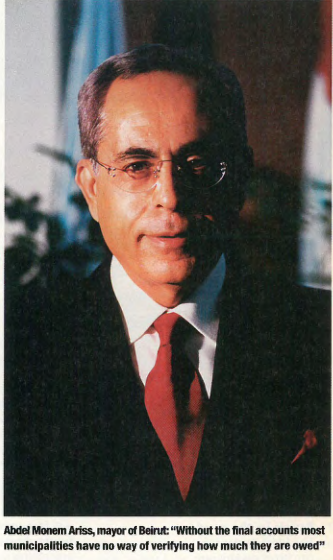
Beirut’s experience is typical. The city is owed money by just about everybody. “Nobody is paying us on time. The Independent Municipal Fund is way behind and we’re concerned that there should be a final audit of what they owe us. And the three utility authorities, water, electricity and telephone, have not sent us final accounts of their debts to us,” says Abdel Monem Ariss, the mayor of Beirut. Without the final accounts, most municipalities have no way of verifying exactly how much they are owed and how the money from the municipal fund is spent. Faced with high salary costs because of overstaffing and uncertain sources of revenue, municipalities are strained to provide the bare essentials.
Municipal budgets are sourced from 23 different taxes: 16 are local and the rest are central government taxes. The local taxes are the backbone of every municipal budget, because they are usually easier to collect. Beirut collected $33.2 million in 1999, while Ariss estimates that another $13.3 million went uncollected. The collection rate is respectable, he says, because the longstanding employees know who owes what, so the city can eventually collect.
But not all municipalities find it so easy. In Mazboud, a village of 4,200 in Mount Lebanon, the tightly knit nature of the community can make prosecution for tax evasion or raising property rates difficult, says town mayor Muhammad Habanjar. The resort town of Aley has a large number of emigrants and Gulf property owners who are difficult to track down for payments. Down south in Nabatiyeh, the council isn’t strict on collection, says Bassam Fahs, a council member, because of the economic hardship suffered by locals due to the town’s proximity to the Israeli-occupied zone. He does, however, believe that property taxes are ridiculously low and should be reviewed. Charging a homeowner $50 a year on average in return for municipal services is not practical.
The direct taxes are only part of the revenue equation; the other half is the government contributions. These include funds funneled through the municipal fund, which is run by the Ministry of Rural and Municipal Affairs (MRMA), and contributions from the utilities.
Taxes collected by the government on behalf of municipalities include a percentage of customs receipts, a 10% tax on cellular phones, a portion of the built property tax, as well as a surcharge on fuel and tobacco products. Each year, the MRMA should pass a decree to apportion the funds to the different municipal councils, usually by September for the previous year’s revenues. Last year, the Ministry of Finance disbursed about $126 million, but that was only a portion of the dues for 1997. Mazboud is still owed $23,700, and should receive another $67,000 for 1998. Beirut received $6.6 million for 1997, but it is still owed another $18.6 million. A similar decree for 1998 has been included in the proposed 2000 budget.
If getting paid on time is a problem, the portion being allocated to each municipality is another. For starters, divvying up the municipal portion of the property tax can be difficult when owners have real estate in more than one area. And while total allocations are based on the number of registered voters, that may no longer reflect the actual number of residents in the municipalities, argues Kassem Rahal, the interim mayor of Burj el Brajneh in the southern suburbs. His area, which includes Burj, Ramel el Ali, Ouzai and the Palestinian camp, counts some 13,000 voters over the age of 21 on the electoral roll but is congested with new emigrants who may actually vote elsewhere.
This is because in Lebanon, people are registered to vote in their family’s place of origin, which is often different from their place of residence. Re-registering in a different municipality is such a bureaucratic nightmare that most don’t bother. His local data, in the absence of an official census, shows the district is home to some 300,000 to 350,000 people, with 50,000 homes and commercial establishments. Last year, his municipality received only $165,000 from the municipal fund, whereas Rahal believes that figure should be higher based on the number of actual residents in his area.
Another headache comes in trying to collect from the delinquent utilities, even though by law utilities are supposed to pay their dues to municipalities every three months. “We have asked the Ministry of Post and Telecommunications (MPT) to pay us, but we haven’t seen a penny since 1994, although every resident pays a 10% tax on phone bills,” says Sheikh Wajdi Mrad, the mayor of Aley. He does receive payments from the water authority and electricity, however. The electricity facility in Aley is privately owned. Beirut’s municipality is owed $23.7 million by Électricité du Liban, and $20.9 million by the MPT. Those debts date back to 1995.
The Beirut water authority is more up-to-date, having paid the bulk of outstanding debts in 1999, with about $1.6 million remaining, says Ariss. In Nabatiyeh, where residents are exempt from paying water and electricity, the council does not expect much. But the MPT has expanded its service and improved collection, while the council has only received $12,600 for the first quarter of 1999.
On top of the problems with collection and allocations, staff wages eat up a huge chunk of municipal budgets, 60 to 70% for Nabatiyeh and as much as 87% for Beirut. This leaves little money to funnel into services. The responsibilities of municipalities include the supervision of schools and hospitals, zoning, health inspections, traffic police, road signs, street lighting, as well as clearing drains, maintenance and construction of inner roads.
In order to fund new projects, Fahs says the council lobbies members of parliament to volunteer some of their money received from the Ministry of Public Works. Municipalities also stretch out projects over time to help cover costs. When the projected budget of $172,000 did not materialize due to unpaid government disbursements, the municipality of Mazboud cut back and spent $107,000.
Despite Ariss’ concern for funding, Beirut, as the capital, probably has the most options. The city council has been studying schemes to raise money. “The two most rewarding would be municipal bonds and BOT projects,” says Ariss. “The money raised by bonds should mainly be used to improve tax collection and the quality of services.” The city is also looking for individual contributions, such as the fence that was put up for the planned Horsh of Beirut park, on the old road to the airport.
The city hopes to receive foreign funding from either the Arab, Saudi or Kuwaiti development funds, or by signing agreements with overseas municipalities. Île-de-France, for example, has agreed to pay $300,000 annually over a period of five years to rehabilitate the Horsh area. The Beirut municipality is expected to match that amount. The main stumbling block to these projects is the lack of qualified staff. Meanwhile, there is a freeze on hiring and the city has between 1,000 and 1,300 excess unskilled employees.
Fortunately, successive governments have recognized that municipalities lack proper means and have taken over the maintenance of storm drains, highways and main roads, although the money is sourced from the municipal fund. Beirut is the exception, where the administration’s involvement is not restricted to main byways. Maintenance projects have been awarded through the Council for Development and Reconstruction, but those contracts expired at the beginning of 1999 and were not renewed until October. That, unfortunately, was too late to get ready for the deluge of late January and avoid the flood damage.