
As darkness descends on Beirut’s
international airport, couriers are
busy clearing incoming shipments.
Enter one colonel from the army’s customs
brigade. He barks orders that shipments
over 20 kilos should be stopped, quoting an
obscure 1959 law governing the former
directorate general of post, telephone and
telegraph (PTT). Thousands of packages are
stacked around the room as couriers refuse
to continue their work and exit the scene. This
is just one small excerpt from Lebanon’s latest
farce. If only it were just a play.
The government has been courting international investors and trying
to sell Lebanon as a country that is ready for globalization. But
rumors that Lebanon is ready for business are little more than hollow
words in the ears of international courier companies that have
set up shop in the capital. The welcome mat has been unceremoniously
yanked out from underneath them.

Couriers are being forced to operate in a rigid regulatory environment
that is based on antiquated laws. Beirut was being viewed as a
possible hub for the region, but it is fast becoming the place not to be.
“You can imagine what regional management thinks when
every week we come back to them with a different problem. If it’s
not customs, it’s the PTT,” says John Chedid, country manager for
DHL. “It’s a constant headache for them, and they’ve begun to
rethink: ‘Is Lebanon really the place to have a hub?'” For now,
they’ve decided it isn’t.
That’s a sharp slap of reality for a country dreaming about its previous
role as the region’s financial and business center. All the more
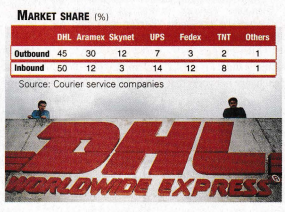
so since DHL holds the lion’s share of courier business and other companies depend on its services.
Much of what has exasperated couriers is the tax levied on non-document shipments up
to two kilos and on documents up to 10.5 kilos. A ministerial decree,
376, effective from June 1, raised the tax from about $6 per kilo
on inbound documents only, to $12 per kilo on inbound and outbound,
which the couriers have refused to pay. At that rate, a full
year’s tax bill would be a crippling $8 million, or 67% of the estimated
$12-million market. Why inbound shipments are even
taxed is a mystery since couriers only generate revenues on outbound
items.
With the unpaid tax bill getting out of hand, the couriers, except
DHL, agreed to a compromise rate of $7.50 per kilo on inbound
at the end of October. But the agreement has yet to be finalized. At
the end of November, the couriers sent a letter with their demands
to Issam Naaman, the minister responsible. Stipulations include that
non-documents be exempt, as was the case prior to decree 376, and
that the kilo-based tax eventually be replaced by a value-added tax.
When the magazine went to press, the couriers had not received
a response from the ministry. Naaman, who says that the letter has
not yet been brought to his attention, commented: “All I know is
that DHL won’t agree, but all the other couriers have agreed to a
compromise.”
The ministry sees the tax as a way to make up for lost terminal
dues, or compensation for an inequitable flow of mail between
the postal services of two countries. Omar Tabbarah, an advisor to
Naaman, argues that the government is losing compensation because
of the private couriers. The ministry of post and telecommunications
(MPT) also claims the right to exercise its monopoly on mail
up to two kilos, while the couriers maintain that their business does
not fall under the monopoly.
“The government is trying to distinguish mail by its weight, value or contents,” says
Brendan Cody, commercial
manager of DHL in Lebanon. “The point
is how fast it gets there and what you want. We are
part of a global transportation network that can move as fast,
slowly or as cheaply as you want.” Even so, the MPT’s monopoly argument
is faulty since taxes are levied on documents up to 10.5 kilos.
Couriers suspect that the root of their problems lies with the government
trying to give LibanPost the upper hand. The Canadian-run
consortium disputes that claim. “This is none of our damn business.
We’re the operator, we have no authority on regulation,” says
Nassib Husseini, chairman of LibanPost. “We don’t want to be the
scapegoat for anything.” While the
couriers claim that a share of those
tax revenues goes to LibanPost,
both the MPT and Husseini say that
is not the case.
At the old rate, Federal Express
paid $100,000 in taxes on a revenue
base of $600,000 for 1998, before
any social security or corporate
taxes. United Parcel Services (UPS)
paid about $80,000 on $1 million in
revenues. DHL paid about
$750,000 on 1998’s total revenues of
$5.5 million. “We can’t afford to pay that tax anymore,” says Chedid. “There’s no justification for
it other than the government needs money.” DHL has filed suit
against the MPT with the Shura Council, the country’s highest court.
A suit was also filed by the couriers association and will only be
lifted when a final settlement has been reached.
Such a difficult business environment makes it hard to break
even, let alone turn a profit. At the end of November, DHL was
showing a loss of $556,000 for 1999 based on the old tax rate, a
further drop from 1998’s year-end loss of $267,000. FedEx will also be in the red for 1999. That follows a year in which the company
“didn’t quite break even,” though Hassan Hajjar, general manager
of FedEx in Lebanon, would not release exact figures. UPS was
expecting a profit this year, but that has been wiped out by the
increased tax.
While that dispute has yet to be resolved, at the end of
November customs dusted off a law from 1959 to stop couriers
from clearing packages over 20 kilos as express items. The law
actually regulates the former PTT, now the MPT. “This is really
ridiculous. Forty years ago, our industry didn’t even exist,” says
Hajjar. Regular customs formalities are making those shipments
both slower and costlier for the customer.
The conflict reached boiling point when the couriers stopped
working on December 16. But feeling the pressure from unhappy
clients, they agreed to abide by the 20-kilo regulation based on the
government’s promise to form a committee that will create a
regulatory framework for the air express industry. “But we were
promised that six or seven months ago and nothing has happened,”
says Roger Saade, general manager of UPS in Lebanon.
And where’s the guarantee that other obscure laws won’t be
unearthed in the meantime?
Some are hopeful that, with the president’s backing, a solution is
near. “I believe the government got the message that they can’t deal
with us lightly and that if we stop working, it’s a problem for the
country,” says Mourad Aoun, general manager of Skynet.
But couriers are taking a reality check on their operations in
Lebanon. DHL even says it regrets its $2-million investment to
build new facilities at the airport. “They’re seriously regretting this
[investment],” says Cody. “Would they, if they had $2 million, do
this now? No way, absolutely not.”
The company’s airport facilities, completed in early October, include an area
for customs clearance. But three
months later, no customs officers have
been stationed there, although both this
government and the previous one
promised this would become a reality.
A year ago, UPS was also looking at
building airport facilities and viewed
Beirut as a mini-hub for the Levant.
“Now the peace talks are at a critical
stage and I’m not sure our company
will consider Lebanon under the current
regulation,” says Saade. “If the government wants us to stay in the country and invest, they have
to find the proper regulation for us.”
While none of the couriers are likely to pull the plug on their operations
in Lebanon, the government’s credibility has been tarnished.
Such an unfriendly reception will displease the scrutinizing
eye of world business. The Lebanese authorities need to
decide whether they wish to be included as a link on the global and
regional chain of business or whether they prefer to keep shooting
themselves in the foot.