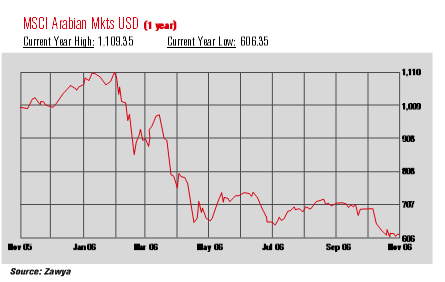
Instead of the post-Ramadan surge which many of the region’s financial analysts and traders had augured during the slow days of summer, important Middle Eastern stock markets converged to a measly November diet in the bear’s kitchen. Over the coming months, these markets will have to deal with the poor investor confidence of which the selling mood speaks volumes—all the more so since corporate results and macro indicators may be much friendlier than the share price performance toward the end of 2006.
Downturns across the region
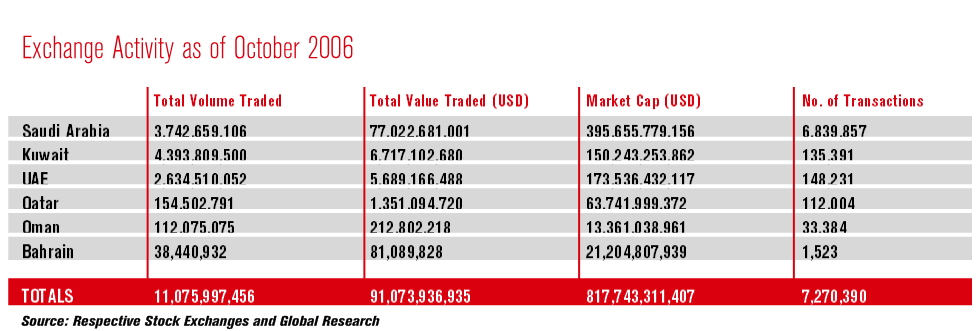
The Cairo and Alexandria Exchanges retained their ground with continued sideways trading, but the Tadawul Index of the Saudi Stock Exchange moved south by about 2,000 points, or 20%, between Eid Al Fitr and November 26. The Dubai Financial Market was not far behind with a drop of 17%, the Doha Securities Market lost 15%, and the Abu Dhabi Securities Market retreated by about 12% over the period.
The Bahrain Stock Exchange shed the gains it had made between mid-August and late-September and dropped back to levels in the 2,100 points range. The Kuwait bourse similarly weakened more than 5% and receded below 10,000 points in late November.
In Amman, the market gave up over 8% and in Beirut, the BLOM Index fell 7%—but that was its closing before the country received another blow through the assassination of Industry Minister Pierre Gemayel, after which the Beirut Stock Exchange shut its doors for several days, along with most of the country’s businesses.
This means that with exception of the smallish North African bourses in Tunisia and Morocco, Arab stock markets had nothing to boast of in the period immediately following the fasting month of Ramadan, a period which many experts had assumed would lead the markets to new consolidation or signal growth impulses after the correction phase that hit GCC and Levant capital markets in the first half of 2006, with some variations in terms of exact timing and severity of the respective share price drops.
While the danger of a crash in regional stock markets was thought distant by a substantial share of market protagonists in 2005, by the spring of 2006, capital market experts had noted that the downturn could no longer be considered a brief interlude. Many still expected the second half of the year to bring new promise, however.
With the year-end in sight, that optimism seemed increasingly premature, even as analysts said that the valuations of GCC equities are reasonable and offer good new potential—also given that the burst of the bubble in 2006 was fairly predictable because the region’s capital markets rally was driven by the oil boom and toward the peak of the rally, the ratios between oil prices and GCC equity market valuations had become excessive.
“At the market peaks, a significant disconnect developed between oil and regional equity pricing,” said Dubai-based investment firm Gulf Capital Group in a recent report, while concluding nonetheless that the markets are poised for future growth.
Harvest of oil revenues will continue
The broad consensus of international and regional financial institutions and banks is that oil will be the major force behind Arab economic and capital market trends for years to come, which also means that the region’s influence in the current account triangle of Western consumers, Asian manufacturers/new consumers and Middle Eastern oil suppliers is likely to increase.
In long-term perspectives, the global thirst for oil will not relent and oil-producing economies are bound to harvest the benefits. Within this outlook, the region’s economies and sectors will have further development opportunities, and various methods of share price modeling show that there are plenty of Middle Eastern companies with attractive upsides to their current share prices.
This is true even as 2006 results of listed companies suffered on the whole, due to shortfalls in their investment-related income and because some companies incurred losses that depressed the picture. As the National Bank of Kuwait pointed out in an analysis of earnings by UAE companies in the first nine months of 2006, one group of 14 companies with sound core earnings and accounting for over 60% of market capitalization achieved 27% growth in their net profit to a total of over $5 billion.
That was a much better performance than suggested by the modest 5% profit growth for 66 listed companies with published results, due to the fact that 23 companies reported declines in earnings and 11 incurred losses.
Thus, by global and local reasoning, investors will be well-advised to review the performance of Middle Eastern equities in the first nine months of 2006 and the entire year neither in search of short-term profit nor obsessing over the year-on-year slowing of earnings growth by many companies—which already a year ago seemed hardly avoidable for the 2006 earnings season, when corporation after corporation in the third and fourth quarters of 2005 had announced stellar growth rates in profits.
However, quick and speculative gains may not be easy to come by in the coming months and analysts now tend to see the consolidation phase of Arab stock markets as bound to take more time than expected earlier in 2006, which implies that rallies and bull runs in the near term will be the exception rather than the rule. But by measuring price to earnings as well as price to earnings to growth ratios, researchers such as Gulf Capital say that Middle East equity markets—with the exception of Saudi Arabia—are priced attractively in the long run.
Another matter of importance for the development of Arab equities is the regulatory environment and market culture. In this regard, several GCC countries moved to implement strict regulations and standards in order to purge violators of corporate disclosures and transparency issues.
UAE, Kuwait and Saudi Arabia tried hard to implement these rules and presented several companies to trials for lack of transparency and insider trading.
Additionally, the GCC countries realized that trading awareness and diversification are key aspects of sound capital markets. Governments encouraged education of market participants and supported the creation of increased awareness in the minds of inexperienced investors who were following the market trends and buying stocks without conducting fundamental analysis.
IPOs
The stock market correction did not prevent GCC investors from looking for quick profits through subscription in initial public offerings by Gulf companies in 2006.
IPOs of large companies such as Emaar the Economic City in Saudi Arabia, Al Babtain Power and Telecommunications, Advanced Polypropylene Co., Saudi Research and Marketing Group, Qatar’s Al Rayyan Bank, Bahrain’s Al Baraka Banking Group, the UAE’s Emirates Integrated Telecommunications (DU) and Kingdom Hotels Investment were oversubscribed several times.
The IPO trend is expected to continue in 2007, with 65 planned or rumored IPOs currently included in the IPO Monitor of regional business information provider, Zawya.
More than half of these IPOs are scheduled for Saudi Arabia and another 20% for the UAE, clearly indicating that the GCC markets will again dominate the regional IPO scene in 2007 as they did in 2005 and 2006. In Egypt, privatization and sales of already listed but state-owned companies will continue to appeal to investors.
Some of the high profile companies planning to go public or be privatized in the GCC are Saudi Development Bank (Inmaa) with $2.8 billion IPO, Saudi Arabian Mining Company ($1.06 billion), Saudi Aramco with $1.01 billion, Bahraini United International Bank ($800 million) and the privatization of UAE’s International Petroleum Investment Co. for between $540 million and $810 million.
Syria, where plans to launch the Damascus Stock Exchange are more likely to be implemented in the latter portion of 2007 than early on, could bring a boon to local investors through public offerings of new joint venture banks even ahead of the formation of the bourse. Later on, when the bourse’s rules have been tested and the playing field is open, the country has strong potential for its own IPO wave.
In Lebanon, where a number of IPOs scheduled for 2006 have been postponed until 2007 because of the summer conflict, the new year’s IPO prospects may have become open questions as long as the country’s political struggles preclude a clear investment picture.
To secure the interest of investors in future IPOs where political risk is not the problem, observers say that markets need to free themselves from overpricing issues through excessive issue premiums. One such example was the August 2006 IPO of Red Sea Housing Services in Saudi Arabia. The company’s asking price of 58 Saudi riyals ($15.5) per share represented a premium of SAR48 added to the share’s par value of SAR10. Analysts said that the SAR48 premium was 35% above the stock’s fair value.
Quick and speculative gains
may not be easy to come by
in the coming months
On the other hand, investors are also likely to stay alert to the unfulfilled promises that marred some IPOs such as the flotation for 20% of the Hariri family’s Oger Telecom on the London Stock Exchange and the Dubai International Financial Exchange, which was called off in the last minute in November because of “adverse market conditions.”
Integration of markets or expansion of corporate networks?
Other than tunisia and morocco, Arab stock markets had nothing to boast of
following Ramadan
One aspiration of Arab capital markets is convergence into larger trading realms. As a herald of greater integration of Arab capital markets into globalized trade, the DIFX was overall off to a slower start than its promoters had announced at its launch in September 2005. Similarly, rapid integration and eventual mergers of other Middle Eastern stock markets are not to be counted on with certainty for 2007.
However, on the level of corporate expansion and investments, the region’s equity markets are set for further enhancements. Some of the strategic privatization investments in Egyptian companies are prone to originate from investment firms and other corporations in the Gulf, and there is a strong likelihood of expanded equity participation by Gulf companies in firms in Jordan, Syria, and, provided that political fundamentals improve, Lebanon.
In one example for infusing capital into regional firms, Dubai International Capital invested $272 million in the Amman-based Jordan Dubai Capital Investment Company.
Such involvements are less prominent but for regional economies no less meaningful than high profile international investments by the likes of Dubai International Capital, which in 2006 included the purchase of UK engineering firm Doncasters and assumption of a $1 billion stake in DaimlerChrysler.
A recent report by International Institute of Finance (IF) and Dubai-based Hawkama, a corporate governance institute, said that GCC companies acquired close to $26 billion worth of assets in UK, Europe and North America in the first eight months of 2006.
Despite the scrutiny of Arab investments in US-linked companies and the problems that marred Dubai Port World’s acquisition of P&O over the group’s US operations, the 2006 trend of international investments by regional corporations is bound to continue in 2007, while the importance of Arab investment firms grows in regional and global capital markets.