
In the past few years, bullish financial markets have witnessed an unequaled surge in profits, on which financial institutions have capitalized massively. In the MENA region, the constant income stream stemming from spiking oil prices has added to this phenomenon. Financial Funds Advisors (FFA,) a Lebanese financial institution, seems to be gearing up for the race to offer sanctuary for this surplus of Arab money. Quintupling its shareholder’s equity to $25 million, it has moved into the rarefied circles of private banking
Established in 1994 as a brokerage firm focusing on financial advice delivery and mutual fund distribution, FFA has recently acquired a specialized license from the Central Bank, allowing it to become FFA Private Bank. Its change in status, which required moving from the structure of financial institution and brokerage firm to a private investment bank, was mainly drawn from the need to build recognition among potential local clients and correspondent institutions.
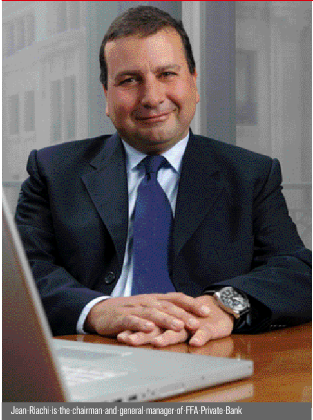
“The status of a financial institution in Lebanon is the equivalent of an investment bank anywhere else in the world. It specializes in non-commercial banking services such as lending, fiduciary deposits, portfolio management and brokerage as well as advisory services,” explains Jean Riachi, chairman and general manager of FFA Private Bank. “However clients and other company stakeholders had trouble grasping our institution’s former status,” he adds.
Setting a precedent
Another underlying reason behind FFA’s change of status was rooted in some of the operation’s technical aspects. “Investment operation activities are for the most part off the balance sheet ,” says Riachi. “In terms of wealth management, a client can hold with us custody money, securities or cash under fiduciary. But we also need to offer him the option of term deposit accounts.”
In addition to providing equity and debt financing, the new license allows FFA to participate directly in companies with its own funds without reverting to outside investors.
“As a private bank, we can operate fully with some restrictions on the retail and commercial side of activities, such as short term credit and deposit, which in any case, we have, no real interest,” underscores Riachi.

Two years ago, FFA held talks with Central Bank governor Riad Salame who said he also believed it was time to strengthen areas such as the capital market, mutual funds and investment banking. “We informed the governor of our desire and commitment to consolidate our human and financial structure by increasing capital, inviting powerful shareholders and hiring additional staff,” Riachi recalls. “However, we did not feel comfortable with the FFA financial institution status.” One possible solution was to aquire an existing commercial bank.
“We went through some of the files on hand and came to the conclusion that much time and resources were needed to restructure any available operation, something which we did not really have. As a matter of fact, we were not really interested in the commercial banking activity.”
Another option was to obtain a specialized bank license — which imposed restrictions on certain operations such as short term deposits and credits. “Today, we’re the first independent private bank in the Lebanese market, where the investment banking activity is, for the most, affiliated either one way or the other, or fully owned by financial institutions and commercial banks. I believe granting a specialized license to a private group constitutes a precedent for the Central Bank,” says Riachi.
Given the positive sector reactions, Riachi feels the launch of FFA Private Bank will set a much needed trend within the Lebanese financial sector. “Commercial banks are commercial banks and this can lead to a conflict of interest when dovetailed with private banking,” he says. Riachi believes that commercial banks may adopt a less aggressive stance towards their investment banking arm and not allocate sufficient resources. “It is also a question of corporate culture, one that varies greatly between private investment and commercial banking structures, leading sometimes to undeclared conflicts, when the two operations are functioning within one framework. Today, I can see the sector increasingly moving towards banks splitting and spinning off these two activities.”
The FFA Private Bank depends on a revamped framework comprised of several core activities such as private wealth management, capital markets, asset management, corporate and merchant banking, online trading and a real estate division. According to Riachi, its independent structure grants FFA a competitive advantage in terms of mutual funds, allowing it to deal with many different providers and hand picking the best. The private wealth management arm is built on a strict approach to asset allocation comprising sector and regional diversification. “Of course, in terms of asset management we are free to focus on areas where we believe we can add the most value,” he adds. One of such examples would be the Lebanese real estate fund offered by FFA. In Georges Abou Jaoudeh’s opinion, FFA’s other general manager, the real estate development activity has proved to be successful and the company intends to duplicate the same line of business in the Gulf region. “We are working also on launching a real estate fund that will be investing in Lebanon and the neighboring countries,” he adds. “Since all of FFA Private Bank’s high-net-worth clients in Lebanon and the region are very sophisticated, customized financial solutions have been devised through FFA open architecture platform, in order to respond to all their needs,” says Abou Jaoudeh.
Hence, a product in relation with the equity regional market is under preparation. The company is supported by an online division dubbed FFA direct, a platform for online trading in equities, future markets and currencies, headed by Elie Khoury.
In a market dominated by major international players, Riachi has relied on the advantage of cultural and physical proximity FFA offers. “This advantage is backed by a reputation for offering the highest standard in terms of service and performance, as well as access to the best fund managers in the world.” For clients who are concerned by the unstable situation prevailing on the local level, Riachi believes that as security accounts are not exposed to corporate or country risk.
Carving a niche
“Regarding the corporate and merchant activity, we understand that competing with big players might be difficult. On the other hand, we believe that we can carve a niche for ourselves in the market of medium-size deals, which by nature are not handled by big industry names for reasons of economies of scale,” states Riachi. The FFA chairman nonetheless concedes that although the company may face much competition on the different corporate levels, the challenge is part of the job. “In the corporate and merchant banking sector, FFA Private Bank has yet to prove itself.”
FFA’s regional presence is secured through its DIFC subsidiary FFA (Dubai) Limited, a financial service provider that will essentially cover the GCC countries and will be fully operational by next fall. “Our marketing approach targets very high net worth individual with $1 million or more in liquid assets. Such clients are constituted for the most by business owners and we intend to capitalize on this specific factor to market our corporate and merchant finance activities,” says Riachi.
To build and expand its client base, FFA is looking into new investment tools. Abou Jaoudeh underlines that FFA is closely following the success and growth of Islamic financial products in the region. “We aim through our asset management division to participate in structuring new financial products that will be sharia compliant,” he explains. “We are monitoring the Arab equity markets and believe that there is tremendous growth potential; consequently we are in the process of finalizing and launching a new certificate that will give exposure and participation, through one product, to all the upside potential of these markets.”
