
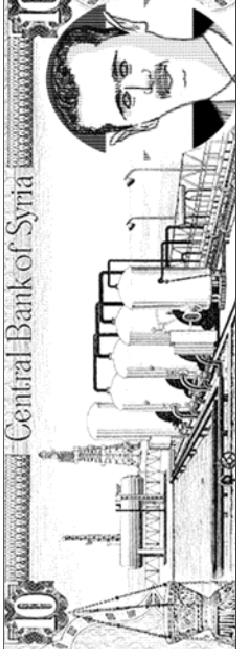
Syria’s reform drive, expected to step up in 2007, is most noticeable in banking and finance. Although the state dominates the sector, private banks and financial services are opening up, and banks are increasing their lending to industry as well as retail banking. Syrian bankers are cautiously optimistic overall, though often frustrated by the slow pace of change.
After a half-century absence in the Syrian market (since nationalization in the 1960s), Law 28 legalized private banks in 2001; there are now 10 banks operating (or about to open shop) in Syria, according to reformist Deputy Prime Minister for Economic Affairs Abdullah Dardari, including three Islamic banks following their legalization in 2005. The first Islamic bank, a joint venture of the Bahrain-based Al Baraka group and Syrian investors, called the Syrian Islamic Baraka Bank, is slated to open before the end of 2006 with $100 million capital.
Banks that got in early have started to turn modest profits, despite only two years in the market (although legal since 2001, the first private banks only opened their doors in 2004). One of these, Bank Bemo Saudi Fransi, a Syrian-Saudi-Lebanese venture, saw its assets nearly triple in the first year and turned over a modest profit of SYP 53 million in 2006. Although state banks account for about 70% of business, private banks are making inroads, with their deposits going up by 95% in 2006, Dardari says.
Retail banking potential remains untapped, with little awareness
of services available
Since late 2005, cuts in stamp duty and central bank permission for private banks to finance up to 65% of import needs and issue their own letters of credit have opened up new possibilities for banks in Syrian trade financing, hitherto largely the domain of Lebanese and Jordanian banks. Liberalization of the trade sector should provide rich pickings for banks in the coming few years. The target for Syrian banks will be the capital that 41% of Syrian enterprises still place in offshore banks.
Syria’s retail banking potential remains largely untapped, with many Syrians having little awareness of services available. Syrian banks plan to roll out more branches in 2007. According to Ernst & Young Syria’s Abdul Kader Husrieh, speaking at a British-Syrian Society banking conference in November, Syria’s 300 bank branches need to double to match regional standards, and more than triple to meet those of emerging markets. Such an under-developed sector, he argued, offers lucrative opportunities for foreign investors to join Syrians in creating financial institutions.
Private banks have many gripes
Despite broad optimism about the overall direction, private banks have many gripes. Among pressing challenges are the lack of a credit risk agency at the central bank, making it hard to trace a customer’s credit history in a country where corruption is endemic. Syria’s four under-performing, lumbering state-owned banks also monopolize many industries, wrong-footing private banks, distorting the market and prompting private-sector calls for at least partial privatization, which remains an ideological taboo in the socialist country. US sanctions on the state-owned Commercial Bank of Syria, introduced after accusations of money-laundering, also tarnish the image of the private banks abroad, they say.
A lack of options for earning returns on excess liquidity, despite an onerous obligation to pay 7-9% on deposits, is a key difficulty plaguing private banks. The large customer deposits that bless the sector often sit in vaults at zero interest. Difficulty obtaining reliable information about small and medium enterprises is another barrier to investment, detrimental to both the banks and the small businesses that are Syria’s lifeblood.
Answering long-standing bankers’ demands, the central bank has announced plans to start issuing treasury bills by the end of 2006. It has also promised to raise the capitalization limit for private banks from $30 million and increase the permitted foreign ownership of private banks from 49% to 60%. Syrian law still stipulates, however, that foreign banks set up subsidiaries in Syria, rather than branches—an off-putting condition for many international banks.
Syria’s latest five-year development plan promises increased independence from the central bank, which currently imposes foreign exchange controls and caps private banks’ interest rates. Reforms outlined by Central Bank Governor Adib Mayaleh over 2006, if implemented fully, will push the institution towards the role of regulator rather than controller and have raised hopes it is becoming more responsive to the public sector. Mayaleh says the bank will loosen controls on the interest rates set by public and private banks over the next year, unify Syria’s multiple official exchange rates and establish and regulate a foreign currency market.
A key financial services development in 2006 was the establishment of two private insurance companies, legalized the year before, after 40 years of a single state-owned provider. Insurers predict rapid growth in the next few years in this untapped emerging market, with insurance spending averaging out at just $7 per capita (compared to $150 in neighboring Lebanon, for example), based on the state-owned Syrian Insurance Company figures.
Retail insurance provision is likely to be the largest area of growth—just 3,000 households are insured in the country of 17 million people—though low incomes, traditional reliance on family and a lack of understanding among much of the population will pose considerable challenges. Industry observers also want reductions of the hefty social security payments of 23% of the salary of each worker in Syria to the Social Affairs Association. Eleven private insurance licenses have been granted so far; until more insurance companies start up, prices will remain non-competitive, observers say. Other financial services are on the way, though it is not clear how soon: the government has set up a committee to draw up a mortgage finance law and another for developing a leasing law.
Pressing challenges include
the lack of a credit risk agency
at the central bank
Stock market opening anticipated
A reform process milestone to look out for in early 2007 is the opening of a stock market, which is expected to galvanize Syrian banking. Its success will depend to some degree on broader financial and business development as well as structural changes—the lack of an independent judiciary is a particular worry in a country where vested interests appear, if anything, to be on the rise.
The Syrian Capital Markets Authority, however, features a cast of experienced and capable names. At the November banking conference in Damascus, Authority Chairman Mohammed Al Imady said regulations to establish the market (awaiting cabinet approval at the time of writing) were up to international standards and incorporated good governance principles. Even an imperfect stock exchange, many observers believe, should encourage transparency, especially since it will be open to both domestic and foreign investors. Listed companies will also be legally required to appoint compliance officers.
The Commercial Bank of Syria’s announcement that it was preparing to list on the stock market was welcomed as a sign of a shift from state dependence even in the public sector. During 2006, public banks upped their game in response to the private sector challenge, with the Commercial Bank of Syria in particular increasing its capital, improving client facilities and training of employees and computerizing its system.
Syria’s banking scene is already unrecognizable compared to the start of the decade. Realizing the potential of this alluringly under-banked country will depend on parallel reforms in the real economy that will allow banks to generate assets from industry, agriculture, trade and tourism.
