

Corporate governance—or CG—is the new buzz word in the region as banks and financial institutions scramble to adopt anti-money laundering and counter terrorism financing laws, implement due diligence, and abide by the Basel II accords to effectively compete in our globalized world.
Since 2001, the US has been at the forefront of pushing this new corporate diligence ideology, and the region, particularly the oil-rich GCC, is wising up to the new mindset—not only to attract investment but also when investing in other markets. Foreign companies, particularly from the West, are looking for effective CG before investing. But the spanner in the works is that the implementation of CG in the Middle East is moving at a snail’s pace.
Out of 10 major banking and financial institutions contacted by Executive to discuss the implementation of CG, only one could talk with authority on the subject. And this is with four of the 10 in the top 20 of The Middle East magazine’s top 100 Arab companies.
This is somewhat surprising, as CG is about improving performance, transparency, management and communication. In a nutshell, CG is about the way in which board members oversee the running of a company by its managers, and how board members are accountable to shareholders and the company itself.
CG involves improving performance across the board—the “governance” in “CG”—and in company behavior toward shareholders, clients and employees. And rather than have management governed centrally, CG is about de-centralization and distributing the workload more effectively, freeing up, rather than overloading, upper management’s time, for instance—hence the need for corporate officers, PR spokespeople, compliance managers, and so on.
But the attitude of financial institutions contacted could not be further from even moderate aspirations of CG implementation.
One leading bank said that they had implemented CG in Lebanon, but for authorization would have to speak to their headquarters in Jordan, as that was where CG decisions were made.
Elsewhere, asking to speak to an administrator concerned with CG at a financial institution the response was: “I really don’t know what you are talking about.” Likewise, one of the top banks in the GCC said: “You need to liaise with the corporate … what do you call him?” After being shunted from one person to another and innumerable emails with promises to reply, there was nothing to report.
At a different bank, the caller was directed to the head of PR, but on getting through was informed by voice mail that the person was away for the week. No one had been deputized to take over.
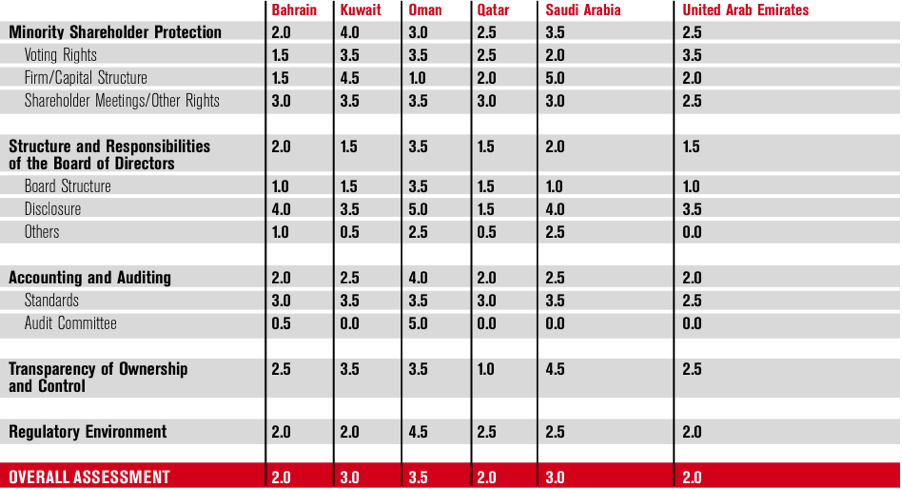
Comparison of corporate governance frameworks in the GCC with IIF guidelines
(On scale of 1-5 with 5 being fully compliant)
Few can define CG, much less institute it
Judging by this small sample, it would seem as if some of these institutions do not fully understand what effective CG means.
This is something that the Dubai-based Hawkamah Institute for Corporate Governance, set up to encourage CG in the region and headed by the former economy minister and vice-governor of Lebanon’s central bank, Nasser Saidi, is only too well aware of.
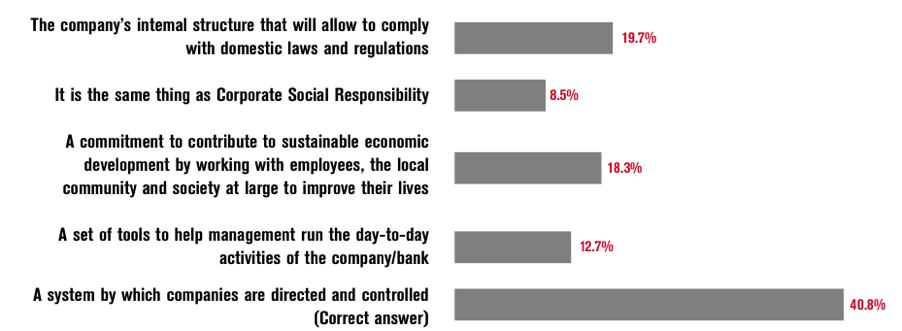
In a recent Institute of International Finance (IIF)-Hawkamah survey on the GCC, 59.2% of respondents were unable to define CG, while only 59.3% of respondent cited CG as important or very important.
The survey, evaluating CG standards across 56 criteria in five broad categories—minority shareholders’ rights; responsibilities of board of directors; accounting and auditing standards; transparency and ownership; and regulatory environment—found that the average for compliance with international best practices was almost 50%. Considering the GCC is ahead of other Arab countries, the region’s adoption of CG is far lower than other emerging markets such as India with 75% and China with 65%.
Taking these results into account, it is perhaps not very surprising that so many banks and financial institutions were mute in their ability to discuss CG.
Stephen Vink, head of group risk management at Global Investment House in Kuwait, said it didn’t come as a surprise that so few companies responded.
“I went to an inaugural conference on CG in Dubai about one month ago. There was a huge turn out but because of specific methodology there is a fear CG will impact on business—profits, disclosure and transparency,” he said.
“I think there’s a fear, a misunderstanding, of what CG is about, so people are shy. To say companies have not implement CG is not correct, but to say they have 100% is not true either,” Vink added.
Indeed, the IIF-Hawkamah survey found that the top three barriers to CG cited by respondents were a lack of qualified specialists to help with implementation (53.6%), lack of information or know-how (37.7%), and low priority of CG in relation to other tasks (24.6%). It is the latter statistic that is perhaps of most concern to proponents of rolling out CG in the Middle East.
“The region is still at very early stages of corporate governance implementation. While there are a number of companies that are implementing good corporate governance practices, they are few and far between,” said Nikolai Nadal, director at Hawkamah.
Nadal said that banks, primarily because of Basel II requirements, are the most responsive in implementing CG. “Listed companies, primarily because of listing requirements on CG, are also responsive, but their responsiveness depends on the degree that capital market authorities and stock exchanges enforce the corporate governance frameworks,” he said.
“The corporate governance legal and regulatory environments, except for Oman where it is quite advanced, are starting to take shape with some countries looking at modernizing their company laws to include adoption of key CG principles,” he added.
In a comparative survey of CG frameworks in GCC countries that abide by IIF guidelines, rated from 1-5, (5 being fully compliant), Oman scored highest with a 3.5, Saudi Arabia and Kuwait got a 3, and Bahrain, Qatar and the UAE received a 2.
Who knows what CG means? (Nearly 60% don’t)
Oman on top when it comes to CG
Oman tops the league, said Nadal, as the Oman Capital Market Authority adopted a corporate governance framework as early as 2002.
Spurred on by the IIF-Hawkamah findings, the financial hubs of the UAE are scrambling to get up to par.
Khaled Deeb, Head of Internal Audit at the Abu Dhabi Chamber of Commerce, said some companies in the emirate had implemented CG and the government was fully behind such initiatives, kicking off a program this year to encourage companies to do the same.
“CG is very important. It is not new, but new in the market, in this country, and this region,” he asserted.
Regarding family businesses, of which there are 200 in Abu Dhabi, he said the chamber was working closely with Hawkamah to encourage family run enterprises to adopt a certain CG code. “But it is not easy to implement, you need to believe in CG first. You can get a consultant, but companies need to see the value of implementing CG,” Deeb said.
To encourage companies, Deeb said the chamber is thinking of implementing GC free of charge at a private company or family business as a pilot case to highlight the benefits to other companies in the emirate.
The Union of Arab Banks (UAB) on the other hand has been working for the past five years with the OECD, and now Hawkamah, to implement CG in the region.
“CG is essential for economic reform and attracting investment, for without CG there can be no reform,” said Fouad Shaker, the UAB’s Secretary-General.
Shaker said he was pleased with the adoption of CG in the region, particularly in Jordan, the first country to implement CG regulations, in Lebanon, which has adopted a Manager Institute, and in Egypt, which has also established an institute.
“As for the central banks, most—if not all—have set rules to apply CG,” he added.
However, Vink believes that central banks could be doing a lot more to regulate CG, such as introducing spot inspections.
“A lot of reliance is placed on returnees ticking a certain box. If you look at the growth of CG in the West, inspections are part of the process. Very soon the next process here to kick in will be the fear factor: ‘I’m from the central bank, you are regulated by us and I’m here to inspect for two days.’ This is not happening here, but to be taken seriously the region is going to have to do this,” Vink said.
Other factors of good CG also need to be taken seriously. Compliance, risk management and internal audits are the backbone of CG, but in Kuwait, Vink said, there is no requirement to have a risk management department. “But any investment company that doesn’t is probably committing suicide,” he stated.
Other regulations also need to be tightened and standardized as there are differing regulations for retail banking and investment houses, with CG regulations a lot less stringent for retail banks.
“You need to level the playing field, and more or less have the same requirements to apply because both are dealing with clients’ money and customers,” said Vink.
Local peculiarities are also hindering CG growth, with traditionally more trust between companies in the Arab world than elsewhere, few corporate failures, and minimal white-collar crime or fraud. “I don’t think we should wait until that happens,” Vink asserted.
Indeed, the IIF-Hawkamah survey found that due to high liquidity in the region, with easy access to capital, there was little incentive to change at the company level. Excessive liquidity is also creating high volatility in stock markets with too much money chasing too few stocks, which Hawkamah attributes to a lack of sophisticated investors and poor equity culture.
Despite such economic complacency, Vink said that all it would take is for a major scandal, such as the collapse of a large bank, to send a shockwave through the region that would have seriously negative repercussions, particularly on the outlook of Western investors.
With an international tendency to lump Arab countries together and refer to businesses as “Middle Eastern,” rather than country-specific as in Europe or the States, the relative interdependency of Arab markets would suffer from a major scandal. And some 99% of corporate scandals, according to Vink, happen due to a breakdown of CG.
Vink said he based his benchmark for good CG on his native South Africa, which has adopted similarly strict rules as the UK. But he said institutions are perhaps overregulated in South Africa, such as the dual listing of the Johannesburg Stock Exchange and the London Stock Exchange. Equally, some countries have responded to corporate scandals such as Enron in the US and Parmalat in Italy in a reactive way, often implementing excessive CG regulation. The Sarbanes-Oxley Act of 2002 for instance, implemented in the US in the wake of the Enron scandal, has been criticized by financial institutions in recent years for hindering the decision making process—a view shared, incidentally, by former US Chairman of the Federal Reserve Alan Greenspan.
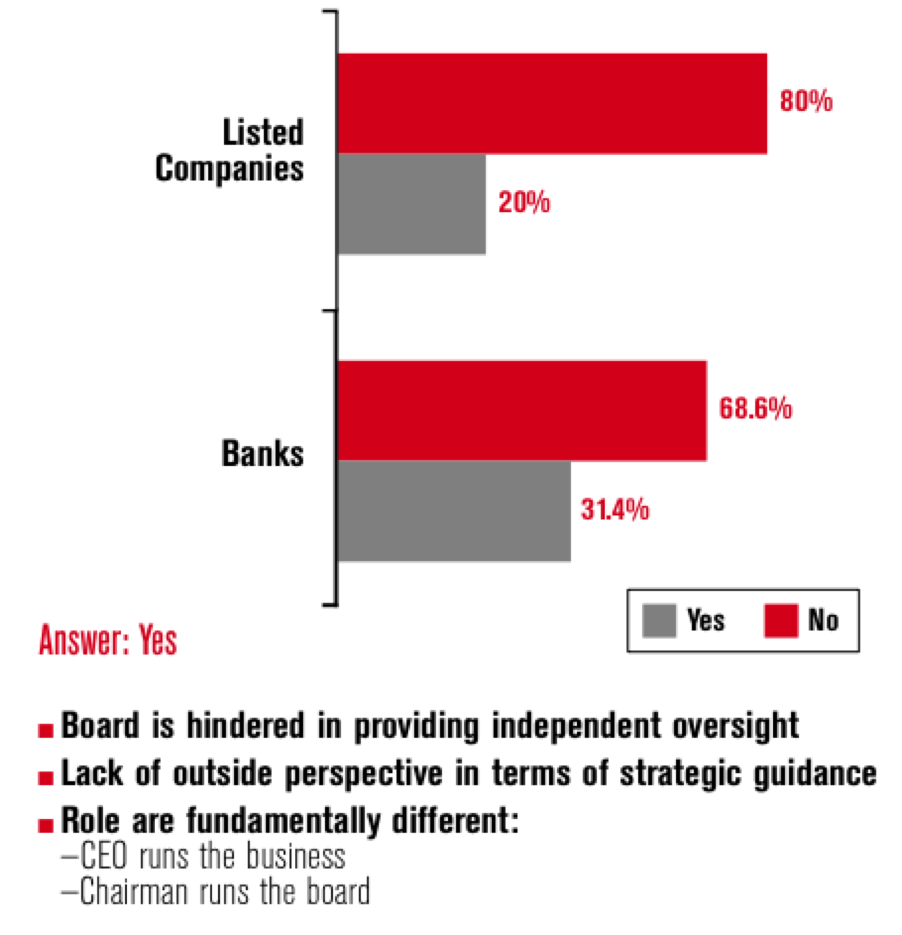
Is combining the positions of CEO and chairman against best practices?
As a result the region should learn from the experience of other countries in the implementation of CG and get the right regulatory balance.
The ultimate question however, as the IIF-Hawkamah survey highlighted, is why companies should implement CG.
Vink’s Global Invest is applying a risk management framework based on best practices. The reasons for that are two fold, he explained: “It’s prudent business to be proactive and have risk management for the organization. Secondly, as a result of methodologies, organizations will be a lot more efficient.”
As CG is a long-term view and essentially a bottom line cost, companies should not be looking for immediate short-term benefits. “There is a price to be paid for sustainability,” said Vink. “From a scientific and mathematical perspective, CG does make sense. Investors are prepared to pay a 30% premium to have CG, but there is no way CG will cost 30% to implement, so that’s the value.”
And the value of CG goes far beyond profit margins. Implemented effectively from the top-down, good CG will improve a company’s performance, attract more investment and help it get taken more seriously by international investors.
“Any big organization outside the Middle East will not put money in an organization without transparency,” asserted Vink. “Regional organizations need to be proactive; there needs to be a new mindset” to implement CG, he added.
