Syria is stepping up reforms to become a “social market economy,” and accelerated changes are widely expected in 2007. But with the country projected to become a net importer of oil in 2008 and the structure of a command economy still in place, deep and radical change cannot come too soon.
Syria’s economy has the potential to one day be among the region’s most diversified. Strong foreign currency reserves, low national debt, abundant agricultural production and a large manufacturing sector are some of the points in its favor. Yet the economy is not even operating at 15% of its capacity, according to the estimates of Abdul Kader Husrieh of Ernst & Young Syria. Corruption, chronically inefficient industry and agriculture and a bloated and opaque bureaucracy are among many reasons for decades of underperformance.
A long-awaited reform program to provide cohesion and underpin the ambitious goals stated in five-year indicative development plan that started in 2006 is under formulation and expected in the first half of 2007. Ambitiously, it projects a growth rate averaging 5-6% per year, reaching 7% in 2010. Although many economists doubt this is possible, they applaud a new desire to aim high as a sign of commitment to progress. In a significant ideological shift, heavily centralized Syria formally adopted market reforms at the Baath Party congress of June 2005, arming reformers to defend their arguments against a shadowy “old guard” that remains resistant to change.
Leading Syrian economist Nabil Sukkar points out that reform will require the leadership to lose its adversity to risk at a time when dwindling oil reserves—and with them hard currency receipts and state revenues—threaten the macroeconomic framework and the political environment is particularly unstable. Syria remains under severe international pressure with US sanctions and the international investigation into the assassination of former Lebanese Prime Minister Rafik Hariri, which has implicated Damascus.
Expectations of a US rapprochement with Syria were gaining strength at the time of writing, in anticipation of the release of the Baker Commission’s Iraq study, which is expected to recommend dialogue with Syria and Iran. Syria and major trading partner Iraq restored diplomatic ties in mid-November. But strife in Iraq and Lebanon in 2006 exposed the vulnerability of Syria’s investment climate to regional troubles. Accusations that Damascus had a hand in the assassination of Lebanese Minister of Industry Pierre Gemayel in November cast a shadow over hopes that Syria was coming in from the cold.
Reform outlook
Reform started at a snail’s pace in the late 1980s under late President Hafez al-Assad, who, faced with a public sector that could no longer provide, made tentative steps to encourage the private sector. But after Investment Law No. 10 of 1991, which offered incentives to investors, including those from abroad, reform largely froze.
Bashar al-Assad’s reform pledges when he took over in mid-2000 built up hopes, but bankers and investors have grown impatient with the slow pace and lack of depth and say reforms tend to be disjointed and reactive. The term “social market economy” is also ambiguous. Policy-makers have yet to determine, Sukkar says, how much emphasis to place on social safety nets, how much on growth.
Change has been significant, however—particularly in banking and insurance—and appeared to regain some momentum in 2006. A stock market is expected to open in early 2007. Economists hail Deputy Prime Minister for Economic Affairs Abdullah Dardari as a determined reformer. Despite initial resistance from reactionaries in the leadership, he now appears to have stronger state backing, reflecting a belated recognition that there is no alternative to reform. A February cabinet reshuffle handed technocrats the ministries of Industry, Economy and Higher Education.
A fundamental shift is needed in the state’s role. Subsidies on fuel and commodities are an example of state drainage of the economy and one of the most pressing—and politically sensitive—concerns. An International Monetary Fund report from October 2005 found that subsidies equated to about 14.7% of Syria’s GDP. Dardari has promised a blueprint by the end of 2006 showing how to tackle the problem. No doubt with an eye to the civil disturbances that followed subsidy cuts in Egypt, Jordan and Yemen, it is believed the government is seeking a way to “target” the subsidies to ease the burden on the poor.
Creating jobs for a burgeoning population is one of the most urgent challenges for Syria. New entrants to the job market number 250,000-300,000 per year, but the economy only creates 180,000 new jobs. The realization is dawning that only a dynamic private sector can fill the gaps. A UNDP report in 2005 found that 2 million Syrians, out of a population of 17 million, could not afford to meet their basic needs. Broader poverty affected nearly a third of Syrians. While the government estimates unemployment is around 8%, economists say it is closer to 20%, and that does not include legions of under-employed workers that would need to be retrained and redeployed under any far-reaching reform of the public sector.
Using some of the oil revenues to create a fund to cushion the transition, pay unemployment benefits (currently non-existent in Syria) and retrain is advocated by reformers. Some 90% of the workforce is employed by the state, and under Syria’s antediluvian labor laws, only the prime minister can fire them. A major obstacle to creating a competitive market economy in Syria is the low level of technical training—Syria’s free and universal education system places little emphasis on usable skills. The recent decision to allow private universities is hailed by the private sector as a step in the right direction.
Economists hail Deputy PM for
Economic Affairs Abdullah Dardari as a determined reformer
Growth areas
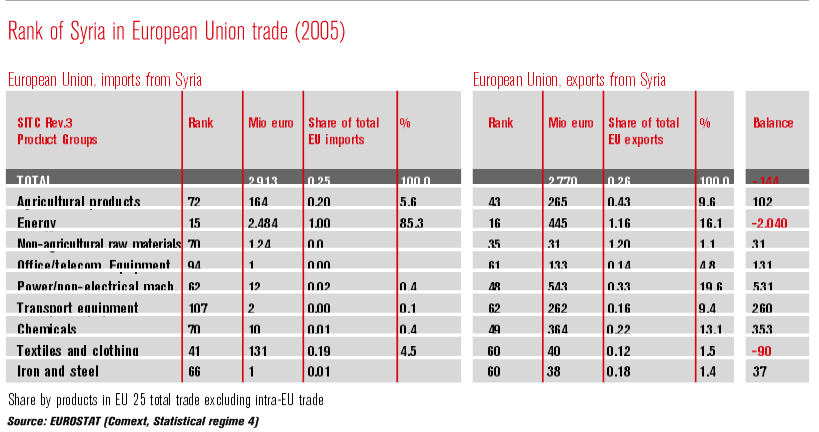
Syria’s oil reserves are estimated at about 3 billion barrels of crude. Oil production is trailing off dramatically, barring new discoveries. Natural gas reserves are considerable, at around 240 billion cubic meters, but production is under-developed and most of the gas is destined for internal use rather than export. Syria’s potential for diversification is high, but will take a radical overhaul of state structures and institutions. According to the Syrian Investment Bureau, FDI in licensed projects rose to 30% in 2005 from 11% in 2004. With free trade agreements (FTAs) with Iran, Iraq and the Gulf—not to mention an anticipated EU agreement currently held up for political reasons—Syrian manufacturers have no shortage of markets.
However, FTAs hold severe risks as well as promise in a country where, for decades, industries remained deliberately small—95% of companies employ 10 people or less—for fear of nationalization. The government and rapidly developing private sector need to focus on supporting small and medium-sized enterprises (SMEs), the backbone of Syria’s economy, to help them upgrade if growing free trade is not to destroy local businesses and harm Syria’s balance of payments. Providing a transparent regulatory environment is crucial to enabling private factories to compete.
Manufacturers are missing out on considerable profits because of a lack of marketing and packaging capacity. In textiles, Syria’s second industry after oil, Syria tends to provide to wholesalers. Critics say the government has opened up to foreign competition—cheap garments from Asia hit the shelves this year—without supporting an industry that employs a third of the workforce. Syria gives no financial breaks to the textile exporters that would help the industry, mainly based in the northern city of Aleppo, to compete with Egypt and Turkey, particularly in European markets.
Similarly, Syria is the world’s fourth-largest producer of olive oil, but the country has no capacity to bottle and market it, so well-equipped producers such as Italy buy Syrian oil, repackage it and earn the bulk of the profit. At $800 a barrel, olive oil could be considerably more lucrative than fuel oil. Economists say local businesses need technical assistance and exposure to the outside to learn how to standardize production for export and compete internationally after decades of protectionism.
Across agriculture as a whole, it’s a similar story. Syria has food self-sufficiency and the potential to become a regional breadbasket, but socialist land laws—which place limits on the amount of land one person can own—mean farms are small. These ceilings are another sensitive issue, but one Syria will need to overcome in order to upgrade and mechanize production for export.
Damascus is placing high hopes in tourism as an eventual replacement for oil’s hard currency receipts. Tourism Minister Saadallah Agha al-Qalaa has stated tourism figures will be up by 6-8% for 2006, despite a disappointing summer season because of the war in Lebanon. Growth reached 11% in 2005, when 3.4 million tourists visited Syria. Damascus hopes that figure will reach 7 million by the end of the decade.
Syria has abundant cultural, historical and recreational tourism potential, with a wealth of historical sites and a stunning coastline. The country’s largest-ever tourism development plans to take advantage of the latter: Antaradus, a $200 million hotel and leisure complex at the northern port city of Tartous, was inaugurated this year. The tourism ministry has earmarked a further 82 projects for investment and cut taxes and red tape applying to tourism investments. Critics say the government could do more to promote tourism abroad, and in November, the ministry announced a sharp increase in its marketing budget for 2007, up to $5.5 million from $1.6 million. Gulf interest is considerable and expected to be keener if the regional political situation calms in the coming months.
Syria must catch up with
decades of lost momentum
The fledgling real estate sector has received much attention since licenses were first permitted in 2005, especially from Gulf investors, though again, many appear to be waiting for political tensions to ease. Emaar jumped in with the Eighth Gate, a multi-billion-SYP project in Damascus. The potential is clearly vast, but few projects have yet broken ground.
For Syria to defuse the economic time-bomb presented by shrinking oil reserves, it must catch up with decades of lost momentum. All eyes are on the state’s reform program, hoping it will provide a clear path to the market economy that is now all but inevitable for Syria. For this challenge to be met in more than a piecemeal way, Syria will have to tackle the toughest problems of all: setting out an independent judiciary and a transparent bureaucracy, almost certainly in the face of vested interests. As other emerging economies have shown, taking a shallow approach to market economy transition can concentrate money in the hands of a corrupt elite, deepening the economic woes of the masses and risking eventual instability.