
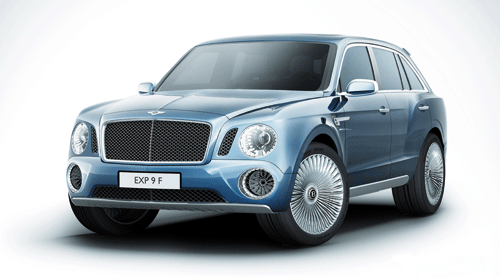
Every time the curtain rises on a motor show these days, it seems a new luxury sports utility vehicle (SUV) is crowding the limelight. A year ago it was the Ferrari FF, four seats, four-wheel drive, a 650 horsepower “family car” targeting the snow-bound vacationer. This spring we got our first glimpse of Bentley’s XP9 concept, the “Queen’s Car” for the super-rich soccer mom, packing both a 12-cylinder engine and a built-in silver-and-Lalique crystal picnic set.
A month later, Lamborghini unveiled the Urus at the Beijing motor show, signaling its own entrance into the luxury SUV ring. Three makers, 7,500 miles apart, but as the saying goes: Once is an anomaly, twice is coincidence. But three times makes a trend.
The entrance of these ultra-luxury brands solidifies a trend started more than two decades ago. It was 25 years ago, after all, that Lamborghini sortied what many consider the first luxury SUV, the LM002 — a chiseled, muscular SUV that would have been right at home in the movie ‘Jurassic Park.’ The car, originally modeled on a military-purpose vehicle codenamed “Cheetah”, sold out almost overnight. Then, of course, there was the Cadillac Escalade — a revamped version of the GMC hauler — bombarded with derision until its sales numbers shut up the critics for good.
The real pace-setters for the modern wave of luxury SUVs came in the late 1990s, in the form of the BMW X5 and Mercedes-Benz M-Class. These “crossovers” were the first to take the concept in a truly new direction, moving away from the militaristic ruggedness of the old design toward something closer to a synthesis with the sports car model. But what started as a trickle has since grown into a flood. Luxury SUVs are taking an increasing share of the limelight, attracting a new class of car buyer — the top-dollar family man, the ultra-rich soccer mom. And that means new business — a lot of new business.
Business is ‘bigger’
In part, the movement toward luxury SUVs has simply been a matter of market inertia. Many people outside automotive circles will tell you that the heyday of the SUV waned a decade ago; that, like the dinosaurs, the big-car movement of the 1990s tripped into a tar pit of high gas prices and drowned, succeeded by a generation of fleeter, more economical sedans. Nothing could be further from the truth. In the commercial markets, many makers are counting on big-car sales to flush out their profit margins this summer. Ford Escapes, Honda CR-Vs and the new Mazda CX-5s are selling like hot cakes, so much so that many dealerships are struggling to keep them in stock.
You can see similar patterns in the sports car markets as well, with sales of BMW’s “sports activity vehicle” segment — the X3, X5 and X6 — up more than 20 percent, and Audi’s Q5 Crossover SUV up an incredible 60.5 percent.
Porsche, one of the first makers to branch into the luxury family vehicle, saw more than half its June sales claimed by two of its break-out models, the best-selling Cayenne SUV and the Panamera four-door sedan.
For commercial and luxury markets alike, SUV sales have never been better.
Trimming down the Hummer
Some things have changed. The new genesis of utility vehicles has less and less in common with the behemoths of the 1990s, such as the Hummers and Mega Cruisers, designed for armored convoys and co-opted by suburban driveways. Sales of those hulking gas-guzzlers did, in fact, tank with the oil price spike of 2002, and today make up less than 10 percent of the big-car market.
The SUV idea has itself evolved to fit the times. The credo of “bigger is better” has been tempered by the reality of gas prices and the more carbon-conscious consumer, so that each new luxury SUV seems to compete for the mantle of greatest fuel-efficiency. Relying on clean fuels and ultra-light carbon-fiber components, the SUVs of today outdistance the Hummers of yesteryear by an order of magnitude.
Currently, the vast majority of SUVs sold are small and mid-range vehicles, defined by their high carriages and focus on front or all-wheel drive. These are family autos for the all-purpose urbanite — a synthesis of power, prestige and, of course, utility. The Bentley XP9 packs a W2 engine, 600 horsepower and enough cargo space for a family of five. The Urus’ chief designer, Filipo Perini, told Forbes Magazine that he wanted the car’s trunk low enough for the family dog to jump in the back. Size has given way to an emphasis on handling, speed and, of course, all the latest gizmos and gadgets to trick out your dashboard.
The marketing angle here is no mystery. While high-end sports cars have traditionally targeted young and middle-aged men, women make up more than half of all SUV drivers. Access to this sizable and previously untapped market segment has been largely responsible for the surge in sales that many of the early pioneers have enjoyed in recent years.
Super cars and Soccer practice
This creates a possible dilemma for the brand, of course. Not every critic out there is happy to see Lamborghini marketing family vehicles. In general, their arguments run as follows: It takes years — decades — to build a brand, to imbue it with certain qualities that go beyond carbon-fiber and chrome. For super cars, those aren’t necessarily qualities that mesh well with soccer balls and picnic baskets.
The machines that Maserati and Ferrari build are supposed to be pure experiences, works of art that sit outside the realm of the day-to-day. You wouldn’t treat them like a family minivan, the argument goes, any more than you would prop up a table with one of Michelangelo’s marble busts. The very idea of “utility” in conjunction with these brands seems heretical.
Ten years ago, just as the Cayenne was being unveiled, I posed this question to the president of Porsche. I told him I couldn’t believe that now, on some wind-blown highway outside of Dubai, I might come across a Porsche towing an Audi through the desert. He laughed, and assured me that the brand was safe. The SUV, he said, represented a new branch in the company’s activities, but not a new direction. This was hardly a step toward becoming a mass producer, and it wouldn’t shake the company’s focus on its core market — the fast, sleek sports cars that will always define the high-end auto consumer.
That much, at least, has stood the test of time.
And despite the many hybrids and crossovers to make their way into the market, when it comes to rough terrain, many believe the originals — Nissan Patrol, Range Rover, and of course, Jeep’s many iterations — still do it best.
Because seriously, if you’re going off-roading in Iceland, are you really going to risk the fenders on a $200,000 car?
