T he rating agency just won’t quit. Two
months ago Standard & Poor’s
(S&P) threatened that if the government
didn’t do something about fiscal problems
running wild, Lebanon would be downgraded
later this year. S&P’s latest incoming
targeted the country’s most cherished sectorthe
banks. Rest assured: The recent warning
did not highlight problems within the banks.
Whether or not the government heeds S&P’s
earlier signal will determine to a great extent
the problems that banks may face.
The agency went after financial systems
around the world that are vulnerable or
already tasting deterioration of credit quality.
If, by chance, defaulting on loan payments
reaches critical mass, banks could experience
a credit bust. Out of 15 banking systems
cited by S&P, US banks’ credit exposure
could be hit if the booming economy comes
to an end with a hard landing. Japanese banks
cannot prosper as the country’s recovery
from its financial crisis a decade ago is moving
slowly. Lebanese banks, on the other hand, are operating
in a feeble
economy and if it’s
not resuscitated in the
near future, loan portfolios could be in jeopardy.
“Lebanon is a special case,” says
Navaid Farooq, S&P’s sovereign analyst for
the Middle East and North Africa. “It’s about
macroeconomic conditions. We’re not concerned
about the banks themselves as much as
the environment they operate in, which is
riskier due to the government’s severe fiscal
imbalances.”
Relying on a rescue team to pull the
economy out of its dismal state is in question.
The administration, in office for two
years, put together a fivt:-year plan that
included lowering the debt, correcting fiscal
imbalances and stimulating growth.
Instead, it let debt to GDP climb from
118% at the end of 1998 to 140%. In the first
half of 2000, the budget deficit reached
53%, way above this year’s target of
37.3%. Economist Intelligence Unit reports that GDP growth fell to – l % in
1999 and predicts only 0.5% this year.
Right now there is a glimmer of hope that the
elections will bring in a new government able
to repair the crippled market. But the next government
has little room to maneuver. After debt
servicing and salaries and wages, the government
can only play with about 15% of its
expenditures – something they can’t reduce
since it’s their meager contribution to growth.
Raising taxes again to increase revenue
would bury the economy even further.
Many analysts believe emergency action
must be taken. ”The most important thing is
for the government to get money today,”
says Marwan Barakat, head of research at
Banque Audi. “It must relieve debt and debt
servicing as soon as possible.” He suggests
selling mobile phone licenses – $2. 7 billion
was lost when the government rejected offers from LibanCell and Cellis – and
picking up the pace on privatization. But
once a new government settles in, it might
be too late to make an impact this year. And
some wonder whether any Lebanese
administration can unite and generate political
will to implement solution~ “I don’t pin
any hopes on anybody anymore,” say~ um: analyst.
“We have to be realistic:
All government
policies will be dictated
by political interests, not
political will.”
On the upside, unlike the
wayward government,
most banks have the discipline
to prepare for the
worst. “Most of the banks
are low on lending compared
to other countries,
which gives them a lot of fat,” says Andrew Stephens, head of retail at
Credit Libanais. “And most have significant
assets in Lebanese T-bills. The banks do not
face deep problems.” By the end of June, the
loan-to-deposit ratio for the sector was 42%.
And expecting hard times, banks have
become less generous handing out money.
Loan growth fell from 20.5% in 1998 to
12.7% last year. Lending up to the end of June
increased only 3.7%. The banks are also high
on liquidity: Liquid assets to total assets
stood at 68% in the first half of 2000.
Creating a cushion using conservative tactics
makes it unlikely for numerous banks to
fall if defaulting on loans accelerates. “The
banks will get into problems only if they stop
lending prudently and start lending outside
certain banking criteria, as a couple of them
have done,” says Stephens. One case was
Inaash Bank. Found with bad loans and
fishy lending in violation of regulations, the
central bank stepped in and sold it to Societe
Generale Libano-Europeenne de Banque.
If obituaries are rare, one area will be difficult
to defend: profits. “Not many banks will
fail in the near future,” says Bassam
Yammine, senior manager of corporate
finance at Lebanon Invest. “Banks have
enough ammunition, especially the large
ones, to continue. I’m worrying mostly about
the bottom line.” There have already been
attacks on banks’ earnings. Spreads have been pinched in recent years. With interest
rates on two-year government paper falling to
14%, stiff competition has kept deposit rates
up (around 12% on LBPdeposits). The economic
slowdown has put pressure on growth
in deposits and assets. An increase in deposits
fell from 20% in 1998 to 11 % last year. Nonperforming
loans are now starting to move up.
Doubtful loans to gross
loans inched up to 14%
last year from 13.75% in
1998. In June, they
climbed to 15.1 %.
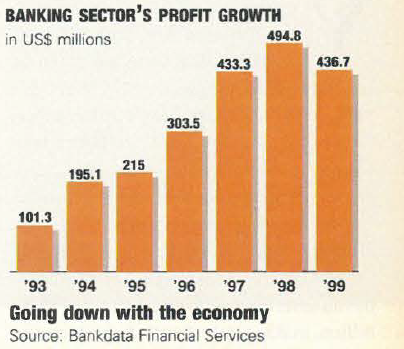
After profits dropped 13%
for the sector in 1999 – a
blow after 40% average
annual profit growth
between 1993 and 1998 -many predict that earnings
will experience a similar fall this year. “Now adding
deterioration of asset quality and an increase
in provisioning to revenue stagnation and
tight spreads, profits will drop between 15%
to 20% this year,” says Yanunine.
Finding solutions for the banks to generate
better earnings will not be easy. Banks are still
heavily investing on a safe bet: Thirty-five percent
of assets are in T-bills. But with the
spreads in a vice and the option of increasing
lending to the private sector with higher
yields a no-no for now, the banks are in a catch
22. “With the loan ratio this low, banks cannot
make up the thin spreads on lending,” says
Stephens. “That’s about it for the bottom
line.” Banks have been moving more into
retail banking to help beef up non-interest
income. “It’s important for the banks to move
into products and services as profitable activities,”
says Haroutiun Samuelian, vice governor
at the central bank. “In the early ’80s,
non-interest income for US banks took up
20% of their revenues. Now it’s a 50/50 split
between interest and non-interest income.” But
retail banking has yet to pay off. It requires
high volume, which is difficult in a small
market, while other non-interest tools, like letters
of credit, have been pulled down with the
recession, damaging gains coming from new
products and services to make a difference.
As in any sector, downtime means lowering
costs. “Banks must focus on restructuring,
cleaning up, cost cutting,” says Yammine.
Banque du Liban et d’Outre-Mer, Lebanon’s
largest bank and one that is still enjoying
healthy profit growth, is not only conservative
in lending but has focused on reducing
expenses. Its cost-to-income ratio dropped to
34.7% after the first six months this year
from 38.4% at the end of 1999. But other
majors more aggressive expanding on retail
find it more difficult to contain costs. Banque
Audi’s and Byblos Bank’s cost-to-income
ratios have moved up this year. ”The human
cost is already low compared to other countries.
Plus, many banks, out of necessity, are
investing in new services which all have
costs,” says Stephens.
If economic agony is prolonged, the pace of
mergers and acquisitions may pick up-especially
small and medium-sized banks swallowed
up by larger ones. Out of the 63 banks
operating in the country, the top 20 carry the
most muscle. Over 90% of total profits are in
the top tier, which leaves less room for the rest
of the banks’ earnings to fall. “With consolidation,
economies of scale can help,” says
Samuelian. ”The sound ones will survive
while the weak ones will not.”
Going abroad would help. But up to now
Lebanese banks have been hesitant to fan
out across the region. This could change.
Syria, with a state-owned, dilapidated banking
system, is opening up. It just established
free-trade zones and three Lebanese banks got
the green light. The problem is having to wait
for the entire Syrian market to open up.
“Syria is the place,” says Stephens, “but not
tomorrow. Maybe the day after tomorrow.”
What’s more certain is that if banks
remain mostly entrenched in the Lebanese
market and the economy continues to falter,
it may take time for them to see glory days
in profit growth again.