Editor’s Note: This article was written before the outbreak of the current conflict in Lebanon and does not include considerations relevant to conflict’s impact on exchange rates and monetary policies.
Lebanon has long lived under the pleasant illusion of financial stability, anchored by a fixed exchange rate regime that was maintained for more than two decades. It was widely believed that such a monetary system constitutes the backbone of currency and financial stability. This stability, a rare boon in a country afflicted by repeated political upheavals, would shield international creditors, regional investors, local importers and savors from multiple risks, beginning with currency risk.
The central bank’s long-standing maintenance of the fixed exchange rate supported the prevalent perception of relative stability in the national currency, even against the backdrop of a high dollarization rate. Proponents would argue that, had the exchange rate been allowed to fluctuate instead, inflation pass-through would have eroded confidence in the financial system and a crisis would have ensued.
However, beneath the surface, the fixed exchange rate regime masked deep structural weaknesses, alongside constraining Lebanon’s policy space. Policymakers could not lower interest rates without risking capital outflows, in which case the currency would come under downward pressure and the central bank would be compelled to intervene in the foreign exchange markets. Fiscal expansion, on the other hand, while necessary to stimulate a stagnating Lebanese economy, would similarly strains the peg.
This tradeoff resulted in sustaining a supposedly stable financial system at the cost of slower growth and higher unemployment. Either way, the key question to ask is whether the fixed exchange rate truly cushioned the financial system, or whether it contributed to or even triggered its collapse.
Doomed to collapse
First, a fixed exchange rate maintained over a long period of time is, by nature, unsustainable. This is even more pronounced in economies characterized by persistent fiscal deficits and widening external imbalances, because they depend on a continuous inflow of foreign currency to survive. In Lebanon’s case, the central bank could not indefinitely draw down its foreign reserves without either running out of those reserves or undermining confidence among savers and investors.
In addition, financing the external imbalances requires ever-increasing amounts of foreign currency at a time when, as was bound to happen at some point, FDI remained weak and fresh USD bank deposits slowed down, leaving the country with fewer external sources of funding. As this became undeniable in concert with deterioration of regional circumstances, and to make matters worse, capital outflows accelerated and the dollarization rate rose, putting further pressure on the fixed exchange rate.
This exposed the fragility of the financial system and pushed the central bank into a dangerous balancing act: defending the currency peg to enable paying for imports and servicing public debt at the same time, all while capital flowed out of the system. By the mid-2010s, it became clear that conventional monetary tools, in the form of high interest rates and persistent use of foreign reserves, were no longer sufficient to support the peg, which pushed stakeholders to adopt unconventional tools in the form of financial engineering. While financial engineering provided a respite, it drained USD liquidity from commercial banks and ultimately resulted in a banking and financial crisis.
An option to bend and not break
Rather than masking economic vulnerabilities, a flexible exchange rate anchors the economy to its underlying fundamentals, revealing the currency’s true value. The net benefits of a flexible exchange rate outweigh the costs, because such a regime allows economic adjustment to occur through increased domestic production and improved export competitiveness. In addition, it automatically expands the policy space, allowing policymakers to make effective use of fiscal policy to pursue economic objectives and to utilize monetary policy to stimulate lending and maintain prices. In contrast, fiscal expansion under a fixed regime is difficult because any increase in spending threatens the stability of the exchange rate.
With the Lebanese pound depreciating under a flexible system, excessive imports would be curbed, the trade deficit would be narrowed, and the relative price of Lebanese goods and services abroad would become more competitive. In turn, the central bank would be able to conserve foreign reserves for essential imports, alongside using these reserves to mitigate the impact of external shocks.
One may reasonably ask how Lebanon might have fared had it transitioned to a flexible exchange rate regime already years ago, before imbalances became wider and more pronounced. The argument is that, had Lebanon transitioned to a flexible exchange rate arrangement during the relatively prosperous years of 2008- 2011, the shocks that arrived a decade later might have been partially avoided, or even fully managed, preventing the full collapse.
This claim is plausible, but the reality is far more complex and nuanced in Lebanon’s case, given the country’s limited export capacity and severe supply-side constraints. As such, the transition to a more flexible exchange rate would not have guaranteed a smooth adjustment. Developments following the 2019 financial crisis validate this point: the currency depreciation failed to boost exports while imports rebounded almost to pre-crisis levels, pushing the current account deficit back to elevated levels.
Responsible prerequisites
In principle, the currency depreciation would not make domestic goods cheaper because production in Lebanon is constrained and partly depends on imports which become more expensive when the currency loses value. In this case, the currency depreciation resulting from the flexible exchange rate would risk fueling inflation and eroding the purchasing power of the citizens, ultimately resulting in severe social and economic repercussions. At the same time, fiscal expansion would make matters worse because it would translate into higher imports, thus worsening the trade balance and negating the effectiveness of government spending. This is why a successful shift to a flexible exchange rate requires in the first place addressing Lebanon’s production and export capacity.
By investing in infrastructure and power generation, Lebanon could remove those constraints on production and lower production cost. A multi-year, well-targeted capital expenditure program focused on energy, transport, logistics, ports, and manufacturing would lower business costs, improve efficiency, and enhance the international competitiveness of Lebanese goods. When complemented by an industrial policy, partly based on the 2017 McKinsey & Company Lebanon Economic Vision study, and particularly targeting export-oriented industries, Lebanon can focus resources on the sectors with comparative advantages, enabling a domestic production of several goods that it currently imports.
Firms would then be able to access affordable electricity, better logistics and transport, and domestic suppliers, which would lower their input costs and expand their output. Currently, the country suffers from a deficient infrastructure and a chronically underdeveloped energy sector. If these are not addressed head-on, higher production costs will feed into local prices, cancelling the benefits of depreciation. In one sentence, capital expenditure under international and local, public, private, or public-private partnership programs will be vital for Lebanon but must be done right, that is in context of a viable exchange rate regime.
A managed float first, a full float later
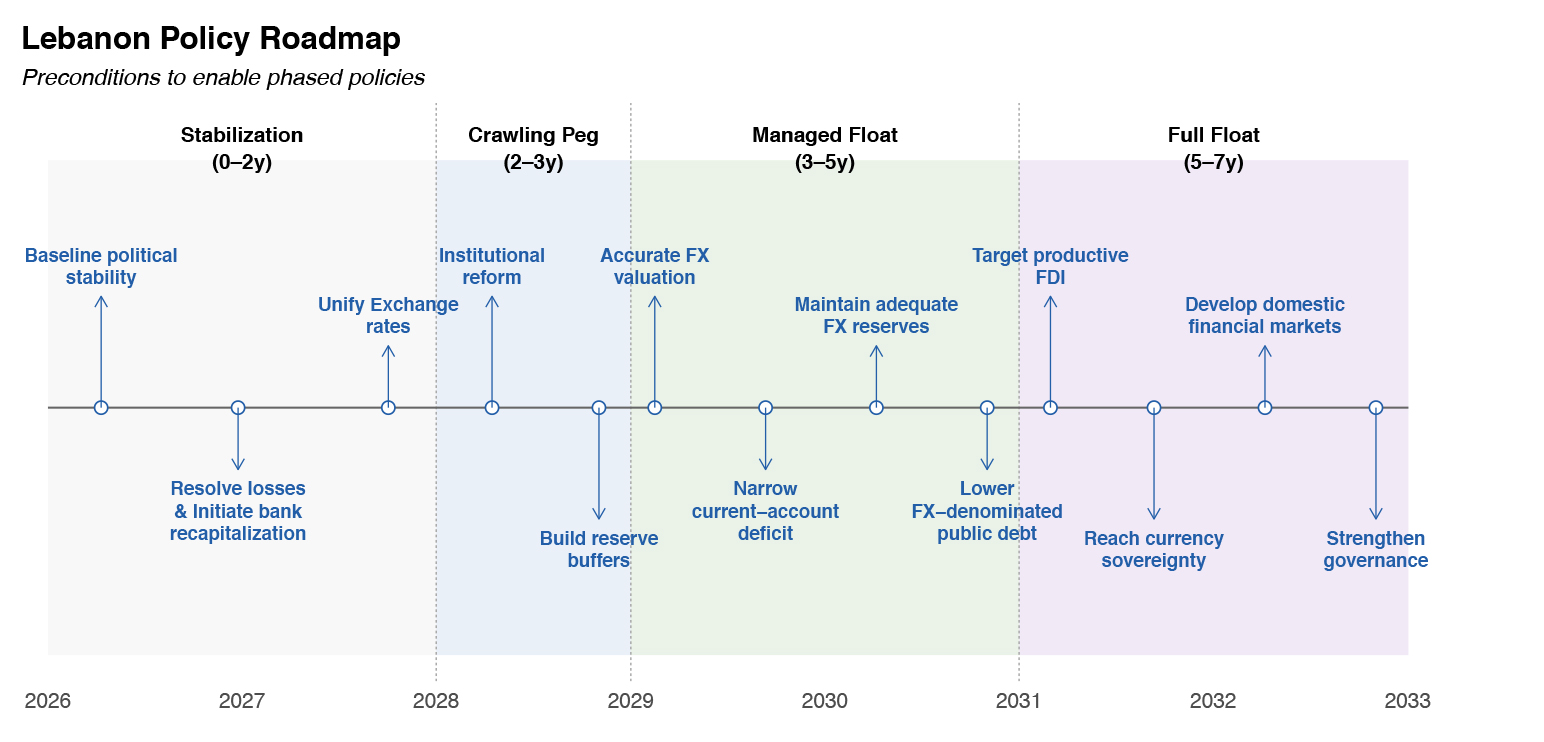
A multiyear capital expenditure program should only run under a semi-flexible or flexible exchange rate framework. If a sudden shift into full exchange-rate liberalization is risky and unfeasible today, why not start preparing the groundwork for a gradual transition, in which Lebanon can implement a phased approach, starting with a crawling peg and followed by a managed float. Each of these phases could be attained after achieving a set of preconditions aimed at strengthening Lebanon’s fundamentals, as outlined in the last section.
A managed float allows the rate to adjust within a controlled bound, removing the immediate need to defend it and reducing the need to drain reserve. In addition, under such a regime, the central bank intervenes only selectively to correct misalignments with underlying economic conditions and counter speculative attacks rather than employing frequent, heavy-handed interventions to keep the exchange rate pegged. The point is to allow the exchange rate to adjust in response to market forces, reflecting the country’s underlying economic conditions, while intervening only to curb high volatility or sudden and deep depreciation. Only then would the central bank be able to build confidence in the currency, along with accumulating foreign exchange reserves and deploying them as buffers in times of distress and external shocks (i.e. the 2011 Syrian crisis, the 2014 decline in oil prices, the US Federal Reserve’s interest rate hikes, the October 2019 protests, and the disruptions triggered by the COVID-19 pandemic).
Therefore, a managed float should enable the condition for fiscal policy to expand in order to address Lebanon’s production constraints and unlock its productive capacity. Together with a targeted capital expenditure program, it could create the conditions under which Lebanon can move into building competitiveness, employment, and export growth.
Such a framework offers both stability and flexibility: the financial stability presumed under a semi- fixed exchange rate in which the central bank retains the ability to counter disruptive currency swings and financially destabilizing devaluations; and the flexibility of taking advantage of a greater space to leverage fiscal policy for economic objectives, particularly during economic downturns. This is coupled with a greater ability to use monetary policy to stimulate lending and maintain price stability.
This transition would deliver two critical outcomes: first, rising exports would narrow the trade deficit, easing pressure on the currency and reducing Lebanon’s reliance on foreign reserves and external borrowing; second, a targeted fiscal expansion would stimulate job creation and economic activity.
A policy roadmap
A phased policy requires the country to proceed in phases to achieve several milestones aiming at strengthening economic foundations before a free float could be attained.
The first phase focuses on stabilization including cementing baseline political stability, unifying exchange rates, and recapitalizing banks to re-enable credit intermediation and financing of the real economy.
The second phase would involve adopting a crawling peg to anchor expectations, after effective reserve management and institutional reforms aimed at restoring public confidence in monetary policy and rebuilding trust in state institutions. A crawling peg is a framework that intends to stabilize the currency while allowing for small, controlled adjustments.
In the third phase, Lebanon can move toward a more flexible arrangement in the form of a managed floating regime provided the achievement of a set of preconditions: establishing a more accurate valuation of the currency, narrowing the current account deficit, maintaining adequate foreign exchange reserves, and gradually phasing out foreign-currency debt. Only after these preconditions are achieved would Lebanon advance to a managed float, which represent a very important milestone enabling making effective use of the country’s enlarged fiscal space for targeted investment in idle capacity and the productive sectors, boosting export potential and strengthening the economy’s ability to absorb external shocks.
With the managed float cemented, the country can start preparing for the full float, which represents the final phase and requires implementing a clear strategy to attract foreign investment into the productive sectors; achieving full currency sovereignty; developing domestic financial markets; and strengthening and cementing governance that supports transparency and accountability.
These phases should not be perceived to be rigid and should not be followed in a strictly linear sequence; rather, they represent a structured path away from crisis-prone policymaking and towards a more a more sustainable monetary framework offering financial resilience and unlocking Lebanon’s growth potential.
* This article is an adaptation, exclusive to Executive, of the author’s working paper, “Lebanon’s Eventual Transition to a Floating Exchange Rate System: Balancing Flexibility with Stability,” published by the Levy Economics Institute of Bard College. Lebanon’s Eventual Transition to a Floating Exchange Rate System – Levy Economics Institute of Bard College