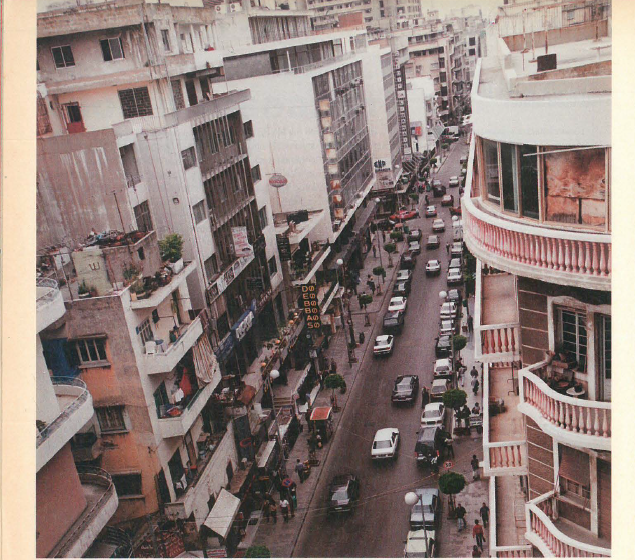
0vercrowded, congested, dirty and
literally falling apart, Hamra street
bears little resemblance to the
fabled upscale shopping and nightlife hub it
was less than three decades ago. Lined with
chic boutiques and elegant sidewalk cafes, the Champs-Elysees of the Middle East – as it was
once called – was the grande dame of Beirut
prior to 1975. But the war rubbed off most of
the area’s luster. “The Christian residents,
fearing for their lives, fled the area,” says
Walid Noshie, president of the Hamra Trade
Association. ‘The Kuwaiti and Saudi owners
of buildings and businesses abandoned their
property, leaving janitors in charge of everything.”
Hamra was left to deteriorate. Stores
are run down, cafes cater to a seedy clientele
and the formerly lavish movie theaters now
screen soft porn flicks to a crowd of Syrian and
Egyptian laborers.
Younger, trendier shopping and business
centers have taken over the role Hamra once filled.
Verdun is Beirut’s Fifth Avenue, with
high-class boutiques and upscale shopping
centers, while Ashrafieh is the undisputed
center of the capital’s nightlife – Hamra is virtually
dead after sundown. North of Beirut,
Kaslik provides yet another elegant shopping
venue and a good selection of restaurants and
11.ightclubs. What’s more, since most Hartlra
property owners are not even in Lebanon –
while many residents are still paying ridiculously
low old rents – there has been little
incentive to rehabilitate or redevelop the
area. At the same time, the government has
made no attempt to reinvigorate Hamra and
its image. The street now offers a sad picture
of urban decay.
Despite all its faults, Hamra can still lay
claim to some of the capital’s most prized
real-estate. The average sale price for residential
space in the area is between $500 and
$1,000 per m2, while retail prices range
from $2,000 to $6,000 per m2
• This compares to Ashrafieh, where residential runs from
$600 to $ 1,500 per m1 and retail averages
between $2,500 and $5000 per m2
. In Verdun residential apartments cost between
$850 and $1,300 per m2, while retail goes for
$7,500 to $10,000 per m2
.
In the last few years Hamra has become an
attractive spot for investors. Starbucks, The
Body Shop, Grand Stores (GS), Calzedonia
and lntimissimi have all set up shop along the
busy street. The Crowne Plaza hotel, opening
in June 2001, is the biggest real estate project
in the area. The hotel will contain 200
rooms, two movie theaters, a huge shopping
arcade, six conference rooms, three banquet
halls and a food court with seven restaurants.
General manager Georges Aoun firmly
believes that Hamra is on its way to
regaining its past glory. “Hamra is in a prime
location,” he says, “and the area is changing.
It will go back to what it was before the war.
That’s why we’re building the hotel.”
Hamra may no longer symbolize the opulence
of Beirut, but the street is still one of
Lebanon’s biggest hubs of activity, surrounded
as it is by universities, hospitals,
banks and hotels. It is near downtown,
Verdun, Ashrafieh, the sea and the airport. Its
proximity to the American University of
Beirut, Lebanese American University and
Haigazian University has helped to buoy
rental prices. As has the Lebanese tradition
of holding onto property – even in a recession
– kept real estate prices artificially high.
Selling today wouldn’t catch the price that
most owners are holding out for. ” Prices in
Hamra have technically declined,” says
Noshie. “But since some landlords and
homeowners don’t need the money right
away, they prefer to hold on to their property
until there is an upswing in the economy.”
But Hamra’s biggest asset is undoubtedly its
charm. “Hamra is the only street in Beirut
where you have Muslims and Christians, rich
and poor,” says Noshie. “It’s the only city
street where you have decorations for both
Ramadan and Christmas.” In Hamra, he
explains, all of Lebanon’s sects intermingle,
regardless of personal income. “Eventually,
downtown will look like Europe, but Hamra
will always look like Lebanon.” The area’s
nostalgia is also a major draw. “People who
used to come to Beirut before the war still want
to stay in Hamra,” says Karim Ibrahim, managing
partner of the property management
firm Operators. “It’s the memory of Hamra
that accounts for its appeal.”
Syrian painter Khaled Takreti comes to
Beirut every other week for a two-day getaway
from Damascus. He always stays in
Hamra. “Some streets are more fashionable
or upscale than Hamra,” he says. “But that’s
not what I’m looking for. Everything I need
can be found in Hamra. There are sophisticated
and common people, shops are varied
and have reasonable prices. And there are
good movie theaters and lively cafes.”
During his Beirut sojourns, Takreti stays at
the Al Sultan House, near the St. Michel
store, where the rate per night is a mere $30.
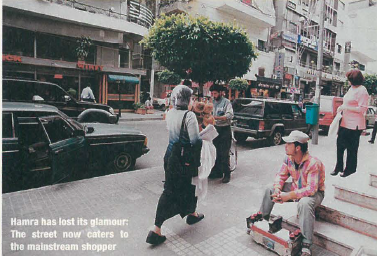
Hamra now welcomes a certain kind of
visitor – mostly Arab tourists who drive to
Lebanon and want affordable shops and
cheap hotels. “Hamra is Like Mar Elias and
Furn El Chebak. It’s a lower-middle class
shopping area, where customers can argue
about the cost of an item and pay 20% less
than the listed price,” says Ibrahim, adding that
new investments in Hamra cater to mass
market shoppers and not to the upscale travelers
who came in the ’60s and ’70s.
Thanks to the heavy foot traffic in Hamra,
store owners rely on high volume sales rather
than big profit margins. According to Noshie,
the GS branch in Hamra has higher turnover
than in any other location. “In Verdun, you
have one customer who comes in and spends
$ 1,000. In Hamra, 500 customers come in and
spend $100 each. That’s five times more
money than in Verdun,” he says.
Even though Hamra has retained a certain
allure and real estate prices remain stubbornly
high, poor infrastructure, lack of parking,
congestion and the ugliness of many buildings
will probably prevent a major renaissance. But
in a decade or two, when Solidere fills up and
becomes too expensive for the average resident
and retailer, the overflow will hit
Hamra, and the historical street will be rediscovered
by a new generation of Beirutis