Ever since the Golden Arches first lit
up the night sky in Dora in
November 1998, the Lebanese just
can’t seem to get enough of that all-American
fast-food chain. Beirut’s five
branches of McDonald’s are almost always
packed to overflowing: a gaggle of kids
dipping fries in ketchup and parents sinking
their teeth into a Quarter Pounder with
cheese, while the drive-thru outside does
just as brisk business. But wait a minute, this
is not an article about the Zoghzoghi’s success
in bringing the Big Mac to Lebanon’s
shores — in fact they have repeatedly
declined to be interviewed. This is the
story of the family in charge of distributing
all McDonald’s consumable products: the
Obegis. Ring a bell? McDonald’s is just one
of their most recent business associations
and is sure to beef up their business even
more. The Obegi family dynasty has
already made it into virtually every
Lebanese home. Look around; you’re sure
to find a detergent, soap, canned food or cosmetics
which Obegi Consumer Products
(OCP) supplies and distributes.
The Obegis’ business is grouped into
three main activities: consumer products
(OCP), chemicals (Obegi Chemicals, OC)
and banking (BEMO). Their size is
impressive. OCP chalked up consolidated
revenues of $71.8 million last year, while
OC did even better, hitting $82 million. At
the same time, BEMO’s assets reached
$381.5 million (see box). As enviable as
those numbers might be, the Obegis didn’t
get there by sitting comfortably in the back
seat. But the family’s thirst has yet to be
quenched; they continue to expand the
activities of their mushrooming business.
It all started in Syria when Yordan Obegi,
grandfather of the current division heads, began
working with BASF in
1905, the number one
chemical company in the
world, and became its agent the following year. OC is still BASF’s
sole agent for Lebanon, Syria and Jordan. In
the late 40s, Obegi entered Lebanon importing
carpeting and all types of furnishings for
the home as Obegi Better Home. Its cooperation
with German manufacturer Henkel
began in 1954 with the importation of Pre, the
predecessor of Persil. Ever since, Obegi has
maintained a strategic alliance with Henkel
— which had revenues of about $42 billion in
1999 — importing, distributing and then a joint
venture manufacturing core products such as
Persil, Der General, Pril and Nice.
“Our partnership with a multinational like Henkel
makes us sustainable for the long run and
gives us access to their know-how and global
expertise,” says Georges Obegi, president
and CEO of OCP since 1994. With
Henkel’s internationally known brands,
OCP has been able to penetrate Syria and
Jordan, and its sights are set on Iraq.
With OCP in the driver’s seat, its market
share for Persil increased from 12% to 48%
from 1985 to 1996. Henkel and OCP then
entered a joint-venture deal, similar to their
agreement prior to 1971, though OCP kept
control of both marketing and distribution.
Backed by strong international brands, the
ability to manufacture locally and solid distribution
that doesn’t rely solely on wholesalers,
OCP has grabbed strong market
shares in its core Henkel products.
OCP is big on detergents and cleaning products,
with a large market share in two core
brands: Persil and multi-purpose Der
General, which are manufactured locally.
Persil still holds the lion’s share of the market
equally with Ariel, despite having
recently lost ground to Syrian imports like
Madar Super Topper, Modhish and
Nourass. How important is that? Very, now
that OCP holds a 42% share of the $56 million
local market for low-foam detergents
with Persil. OCP also leads the multi-purpose
liquid detergent market with its second
core brand Der General with a 65% share.
That compares to 22% for its main competitor
Ajax, which is distributed by the
Abou Adal Group. Though Ajax has a sizable
market share, it is an imported product.
“We’re at a disadvantage against locally
manufactured Der General because they
save on shipping and import duties,” says
Raymond Abou Adal, president and CEO of
the Abou Adal Group.
With its 9% market share for Palmolive,
Abou Adal does compete against Fa, for
which OCP has a 15% share. But this is a market
dominated by Unilever products, such as
Lifebuoy and Lux, both of which are manufactured
by Unilever-Fattal, Dove and Good
Morning. That gives Unilever an estimated
20% market share, while Procter & Gamble
(P&G) holds a 17% share with Camay and
Zest.
Unilever Levant (UL), a locally based
firm covering Lebanon, Jordan and Syria, is
part of the multinational giant Unilever with
$45 billion in revenues last year. Established
in March 1998, UL has a five-year plan to
grab a 25% market share in the Levant, or
$150 million of a $600 million consumer
market in the areas where they compete,
according to Abdul Jessani, UL’s chairman.
“These are the guys we have to watch for;
they have strong brands like Sunsilk shampoo,
Lipton tea, Signal and Close Up toothpaste,
Comfort fabric softener, and others
that can really take off with their undeniable
marketing expertise,” says Obegi.
But while Lux matches OCP’s market
share in soap with a 10% market, according
to AMER research firm, its multi-purpose
detergent Jif has so far underachieved
against Der General with only a 2.8% market
share. P&G is their main competitor on
OCP’s remaining core products with Henkel.
Locally manufactured Nice, a high-foam
multi-purpose powder detergent, has
a 19% market share versus the 65% share of
locally produced Yes, according to Nadim
Tabet, CEO of Transmediterranean, P&G’s
local distributor. Against OCP’s dishwashing
liquid Pril, P&G’s Fairy has a commanding
75% market share, says Tabet.
Obegi says he will take up the challenge
against P&G primarily through greater visibility
and increased presence in the market.
The last of the core products is one that
belongs to the Obegis independently of
Henkel. That’s Al Wadi Al Akhdar, a 50%
locally produced canned and frozen food
brand. Whenever the foodstuff is not locally
available, the product is toll manufactured
in Hungary and Belgium and imported
into Lebanon. Al Wadi Al Akhdar is
OCP’s own-labeled brand, similar to G.
Vincenti & Sons’ Maxim’s brand.
Like Vincenti, OCP manufactures and exports Al Wadi Al
Akhdar to the US, Europe, Brazil and the
Gulf. Exports of this brand represent 50% of
local production and 25% of the brand’s
total turnover. The entire range of core products
represent 60% of OCP’s turnover.
The other 40% of OCP’s revenues are generated by the sale of a range of auxiliary
products, including Hajdu Bihar Kashkaval
cheese, alcohol like White Horse and
Carlsberg beer, frozen foods and cosmetics.
Here, Vincenti and Fattal compete better as
this represents their core products. From
1997 to 1998, OCP increased sales 9% in
these frozen foods, which represent 4% of
the company’s turnover. OCP abandoned
the sale of selective cosmetics in Lebanon
this year in favor of mass cosmetics like
Rimmel and Diadermine, which represent
10% of revenues on auxiliary products.
OCP did it for a good reason: mass cosmetics
target a larger audience, which is in line
with its other products.
So how has Obegi fared since he was put
in charge of marketing and distribution?
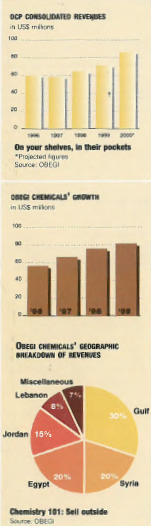
OCP’s consolidated revenues have grown
from $60.5 million in 1996 to $71.8 million
in 1999. And he expects that will rise to $83
million as a conservative figure for this year.
“The Obegis have an empire, they are very
respectable, and they get a lot of merit for
developing products,” says Tabet.
Now here comes the exciting part of OCP.
Last June the Obegis took over manufacturing
in Syria from a previous Henkel licensee
that was producing Persil. There they have
embarked on an expansion plan. OCP added
the manufacturing of Nice, Der General, Pril
and recently launched Al Wadi Al Akhdar and
Yemel fabric softener. Almost $1.5 million,
or 2% of OCP’s consolidated revenues, were
generated in Syria, where Henkel has an
option to buy into the manufacturing operations
after two years.
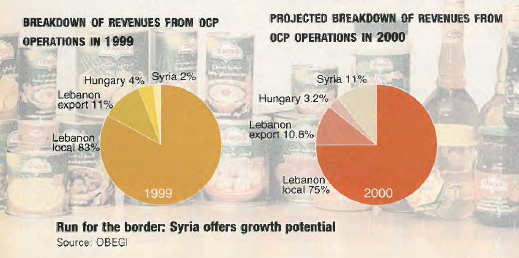
This year Syria is expected to account for
11% of revenues with an additional
$8 million to $10 million. And Obegi
projects at least another $25 million in revenues
in three years. The main office is located
in Aleppo, the Obegi family’s original
stomping ground, while another was set up in
Damascus. With a national sales force of 30,
OCP plans a uniform and aggressive product
launch across the country.
The starting point is a 0% market share
for Der General and Pril, and just a 5% share
for Persil. However, since a July launching,
OCP has grabbed a 7% share of the $26 million
high-foam market with Nice. Could this be a sign of things to come?
The total powder detergent market,
which is at $82 million, is up for grabs.
Nice is already doing well for a few reasons.
“The three-in-one detergent concept is new to
Syria and is designed for low-income people,”
says Obegi. He also has a marketing budget
advantage. Local production relies heavily on
labor so the products are uneven in quality and
quantity, while OCP’s factory is highly automated
and meets international standards.
The competitor for Persil is UL’s Omo.
The retail price for Omo is 235 Syrian
pounds, whereas Persil is at 280 Syrian
pounds for a 2.7kg pack. So shouldn’t
Obegi lower its price to better compete?
Persil is priced at 35% to 40% lower than
the Lebanese product, which is proportional
to the gap of GDP per capita
between the two countries. For now, Obegi
has no intention of lowering the price significantly.
He doesn’t want to widen the gap
in prices between the Lebanese and Syrian
product because of trans-border trade. That
would allow wholesalers to buy in Syria and
sell at cheaper prices in Lebanon. “Omo
started on the high end, then dropped their
prices 17% and it didn’t increase their
sales volume; on the contrary, it damaged
their brand,” says Obegi.
OCP’s Syrian operations are by no means
the first outside Lebanese borders: another
4% of turnover comes from operations in
Hungary. Under the name Dove Cosmetics,
OCP acts as the exclusive marketer and
distributor for suppliers like Chanel,
Clarins, Guerlain, Orlane and Lancaster.
The company also operates in Jordan,
where it markets Henkel products only,
such as Dixan, Persil and Pril. Total Henkel
detergents in Jordan represent about 13.8%
of the market share, according to AMER,
compared to a 19.6% market share for
Unilever products such as Surf and Omo.
While OCP’s products have long been household names, few probably know that OC
is a larger operation in terms of revenue. Its
main activity is the distribution of industrial
chemicals, from suppliers like Egypt’s Dow
Chemicals, BASF or US-based Hercules.
OC supplies plastic, polymer, solvent and
thousands of other chemical products to
industries. Dealing with a high-risk commodity,
the company bears the responsibility
of product selection, shipping and/or storage
and delivery to the client. OC also explains
the nature of products on behalf of the
producer, as well as giving alternate products
and solutions for industry. For these services,
the company collects a hefty fee.
OC increased revenues from $56.7 million in
1996 to $82 million last year. Not bad for a
company not involved in marketing, manufacturing
or retail. OC has eight warehouses
(4,000 m² each) in the Middle East and one in
Brussels, employing some 120 people.
The largest chunk of business comes from the
Gulf at 30%, followed by Syria and Egypt
each at 20%, Jordan at 15%, while Lebanon
accounts for just 8%. “Lebanon is a small market
for a regional company like us,” says
Yordan Obegi, managing director.
But is OC content with distribution? No.
The firm is moving into manufacturing in
Lebanon for some products from its factory
in Bauchrieh. But the bulk of manufacturing
will be done in Aleppo, Syria, where it will
begin making chemical products for textiles
and printing inks for industrial use in two months.
Within a year, another factory will open in
Egypt to produce PVA, used in paint and
adhesives. A joint venture between OC and
an Italian company, the plant required an
investment of close to $10 million. OC will
manufacture under license.
Not only is OC catering to the needs of Syria
and Egypt, where textiles and paints constitute
a big market, but it will also save on import costs.
That’s important for an industry where profit margins
are a slim 2% to 5% on average.
Now that you’ve seen the size and breadth of
their business, you’d think the Obegi family
already had their hands full? Wrong again.
Like we said at the beginning, OCP has been distributing
all the consumable products for McDonald’s five
franchises since November 1998. If history
is any indication, less than 5% of McDonald’s businesses fail
worldwide compared to an overall failure
rate of 65% for restaurants in the US.
This should represent a healthy stream of
income for OCP. Because McDonald’s doesn’t mix the business of the franchisee
with distribution, Zoghzoghi recommended
OCP. “What’s interesting about this
account is the credibility and expertise it
gives us, because we are monitored in a very
strict way,” says Obegi, explaining that
McDonald’s has tight regulations on the timing
of delivery, hygiene, storage temperature
and stock level.
OCP built storage facilities within its existing compounds for its business
with McDonald’s; it is also using existing
facilities to freeze OCP products to benefit
from economies of scale. Although these
operations posted losses for three and a half
months in 1998 and broke even in 1999,
Obegi expects to be in the black in 2000.
Ubiquitous in nature, OCP products have
invaded the homes and lives of just about
every Lebanese consumer. The same is now
happening in Syria, with Iraq next on the hit
list. Will the Obegi dynasty be resilient
enough as it conquers more territory to defy
the odds that all empires eventually fall?
Top of Form
Bottom of Form
A weakness in Obegi’s operations?
Everybody’s heard of Obegi Better
Home, which sells upholstery, carpeting,
wall covering, office furniture, furnishings,
decorations and others.
Maybe fewer have heard of Obegi
Audiovise for audio-visual equipment,
acoustical and telecommunication systems
trading, or Byblos Teppish Fabrik
(BTF), which is mainly involved in carpet
manufacturing. Collectively, these businesses
are on a negative growth path.
Their total revenues decreased from
$14.5 million in 1996 to $9.9 million in
1999. The Obegis are only managing
some of them, and they don’t constitute
part of their core activities.
These operations appear to be nothing
more than excess baggage for a
family firm that is showing tremendous
growth. Georges Obegi said the family
has no intention of divesting those
businesses. “We are reinforcing and
strengthening those companies,” he
says.
Obegi Better Home is undergoing
restructuring to enhance quality of service.
Previously under one umbrella,
management for office furniture and
everything under the home is being
separated. Obegi is also focusing
more on the upper-end market with a
consistency in price and marketing via
direct mail and some press.
As for Audiovise, the decrease came as the
firm got out of retail, continuing only with
distribution. Obegi got rid of Supra TV
and is focusing on high-end German
manufacturers Kenwood and Loewe.
According to Obegi, BTF was in
small part responsible for the decline
but will have a larger effect in turning
things around. There are plans to
expand its export markets for its
machine-made rugs from an estimated
25% to 50%. The expansion will hit
South America, Europe and the Gulf.
Then again, these businesses are so different
from the family’s other operations,
are relatively small and receding
even further. Why not just dump them?