
The US is experiencing its longest economic growth
period in history. The end of February marked the
107th month of strong economic performance,
surpassing its previous record set in the colorful 60s (106
months between 1961 and 1969). A bull run on US equities
- with the occasional hiccup – has kept in stride with
growth. Over the last five years, the Dow Jones Industrial
Average (DJIA) rose 197%, S&P 500 climbed 219%, and
the Nasdaq composite index soared 907%.
Rejoice, celebrate, open a bottle of champagne? That’s not
what is happening on Wall Street. The Federal Reserve,
headed by chairman Alan Greenspan, is worried that the
American dream is on the verge of overheating (average
GDP growth rate over the last three years was 4.8%), with
the threat of inflation just around the corner. Since June last
year, the FED has raised the federal funds rate by a quarter
percentage point four times (three times for the discount
rate). Its objectives are clear: To keep inflation from getting
out of hand, the FED wants to strike first by curbing robust
consumption, slowing down the economy.
A slew of indicators show that there’s potential for overheating.
Greenspan is keeping his eye on the tight labor market.
In January non-farm payrolls increased more than
expected – by 387,000 – the largest jump in two years. That
pushed unemployment down from 4.1% to 4%, the lowest
level in 30 years. This could lead to wage and compensation
increases that would pass on to prices covering costs,
and there are signs that upward pressure on prices might
come soon. In the fourth quarter of 1999, the employment
cost index (wages, salaries and benefits) rose 1.1%, above
the expected 0.8% increase, followed
by a wage increase of
$.06 per hour in January.
Another concern for
Greenspan is the stock market
pumping money into consumers’
pockets which lifts consumer
spending. In 1989, 28% of
household financial assets were
linked to stocks. That now
stands at 54%, and Greenspan
believes that about a quarter of
the GDP growth rate is derived
from wealth coming from stock
gains. This gives Greenspan a two-pronged attack: slow
down the economy and/or get the
stock market to take a breather.
Greenspan’s intention of controlling inflation has sent
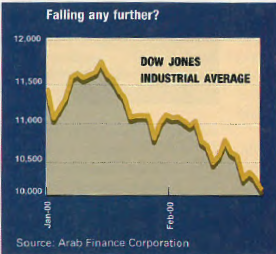
shimmers through some markets. So far this year, the DJIA
fell more than 11%. And to make matters worse, hikes in interest
rates are expected to continue this year. “The chances are
high,” says Douglas Wilde, a global investment strategist at
Merrill Lynch. “We will probably see interest rates go up
between 50 to 75 basis points by the end of the year.”
If this is the case, should investors expect the markets to
respond negatively, fueling a correction, or something
even worse? According to Gary Shilling, president of A.
Gary Shilling & Co, economic consultants and investment
advisers, there will be a correction or even a crash coming
from the sting of rising interest rates. But it appears that
there have been two markets going on recently. While
many stocks have already been hit, technology stocks
have been immune; they have pushed Nasdaq up over 8%
so far this year. Shilling believes that technology stocks,
which are seen as extremely overvalued (many companies
trade more than 100 times projected earnings in 2000, if they
have any), will eventually be affected with the rest of the
stocks and prices will plummet.
Wilde, on the other hand, believes Greenspan will be cautious,
moving rates no more than a quarter point each
time, knowing that markets are sensitive to his actions. The
chairman has a history of taming economic growth with a
soft landing. And some figures are working against the indicators
that are screaming danger. In the third quarter of 1999,
the consumer price index climbed 4.2%. But in the fourth
quarter, it increased by 2.2%, followed
by a less-than-expected
0.2% rise in January.
But Greenspan still appears to be
on the hunt. In his last semiannual
economic presentation to
Congress in mid-February, he
made it very clear that he would
continue raising interest rates
until consumer spending retreats
and the stock market calms
down. Tightening the screws is a
sure bet. But if and when it hits the
breaking point, sending all stocks
south, is anybody’s guess.
