
Microsoft’s much-awaited Windows
2000 has finally made its worldwide
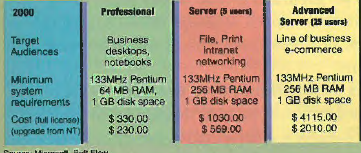
launch. The new product comes in
three packages, Professional, Server, and
Advanced Server (see table). The new
operating system is an upgrade to
Windows NT rather than to Windows 98,
and is therefore designed to target businesses
rather than home users. Still,
Windows 2000 incorporates the features of
Windows 98 to make for an easier-to-use
platform. What’s the best thing about the
new version? “Its reliability in running
with multiple users and multiple applications,”
says Charbel Fakhoury, Microsoft
Lebanon’s business development manager.
Windows 98 users suffered from crashes
because individuals would run several different
programs, including games, says
Fakhoury. But Windows 2000 is designed
for a business environment, which eliminates
this problem.
Gartner Group predicts that 15 to 20% of
Windows 98 commercial users will be
upgraded to Windows 2000 Professional by
the end of this year, increasing to 40 to
45% by the end of 2001. Only 3 to 6% of
Windows NT users are expected to
upgrade to Windows 2000 by year-end,
while 45 to 50% are expected to have done
so by the end of 2001.
On a scale from one to ten, Majed Al-
Saadi,
a Microsoft certified systems engineer,
gives Windows 2000 an eight. He considers the new program very easy to use,
especially with the integration of Plug and
Play from Windows 98, and is impressed by
its high level of handling security. Saadi said
that the only reason he did not give
Windows 2000 a ten was because of its
steep price and because it requires users to
be re-trained. According to Saadi, the total
cost to upgrade is $1000 per user, which
includes cost of ownership, installation,
hardware upgrades, and training. “Home
users will not benefit very much from the
features of Windows 2000 because it is
designed for a network environment,” says
Saadi. “It’s slower than Windows 98 and
Millennium.” Home users should wait for
Windows Millennium, due out next year.
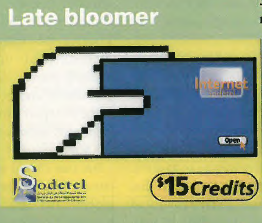
Internet service provider Sodetel has cut
prices and is offering new prepaid cards
in an aggressive push to attract dial-up
customers. The new cards cost $15 and
allow users to sign up for free using the
website. Clients get a choice of unlimited
access for $15 per month or “pay and
stay”, at $2 per hour. Previously, the company’s
rate for unlimited off-peak hours was
$20 per month, one of the highest in the
industry. The company earns most of its
revenues from corporate customers,
according to Louis Hobeika, Sodetel
chairman. “We’re looking at the consumer
market,” he says. “We’re under-utilizing
our network now. I think we can easily
double our clients.”
The company has issued 2000 cards so
far. They are available at 66 points of sale
throughout the country. The ISP has also
added a new design for its website. Some
within the industry expect that tough competition
will cut the number of ISPs from 15 to five by the end of the year. Sodetel
clearly plans to be one of the survivors.
Slow connection, fast download
TerraNet has reorganized and reduced the
graphics on its web site in order to
speed up download times and facilitate easier
access. The main page is now plain and
dominated by text. “All the inside pages can
now be accessed directly from the main
page,” says Fadi Ghazzaoui, the company’s
marketing manager. The webmaster has
instructions to not exceed 43kb for the file
size, down from 100kb. Downloading
should not take more than 20 seconds at
33000bps, or 46 seconds at 24000bps. Two
new sections were also added: Jokes and
Sports. The website is more user-friendly,
but those used to the old look will miss the section icons at the top.
New ISP on the block
A new company is preparing to enter
the already heavily saturated market
for Internet service providers. Diginet, an
ISP that was founded last summer but has not
yet gone into operation, recently started
advertising one-month free Internet access
in a bid to lure customers. The new company
will probably start offering services next
month, according to Ghassan Khazen,
operations manager for Diginet. The company,
formerly owned by Ghassan Mahdi,
was bought out in December by the US-based
Eagle InterCommunications.
“Diginet is now 100% owned by
EagleCom,” says Khazen, who claims the
company currently has 300 lines and an E1
(2 Mb) broadband to Cyprus with a direct
fiber optic connection to the US. The ISP will
donate 5% of its profits to research institutions
for the development of prosthetics.
According to Khazen, Diginet plans to
expand its customer base by acquiring
small local ISPs. The arrival of EagleCom
coincides with the acquisition of Lynx by
PSINet, another US-based company.
