Ego and tradition have tended to
dominate Lebanon’s business circles.
Losing control of the family
fiefdom is viewed as one of the worst
nightmares, regardless of whether that
might involve a sound business decision.
But this is the new generation and
Lebanon’s Internet service providers are
among those at the forefront.
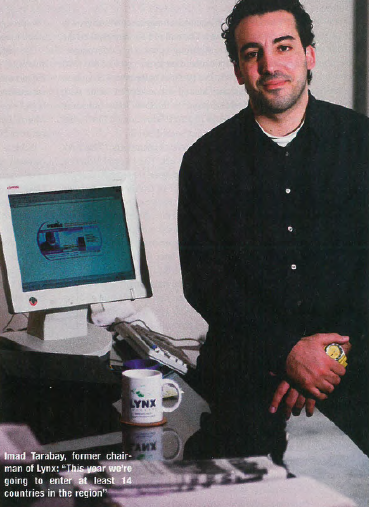
Imad Tarabay, the 27-year-old chairman
of Lynx, received an offer he couldn’t
refuse and wouldn’t disclose from
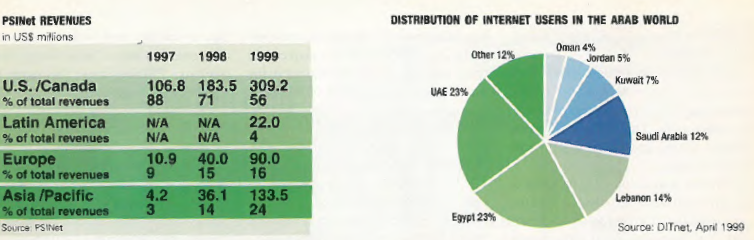
PSINet, a US-based multinational Internet
company with revenues of $555 million
last year. It was a tough choice: either roll
up the drawbridge and face a competitive
local market alone, or give up the reigns reins to
an international heavy**-**weight. Tarabay,
now vice-president of sales and marketing
for PSINet Middle East and Africa, decided
to sell at the end of December. And as
competition increases and prices drop,
more of Lebanon’s ISPs are having to face
the bitter reality that they cannot stay afloat
without financial backing.
But what on earth would attract a multinational
to a market of not more than
100,000 Internet users, less than 0.05% of
worldwide surfers?
The target is not just the local market.
Now, Tarabay is standing tall among local
competitors and is readying the company for an aggressive push into the Middle East, a
region with an estimated 1 million Internet
users (see chart). “This year we’re going to
enter at least 14 countries in the region,”
says Tarabay. The buy-out of Lynx is part of
PSINet’s strategy to expand internationally
by acquiring existing ISPs rather than
establishing new ones from scratch. In
1999, the company acquired 43 ISPs
worldwide, including the purchase of
seven in Latin America (see box).
According to Tarabay, PSINet was
attracted to Lynx’s fiber-optic network.
Though ISPs are generally reluctant to
reveal the arrangement of their network’s
structure, the majority have routes through Cyprus or the UK. Lynx, the self-proclaimed
fifth largest local ISP with over
4,000 subscribers, claims to be the only
one with a direct fiber optic connection to the
US, avoiding any nodes or intermediary
connections. This minimizes the number of
errors and error-corrections during transmission.
Lynx still had to go through the
MPT. “I spent six months working on it,”
says Tarabay.
The regulatory environment could create
obstacles to further expansion into some
countries in the region. Egypt, where there
are about 55 ISPs, Jordan and Saudi Arabia
offer attractive markets for acquisitions.
Others, like the UAE, where one company
monopolizes the Internet, are off-limits. In
Lebanon, ISPs are at the mercy of the ministry
of post and telecommunications
(MPT), which has the sole power to grant
companies the bandwidth they require.
But whatever the hurdles now, the company’s
strategy is long-term. Many multinational
companies go into markets prematurely
in order to gain a head-start on competitors.
Ericsson, the Swedish mobile phone manufacturer,
recently opened a regional office
here. Sony, Japan’s leading electronics giant,
opened its Lebanon office two years ago.
Both are the first in their industries to enter the
local market, before the environment
becomes attractive to competitors.
“Privatization is being echoed in Lebanon
and international research firms contracted for
studies,” says Sam Lutfallah, executive
director of Inconet. “They are lured by this.”
And what better way to get into a market
than by linking up with a local firm. It was
Lynx that originally approached PSINet in
July with an offer to form a joint venture.
Tarabay, who had established Lynx with his
partner Raed Rayess only three months earlier with a $300,000 initial investment,
wanted to expand into the region and needed
a financial backer. “We had a lot of contacts
in the area, but we needed technical
and financial assistance,” he says. “Any
country you want to go into requires an
investment of $1-2 million to start up.”
Negotiations proceeded till November,
when PSINet suddenly handed Tarabay its
offer to buy.
But the new entity will not recreate the
Internet. The company has the same dial-up
and e-commerce services offered by other
ISPs. A number of services that PSINet
provides elsewhere, such as ISDN and
VoiceOver IP, cannot be offered here for the
moment because of the monopoly of the
MPT. “They are offering nothing that
[other ISPs] here don’t have,” says Abude
Omari, CEO of Cyberia. Since it’s a carrier
as well, PSINet/Lynx will be able to sell international links out of Lebanon to other
ISPs, once the MPT relinquishes its monopoly.
Lynx can take advantage of the financial
and technical boost in order to improve
services. Tarabay plans to upgrade the
amount of bandwidth in order to increase the
speed and capacity of connections.
Although the company may have the
financial weight to cut rates, don’t expect
any new price wars on dial-up. Already,
Lynx has some of the highest rates on the
market, ranging from $14.99 for unlimited
access ($9.99 for students) up to $29.99 for
unlimited corporate accounts. Tarabay
says that there are no plans to reduce these
rates any time soon. “Cutting prices was
never our strategy,” he says. “We’re going
to maintain our prices because we believe
that if you want quality you have to pay a
higher price.” Nor is the competition worried.
“This move will not affect prices,”
insists Fadi Ghazzaoui, marketing manager
for TerraNet.
With dial-up prices unprofitably low,
Lynx is focusing on the corporate market,
where it can offer a greater array of services
at higher rates. That will pit it against
Inconet, the self-proclaimed leader in corporate accounts.
PSINet’s acquisition of Lynx came as
no surprise to others in the sector. “The natural
trend is toward consolidation,” says
Bahjat el-Darwiche, IntraCom’s managing
director. “If ISPs are not backed up
financially in some way, they will not
last,” says Tarabay.
The prospect of international firms entering
the market did not seem likely last
September. Sitting in his office in Hamra,
Omari was skeptical. “Why would [a
multinational] want to operate this small
Internet service in a market of 60,000
users, when they add close to a million
users per quarter?” he told EXECUTIVE at the
time. But now he thinks differently:
“International players who bring in money
and expertise show that the market is interesting.”
Louis Hobeika, chairman of
Sodetel, welcomes the healthy dose of foreign investment that the entrance of companies
like PSINet into the market will
bring. ISPs are having trouble surviving
with rates so low, and most of the major ones say that they would welcome some sort
of partnership with a large foreign firm
(see box). PSINet’s move just might be
what’s needed to get the ball rolling.
Top of Form
PSINet’s expanding by buying out ISPs worldwide
Internet carrier PSI Net was the first company to commercialize the Internet in 1989.
CEO William Schrader was one of the founders of NYSERNet in 1985, the first network
to link university, government, and corporate supercomputers in New York.
He realized the potential of the Internet when corporate clients started approaching
NYSERNet. Being a non-profit organization, the company subsidized PSI Net
to sell Internet services.
Acquisitions in the third quarter ended September 30, 1999:
- Transaction Network Services (TNS): provider of eCommerce data communications
processing. Revenue in the third quarter 1999 was $46.1 million, net profit
$5.5 million. Sold for: $720 million in cash and stock. - In the US/Canada: Two ISPs, Internet Network Technologies (US) and TotalNet
(Canada). Add 100 business accounts. - In Europe: Seven ISPs in Spain, Austria, Hungary, and Italy. Add over 1,200 business
accounts. - In Asia Pacific: Two ISPs in Hong Kong, Global Link and Vision Network Online.
Add 500 business accounts. - In Latin America: Seven ISPs in Panama, Brazil, Argentina, and Chile. Add over
500 business accounts.
Would you sell? Here’s what the ISPs replied
Word has it that America Online
Inc. (AOL) has its eyes set on the
local market, though it seems that the
rumor’s been running for a while now.
EXECUTIVE also found out from several
sources that the French ISP Wanadoo
(www.wanadoo.fr), associated with
France Telecom, is in talks with Gellis.
This is the next big thing now.
Most ISPs refer to “partnerships”
rather than mergers and acquisitions.
The sector should witness a number of
joint ventures in the near future. Here’s
what the main players had to say.
CYBERIA: “We have no incentive at
this stage to sell. We might partner up,”
says CEO Abude Omari. Cyberia is privately
financed and will continue to be so.
INCONET. “We welcome a joint venture,”
answers executive director Sam Lutfallah, “but one in which we have a controlling
interest. We would not release our
shares.” But, he adds, if the offer were
good, the company would be open to a
buy-out. Inconet is under the umbrella of
GlobalCom, a holding company half
owned by Audi Investment Group.
SODETEL. Louis Hobeika said that he
is open to a partnership. Telecom Italia
and France Telecom together own 50%
of Sodetel.
TERRANET. Marketing manager Fadi
Ghazzaoui claims talks are underway “in
Europe and Arab countries for a partnership.
Acquisitions are not healthy,
because they would allow an [international]
firm to take control of the local
market.” TerraNet is a sister company to
LibanCell. Nizar Mohsen Dalloul is a
major shareholder in both companies.
Bottom of Form
Bottom of Form
Hack Attack: the World Wide Worry
Accessing someone’s server can be surprisingly easy.
Luckily the “art of hacking” is still rudimentary in Lebanon
Hack attacks are all the news almost monthly now.
International news, that is. Think you’re safe from similar
attacks because your Internet service provider certifies
it, because you have a firewall, or because there are no hackers
locally? Think again. “Hacking, like AIDS, is thought to happen
to other people,” says MajorD0m0. “But it can happen anytime,
anywhere, to anybody. It’s simple, and I can prove it.” So EXECUTIVE took him up on his word.
MajorD0m0 is a 20-something ethical
hacker, a rare breed whose reputation has
been soiled over the last decade by Internet
vandals and egotistical teenagers. In fact,
MajorD0m0 is a hacker in the original sense of
the word, which used to describe an amateur with a thirst for knowledge about computer technology without the
malicious intent. Web-wise, MajorD0m0‘s hacking expertise is the
result of years of surfing and learning.
“Name your website,” smiles MajorD0m0. He makes hacking look
easy, to the extent that one forgets its implications. He uses point-
and-click software, and types in just a few commands. The tools are
at his fingertips on the PC. Each is a downloadable program rarely
larger than 50kb and thus takes minutes to install and use.

They are just a few clicks away on the Web. Port scanners detect
types of networks, servers and ports that give leeway to hackers.
A trojan horse is a program embedded in email attachments that
can be secretly sent to users, allowing hackers to take control of
the remote computer. Mail bombers send thousands of junk
emails to an address, blocking or slowing down access to
emails. Password crackers are programs that can crack a user’s
password. The list goes on.
He thinks up a few local dot-coms, considering the rush to e-commerce
and everybody feeling hip about being online. Scanning a
server, MajorD0m0 detects which ports are “open.” Any information
a port provides gives the hacker more to work with. Most
ports are susceptible to some form of attack, be it access to files
or databases. He clicks, types in the website’s IP address, and up
comes the message: “start scan … ports 0 to 1000.” Seconds later
a list of ports follows. “Eureka,” he exclaims.
Each of the seven websites he tried, owned by major local
companies, had at least eight ports exposed, most commonly the
file transfer and mail ports. Secured sites wouldn’t allow scanners
to detect any of their ports. Their security system would trace the
intruder’s IP address and block access from it. MajorD0m0
demonstrates with two secured websites, where the scan message
appears but returns no information. This is one step short of
actually breaking in. But that’s as far as MajorD0m0 will go.
Hacking in Lebanon is still amateur, MajorD0m0 confirms. It’s
usually done upon a dare. The hacker uses software to crack a
friend’s email password, or take control of their desktop, turning
it into a zombie, shutting down Windows and performing tasks remotely from their own
computer, all for a laugh.
Locally, the Internet’s
limited speed (up to
36kb/s) and the lack of
permanent connections
to the Web pose difficulties
to any serious hacking
activity.
But that should not be
comforting. The threat is
global, and proficient
hackers worldwide can
attack. There is little
awareness of security in
the Middle East as a
whole and in Lebanon
particularly. Hackers
from Brazil recently
vandalized several websites in the UAE and Saudi Arabia. Vandals usually post a message
mocking the webmaster or the institution, send greetings to their
buddies and boast about their skills. After such attacks, the
servers have to be shut down and scanned, since it’s not easy to
identify exactly what the hacker did.
This is not to imply, however, that anyone can or should attempt
hacking. In fact, amateurs lacking programming and Internet
knowledge could put themselves in danger of being traced and
caught. A hacker doesn’t always go it alone, since collaboration
and speed are needed to “get in and get out” safely. MajorD0m0
points out that hackers work in pairs or groups. While one gains
access to the server and proceeds to vandalize it, the other erases
any “traces” left behind.
Did MajorD0m0 hack into any websites? No. Reading up on hacking
remains his hobby, and besides, he has better things to do. We might
be better off taking his word for it. After all, never dare a hacker.