
Few would argue that the Internet
offers enormous opportunities for
organizations that want to conduct
business electronically. With such unheralded
best-selling e-stories as Amazon, it’s not
surprising that a number of web brands have
popped up in the ether like eBay, eToys and
CDNow. Or that the traditional brick and
mortars, afraid of eating their cybercompetitors’
dust, have been seeking ways to get
online in a big way without ruffling the feathers
of their existing distribution networks. In
Lebanon, though, with the exception of some
websites and internal intranets hosted by portals
like LebanonLinks and Libanis, only a
select few companies have actually integrated
and exploited the powers of the Internet
within their strategic business processes.
The number of Internet users in Lebanon
has topped 85,000, a year-on-year growth
rate of almost 42%, according to ISP estimates.
This annual count projected the
number of users would reach 100,000 by the
end of the year and exceed 200,000 by
2003. The two major drivers of consumer
demand? The Internet and e-mail.
With the number of Internet servers and
desktops growing exponentially, access to
the Web is commonplace. Internet
Facilities, a consulting firm that owes its
steroid-induced growth to the emergence of
the Net, calculates that in global terms, e-commerce
represents a monthly $25 billion
worth of goods in revenues, versus some
$30,000 for Lebanon. And given a
respectable number of users and a growing
number of companies now active on the
Net, why is Lebanon lagging so far behind
the West when it comes to shaping the
Internet and the electronic economy that’s
springing forth from it? The answer to that
question is complex and open to interpretation.
Nevertheless, it’s clear that
Lebanon has several fundamental hurdles to
clear before it can hope to assume an
important role in the new economy.
A favorite whipping boy of most is the
high communications costs that both businesses
and consumers face. This is something
almost everyone complains about, says
Walid Hanna, general manager of e-commerce,
which beat the competition in
Knowledge
Lebanon by registering such an aptly
named dot-com with the Beirut Chamber of
Commerce last fall. “And the more users
stay online, the more it costs. So of course
it’s a problem,” he says. “The high phone
charges certainly adversely affect e-commerce.”
Such criticism is echoed by leading
ISPs across the board. “We need a measure
of liberalization in the telecom industry,”
says Sam Lutfallah, general manager of
Inconet. “Charges for local services remain
high, which poses a serious obstacle to
Internet use among Lebanese consumers.”
An official at the Ministry of Post and
Telecommunications counters that argument:
“High connection charges are used as
an excuse. They’re not the big issue everyone
tries to make them out to be. $1.4 per hour is not
big money.” Perhaps, but like snowflakes
such charges can quickly mount up.
“When you spend some time on the
Internet, and you get a bill for $100 or $150
a month, you quickly change your ways the
next month,” says Khoury.
Still, despite the high telecom fees, e-companies
that have something special to offer are achieving a measured success.
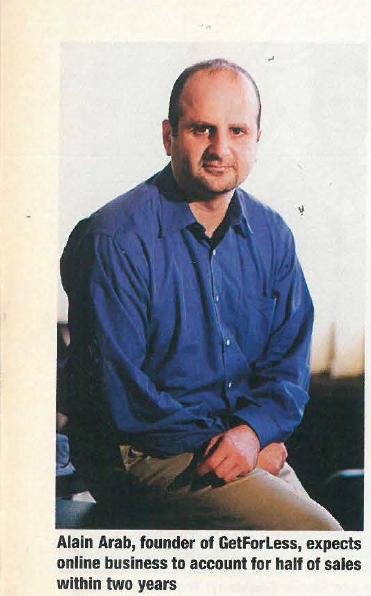
GetForLess carries 140 brands ranging
from such items as espresso machines and
cameras, to computer software, music CDs
and home gyms. It has been selling goods
online since September 1999 – a burgeoning
e-business that is currently at 10% of total revenue – and reports monthly revenues of
some $25,000.
“We expect that our online
business will grow to 50% of total sales
within two years,” says founder Alain Arab,
adding that Lebanese culture is ripe for the
transition to an e-commerce environment.
With monthly revenues of $2,000,
LebanonShop is also profiting from a budding
dot-com landscape. As much as 90%
of their sales come from abroad in a clear-cut
positioning that aims to attract
Lebanese expatriates. “All our products
have a strong Lebanese or regional element,”
says general manager, Fouad
Khabbaz. “Whether it’s books, CDs or
antiques, our clients tend to be expatriates
looking for a taste of home.”
The Internet has evolved into a global
infrastructure – capable of connecting multiple
applications and business processes –
not only within organizations, but also
between trading partners around the globe.
And while the consumer market captures the
hearts and minds of the public, the real
money is in the business-to-business (B2B)
market. Vicky Khoury, consultant at
Internet Facilities, calculates that, of the
$300 billion global e-industry in 2000, as
much as 80% is grabbed by B2B.
By 2002,
Khoury believes e-commerce will be worth
$1.3 trillion as more businesses catch on to
the benefits of harvesting the cyberfields.
That’s a lot of buying and selling going on.
“But I bet that if you asked most people what
business-to-business e-commerce means,
you’d probably get a lot of glazed eyeballs,”
says Khoury, adding that the problem
in Lebanon is mostly perceptual.
Internet
Facilities is currently helping companies –
such as Home Interactive, manufacturers of
construction materials – gain footholds in
cyberspace.
“While the consumer side of e-commerce
offers plenty of sizzle, pretty
pictures and graphics, the business-to-business
side is all about the bottom line.”
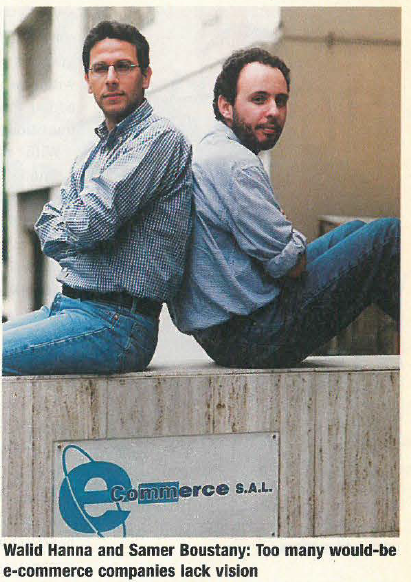
A more fundamental problem, argues
Hanna, is that too many would-be e-companies
lack vision. Some major corporations
have, he concedes, established online
networks between themselves and suppliers
to facilitate supply chain management.
But he is critical when the same corporations
refrain from moving to the next level of
integration, and allow full information
sharing between all the entities composing
the supply chain.
Compare that cautious
approach to Dell Computer, now the
biggest PC vendor in the United States and
number two in the world. Dell is rapidly
integrating the Internet into its internal and
external operations, and sees the sharing of
information as the key to a successful transition
into the new economy.
“Information
and intellectual assets are replacing physical assets,” says Hanna. “Our dot-coms need to
get into a more collaborative mode with
partners, buyers and customers.”
Dell is not
only able to optimize the delivery of goods
and services to its customers, but has also
slashed inventory to just six days’ worth.
This whole-hearted adoption of the Internet
contrasts starkly with the narrow mind-set of
too many Lebanese corporations, which
still view the Net with suspicion.
“The greatest challenge facing Lebanese
organizations today,” says Khoury, “is not
deciding if they should leverage the
Internet, but how best to leverage existing
investments in technology and infrastructure
with the cost efficiencies and flexibility of the
Net.”
While Web commerce typically refers
to the selling of products over the Web, the
broader term “Internet commerce” can be
viewed as a term that means any exchange of
business information over the Internet.
That could be business reports, purchase orders,
shipping and manufacturing information,
or bank-account updates.
Internet commerce
enables the sharing and exchange of this
business data within and beyond company
walls, across town or to the other side of the
world.
The Internet allows this exchange of
information to occur in a fraction of the
time required by traditional paper-based
processes – reaching more customers and
trading partners faster, more efficiently and
certainly more affordably, than ever before.
To fully leverage the benefits and opportunities
on the Internet for information
exchange, you must look beyond the obvious
person-to-person communications to
the underlying internal communication layers
that enable business processes.
Customers and business partners in an
enterprise will be much more likely to
embrace the concept if it is cost-effective,
readily available and automated.
“For many companies, it’s not the customer who
demands key business
data but rather business
partners, such as vendors
or suppliers, banks and
clearing houses,” says
Hanna. “These partners,
due to the very nature of
their businesses, require
timely, reliable, automated information delivery, guaranteed.”
In a global environment
where information is in such
high demand, information is
the business.
And perhaps the best model
for B2B transactions in the
near future may be eBay.
Since the Internet can provide
real-time pricing and availability
information, companies
will bid on whole lots of
goods – 1,000 DVD players
from Japan, say, or 500 crates
of champagne from France –
always opting for the best
price.
It’s almost as if a name-your-price strategy will
become de rigueur in the corporate
world.
It also benefits the
seller. Say you’re a leading
watermelon cultivator in the
Bekaa and you’re overstocked on summer watermelons.
With a global reach, you could peddle your watermelons to
countries with opposite weather patterns.
According to Khoury, there is a similar
lack of vision at play in the business-to-consumer
sector. She is down on merchants
who take a “build it, and they will come”
approach to e-commerce.
“They put their
products on the Web and hope everyone
will visit,” she chides.
“But you need to
offer interesting products you can’t easily
buy in the real world. And you need bulletin
boards, chat services and newsletters to
keep bringing customers back.”
Buying in
cyberspace also remains a stretch for many
Lebanese consumers who are more comfortable
in what is still a cash-based society.
While the use of store credit cards is on the
rise, dealing in hard cash wins out easily.
Such reluctance is only heightened, when the next-door neighbors are convinced, through the
purple prose of the press,
that cyberspace is awash
with hacker pirates looting
lists of credit card numbers
on a daily basis.
As a result, innovative
Lebanese companies are coming up with hybrid solutions that allow
customers to order online, yet pay in traditional
ways.
One such pioneer is
GetForLess. Customers can browse the electronic
catalog online, place orders and pay on
delivery by credit card or cash.
Critics of
hybrids say it’s not true e-commerce when
payment is in cash. Nevertheless, it works and
suits the current Lebanese psyche.
As other
businesses take up this approach, Lebanon
can expect to significantly boost business-to-consumer
online trade.
But is it actually possible to have too much
e-commerce? In the West, economists are
asking whether the technology boom on the
stock market has led to over-investment in the
new sectors.
If so, there could be a depressing
fall-out as the bubble, if it is one, bursts.
Here, we are far from these earthly concerns.
Dot-com commerce in Lebanon is still in its infancy;
and virtual horizons, with the promise of
enormous opportunities, appear as cloudless
as a summer sky.
As Khoury puts it, “The
greatest advantage as newcomers is that
we’re at the bottom of the league – there’s only
one way for us to go.”
At least in terms of conducting
business on the Internet, we’re still far
from having too much of a good thing.
