
The business concept is simple: if you
can stuff enough services and content
into a single web address, you will, in the
ugly parlance of the industry, “aggregate
eyeballs” – that is, bring a lot of people
with disparate interests and needs to the
same place.
This explains why ISPs (Internet
Service Providers) continue to add
entrees to their menu of offerings, as fast
as a short-order cook, hoping to get the
edge in an increasingly cutthroat marketplace.
After web hosting, freefax and
Interactive Voice Service (IVS) comes
the latest in the brave new, value-pumped
ISP: online reading.
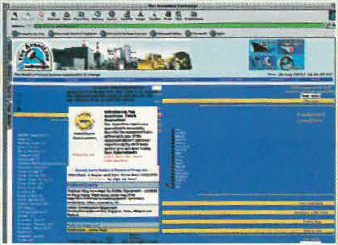
ln Lebanese terms, Cyberia (www.cyberia.
net.lb and www.thisiscyberia.
com) is the 800-pound gorilla in the middle
of the information highway and the
new user’s magneL ln the late 1990s, it
was its simple-to-install software and
ubiquitous distribution that led to its rise
to pole position. But what distinguishes it
from the pack these days is the launch in
July of a bright (some might say garish on
account of the intense background colors)
online magazine – with news, arts and a
variety of features written in-house that
include cinema and book reviews.
Rumors abound that Temmet, who has met
with some success following the launch of
their parallel French site, may be following
suit with their own e-periodical. Nobody
knows bow the fight for online turf will
shake out, and even whether online magazines
will ever be a hit with local surfers, but
at least Cyberia has proven that, if nothing
else, it is riding high on ideas and should be
well positioned to capitalize on whatever the
outcomes may be.
Vote-for-me.com
A thought for the day: how
would those who have
enthusiastically invested in a
website react if the department of
transportation were to design a
huge highway interchange with the sole objective of having drivers continuously
circle a row of billboards?
Unfortunately, such a comparison is not all
that far-fetched. In the run up to parliamentary
elections, cyberspace has emulated
the real world with candidates posting
their pictures on
trees, walls and electronic
nodes alike.
As more inexpensive
Internet campaigning
goes onlinc, a plethora
of sites are cropping up
like mushrooms after the
rain, ranging from the
uninspired (picture galleries
of the candidates
with their families) to the less banal with
manifestos and other political statements.
Some independent sites such as
www.niyabiyat.com have built systems
to enable voters to cast ballots over the
Internet. Since there isn’t a country that
allows Internet voting – few are even in the
earliest stages of contemplating it – the
exercise remains all but academic.
Not everyone sees Internet voting as a
portal to a more democratic future – only
a portion of the online public, which itself
is a minority of voters, are turning to the
Internet for political information. Online
tactics are therefore swaying voters about
as much as a photograph stapled to a
sorry tree.
B2B in a big way
In the West, even businesses are starting
to use Internet auctions to buy everything
from office equipment to electric power. You
can usually haggle over the price of a car, or
cut a better deal
for that rowing
machine at a
garage sale. But a
giant crane or a
drilling rig?
Imagine walking
up to a salesman
of heavy-duty
construction
equipment and
flashing a wad of bills. The salesman
would probably call security.
That is what Lebanese users are virtoally
able to do now with AssetLine (www.assetline.
com), the US-based purveyors of
machinery and building tools following an
agreement with local trading company
Baladi. “Internet commerce is rapidly gaining
recognition as a new engine for growth,”
says Carl Baladi, CEO. Lebanese users are
now able to access nearly l,<XX> equipment
listings ranging from asphalt equipment to
compressors to dumper trucks. Over the
nextyear,Assetline plans to extend the service
to other countries in the Middle East
Made to order
0 nline help is at hand – help, that is, of
the domestic variety. Manpower has
entered the e-cruiting market from the
Wlderside-from the unswept floor, as it were
-offering prospective employers a gamut of
live-in maids and other job seekers of bluecollar
work. Surfing housewives can now
look for their ideal femme ck cluunbre on
www.jalloul.com, a site that is searchenabled
on the basis of age, education, marital
status and nationality. Racial types, with
accompanying photographs, include the
Philippines, Sri Lanka and Vietnam.
There are almost 100 maids to choose
from with monthly salaries that range from
$100 to $150. But if you’re looking for a
Lebanese maid. then look elsewhere. Corne
to think of it, look elsewhere anyway.
