
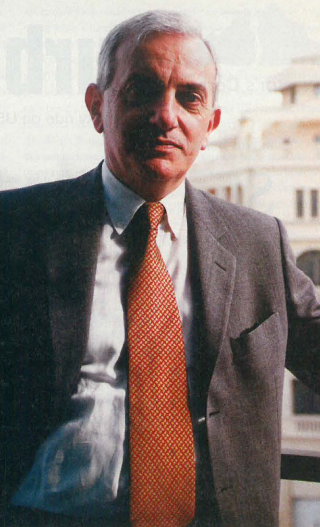
It’s been anything but plain sailing. Joe
Faddoul, the 56-year-old chairman of
BML Istisharat, has been pursuing a
personal quest since he got into the computer
business almost 30 years ago. His
goal is to simplify the handling of complex
computing systems, the huge software programs
that companies and banks use to
manage everything from finances to customer
service. “We’re selling a service, so
our job is to be reliable and extremely cost-
efficient,” says Faddoul.
This could be rhetoric, but the fact is that
he has successfully marketed the company’s
products and lifted revenues from almost
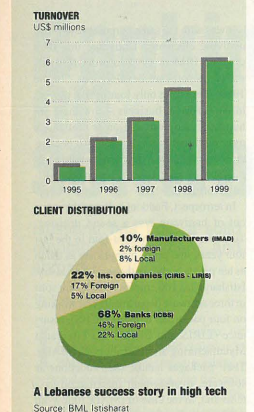
zero in 1976 to $6 million last year (see
graph). The firm’s banking software,
Integrated Computerized Banking System
(ICBS), is mentioned in the annals of IBM
in New York as one of the top ten success
stories in software, and according to 1998
figures from the London-based International
Banking System, it ranks fourth out of 34 in
terms of sites where it has been installed:
some 40 banks in over 350 sites. With about
20 cents of operating profit extracted from
every $1 of revenue, Istisharat appears to
have something of a golden touch.
These respectable payoffs, rising to $1.2
million in 1999, have attracted such local
heavyweights as Societe Generale, Societe
Nationale d’ Assurance (SNA) and the
Lebanese Swiss Bank who are among the
company’s main shareholders. “Within its
class, BML Istisharat has the largest revenue base and the most advanced products,”
says Maroun Badr, assistant manager of
development at Societe Generale.
How do they do it? Analysts say
Istisharat’s $100,000 to $600,000 software
packages help organizations become more
customer-friendly on two fronts. This 28-
year-old company offers what both foreign
and local rivals cannot offer: a combination of
built-in customer profiling based on a successful
track record and personal attention
to the quirks of the local market. Using
Istisharat’s software, companies can make
their organizations more self-service oriented.
Credit Libanais replaced the French
software, Delta, with the Istisharat system
because, in the words of deputy general
manager Antoine Raad, “Istisharat has a
solid foundation for building the relationship
between businesses and the customer.”
Sammy Hashem of Libano-Suisse
agrees. The insurance company bought
Istisharat’s URIS package (Life Insurance
and Reinsurance), for about $100,000.
Today, Faddoul’s software firm derives
60% of its revenues from export sales to the
US and Western Europe, with a sprinkling to
the Middle East. Clients include Citibank,
Assurances Generales de France and
Banques Populaires (BPRNP). In the Middle
East and Lebanon, Banque Nationale de
Paris International (BNPI), Societe Generale
and Credit Bancaire all use Istisharat’s software
packages. But most of their bank clients
are foreign, not Lebanese. “This is a paradox,”
admits Faddoul. “Lebanese prefer to buy
blue-eyed software.”
Competition is particularly stiff from foreign
software manufacturers like Kindle
and Midas-Kapiti International (MKI) who
compete for banking accounts. They hold
the top three notches in sales figures of the International Banking Systems (MKI is
second and third with two banking packages,
Midas and Equation).
The Arab Bank has completely transformed
its operations over the past eight
years to install an English/Arabic version of
MKI’s Equation system. MKI’s software
was chosen because “the innovative use of
MKI IT has revolutionized our banking
business in the areas of cost savings and
improved customer service,” says Tarek
Abdulrezak, deputy manager of Arab
Bank’s IT department.
Kindle and MKI are subsidiaries of
Misys, a UK publicly-owned company
quoted on the London Stock Exchange.
The Misys Banking and Securities
Division (BSD) is the world’s largest independent
provider of software products to the
sector, supplying applications and services
to around 1,600 customers in 100 countries, 360 odd customers with Kindle’s
Bankmaster system, and the remaining
1240 on either of the MKI packages. In
1999, Misys generated revenues of $920
million and an operating profit of $213
million. BSD accounts for 60% of revenue
and the Insurance Division for 9%.
Given Istisharat’s turnover of $6 million,
Faddoul is hardly a big-company guy in
global terms. With his core of just over
100 key accounts around the world,
Faddoul is refining the art of nurturing customers.
Citibank has been a loyal Istisharat
client since 1988, which has accounted for
$2 million in sales in 11 years.
As a result of his own experience in market
research, Faddoul is quick to advise
potential clients to conduct thorough surveys
of corporate IT before any costly purchase.
He has also made local prices on
Istisharat software low compared to
Europe, at averages of $100,000 and
$350,000 for insurance and banking
licenses respectively, compared to
$250,000 and $500,000.
It may seem somewhat unexpected to
learn that Istisharat entered the electronic
arena almost by accident and that, like most
success stories, the company has humble,
back-office roots. Istisharat opened its doors
in 1972, on a radically different footing.
Istisharat, Arabic for consulting, was set up by
four partners, including Faddoul, with a
business plan aimed primarily at market
research and management consultancy. The
subsequent replotting of corporate strategy
came with the start of the war, when demand
for management consultancy and research
dwindled to almost nothing overnight. “War
forced us to transform into a computer services
company,” says Faddoul. By 1988,
Istisharat had graduated into a principal software
developer with a breakthrough on the
lucrative Citibank account.
But as IT matured, businesses were forced
to broaden their plans. Istisharat acquired
the agency for IBM in 1990 and an extra three
letters to its company logo. “Lebanon
Business Machines was our and IBM’s first
choice,” says Faddoul. “But that was already
registered by a company that sells typewriters.
So we became Business Machines of
Lebanon, BML Istisharat, a name we kept
even when we sold our IBM agency.”
It was with the same corporate eye on an
evolving electronic landscape that they
dropped IBM in 1995 in order to focus
solely on software development. “In the
1980s there were only four or five players
in the hardware business, now there are
hundreds and competition is that much
more cutthroat,” says Faddoul. “It became
clear that we were losing time selling computer
boxes when the real action had shifted
to software.”
In retrospect, Faddoul believes the move
out of hardware was a sound decision.
Turnover has grown eight-fold in the last
four years, and profit margins are as much
as ten points higher in the service industry.
Istisharat has 100 employees who are split
into three software departments and working
on four packages: banking (ICBS), insurance
(LIRIS and CIRIS) and Integrated
Manufacturing and Distribution (IMAD).
Their packages handle such functions as
management information systems and, in the case of IMAD, follow-up
on the manufacturing process.
Here’s how it works: Software is created,
developed under Oracle or AS/400 platforms
and installed on UNIX or NT, which
is then assembled into application-style
packages. These tailor-made programs are
then used either within companies or
between them, allowing companies to create
customized relationships with each of
their distributors or dealers and clients, giving
them up-to-date catalogs, order forms,
pricing, marketing materials, billing and
inventory. “We’ve developed our system in
a very parametric way,” says Faddoul
about their IMAD package. “You can use it
for textile or beer or cement.”
And while some 50 companies use the
IMAD system, bringing in a turnover in 1999
of about $600,000, IMAD represents only
10% of Istisharat’s business. The true
money-makers are in banking and insurance,
which, respectively, account for 68% and
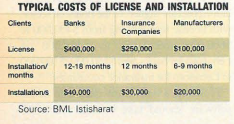
22% of sales. Both licensing fees and installation
costs are higher for the financial sector,
with license fees ranging from $400,000 to
$600,000 ($350,000 to $400,000 in
Lebanon) for banks, and $250,000 ($100,000
in Lebanon) for insurance companies.
Typically, a bank implementation of the
software should take between 12 to 18 months, 12 months for an insurance company
and six to nine months for an average-sized
manufacturing or distribution business.
However, time frames can and do vary widely.
Six months represents roughly two
months in man-days, and these are billed at
$350 a day per project leader and $150 to $200
a day for a standard programmer, increasing
the net revenue for a typical project to
$30,000. Faddoul’s methods are sometimes
considered harsh but effective. He is also fair.
As the brainchild of a profit-sharing
scheme, 25% of company profits are redistributed
to members of the software teams.
An unexpected ally in Istisharat’s business
has come in the form of a general merging of
company descriptions and of nations.
Deregulation in the US and Europe has
brought a convergence of banking and insurance,
a move that is being copied in
Lebanon. “URIS is our latest child. In essence, it’s a bank insurance package which
we have already implemented at Fransabank
and Societe Generale.” Faddoul hopes that
URIS will become the next big earner as
more banks go down the insurance route.
Internationally, the European Union’s
(EU’s) move towards a single policy on tax
and other fiscal matters is also making life
easier. “The EU is actually helping our
industry to streamline and standardize our
products,” he says. At $600,000 per license
fee, the insurance package for the US is 2.4
times European fees. This is partly due to the
upgraded version that is being sold in the US
market, and partly to the differences in
legal reporting in each state.
If Istisharat’s contest with the foreign giant
Misys is something of a struggle between
David and Goliath, on the home front, at
least, the odds are stacked in Istisharat’s
favor. The company stands alone as a
Lebanese provider of banking and insurance
solutions in a market that has become saturated
with software developers all focusing on
similar back-office packages. “There are too
many players in a small field,” says Khalil
Taller, head of Logos, which provides general
bookkeeping and payroll packages.
“Recession is hitting hard with cutbacks in the
IT industry.” As much as 65% of Logos’
turnover now comes from export sales to
the Middle East, compared to 25% in 1998.
This is a strategy that’s been adopted by
Software Design, whose flagship Dolphin
business application package is sold in 15
countries in the face of a dwindling local
market. “In Lebanon’s software ecosystem,
there are essentially only seven or eight true
outfits in terms of western-style professionalism
and pursuit of high tech,” says Michel
Nseir, general manager of Software Design.
And in an emerging industry already marked
by fast consolidation, the company with staying
power may be Istisharat. “[Faddoul] has
done a great job in operations,” says Nseir. “I’d
say BML ranks about top on that list.”
Many executives complain that immature
technology and industry fragmentation
are keeping them from installing the latest
technology. That’s why Istisharat may have
an edge. Says Sammy Hashem of Libano-
Suisse, “In emerging software markets, the
people who win are the people who are
broad.” And Istisharat has proved that it is considerably broader than most of the 250 or
so local software developers. As the service
shakeout intensifies, smaller software companies
with tiny revenue streams are
already falling by the wayside. Skygazer
Technologies, which has been operating for
the past six years as IT consultants in both
the private and public sectors, recently disclosed
its decision to move its business
to Canada. “The bottom line is that
there’s no trust in this country,” says Abbas
Dagher, owner of Skygazer. “Poor business
ethics compound a market that is already stifled
by recession and government control.”
But companies like Istisharat should be
able to survive, not least because with a
healthy roll of major international clients,
they have chosen to specialize in a field that
pays as much attention to street credibility
as it does to software expertise.
Istisharat’s work should easily translate
into a dot-com environment. Faddoul doesn’t
believe that the rise in e-commerce can
adversely affect his traditional bricks-and-
mortar clientele. “Even if banking is transformed
into e-banking, the banking function
itself will remain,” he says. “There will
always be a need for banks, and therefore we
will always have a role to play.” Nor does
Faddoul feel the frustrations of being in a
backwater of the global economy, frustrations
that have driven countless other
Lebanese to take their talents and innovations
to Silicon Valley. “In today’s Internet
environment, it really doesn’t matter where
your head office is located. We can troubleshoot
a bug in Indianapolis, say, from the
comfort of our offices in Riad al Solh.”
Faddoul’s challenge now? To keep abreast
of e-banking and e-insurance with particular
regard to moves that would see software
developers operate their own portals on the
net. Oracle’s chairman Larry Ellison recently
funded a new Internet startup, NetLedger,
which aims to convince small companies that
it can do their bookkeeping over the Web. For
$4.95 a month, companies can hire
NetLedger to store and handle all of their
invoices, bills and general ledger records.
And while Istisharat’s eye is on a different
breed of customer, Faddoul still needs to woo
the industry with ideas that will fend off
rivals. If he can do that, then the rising e-tide
will assure smooth sailing for Istisharat.
