
Even in the occupied zone, people still needed banks. With
its two branches, in Marjayoun and Bint Jbeil, Fransabank
enjoyed a monopoly among 100,000 people. With the
Israelis gone, the bank is in pole position to beat off rivals if stability
returns and the local economy recovers. “They were daring,”
says Nassib Ghobril, an analyst at Lebanon Invest, “and others are
now thinking of following them.”
Thinking, but not acting — at least yet. Lebanese banks are
unlikely to stampede south immediately.
“I don’t think any of the other
banks have applied to work in the
zone,” says Sarni Sfeir, press
spokesman for the Central Bank. “We
will be monitoring the situation.”
Uncertainty persists in the South,
especially with the Shebaa Farms
issue not yet resolved. This leaves
Fransabank sitting pretty. In the
short term, customers require a safe
port and, in due course, Fransabank
will have a firm base.
But think of the worst scenario:
what if someone blows up the bank?
No worries, says Ibrahim Qoleilat,
Fransabank’s deputy general manager:
“The branches in the South hold a
minimum of paper money. What’s
there? Only furniture and PCs.”
And
customers have seen it all before, says
Habib Rohayam, manager of the Bint
Jbeil branch: “People are not unduly worried.
They remember that when the
bank closed in 1978, they could still
withdraw their money from Beirut.”
Back then, the area — known not
so affectionately as Fatahland — slipped into disorder. But gradually
a strange kind of order returned, albeit under Israeli occupation.
“The people who had relocated from the South were
always asking us to go back,” says Qoleilat, “and eventually we felt
the time was right.”
The branches in Bint Jbeil and Marjayoun reopened in 1993,
around the time that the Lebanese ministries increased their presence
in the zone. But Fransabank never closed its branch in
Jezzine, which remained an unofficial part of the zone until last
summer.
In Bint Jbeil and Marjayoun, the bank found a promising
market, as trade with Israel was booming and more than 3,000 local
inhabitants were earning good wages south of the border. The Bint
Jbeil branch has 10,000 customers, which is nearly double the national
banking average of 5,500. The Marjayoun branch is
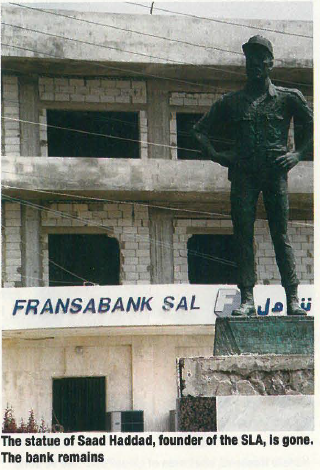
prominently situated at the entrance to the town.
Until the pullout,
a statue of Saad Haddad stood in front of the bank. (It has subsequently
been destroyed.)
“We are serving the whole region,” says
Qoleilat. “Where someone needs a banking service, we provide it.”
In practice, the services offered by the bank are less comprehensive
than elsewhere in the country. Neither branch, for example, has
an ATM. Personal loans have been “limited,” says Rohayam,
adding that it’s not due to difficulties
in assessing or collecting collateral.
Quite how the bank managed during
the years of the occupation, understandably,
is a sensitive matter. But it
has coped successfully with the
anomalies produced by 22 years of
Israeli control.
Think only of the legal
situation: the darak (police) and the South
Lebanon Army (SLA) both had “law
and order” roles; the Israeli-sponsored
civil administration worked alongside
the Lebanese government ministries.
Court decisions were left pending
until the end of the occupation.
How easy was it to deal with default in
such a peculiar legal situation? “The
bank had its own law,” says one
employee. “This could be either the
darak or the SLA.”
Rohayam declined
to elaborate on his policy for bad debts.
“I would protect myself,” he says. “I
don’t know anything else.”
It’s easy to see why Rohayam is
upbeat, at least for now. In the short
term, the cash flows into Fransabank because residents of the now
unoccupied zone save for a rainy day. The local economy went into a downturn
as soon as the Israeli government confirmed its withdrawal.
But there’s an optimistic scenario for the former occupied zone,
at least beyond the short term. A fair proportion of the 100,000 people
who have left the zone during the occupation will want to go
home, and many of them will want to bank.
Front-runners to join Fransabank are probably Al-Mawarid
and Beirut Riyad Bank, which are owned by two natives of
Hasbaiya, Marwan Kheiredin and Anwar Khalil, respectively.
“These banks will know the situation on the ground better than the
bigger, more aggressively marketed retail banks like Audi or
Byblos,” says Ghobril, who is from Hasbaiya. “Local people will
feel more comfortable with them.”
