
Dr. Jihad Azour, Lebanon’s Minister of Finance, sat down with Executive on July 29 to discuss the roles of the government and his ministry in the current war: their efforts in relief and diplomacy, how choices made in the past year have helped them meet these challenges, and what lies ahead for the economy and the state of Lebanon.
E In the coming months, everyone will be competing to adopt the issues of relief and support. The government must lead these efforts, otherwise many people may fall in the hands of other groups that want to benefit from their misery. What is your strategy for relief?
It’s a very challenging task. For the first few weeks, the government was the only provider of supplies. All the aid came from the government, through the High Relief Committee. However, due to the acceleration of the displacement, the destruction of roads, Israeli bombardments of convoys and any truck, and the difficulty of communication between various regions, the Committee opted to decentralize support, and provide the municipalities and districts with the resources to buy supplies locally and provide them to the displaced. So we paid almost LL40 billion to the municipalities directly. The objective was to give them the ability to provide basic needs without waiting for the trucks to come from Beirut or from somewhere else, to give them flexibility and quicken response times. Unfortunately, various political parties took advantage of this strategy as a way to show off and to distribute the aid in their own party’s name. It happened everywhere—all the parties did this.
E How will the government take the lead and become the primary decision-maker in these kinds of situations in the future? Hezbollah made a unilateral decision, and we’ve all had to deal with the consequences. How will the government regain power and authority in decision-making?
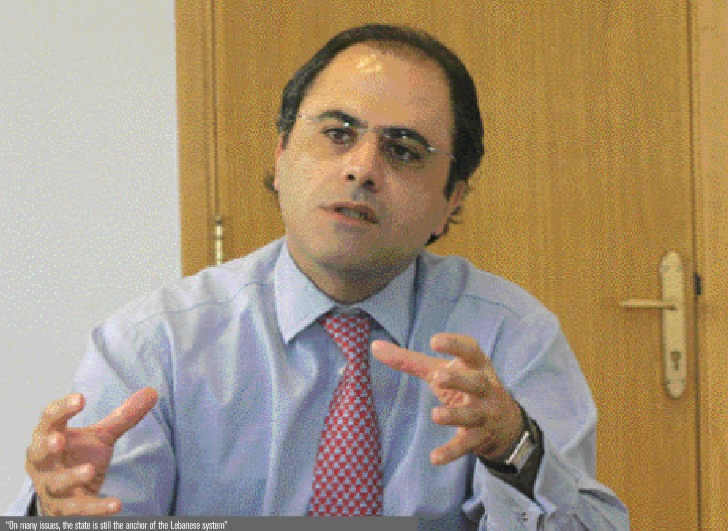
On many issues, the state is still the anchor of the Lebanese system. The majority of the displaced have been taken care of by state agencies: the army, the schools, the High Relief Committee, the municipalities. The government also took the necessary measures to provide unity behind these issues: in the High Relief Committee, you have more than eight ministers.
In terms of financial issues, from day one, the objective of the government has been to provide sufficient financial support to the agencies in charge of relief. In two days, we put in place the necessary support for the army, the Ministry of Health, the displaced fund and other agencies. This was possible due to efforts we’ve made in the last 12 months, which improved the financial situation substantially. We increased our liquidity; this gave us the ability to move very quickly.
The second objective was to keep government agencies functioning during the time of the crisis. We’re not getting any revenues, but we have to supply funds to the various agencies. In fact, we managed to pay on time and even early. Some bypasses and special procedures were implemented to support citizens and the business community. For example, we created a new customs office, because the ports and airport were not very safe, and we provided special procedures for supplies coming from outside.
“we are making the necessary measures
to adjust to different types of war”
The third thing that is important in countries where you have fragility, like Lebanon, is maintaining financial stability. This was a big challenge for us: to make sure the financial situation doesn’t add pressure to the monetary situation; to finance the government without being obliged to raise the Bank’s interest rate; and to maintain confidence in the system. Again, we could do this because we had made certain choices over the last 11 months. For example, on the debt front: the exchange of debt and the Eurobonds, our pre-financing strategy, all this kept us from having a big amount of debt to be renewed in the second half of 2006.
We also substantially improved the primary balance of the budget. In June 2005, the primary balance – the net operation of the government outside debt—had a surplus of LL200 billion. In June 2006, we had a surplus of LL1.2 trillion, which is five times more. We reimbursed the Central Bank $3 billion of debt that was issued last year and improved the balance sheet of the Bank. The improvement of the balance of payment was a surplus of $1.8 billion, and improved liquidity and free capital flows, which strengthened the system overall. We were not expecting what happened, but since I took office as Minister of Finance my policy has been to stay vigilant at all times, and to be proactive. You need to have your safety valves working. After almost three weeks, the system is functioning.
We are now starting to prepare for the day after the end of the war. We’re going to divide the program into two phases. Phase one is the emergency recovery: what to do for the first 90 days. We need to create solutions for a lot of problems: how to deal with the return of people to their villages, housing issues, schooling issues, and all the psychological and physical problems people are sustaining. How to deal with the infrastructure, how to mobilize funds quickly—if you go to the World Bank and others, you need to wait at least six months to get a loan. In order to act in the first 90 days, we must solve where to get the money from.
In addition, you have to figure out how to stabilize the private sector: when the war ends, you may have trouble for certain sectors in the economy, so we need mechanisms in place in advance to support the private sector. The government will also have to take care of its own financial situation, and all this must happen in the first three months. After that, we need a reconstruction plan, which will kickstart after the first phase. But the first phase is a very critical moment: to answer your question, this is how the government will take hold of the situation. This is something we have to plan and structure very tightly; the difficulty is that the situation is changing on a day-by-day basis.
E What type of state will result once the war is over? We have to decide: are we living in a state of war, where war can break out any second and destroy everything that was built? Or are we living in a different type of state where people can be confident in investing and rebuilding the country?
What type of state is viable? The viable one is a state where you have a lasting political solution, in order to assure the citizens of the South that they can go back and rebuild. You cannot bring people back to the South without that, if there’s still a threat that in five years or 20 years, everything will be destroyed again.
Secondly, you need a durable solution for both foreign and local direct investment to operate. Otherwise people will tell you, “I’m not going to adventure and invest heavily in a country where the situation may change,” and you’ll return to the economy we had during the civil war: low investment and low growth; a lot of our comparative advantages would disappear. In this type of model—one without a lasting solution— we will enter into at least five to 10 years of destabilization, especially since we have a vulnerable financial situation. During the civil war, a system was functioning. But at what cost? Per capita went down to less than $800, whereas today, we are at almost $6,000. Our exports have increased by 30%; we’re one of the best destinations for investments in the region. Our expectations were that, progressively, the Lebanese talents would come back and establish in Lebanon. This was the best tourism season for 30 years; we were expecting to import more than $10 billion this year, which gives you an idea about the economy. If you want to have a strong system, where the economy is functioning for the benefit of the citizens, the first model is the only model. This is the type of system that can survive in Lebanon. The second model cannot: it will spill over or make the financial situation unsustainable, and it will impact the socio-political stability of Lebanon. The Lebanese will not accept this kind of life.
E How likely is Hizbullah to subscribe to such an equation?
Hizbullah is not advocating the second model. Politics aside, their level of involvement in the government never gave the impression that they didn’t want the first model. I think the issue is that this war came at a time when it could be used regionally and internationally. There are other purposes, and therefore Lebanese actors become secondary in the decision-making— including Hizbullah. Rather than making the solution, we become the solution. And the solution could be in our favor, or not in our favor— that’s the risk of the current situation.
E How much has already been lost in this crisis? How long can the government support the system?
Damage-wise, I think it’s too early to get a serious assessment that indicates the magnitude of destruction and how long it will take to rebuild. In addition to the destruction of infrastructure, there are other damages to be considered. In the private sector, many industries were directly hit; certain economic activities stopped altogether. Almost all the sectors in Lebanon are suffering economically because of what happened. The owner of one of the biggest supermarket chains was telling me that 80% of his customers left the country with the evacuations. Yes, now he’s going to sell more rice and milk, but that’s not where he makes money. Every sector was hit, from agriculture to tourism to trade to banking.
There is also a negative impact on government finances. Usually, July is the month where we receive the second payment of VAT. Due to the war, we had to postpone it twice, because we cannot ask people in this time to come and pay. Our revenues are down, but our expenditures increased, and there is the risk that interest rates will go up; beyond that, the value of Lebanese assets went down.
There is also a secondary circle of lost opportunities and investment. Billions of dollars of investments were expected to be decided this summer. Now, they will be postponed at best. Many companies were looking at Beirut as their regional platform again— in the last five months, we saw tens of international companies relocating in Lebanon.
The shock is creating many waves. We can easily quantify the immediate wave when the war ends, but we also have to take the others into account if we want to kickstart the economy. We have to be imaginative. How can we involve not only donors, but also private sector investors in the solution? How can the private and public sectors work as partners to address the situation, along with the various NGOs and social communities? It’s not an issue the government or the Council of Ministers can solve alone. This has to be done on a nationwide level, with the full mobilization of all our resources, in addition to the support of others— be it international institutions, donors, expatriates, whoever wants to help.
E How many waves of impact can the government withstand? Can it last another three or four months?
We are making the necessary measures and protections in order to adjust to different types of war. We have to find solutions. We cannot say, “Ok, we can stay up and running for one month”: we have to find a solution to extend it to two, three, four, five, six months. If you have destabilization on the financial side, it will have an immediate impact on the economy and cause a disaster on the social level.
E Are we talking about stabilizing the Lira?
The whole financial situation. The monetary situation has been kept stabilized—there’s pressure, but controlled pressure. The type of crisis we are going through is different from the one experienced after the assassination of Prime Minister Hariri. The war has economic and financial implications, but our ammunitions are bigger: before the assassination, from October 2004, we had pressure on the pound. The Central Bank started using its reserves even before Hariri was assassinated. This time, the reserves were at a peak, and the balance of payments was very strong. We have already taken steps and measures to make sure that the financial situation can hold for several months.
E You’ve just returned from the
Rome conference, where international leaders failed to call for an immediate ceasefire. What did Lebanon accomplish at the conference?
From the beginning, the objective of the Rome conference was to discuss the humanitarian issues and gain support. A ceasefire was one objective, but we went knowing that we might not be able to achieve this. In diplomacy, things move progressively. This was an opportunity to present the Lebanese views to the international community and to increase support for Lebanon, and we did this. We also presented the seven points the government believes are the framework for a solution to the conflict. And we didn’t get any disapproval on these points from the international community. Rome was also an occasion for us to get a feeling for the views and positions of various parties, and to redirect some of their proposals. For example, one of the ideas was to send NATO forces and we said, “It doesn’t work, we cannot accept this.”
In addition, since Rome, pressure on the US government is much bigger than before. When the war started, the international community was not with Lebanon. The international community was even looking at Lebanon as troublemaker, and now the situation is completely different.
We were also able to achieve specific targets. For example, the conference in Rome requested the Secretary-General of the UN call for a Security Council meeting to prepare a resolution for the ceasefire. This was not granted before going to Rome. And lastly, we now know that the international community will be with Lebanon in the reconstruction and rebuilding phases. This is what the trip to Rome was about.
E Many people predict that once this is over, help will come to Lebanon: assistance with pre-existing problems and new ones created by the war. What should people expect?
First of all, we should fight to get a ceasefire as soon as possible. Not only from the humanitarian and political perspectives, which are very important, but also from an economic perspective. If the war lasts for six months, investors will turn away and go somewhere else, even if they love Lebanon. We need a ceasefire.
Secondly, I believe that this country has the strengths and the skills and the energy to rebuild itself. I have no doubt that the Lebanese are going to rebuild. Honestly speaking, this state is holding better than the state of Israel, where you see more and more division.
However, in terms of reconstruction, we have to do it differently this time. It’s not only by rebuilding the infrastructure that the economy can function. We need to develop a comprehensive strategy: how to work with everybody who is involved in the functioning of the economy, even the labor. It’s an effort where everybody has to contribute, to reactivate the economy and to get back to where we were prior to the war. And then, yes, there will be international support. We should work to maximize this support, but we also have to be realistic: we can’t say we’re going to lie back and wait until international support comes, or that someone else is going to rebuild Lebanon, and what we have to do is go to the beach. This is not the way we should do it.
The war may also provide an opportunity to make changes in certain roles and regulations in the government, I think this is a time to say, “Let’s start something new. Let’s revise some of the processes and procedures, let’s renovate some of the ways we do business in Lebanon.” It’s an opportunity.
“In terms of reconstruction, we have to do it differently this time”
E What do you think about the remarkable way in which civil society has reacted?
The Israelis made a big mistake. A lot of people did not agree with what Hezbollah did— and many voiced their disapproval— but when it came to the solidarity among the Lebanese, everybody was there. No one said, “No, I don’t want to help because the decision was not the right one, or this war is not something I believe in.” Even in the cabinet, there are political forces who are not in Hezbollah’s favor, but we’re all standing together.
People who bet negatively on the Lebanese are always mistaken.
