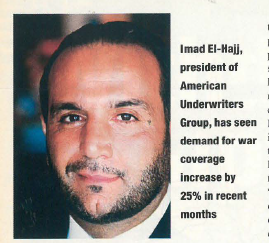
Imad El-Hajj, president of American
Underwriters Group (AUG), probably
never thought of it, but his job is much
like that of a priest. In times of trouble, anxiety,
and worry, people come running to
him. AUG is among a handful of insurance
companies that provide war-on-land
coverage — insurance for damages caused during
a military conflict.
Demand for
these policies increased 25% in recent
months, with tension building prior to the
Israeli withdrawal — not just in the South but
in Beirut and even Jounieh. The price of premiums
shot up by almost a third. Recently,
a professional syndicate requested that its
medical insurance coverage be extended to
include injuries sustained during wartime.
Now the Israelis are gone after 22 years
of occupation. When EXECUTIVE went to
print, there was a sense of victory across the
country. But despite the celebrations, there
remains uncertainty about what will happen
in the weeks and months to come.
Business does not lend itself to an atmosphere
of uncertainty, whether one is a
banana seller, bank manager, importer, or
stockbroker. The withdrawal has perhaps
brought a feeling of greater uneasiness
than during the occupation, which the
Lebanese had grown accustomed to.
“People feel that a scenario will soon be
played out,” says El-Hajj. “What kind of
scenario, they don’t know.”
There are worries that border conflicts
could escalate into far more punishing air
strikes than what has been seen in recent
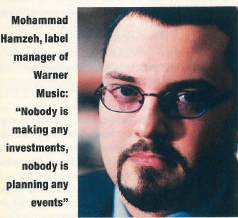
times. “Nobody is doing anything, just
waiting to see what will happen,” says
Mohammad Hamzeh, label manager of
Warner Music. “Nobody is making any
investments, nobody is planning any
events.”
At the Riviera Hotel, 20% of this
summer’s bookings are tentative compared
to last year’s near-zero rate. “They don’t
want to commit themselves,” says Nizar
Alouf, managing partner of the hotel.
The uneasiness of the region is affecting
international business circles. “There’s a lot
of indecisiveness from the Americans at this
point, and when you hear the word
Americans, that is business,” says Michael
Dunn, partner at Healey & Baker, a real
estate consultancy firm that helps local — but
primarily foreign — firms with their real estate
needs.
Even prior to Israel’s promises
of withdrawal, the political environment in
Lebanon had impacted its standing in the
investment community. Standard & Poor’s
sovereign rating for the country is BB with
a negative outlook, which is a speculative
grade allowing for political uncertainties.
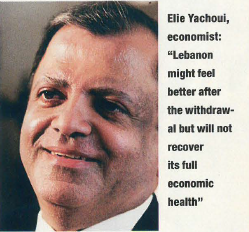
“The probability of conflict after the
withdrawal is becoming higher,” says Elie
Yachoui, an economist, noting the Shebaa
Farms dispute and other issues. “For the
economy, that means a bad outlook for
investors and more recession.”
Probably the most disturbing murmurs
prior to the withdrawal emanated from
financial circles. In April, for the first time
in almost a year, the central bank was
forced to intervene in order to prop up the
pound. While figures were not disclosed,
analysts estimate that the bank spent
between $400 million and $450 million
over several weeks.
The pressure on the
pound had calmed down by the time of the
withdrawal, but the Lebanese currency’s
vulnerability is a cause for worry.
“If the withdrawal of Israeli troops in
South Lebanon leads to a deterioration of
stability, we will see a flight to foreign currencies,”
warns Navaid Farooq, Standard &
Poor’s sovereign analyst for the Middle
East and North Africa.
Even if the central
bank, in a bid to prevent the currency’s
collapse, hiked interest rates and started
spending its reserves, there could be panic.
“If depositors decide, in a mass hurry, to
switch from Lebanese pounds to US dollars,
then nothing that any commercial or central
bank can do could hold them,” says one
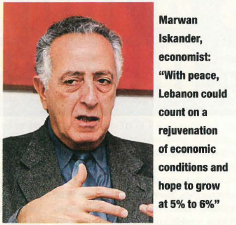
analyst. In the words of economist Marwan
Iskander: “The banking system could be
shaken to its roots.”
Depositors could rush the banks, changing
their pound-based accounts — 61% at the
beginning of 2000 — into dollars. And if that
happens, it could result in calamity.
People’s purchasing power and standard
of living could be reduced overnight. In a
country so dependent on imports, this
would be devastating. “If the pound were to
devalue by 20% or more, the circumstances
would become all that much harder.
Today, we have a difficult situation, and
if compounded further, it could become
explosive,” warns Iskander.
This would
spur high inflation. Many businesses and
individuals would not be able to repay
loans, and the value of Lebanese T-bills,
which represent a substantial portion of
most Lebanese bank assets, would tumble.
The worry isn’t only with local depositors
switching to hard currencies. Capital outflow
is another concern. “If we have confrontation
with Israel, it would be extremely difficult
for Lebanon to maintain the deposits of the
non-Lebanese, which constitute 30% of
total deposits,” says Iskander.
Couple that scenario with the already bad
economy and possibly hundreds of millions
of dollars in infrastructure damage
caused by Israeli air strikes, and it could
cripple the economy. For the cash-strapped
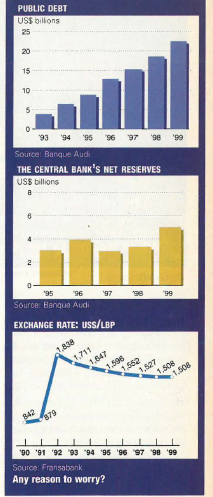
government, already drowning in nearly
$23 billion of debt, devaluation would create
further troubles.
While a weaker pound
would help relieve the domestic debt,
meeting overall debt payments would
become more cumbersome if Lebanon is
destabilized. “In the worst-case scenario,
there would be increased difficulties in collecting
revenues,” says Farooq.
But prophesying the worst might not be
well founded. The last ten years have witnessed
a spate of crises, from large-scale
Israeli bombardments of Lebanon’s infrastructure,
renegade militants in the North, to
a major turn of government. Through it all,
the sky never caved in, the pound remained stable, people
went to work, the kaaki
sellers continued to sell their kaak, and life went on pretty
much as normal.
Whether it is
coming or not now that the
Israelis have gone, conflict
is certainly nothing unusual to
the Lebanese; they have
lived with it through most of
the last three decades.
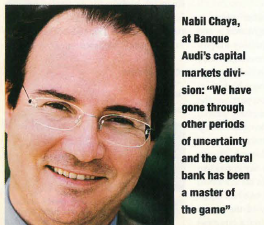
“We have gone through
other periods of uncertainty
over the last few years, and the central bank has been a master
at the game. They know
very well how to contain the pressure,”
says Nabil Chaya, head of the treasury at
Banque Audi’s capital markets
division.
Analysts point to
several key firewalls for the
bank. Foreign investors, who
own less than 10% of
Lebanese T-bills, cannot
directly speculate on the
pound, as they did in Southeast Asian countries during
the economic meltdown in
that region. This will help prevent
a “hot money” problem —
a sudden and massive sell-off
at the first signs of instability.
At the same time, the central
bank’s reserves were about $5
billion at the end of 1999 —
higher than ever since the end
of the civil war. If the bank
needed to step in again to
support the currency, it
should have enough reserves
to last for the short to medium
term.
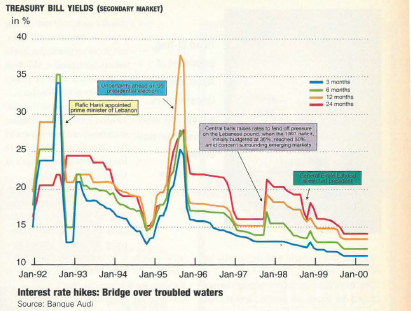
Although it would
choke investment and slow down
the economy further,
interest rates could be hiked to
defend the pound, as they
were during times of uncertainty
in 1992, 1995, and
1997 (see graph).
As a last
line of defense, the bank has
gold reserves estimated to be
worth between $2 billion and
$3 billion.
“Even if things go very badly,
no catastrophe is expected for
the simple reason that even with continuing
pressure, the central bank has huge
reserves,” says Mohieddine Kronfol,
financial analyst in the capital markets
division of Middle East Capital Group.
But even if there is no conflict in the
wake of the Israeli withdrawal, Lebanon has
plenty of problems to lose sleep over. “My
biggest concern,” says Kronfol, “is
Lebanon getting its house in order.”
The
government is stuck with a budget deficit
that reached 51.8% at the end of the first
quarter of 2000. That’s up from 42.4% at the
end of 1999 and a far cry larger than the
37.3% that was targeted for the end of this
year — anxiety.
The economy regressed by between –1%
and –1.5% last year, according to the Economist
Intelligence Unit and HSBC.
Official GDP growth estimates for this
year are at 1.5% to 2%. But a recent report
by the Bank of Beirut & the Arab
Countries states: “This year looks harder
than last, given the prudence and the wait-and-see
attitude of economic agents.”
According to a study done by the General
Labor Confederation and the International
Labor Organization, an estimated 48% of
the Lebanese population is on the verge of
poverty and 68% live below the middle
class line — anxiety.
Serious administrative reform has yet to
get underway, the government is locked in
disputes with a number of foreign companies,
and there are serious doubts that this government’s
privatization plans will go
through — anxiety.
At the same time, parliamentary
elections are coming up this
summer, and many are forecasting a change
of government — more uncertainty.
“These are the issues that weigh heavily
on Lebanon,” says Kronfol. “If the issues
are not addressed, the government will find
itself, against its current intentions, having
to raise interest rates to keep the depositors
from converting and keep banks participating
in T-bill auctions. This
would exacerbate Lebanon’s
current economic problems.”
Without solutions, the economy
will continue to deteriorate,
which itself could put pressure
on the pound.
What’s more, opinions are
divided about what may come
now that the era of occupation
has ended. The pullout could
usher in an era of stability.
“The problems with the economy
are obvious,” says Paul
Salem, development analyst.
“The only thing that can get us
out is peace and investment.”
And many people feel that the
withdrawal could be the first step towards
a comprehensive peace settlement.
“This
will turn a new page,” says Georges
Ghorayeb, general manager of the tile
manufacturer Lecico. “We don’t know
what’s coming, but I think it’s a step
towards a solution. We’re optimistic. We
still believe that the past of Lebanon was
much more dangerous than the future.”
The advantages of a peace settlement are
obvious: millions of dollars in foreign
investment and foreign aid, a flood of
tourists, possible trade liberalization.
“Lebanon could count on a rejuvenation of
economic conditions and could hope to
grow at 5% to 6% [per year],” says
Iskander.
He adds that the country may see
as much as $2 billion in compensation for
damages sustained during the Israeli occupation,
from the European Union, Japan, and
especially the oil-rich Arab countries.
“As
well, the privatization process would result
in greater receipts due to increased investor
confidence, which would lead to a larger
reduction in the debt stock, and we would
see increased tax revenues,” says Farooq.
Without a settlement, the benefits are
less obvious. Many political problems, such as
the Palestinian issue, would
continue to fester.
But if
the situation remains
calm, there would likely
be a certain increase in tourism revenue, and it
might prompt some
investment, especially in
the South.
This, according
to Iskander, would mostly
come from the Shiite community
that made money in
Africa, estimated to have
about $5 billion in wealth.
He estimates that as much as $500 million could flow into the South.
“That kind of investment in an economy as
small as Lebanon’s would make a significant
change,” he says.
While the economic choke on Lebanon
may be loosened, the country won’t
breathe easily. “If someone is sick and has
a siesta, how will he wake up?” asks
Yachoui. “Lebanon will probably feel better
after the withdrawal of Israeli troops, but
it does not mean that the country will
recover its full economic health.”
One thing is certain — Lebanon’s problems
did not go away with the Israelis.