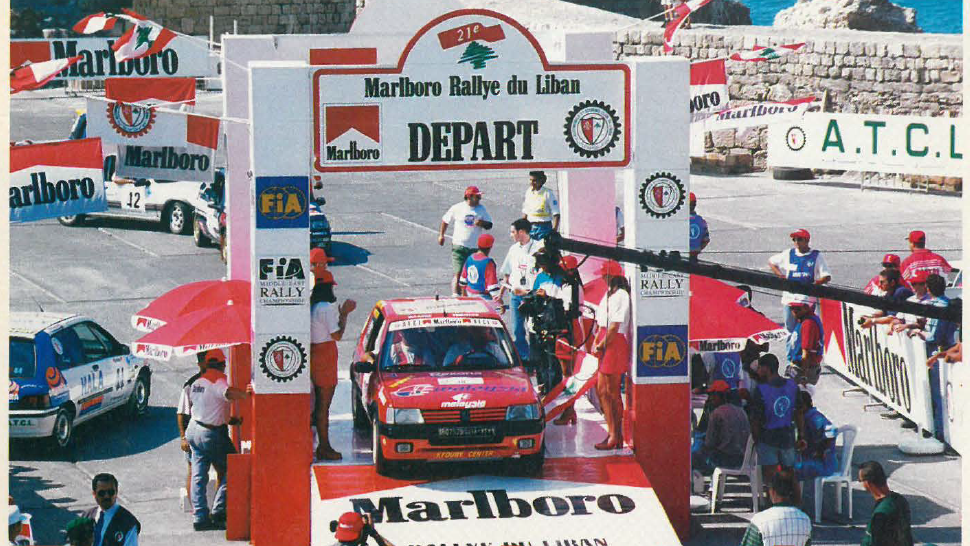
Lebanon, start your engine. “The
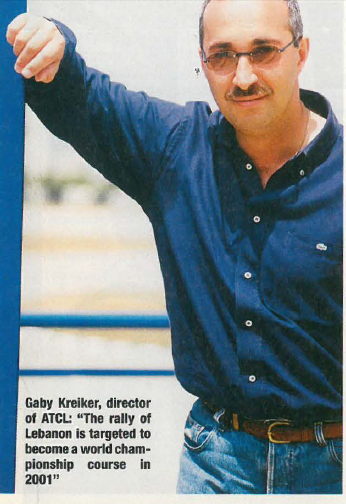
rally of Lebanon is targeted to
become a world championship
course in 2001,” asserts Gaby Kreiker,
director of the Automobile and Touring
Club of Lebanon (ATCL). He expects 500
foreign journalists to swarm the country to
report on the 900-km, four-day race, an
event that is expected to attract big-name
sponsors and professional drivers from
around the world.
Even more ambitious
are the plans to hold a Formula One race in
the Beirut Central District in the next few
years. Over a billion people could watch
Michael Schumacher weave his Ferrari
through the streets of Solidere on TV. The
event could attract as many as 40,000 visitors
and pump hundreds of millions of
dollars into the local economy.
Sounds like the dreams of a motor-crazed
country craving international attention. The
Lebanese have a passion for car racing, as
anyone driving to Jounieh on a Friday night
quickly discovers. But the sad reality is that
motor racing events here are crashing.
“Motor sports are one of the most expensive
sports you can do,” says Kamil Maalouly,
one of three partners who own the Motor
Club, a company involved in organizing
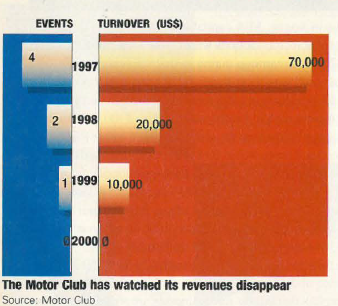
amateur rallies. In 1997, its best year,
Motor Club organized five events, including
the Amateur Cup, which attracted 350 competitors.
The event was covered by LBC,
which contributed 200–300 advertising
spots. Motor oil company IGOL was the
main sponsor, contributing $10,000, with a
number of smaller co-sponsors throwing in
another $15,000.
But in 1998, the Motor
Club organized just two events. The company
had to shift to MTV for coverage of the
Amateur Cup because LBC was no longer
willing to contribute the same number of TV
spots, and the number of participants
dropped by more than a third.
Last year, the
Amateur Cup was the only event organized
by the Motor Club. This time, the company
had to go to Future TV for sponsorship and
only 60 competitors participated. The
Motor Club did well during those three
years, earning profits of around $50,000 on
revenues of $100,000. But for 2000, lack of
demand has meant that the company is not
organizing any events.
Kreiker understands these problems well.
ATCL, a non-profit organization with 9,000
members, organizes such big-name races as
Rally of Lebanon and Rally of the Cedars, as
well as a number of smaller karting, 4×4, and
closed-circuit events.
“Between 1992 and
1994, there were no other spectator sports, and
we made money. But since 1995 we started
to go downhill, losing coverage to basketball
and other events,” he says. Rally of Lebanon
and Rally of the Cedars used to get an average
of 20 TV spots per day, one month
before the event. Today, they get just 10
spots. “This affects our sponsors and drivers,”
says Kreiker.
ATCL has to pay around $200,000
of the $600,000 budget to organize
the Rally du Liban. Marlboro foots about
$250,000 of the bill, with TV stations — such
as LBC and MTV — contributing $100,000.
Co-sponsors pay the rest.
For the Rally of the Cedars,
these days ATCL must
pay the entire $70,000 to
$100,000 needed to organize
the event. The organization
receives no contributions from
TV stations.
ATCL’s difficult situation
could change if the Rally of
Lebanon is promoted from
the Middle Eastern rally car
circuit to the world circuit, as
Kreiker says will happen.
While the Middle Eastern
circuit stops in Dubai, Abu
Dhabi, Jordan, Qatar,
Bahrain, Cyprus, and
Lebanon, the international
circuit is held at 14 different
locations around the world.
With sponsors like Michelin
helping to finance the event,
an international rally car race
could bring an estimated $10
million of revenue into
Lebanon.
Profits generated
from the event could then be
reinvested in order to make
the Cedars Rally into a
Middle Eastern circuit event.
The payoffs of a Formula
One race would be even
greater. The idea first arose
in the mind of Khaled Altaki,
a local businessman, in 1994.
His Beirut Hariri Circuit
would have run along the
Ramlet El Baida promenade.
The idea has since been
scrapped, although Altaki
now claims to be designing a
second closed-circuit track
running in an as-yet-undisclosed
location.
But the main impetus these
days is on the idea of running
a Grand Prix through the
streets of Solidere. The Ministry
of Tourism has appointed a committee of five officials,
including Cheikh Fouad Al Khazen, the
chairman of ATCL, and Nabil Karam, a
five-time champion with ATCL, to prepare
a budget and market the event through a private
company.
Should Lebanon be awarded
the rights to organize a Formula One race,
ATCL would be given the job of managing
the race. The event would demand a year of
preparation and require an estimated budget
of $100 million. ATCL would be charged
with managing the event, gaining valuable
experience and worldwide recognition.
“Formula One will change the face of
Lebanon in the eyes of the world,” says
Karam. Hotels would be full for a week,
generating some $3 million for the government
in restaurant taxes alone. It has
been estimated that the event would generate
$100 million in profits for organizers,
which would be shared by the government,
ATCL, and the company in charge of marketing
the race.
“It will have a snowballing effect on
tourism and everyone will be positively
affected — taxis, hotels, restaurants, malls,
retailers — and it will put Lebanon on the
tourist map for the entire world,” says Fadi
Saab, board member of the national council
for tourism. Saab, also chairman of TMA,
would be involved in facilitating the transport
of racecars into and out of the country.
Sound too good to be true? It probably is.
Lebanon is competing against Egypt and
Dubai to host the event. Although Lebanon
has the best climate, Sundays off, and a casino
for gambling, Dubai has pledged to spend
close to $1 billion to organize the event and
is the leading candidate.
At the same time,
Dubai and Egypt do not have to deal with the
nasty political environment plaguing
Lebanon. “Bernie Ecclestone, the head of the
international association for Formula One organizers,
refuses to come to Lebanon under
these conditions,” says Karam, adding that
Formula One wouldn’t take place here
before regional peace is achieved.
Others feel that Lebanon is not ready to host
an event of this size. “It seems to me that it’s
too early to organize such an event. The
country doesn’t have the necessary organization
to attract the right amount of tourists and
make sure their stay is trouble-free,” says
Ghassan Matar, previously an independent
consultant for the ministry of tourism.
If Lebanon succeeds as a candidate, organizers
will have to wait until 2003 before
they can hold the event. Until then, perhaps
the slogan we should be promoting is
“Rally for peace.”