
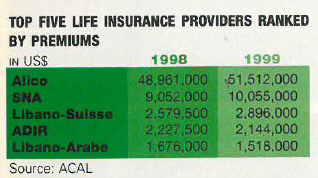
Sales of life premiums grew by just 6%
last year, from $74,778,669 to
$79,272,469, according to the Lebanese
Insurance Companies Association (ACAL).
“The slowdown in growth is more related to
life insurance policies sold as guarantees
for bank loans rather than those sold for
future security,” says Joseph Mrad, a manager
at ADIR, an insurance company catering
mostly to the insurance needs of Byblos
Bank. Over 50% of ADIR’s portfolio is
composed of life insurance policies. The
value of life premiums has dropped from
$2.227 million in 1998 to $2.144 in 1999, a
3.7% decrease. Libano Arabe, which caters
to Banque Audi, is in the same boat. Its life
portfolio has decreased by nearly 10%.
“Banks are being more careful in issuing
loans and consequently the amount of life
premiums collected by the concerned insurance
companies is affected,” says Mrad. In
contrast, firms like Alico, SNA, and
Libano-Suisse, which sell private life insurance
policies not tied to bank loans, have
each seen an increase in business.
NO-LOSE SITUATION
Banque Audi, one of Lebanon’s top
five banks, is offering customers the
opportunity to invest in international equities.
In mid-May, Audi launched “Harvest
Guaranteed” products. Returns are tied to the
performance of the three best-known international
indices: Dow Jones Euro Stoxx 50
(40%), S&P 500 (35%) and Nikkei 225
(25%). Harvest Guaranteed offers three
products. One investment guarantees
returns of 15%, with a maximum return of
between 65% and 70%. A second guarantees
a return of 9%, with a maximum return of
between 82% and 87%; and a third investment
guarantees a return on the capital
invested, with a maximum return of
between 100% and 105%.
“One of the reasons we launched Harvest
was the demand of our clients,” says Nabil
Chaya, head of treasury at Audi’s capital
market division. “It’s also to help investors
think of long-term investing, focusing on
consistent growth, instead of being speculative
and trying to make a quick buck.”
Until now, Audi has offered clients the
chance to trade only on the local market. But
in the last two years, trading volume on the
Beirut Stock Exchange and on Lebanese
GDRs has been in decline, which has been
harmful to the bank’s capital markets division.
Many investment firms, such as
Financial Funds Advisors and Fidus, as
well as the capital markets departments of a
number of banks, including Byblos Bank
and Banque du Liban et d’Outre-Mer, have
been focusing on international markets.
CASINO: EVERYONE
GETS FLUSHED?
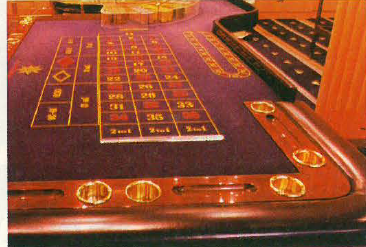
The ongoing conflict between the 11
board members of the Compagnie du
Casino du Liban (CCL) and Elie Ghorayeb,
its chairman, continues. The two sides are in
disagreement over how to handle a government
demand that the casino pay back taxes
on slot machine revenues, from which nearly
40% of the $87 million earned from gaming
is generated. “Deloitte & Touche, the
casino’s auditors, estimates that the claim
can vary between $33 million and $100 million,”
says one board member. Intra
Investment Company, the state-controlled
firm that owns 51% of CCL, is expected to
take action when it elects a new president
soon. Three scenarios are possible: remove
Ghorayeb and elect a new chairman, dismiss
the entire board or a combination of both.
“Those scenarios represent a last-ditch effort
to get Ghorayeb removed and solve our
problems with the Ministry of Finance,” says
the board member. He adds that Ghorayeb has
succeeded in alienating the members, the
employees’ syndicate and the minister.
IN NEED
OF A STIMULANT
The Beirut Stock Exchange (BSE) suffered
operational losses of $70,315 in 1999
due to a slowdown in trading. A decrease in
earnings from commissions, coupled with a
failure on the part of some member companies
to pay their dues, was the root of the problem,
according to Fadi Khalaf, the market’s chairman.
Sales of BSE stocks have cratered since
1997, from $639 million to $331 million in
1998, falling to just $90 million in 1999. The
market did not start off well this year either,
with trading volume amounting to
$28 million in the first four months, in
contrast to $40 million for the same
period in 1999. There have been
reports that the BSE is trying to
encourage television stations to go
public. But there are obstacles: To list
shares, television stations have to get
the approval of the Council of Ministers.
There have also been reports that the
BSE was trying to encourage the two
mobile phone operators, LibanCell
and Cellis, to list shares. “Listing big
names such as LibanCell and Cellis could be a stimulant
to the nearly nonexistent trading activity
on the BSE,” says one analyst. That idea
may have to wait until the operators resolve
their differences with the government.
STAYING
IMAGINATIVE
Lebanese tile maker Uniceramic is celebrating
its 25th anniversary this year by
launching a new line of products. The company
was busy showing off its new
30x60cm, 30x45cm and 10x10cm tiles,
as well as a new imported brand called “Lifetile,”
during the Project Lebanon exhibition at the
Beirut Forum. The company has been trying
to compensate for what has so far been a
20% drop in local sales this year. The company
has also been looking abroad for markets.
“With the drop in construction, our capacity
has been reduced to two days per week, and
now our focus is to increase exports,” says
Nabil Ghorra, assistant general manager.
Exports have increased by 142% in the first
four months of 2000. Uniceramic expects to
acquire ISO 9000 certification some time
this year and has a goal of increasing exports to
20–25% of all sales by the end of 2000. “The good
part is that we have hit the US and Canadian
markets where they have a quality requirement
and we don’t have to compete against cheap
products,” says Ghorra.
MORE WORRIES
Banque Libanaise pour le Commerce
(BLC), a listed bank with shares traded on the
Beirut Stock Exchange (BSE) and the GDR
market, finally released its 1998 and 1999
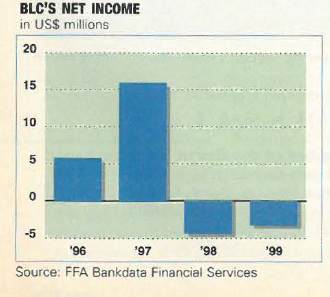
results. After impressive earnings of $15.9
million in 1997, BLC showed losses of $4.3
million in 1998 and $3.2 million last year. But
these are the least of the bank’s worries.
BLC is currently recovering from a messy
merger with United Bank of Lebanon. Two
months ago, Safi Harb, the architect of the
deal, was forced to step down as chairman of
the financial institution after being accused of
mismanaging bank funds. Last month,
UBL-BLC filed a $14 million lawsuit
against Harb. But the bank’s board of directors
is reportedly divided over whether to continue
legal action against their old chairman
or settle out of court. “To be honest with you,
I don’t know where this bank is heading,”
says one analyst. Investors feel the
same. BLC’s shares on the BSE have fallen
over 27% this year, while its GDRs have
plummeted nearly 36%.
DIFFERENT
STRATEGIES,
DIFFERENT RESULTS
Byblos Bank, one of Lebanon’s top five
banks, declared unaudited net income of
$13.4 million in the first quarter this year, a
0.24% decline from the same period last
year. Total assets, on the other hand, went up
7.35% to $3.75 billion, and there was an
11.9% rise in customer deposits, which
reached $2.87 billion. Byblos’ stocks on the
BSE have fallen 20% so far this year. Banque
Européenne pour le Moyen Orient SAL
(BEMO) posted net profits of $866,546 for the
first quarter, an increase of 2.94% compared
to the same period last year. The bank’s total
assets went up 26.8% to $395.3 million and
customer deposits totaled $319.88 million, a
35.4% rise. “BEMO is a recession-proof
bank, having most of its liquidity in US dollars
and 95% of its loans also in dollars,”
says a local analyst. BEMO doesn’t rely as
much on T-bills and tries to forego high
yields for less risky investments.
Banque Libano-Francaise (BLF), on
the other hand, saw its net income fall 23%,
to $36.4 million in 1999. Assets rose 6.7%,
to $3 billion, and customer deposits went up
8.3%, to $2.54 billion. “BLF has a high
exposure to the Lebanese pound and has
extended its loans to the government,
increasing exposure and risk, while receiving
slow-moving returns,” says one analyst.
IMPLEMENTING
PRIVATIZATION:
MISSION IMPOSSIBLE?
Alas, the government has finally passed
the much anticipated draft bill for the
privatization of state-owned enterprises.
Reports from the Ministry of Finance suggest
that the telecommunication sector and
Middle East Airlines are the first candidates
for privatization. Along with the sale of
Électricité du Liban (EDL), Télé Liban and
the casino, the government could net some $5
billion in revenues, helping to reduce the government’s
ballooning debt. “I expect delays
in implementation as the bill had no clear
plan of execution and it faces serious political
opposition,” says one local analyst.
PLASTIC FOR BRAINS
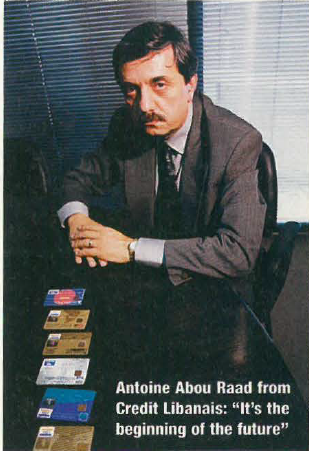
Your credit cards are about to become
a whole lot smarter. Lebanon will
soon become one of the first countries in the
world to adopt Smart Card technology.
Credit Libanais and Visa International, in
cooperation with a number of local banks,
are responsible for bringing the new technology
to Lebanon.
The card contains electronic chips that are
able to store and process large amounts of
information and provide a higher level of
safety and security. “It is the beginning of
the future,” says Antoine Raad, deputy
general manager of Credit Libanais and
coordinator for the seven banks involved in
the project. “It opens the way to multi-applications
which will be possible with the
new technology.” The Smart Card is
expected to replace the magnetic-stripe
card within the next five years.
