• Some signs of moderation are evident in recent economic data, and
inflation remains virtually absent. That’s unlikely to stay the Federal
Reserve’s hand, however. Policymakers are concerned about the
underlying strength of the economy and the tightness of the labor market.
Those worries are likely to prompt a 25-basis-point tightening at
the June 27–28 FOMC meeting, in our judgment.
• Sharp declines in energy prices pushed the April producer price
index down by 0.3%. The core PPI edged up by 0.1% and was only
1.3% above its year-earlier level; excluding the recent pop in
tobacco prices, the year-to-year PPI was unchanged. In other words,
the report showed no inflationary pressures.
EURO
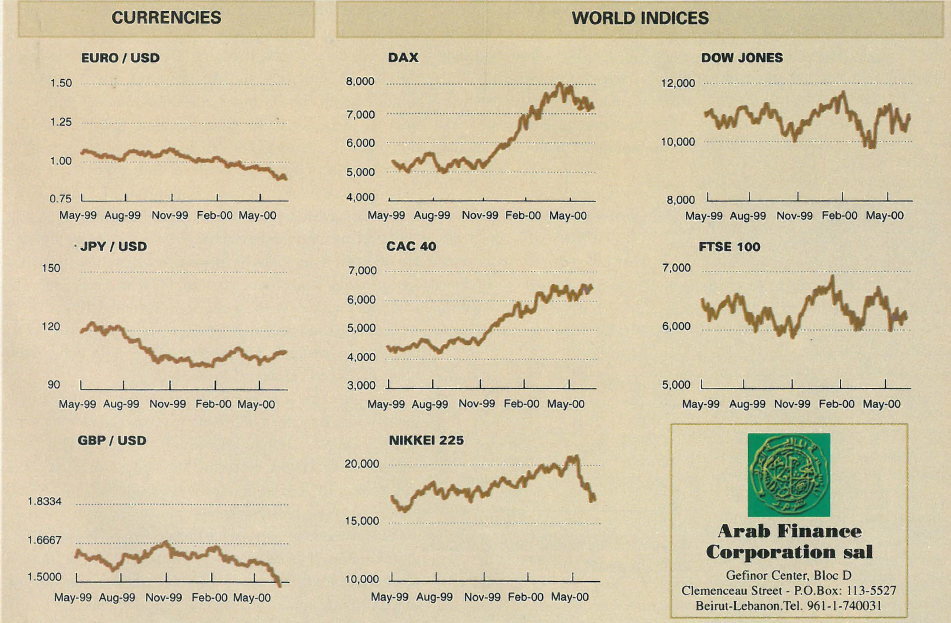
• The euro recently declined to a record low of about 89¢ against the
dollar. We continue to think that the euro will eventually strengthen,
but we have lowered our target. Without a recession in the US or a
burst of public sector reform initiatives in Europe — both of which are
unlikely to occur, in our view — the dollar will probably stay at higher
levels versus the euro than we had been expecting.
• We now think that the euro will remain below parity for much of
2000. Next year, when US and European economic growth rates are
likely to converge, the euro ought to be able to move above parity.
Our new forecast: we think that the $/euro rate will be 0.95 in three
months, 0.99 in six months, and 1.06 in 12 months; our previous forecasts
were 0.99, 1.06, and 1.10, respectively.
• In our view, two major problems plague the euro. First, the US economy
has been growing faster than the Eurozone economy by a wide margin.
Second, structural reforms in the Eurozone have not gone far enough
in the crucial areas of labor policy, regulatory policy, and pensions.
Investors’ concerns about both issues have helped to channel the flow
STRATEGY FOCUS
GLOBAL VIEW
• We have reduced our overweight of Japan in favor of Eurozone equities.
We still like Japan, but the pace of restructuring in that country
in relation to that of the Eurozone does not justify a more aggressive
stance, in our view. It’s particularly true at a time when money
growth is slowing in Japan and the Bank of Japan has let speculation
flourish about possible rate hikes later in the year. The Eurozone has
the added advantage of having a much more competitive currency than
Japan and, consequently, better growth prospects, in our view.
• Consumer spending moderation in April as overall retail sales
declined by 0.2%; excluding automobiles, retail sales were unchanged.
That was a much weaker showing than most market participants
expected. In addition, it appears that concerns about stock market
volatility and higher interest rates have started to show up in consumers’
spending patterns. We expect real consumer spending to increase at a
rate of 4.5% for the second quarter; that’s a healthy pace, but far below
the torrid first-quarter pace of 8.3%.
• Meanwhile, import prices for April declined by 1.6%, led by a drop
of 12.7% in petroleum prices; excluding that sector, import prices
edged by 0.1%. Export prices slipped by 0.1%.
Bruce Steinberg, chief economist
of capital out of Europe and into the US, to the benefit of the dollar.
• Europe’s economic growth is currently the best it has been in a
decade, with Eurozone GDP set to rise by about 3.5% in 2000. Even
so, growth this year will probably be 5.0%. That means that the
growth differential will remain very large for the time being. Next
year, however, we expect Eurozone GDP to increase by 3.2% and
US GDP to rise by 3.6%, the smallest gap in more than a decade.
• Additional pluses for the euro include the development of the
region’s capital markets, which are beginning to resemble those in the
US, and the massive corporate restructuring efforts that are under way
in Europe. Nonetheless, Europe lags the US on a number of economic
fronts. In particular, the political will to implement labor market reforms
appears to be lacking. Without more flexibility in the labor market,
trends in European productivity and economic growth will almost certainly
continue to lag those in America. That, in turn, will tend to limit
the euro’s long-term upside potential.
MICHAEL HARTNETT, SENIOR INTERNATIONAL ECONOMIST
GLOBAL ECONOMICS TEAM
• With liquidity conditions deteriorating, risk aversion rising, and a possible
slowdown in global growth prospects looming, we have moved
the emerging markets down from a small overweight to an underweight,
in our global portfolio. However, those markets appear to be better situated
to withstand a slowdown than they were the last time around.
• The recent weakness in global bond markets suggests that investors
are not convinced that monetary policy has been tightened sufficiently
to ensure price stability. We expect short-term interest rates to rise further
during the next three months. For that reason, our regional
asset allocation guidelines suggest that investors adopt above-average
cash levels.
• GDP growth expectations are still rising and inflation expectations
are under some upward pressure from cyclical forces. As a result, it
is no surprise that European central banks and the US Federal
Reserve have been tightening. The tightening, together with the
effects of higher energy costs, could begin to influence economic
growth prospects as fall approaches. The OECD leading indicator for
the G7 nations has topped out, and liquidity conditions particularly
in the US have begun to deteriorate. Moreover, the Japanese inventory-shipment
ratio, a key cyclical indicator, turned down in March.
Those developments are consistent with a peak in global industrial production
growth this summer. That, in turn, would argue for a shift
toward a more defensive portfolio. Interestingly, turning points in the
growth rate of the OECD leading indicator have tended to coincide
with major changes in sector leadership. Traditionally, when the
growth rate is declining, pharmaceutical and insurance issues have
done relatively well.
• The influence of tighter monetary policy has already manifested itself
in the form of increased risk aversion across a number of asset classes.
We expect that trend to continue as central banks tighten further. Signs
of risk aversion include the major deterioration in equity market
breadth, particularly in the NASDAQ; much wider spreads in the corporate
bond market; the underperformance of many emerging markets;
and the weakness of the Australian dollar (the currency of a country
with a large current-account deficit) against the yen (the currency
counterpart of a country with a large current-account surplus).
• One surprise, in our view, is how well the dollar has held up in the face
of the NASDAQ market’s sharp setback. The dollar’s strength indicates
that global investors are still prepared to fund the US private sector’s
financial deficit and that they still think that returns on US assets will
be better than those on European and Japanese assets. However, we
believe that the current divergence between the performance of the
NASDAQ and the dollar is unsustainable.
• If risk aversion declines and the dollar continues to strengthen, economically
sensitive stock market sectors particularly the technology
sector could start to outperform again. On the other hand, if recent
inflation concerns in the US lead to a Fed-induced period of below-trend
economic growth, our strategy would probably need to become
much more defensive.
• The global context raises two crucial questions in that regard. First,
to what extent have America’s remarkable good inflation trends been
helped, until recently, by below-trend growth in the rest of the world?
Second, what are the implications of the funding of the US private sector’s
financial deficit if investment activity starts to increase faster than
savings in Japan and Europe? The more prospective returns in Europe
and Japan improve, the more the US may struggle to fund its expansion
just when domestic capacity is significantly increased. Against
that backdrop, we continue to prefer non-US markets.