
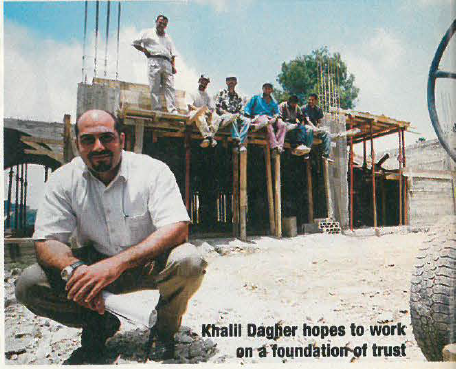
When he was young, Khalil Dagher
was inspired by entrepreneurs. He
realized his dream last December with the
establishment of Dagher Enterprises, a construction
company. About $50,000 has been
invested so far. But has Dagher’s unwavering
ambition obstructed his view of reality?
The stagnant economy generates fierce
competition and this has resulted in underbidding
to win available projects. According
to Dagher, profit margins should be about 5%
but have been reduced to ridiculously low
levels. Many contractors regularly cut corners
to reduce costs. This often involves using substandard
materials and not meeting designs.
“Nobody follows specs,” says Souheil Abou
Habib, general manager of contracting firm
Nassim A. Habib.
Dagher, who has a master’s degree in
construction project management, sees the
potential in working on “cost-plus-fee” or
“cost-plus-percentage” contracts. With
these formulas clients agree to be billed
for whatever the project costs, and the contractor
earns a fixed fee or a percentage of the value.
“I am working for
anywhere from 3% to 10%,
depending on the type of
work,” says Dagher. The system,
which is meant to allow a
higher quality of work, is a
costlier approach. But clients
might be skeptical because –
let’s face it – bills can easily be
forged.
“This system is based
on trust,” says Dagher.
Often unqualified contractors
are unable to finish jobs, leaving
project owners with the
headache – and added expense –
of hiring another firm to take over.
“I would prefer to pay extra and work with someone I
trust to get the job done,” says Abou Habib.
“But he needs to build a good track record.”
Dagher, who previously worked with
Oger-Liban and on such landmark projects
as the Grand Serail, already has a name in the
business. Many big firms hire him as a consultant,
and his company is already working
on six projects, all under the cost-plus formulas.
Five are residential villas (each costing
on average $150,000), and one is a five-story
apartment building (about $500,000).
Dagher plans to build his reputation with
cost-plus contracts, but the system will be limited
to private projects, because the government
only considers lump-sum and unit price
contracts. However, he has every intention to
venture into this sector.
“To expand you must
go for government projects,” he says.
INVESTING IN STOCK
International stock markets have produced
a new breed of investors. Almost
everyone wants to get on the bandwagon,
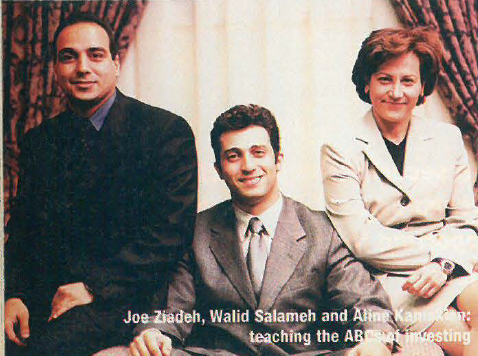
including Walid Salameh and Joe Ziadeh.
“We were interested in trading in stocks,”
says Ziadeh. “But we couldn’t find anybody to teach us the basics.”
The void presented
a business opportunity. Marketing expert
Aline Kamakian came on board, and the
group established Business Investment
Developers (BID), which is sponsored by
Financial Funds Advisors. They began
with an initial investment of
about $50,000.
BID gives seminars on the
basics of stock trading, and so
far they have run at near-full
capacity. The four-week
seminar, made up of 12 two-hour
sessions, costs $600 per
person. BID is conducting its
third seminar.
“We have
recouped about 75% of our
investment,” says Ziadeh.
Four young finance graduates
instruct the seminars.
Each participant is given $500,000 in virtual money to practice trading.
Kamakian, who previously traded
stocks, nonetheless attended the first seminar. How has she fared with the turbulence
in the US stock markets?
“Honestly, if I didn’t take the course, I would have lost
a lot of money – $20,000 to $30,000,” she
says. “I learned how to minimize my risk –
by diversifying and doing options.”
What’s
their view on the dead Beirut Stock
Exchange (BSE)?
“We are not trading on the
BSE yet,” says Kamakian.
“In Lebanon,
stock markets are misunderstood,” says
Fadi Khalaf, chairman of the BSE, which is
organizing a campaign to educate the public
about capital markets.
BID plans to expand regionally. The company
is designing a four-day seminar to be
held throughout the Middle East. Creating an
advanced seminar is under way, as is a workshop
where people can practice trading.
A WINNING RECIPE
David Aouad and Marc Kandakji met ten
years ago in Montreal, where both
were economics undergraduates. They
talked about starting a business together.
But Aouad pursued architecture, and
Kandakji went into hotel and restaurant
management. Reunited in Lebanon a year
ago, they resumed talks about a business
venture and came up with Fusion
Restaurant Study and Development.
Fusion develops concepts and provides
management services for investors in the
restaurant business. The elements that
make a restaurant work? “Good food, good
prices, good design and good location,”
says Aouad.
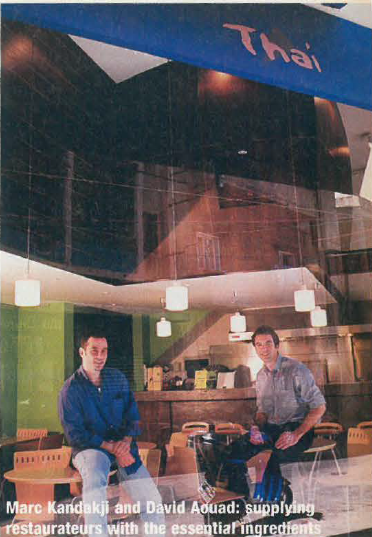
To attract investors, Aouad
and Kandakji had to prove themselves. To
do this, they opened a restaurant, Thai, last
December. “Our concept is to offer good
food at reasonable prices,” says Kandakji.
A meal at Thai costs $10 on average. Raed
Habib, co-owner of Caracas, a bar restaurant,
says restaurants such as Thai work
on profit margins of about 10% and depend
on a high turnover. Caracas, however,
operates on a lower turnover with margins
of 15% to 20%; meals cost about $25 to $40.
Affordable dining doesn’t necessarily
mean compromising on image. Aouad says
that locating the restaurant on Monot Street
– packed with trendy bars and eateries – was
a necessity. The area maximized Thai’s
exposure and put it in the same fashionable
bracket as the venues surrounding it.
The small restaurant, which only seats 20,
is always bustling with activity. “We receive
between 60 and 100 customers a day,” says
Aouad. The two would only say that they
negotiated “a good deal” for the location.
The monthly overhead, about $7,000, isn’t
high for its staff of six, says Aouad. Head chefs
demand about $2,000 a month, but with
Kandakji in charge of food preparation and
menu creation, wages are minimized.
And
because Aouad designed the restaurant, the
expense of hiring an interior designer was
eliminated. The initial investment totaled
about $60,000, which was funded with a
bank loan.
The venture seems to be paying off,
since opening sales have doubled every month.
At that pace the two would need a year
to recoup their investment.
So any future projects?
A joint venture for another Thai restaurant,
due to open soon, say the guys.
CREATIVE WORKS
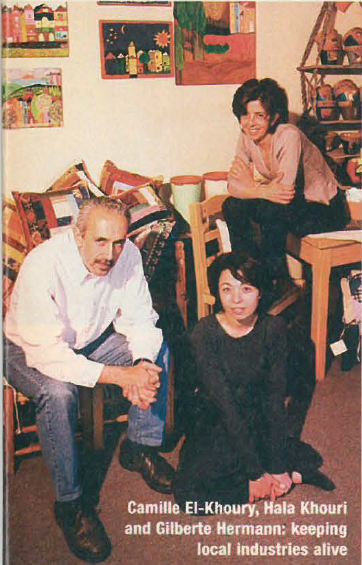
Camille El-Khoury, Gilberte Hermann
and Hala Khouri are artistic types.
Last year, on an initial investment of
$15,000, they established a line of handicrafts
called Scraps & Stuff. The items
manufactured include a range of rustic furniture,
hand-painted flowerpots and fabric
articles for the home, patterned in the
patchwork design.
“The concept was to
produce things from scraps and to keep
local traditions alive,” says El-Khoury.
Scraps & Stuff produces rustic stools, which
are made in rural areas. “They are the traditional
stools made by agriculturalists from
discarded wood from pruning trees,” he
says.
His company enhances the stools to
make them marketable. Each stool retails for
$21. Scraps & Stuff also uses crude clay pots
that are locally produced. They are priced
from $9 to $33. Cushions made for the rustic
stools range from $24 to $46.
Because everything is handmade and unique,
markups are high, at about 40%.
Scraps & Stuff, like other handicraft businesses,
is affected by the slumped economy.
The store Style & Nature offers a selection
of dried flower arrangements. The owner,
Viviane Torbey, says sales are slow, but
boom on special occasions.
At Scraps &
Stuff, the pots, which are most affordably
priced, have been the fastest sellers. The
patchwork items, which are more expensive,
are slow sellers.
Since opening four months ago, sales
have been less than satisfactory. Scraps &
Stuff is displayed at Arcanes in Ashrafieh.
To help local artists, the proprietor offers the
gallery at no charge. El-Khoury believes
that commercial banks should help small
and medium-sized businesses by giving
microcredit.
A loan would enable him to
better market Scraps & Stuff.
