It’s nice to take a catnap. But if you
wake up to find your multi-million-dollar
company has been reduced to
almost nothing and your former employees
are your biggest competitors, then you
know you’ve overslept. A couple of
decades ago, Contracting and Trading
Company was a name to be reckoned with.
C.A.T. was a giant in the region, responsible
for building landmark structures such as
the Presidential Palace in Iraq and the
Holiday Inn Hotel in Bahrain. It was also
one of the first contracting firms to lay
down thousands of miles of oil and gas
pipelines of different diameters in the Gulf,
Libya, Ghana and Nigeria, as well as being
the first to lay down 48″ and 56″ pipelines.
C.A.T. clawed its way into everything –
from highways to stadiums, airports and
power stations in the Middle East, Gulf
and Africa. Its turnover surpassed the billion-
dollar mark.
But in the early 1980s, C.A.T. went into
hibernation, mainly because of the war and
internal conflict among its shareholders.
By the time it re-emerged five years ago,
business had dwindled to an all-time low.
Turnover was just $25.2 million and the
company had dipped into the red by a few
million. It was time for serious reconstructive
surgery. The owners began hunting for
someone who could turn things around and
stumbled across Fred Habeishi, previously
president of the US-based RUST, a design
and build firm with over 22,000 engineers
on its payroll. RUST, where Habeishi
spent 34 years before joining C.A.T., was
one of the leading contracting firms in the
United States, specializing in the construction
of plants and factories. Can this newly
appointed Mr. Fix-it rebuild C.A.T.?
As far as Habeishi is concerned, that has
already been taken care of. “We’re not coming
back,” he says. “We’re already back.”
Since his arrival, turnover more than tripled
from $25.4 million in 1996 to $80.2 million
last year. Projections for this year put that figure
at $130 million. But to do that, Habeishi
had first to get the company geared up to compete
for contracts that would put it in the big
leagues with the likes of the Consolidated
Contracting Company (CCC). “We had to
reinvest, reinvigorate and get the right people,” says Habeishi. In 1996 a capital investment
of around $50 million was raised by
C.A.T.’s owners, the heirs of founders
Emile Bustani, Abdallah El-Koury and
Shukri Shammas. But with the company
losing $4 million to $6 million a year,
Habeishi knew that wouldn’t last long.
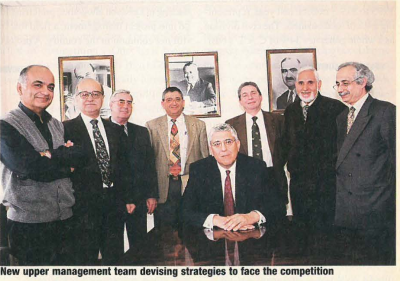
In 1997, Aramco, the world’s largest oil
company and C.A.T.’s major customer in
Saudi Arabia, was getting
ready to kick
C.A.T. out. “They told us we hadn’t done
much in the past ten or
15 years, and the last
few years we’d done
lousy work,” says
Habeishi. Aramco
allotted C.A.T. a probation
period of a few
months. Habeishi was quick to react. “We just
about fired anyone who wasn’t doing his job right,” he says, “especially people in important
positions.” He then rebuilt the work force
with qualified personnel. C.A.T.’s staff
grew from 2,494 in 1996 to 7,452 last year,
while millions were spent on reorganization,
training people and improving standards.
Habeishi also had to replenish the company’s
fleet of equipment. In the early 80s,
C.A.T. was among the best-equipped contracting
firms in the world, with 2,300 pieces
of heavy construction equipment in Nigeria alone. For 15 years the equipment had lain dormant,
been stolen, looted and cannibalized;
hundreds of millions of dollars’ worth was
reduced to almost nothing. C.A.T. managed to
salvage not much more than 60 pieces and
many of these were in need of repair. “We’ll
be spending about $130 million in the next
four years on replacements and new machinery
in the Gulf and
Nigeria combined,”
he says.
C.A.T. was once
again accepted as a
major builder for
Aramco and is now
pre-qualified. “Each
company has to go
through a pre-qualification
process, after
which the lowest bid usually wins the project.
That’s what C.A.T. has done to get mechanical works with Aramco,” says
Bassem Bou Chahine, vice president of
Albinali, a Saudi contracting firm that does
work for Aramco and Sabic and has a
turnover of more than $100 million.
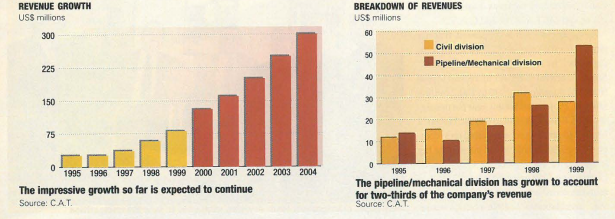
In the pipeline/mechanical division,
which accounted for two-thirds of C.A.T.’s
business in 1999, turnover generated in
Saudi Arabia sprang from $3.3 million in
1995 to $44.5 million last year. That represents
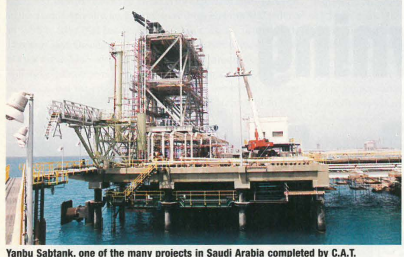
55% of total turnover. Last year C.A.T. won a plant modernization project
with Aramco for $14 million. In the past two
years C.A.T. was awarded two projects
with ADCO, an oil producer in Abu Dhabi:
a $13 million contract to construct 48″
loading rings and a $38 million contract to
build water supply systems. It also landed
the Khuff Gas Project in the Hawiyah and
Hardh areas for about $500 million last
year, again from Aramco. “C.A.T. has
always been the leading contractor when it
comes to constructing pipelines,” says
Youssef Chammas, CEO of Target and
Jima, a contracting firm based in Dubai.
Chammas was general manager of CCC’s
Oman branch for over 20 years in the
1970s and 1980s and remembers when
C.A.T. was big.
Nigeria is a big playground for civil construction
work, but C.A.T. doesn’t have
the run of the place. There it comes up
against the likes of Stemco, a construction
firm with a yearly turnover of over $50
million. The value of projects for most
road and bridge works in Nigeria varies
between $20 million and $50 million,
according to Luke Okoihue, Stemco’s project
manager. And C.A.T. is better equipping
itself to face the competition. “Recently
we have opened some very substantial
credit facilities for projects in Nigeria,”
says Habeishi. “And we’re in the process of
spending around $30 million on equipment
for Nigeria alone.” Turnover in Nigeria
more than doubled from $9.5 million in
1995 to $19.3 million last year, representing
24% of total business. The civil division
as a whole generates 34% of C.A.T.’s business. It built the Sokoto-Goronyo Damsite
road, a contract worth nearly $30 million
in 1999. “C.A.T. has been a big name in
Nigeria for a long time and still is, but
today there are a lot of companies, especially in
Lagos, performing the same kind of work,”
says Okoihue.
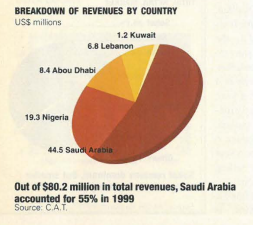
At home, C.A.T.’s turnover rose from
$500,000 to $6.5 million – a contribution of
just 8% to total turnover. The firm has completed its part of the St. Georges Hotel
Complex, a project it was awarded in 1998
for $35 million. It has also finished 25% of
the work on the An Nahar building, a contract
worth $10 million, awarded in 1999.
But here’s the surprise: C.A.T. doesn’t do
construction work here. In fact it avoids contracting
in Lebanon altogether, preferring to
go into project management, a field that is
still not common in the country. A project manager takes on the responsibility of ensuring that a
project is properly executed on time and on
budget, hiring other contractors and engineers
to actually do the work. Should the
price exceed the guaranteed maximum or go
over schedule, C.A.T. is willing to pay a
penalty. Should it come under the maximum,
the savings are shared with the
owner. The Leisure Hill Hotel project, currently
under construction in Dbaye, is
being managed by Soludec Liban, an international
company. “Of course, the client is
informed of our decisions, but we control all
aspects of the project,” says Desire
Nicolai, Soludec’s general manager, who
agrees that project management is a novel
concept in Lebanon.
One example of C.A.T.’s project management
is the modern Lebanese Order of
Physicians Headquarters; ERGA was contracted
to do the architectural work and
Ashada for the concrete construction.
Phase one of the $14 million project is slated
for completion by February 2001. “It’s a
great idea and sure to be popular with project
owners, who have the risk completely
removed from their shoulders,” says
Souheil Abou-Habib, general manager of
Ets Nassim A. Habib, a local contracting
firm. But it might not be so popular with the
contractors: They won’t be able to underbid
to get a job, because it will be more difficult
to reduce costs by using less material.
While project management has allowed
C.A.T. to avoid costly investments in a
stagnant market, it eventually plans to do
construction work in Lebanon. “But only
after the sector picks up and it becomes worthwhile to invest locally,” says
Habeishi, who was initially intending to
do construction work in Lebanon.
Nonetheless Habeishi felt it was important
for a company to work in its home country.
But it was a painful and costly learning
experience. “We had a bunch of guys here
who knew how to build highways in
Amman and buildings in Saudi Arabia, but
they had no earthly idea what was going on
around them,” he says. At the outset C.A.T.
would bid about three times more than the
winning bid on tenders. “We had no idea
about pricing,” says Habeishi. “We didn’t
know the people, and nobody knew us.” So
he sent his staff into the field to learn the
local market. Eventually C.A.T.’s bids
became competitive, and Habeishi’s team
caught on to the aggressive underbidding tactics employed on the Lebanese market.
“Contractors bid below cost in order to get
the job,” says Abou-Habib. “Then they try
to reduce the materials used so they can
come within budget.”
C.A.T. has spent the last three years getting
ready to pounce on the market.
Habeishi believes the company is now
ready to regain its position as one of the
region’s major contractors. In the past few
years, C.A.T.’s biggest project was worth
$50 million, but now Habeishi and crew are
bidding on those in the $100 million to
$200 million range – sometimes as high as
$400 million. “It won’t be easy,” says
Chammas, “all the small companies that
existed in C.A.T.’s early days have grown
to become large contractors. They will face
a lot of competition.” One such foe is
Saudi Arabia’s Ali H. Al-Ghamdi
Est., which has a yearly turnover of
$72 million to $80 million performing
pipeline construction for
Aramco. “C.A.T. is a big name in
this area, but they’re mostly
involved in contracts for testing,
commissioning and maintaining
pipelines for Aramco,” says C.
Sundhyr, the firm’s project manager.
Estimates by some companies
in Saudi Arabia forecast an
increase of 70% from 1999 to 2001 for the pipeline business and the expected construction boom, but CCC is in a much better position to reap the
rewards. CCC employs some 36,000 people
and has a planned turnover of about $1.5 billion
for 2000, 8% of which is in the
pipeline sector. It will be difficult for
C.A.T. to muscle in on CCC’s turf. The
majority of CCC’s work is in the Arab
world and Africa, including new projects for
the Kuwait Oil Company, the Oman Gas
Company and the Abu Dhabi Gas
Company.
C.A.T.’s CEO is cautious about the pace of
growth that the company should expect.
“Today we would be comfortable going
after a project worth maybe as much as
$400 million, especially over a two, three-
year period,” says Habeishi. “I wouldn’t
fool myself that we can go after one worth
$1 billion.” That would stretch our management
and capabilities too far and require
a far greater investment than the company is
ready to make. C.A.T. would be content
with a yearly growth of 25% once it reaches
the $150 million to $200 million mark.
For Habeishi, turnover is not necessarily
a true indicator of size. “To a pure contractor,
it would be the value of the work done,
but to an EPC contractor, who is responsible
for the engineering, procurement and
construction, you also have the value of the
equipment you buy,” he says. If a contractor
builds a plant with $500 million worth
of machinery, turnover becomes misleading.
He especially believes growth through
acquisitions in this business doesn’t work.
Today C.A.T.’s name is still much bigger
than its actual size, but it has made solid
progress. After 15 years of being out of the picture,
the company is trying to build itself
back up to proportions that live up to its
name. The C.A.T. team has more than tripled
business since 1996, re-established a reputation
as potent contractors that produce quality
work, while project management further
refines its skills as a contractor. “They have
every chance of making it back to their initial
position in the market,” says Youssef, a
notion shared by many in the field. They may
just end up proving that old adage about cats
having nine lives. The company has been
reborn into its second one but seems bent on not needing any of its remaining seven.