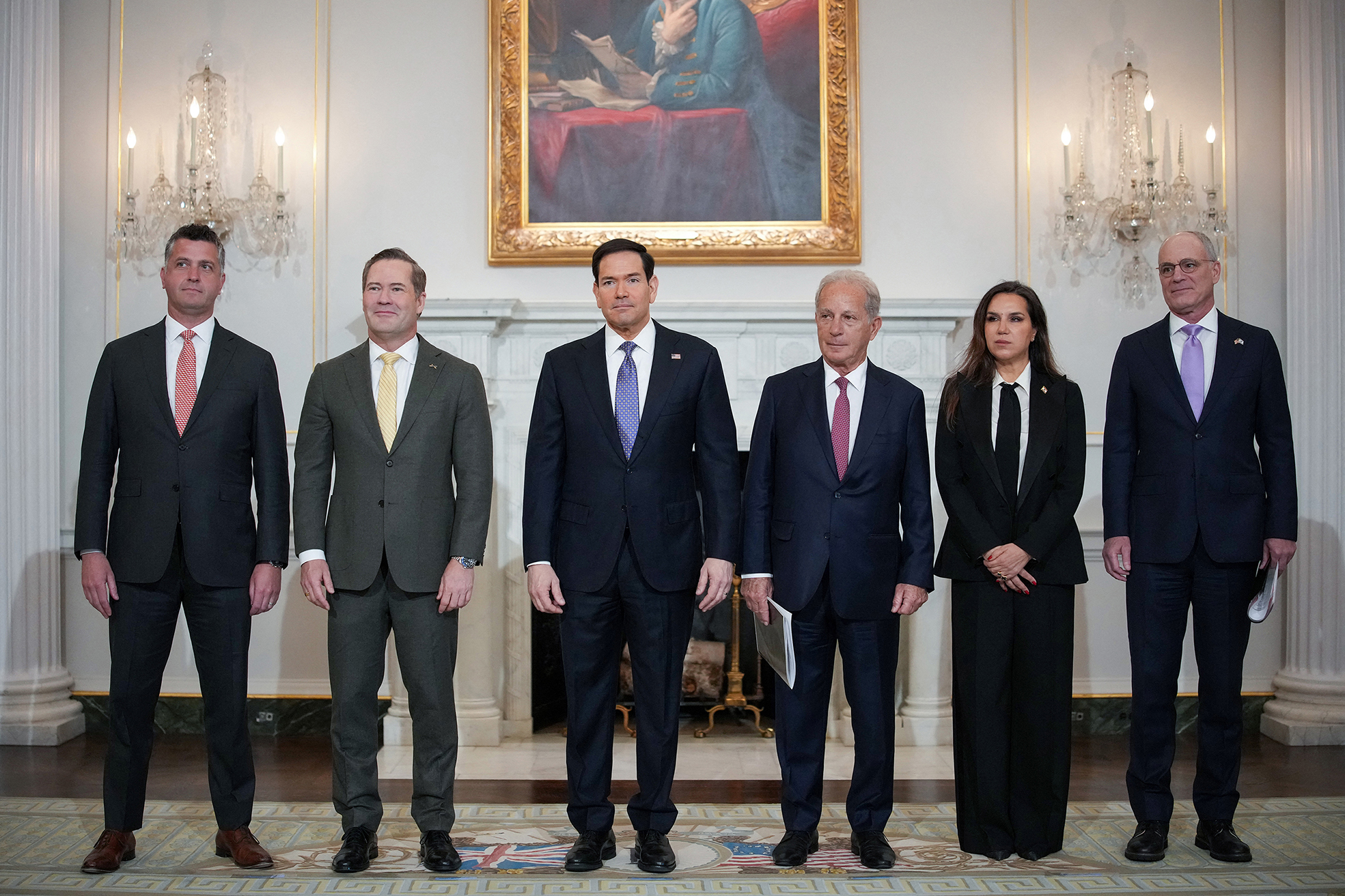
On June 3, the United States released a “Joint Statement” announcing a renewed ceasefire agreed upon by Lebanon, Israel, and the United States “contingent on a complete cessation of Hezbollah fire and the evacuation of all Hezbollah operatives from the South Litani Sector.” The agreement, with all of its imperfections and weaknesses, stipulated “the creation of pilot zones in which the Lebanese Armed Forces will take exclusive control of the territory to the exclusion of all non-state actors.” Following this announcement, Israel reported rockets fired by Hezbollah in apparent defiance of the agreement.
The Lebanese-Israeli negotiations currently taking place under United States auspices have become the target of repeated attacks from the Lebanese political factions opposed to the very principle of direct talks with Israel, pointing to the continuation of Israeli bombardments across southern Lebanon and the Bekaa Valley as evidence of their failure. Hezbollah’s opposition to negotiations was most clearly stated in a May 24 speech broadcast by the Qatari News Channel Al Araby, by Hezbollah Secretary-General Naim Qassem. He stated that the “people had the right to take to the streets and topple the government,” which he referred to as part of an “Israeli-American project,” thereby granting Hezbollah, in his view, the right to confront it just as it confronts its two declared enemies.
A survey conducted by nonpartisan public opinion research network Arab Barometer in the first half of 2024 found that 55 percent of Lebanese respondents said they had lost all trust in Hezbollah, while 30 percent still voiced strong levels of trust in the group. This data was notably collected before the killing of the Secretary General Hassan Nasrallah and Hezbollah’s significant weakening. Although there is little data available to track the group’s popular support in spring 2026, it is broadly acknowledged that public support has plummeted.
Yet beyond the debate over the negotiations themselves lies a broader question: whether Lebanon will finally strengthen the authority of its state institutions or remain trapped in the cycle of militia dominance and regional proxy conflicts that has shaped much of its modern history. In this critical period for Lebanon, battered once again by the ravages of war, the best available path forward is to give the Lebanese state a genuine chance and rally behind its efforts to halt the destruction and rebuild what has been lost. Despite its fragilities, Lebanese legitimacy remains the only internationally recognized framework capable of guaranteeing both Lebanon’s stability and an essential component of regional security.
May 17, 1983: An agreement at the heart of regional fault lines
Any serious reflection on the current situation inevitably leads back to the May 17, 1983 agreement between Lebanon and Israel, as well as its subsequent abrogation by the Lebanese government on March 5, 1984.
More than forty years later, the circumstances surrounding that episode continue to fuel debate because of the profound impact its consequences had on both Lebanese and regional history.
Each side still maintains its own interpretation of the events.
From the perspective of former President Amine Gemayel and his then-Foreign Minister Elie Salem — who detailed the circumstances surrounding the agreement’s collapse in his book Violence and Diplomacy in Lebanon: The Troubled Years, 1982-1988, as well as in a series of documentary interviews broadcast in 2026 by Al Arabiya — the failure stemmed primarily from a sudden Israeli change of position.
According to this account, Israel demanded the prior withdrawal of Syrian forces before initiating its own withdrawal from Lebanon, despite the agreement originally stipulating that Israeli forces would withdraw first. This modification allegedly sabotaged the entire process. Similar arguments were also developed by Amine Gemayel in his book L’Offense et le Pardon, published at the end of his presidency in 1988, and later in The Resistant Presidency, published in 2020.
On the Israeli side, there was a profound breakdown in communication with President Gemayel. According to the second volume of Alain Menargues’ Les Secrets de la guerre du Liban, Israeli officials met with him on the eve of his election after supporting his candidacy—at his own request—and securing, through U.S. mediation, the withdrawal of former President Camille Chamoun’s candidacy.
However, according to the same source, once elected, Gemayel reportedly refused all direct contact with Israel, insisting that all communications be conducted exclusively through Washington. Over time, this distance is said to have fostered mutual distrust and ultimately led to Israel’s disengagement from the process.
As Israel–Lebanon peace negotiations are relaunched in 2026, marking the first direct talks toward a permanent settlement since the failure of the May 17 Agreement in 1983, it is worth revisiting that earlier episode. Although the circumstances surrounding the two processes differ significantly, an examination of the 1983 experience can provide a useful framework for understanding the dynamics and constraints shaping the current negotiations.
On the Israeli side, the country negotiating today is not the country that signed in 1983. By the early 1980s, Israel could be described as a fragile actor whose strategic calculations were shaped in part by economic vulnerability. The International Monetary Fund (IMF)’s 1983 Article IV Consultation with the country categorized it as an “LDC,” or less developed country with a deteriorated trading position, and overburdened by four years of inflation rates at 100 percent. Today, Israel is classified as an advanced, high-income economy with a nominal GDP approaching $720 billion and a per capita income of nearly $70,000, giving it an entirely different weight and leverage at the negotiating table.
On the Lebanese side, both the country’s economy and its internal political landscape have undergone profound transformations. In 1983, despite the strains of civil war, Lebanon still maintained a functioning economy. The political system operated under the framework of the 1943 National Pact, which vested the President of the Republic with extensive constitutional powers. Today, however, the institutional balance established by the 1989 Taif Agreement has transferred many of these prerogatives to the Council of Ministers collectively.
The purpose of looking back on the failure of the May 17th agreement might not be to extract a lesson on what a peace deal with Israel can or cannot provide Lebanon, but rather to make the case that failure to support a sovereign Lebanese state has adverse consequences on the country’s ability to ensure the security and stability of its population.
The collapse of the state and its consequences
The collapse of the May 17 agreement paved the way for one of the most destructive periods in Lebanon’s contemporary history.
At the time, the Lebanese state already represented the weakest link in a country overrun by militias of every kind, financed and backed by foreign powers. Foreign armies occupied Lebanese territory while state institutions had been severely weakened after seven years of civil war. And yet, despite this weakness, the only genuine international and regional bet remained the preservation of Lebanese legitimacy.
Why? Because it represented the only institution capable of providing a credible alternative to militia rule. Only a fully sovereign Lebanese state, acting through institutions recognized under international law, could secure its territory and prevent it from being used as a platform for armed groups or foreign actors whose activities threaten regional and international security.
The failure of this bet immediately plunged Lebanon into a new phase of chaos. It began with the Mountain War of 1983–1984, which quickly evolved into a largely sectarian conflict between Christians and Druze, resulting in massacres and the displacement of large segments of the Christian population. The consequences of this conflict endured for nearly two decades, until the Mountain Reconciliation of 2001, spearheaded by Maronite Patriarch Nasrallah Sfeir and Druze leader Walid Joumblatt. Throughout that period, the Assad regime did everything in its power to undermine and derail any genuine rapprochement, arresting activists and intimidating supporters of reconciliation.
Nor was the Mountain War an isolated episode. Violence also spread to eastern Sidon, where clashes between Islamist militias and the Lebanese Forces produced similar tragedies, further exacerbating the country’s fragmentation and instability.
This decline formed part of a wider process of state collapse. It reached a critical turning point with the fragmentation of the Lebanese Army after the February 6, 1984 uprising, when the principal political and militia factions operating in West Beirut accused the army leadership of sectarianism in order to justify framing this as a basis for their opposition to both the Lebanese government and the state represented by President Amine Gemayel. The weakening of the army, one of the last functioning national institutions, opened the door to the widespread dominance of militias and the expansion of lawlessness. These developments unfolded under the supervision of the Syrian Baathist regime, which leveraged the turmoil to strengthen and entrench its influence in Lebanon.
The deterioration extended further to the wave of kidnappings and hostage-taking operations that targeted foreign nationals in West Beirut, including members of the American University of Beirut (AUB) staff, journalists, Lebanese Christians, and Jews. Amid Lebanon’s growing sectarian partition between predominantly Muslim and Christian areas, both sides of the conflict witnessed widespread lawlessness, political violence, and militia rule, as state authority steadily eroded.
Furthermore, this period enabled the systematic development of Hezbollah by the Islamic Republic of Iran, with the approval and support of the Syrian regime.
The centrality of Lebanese legitimacy
This is precisely why Lebanese legitimacy poses a pivotal question in regional and international calculations. That legitimacy is embodied by President Joseph Aoun, Prime Minister Nawaf Salam’s government, and above all the Lebanese Armed Forces, which serve both as the executive arm and the symbolic embodiment of the state.
Yet legitimacy cannot remain merely declaratory. It must be translated into tangible action through the gradual reassertion of state authority and the enforcement of the rule of law, beginning in areas beyond Hezbollah’s sphere of influence. This process should be accompanied by concrete measures designed to strengthen and expand the implementation of the proposed pilot-zone model, whereby effective governance, law enforcement, and state institutions are first consolidated in selected areas before being progressively extended elsewhere.
This is the historic opportunity currently before the Lebanese government in the context of ongoing negotiations: the chance to rebuild a fully sovereign state whose authority is exercised throughout its territory. Such an achievement would not only serve the interests of the Lebanese people but would also constitute a vital pillar of regional stability and a foundation for the fragile yet genuine hopes for peace that are beginning to emerge across the Middle East.
Executive Magazine is committed to representing a full spectrum of opinions