
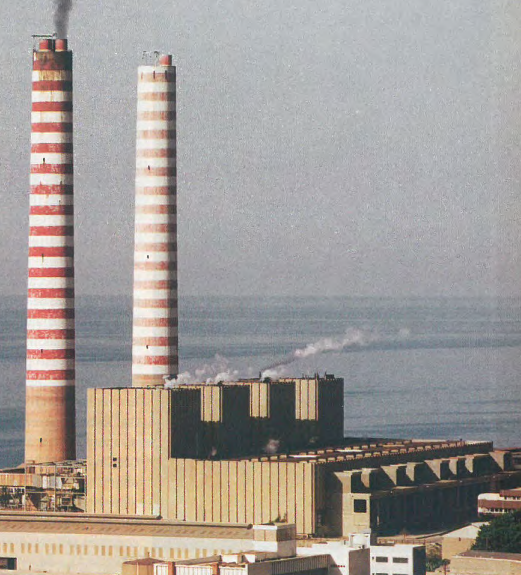
Who would want to have a company that relies on fuel oil for its energy? In less than a year the price of fuel oil has almost doubled, from $90 to $140 per ton. Worse, what if that company sells energy at a flat rate and absorbs the price increase?
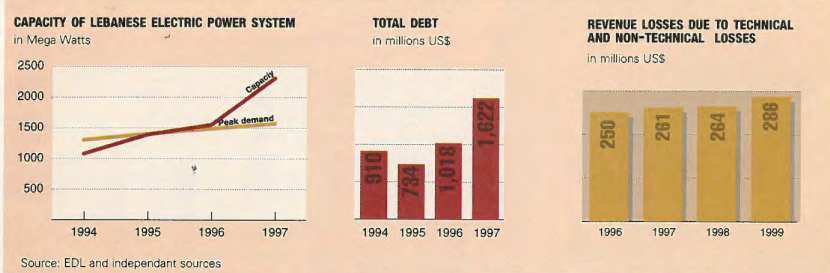
This situation, which no private company would tolerate, is the situation for Lebanon’s electricity provider, Électricité du Liban. The autonomous public authority, which the government hopes to one day put up for sale, is bankrupt. Shouldering huge losses due to electricity theft, uncollected bills, poor management and adverse operating conditions, such as Israeli air raids, EDL regularly reports an annual operating deficit of about $150 million, which is subsidized by the government. Its accumulated debt now stands at a staggering $1.6 billion, 11.4% of the total public debt. And according to Suleiman Traboulsi, the minister of water and electricity, EDL’s almost total reliance on fuel oil generated additional expenses of $80 to $90 million last year.
In the face of this financial disaster, EDL’s ability to supply the country with constant electricity, although improved enormously since the war, is far from reliable. Lebanon has spent around $1.3 billion on the rehabilitation of EDL, including interest on loans, which is responsible for the generation, transmission, and distribution of electric power throughout the country. According to a 1998 report, the restoration of existing facilities and the construction of new power stations has meant that Lebanon’s electricity capacity exceeds total demand. But the lack of transmission capacity and high losses of electricity through its network, reportedly more than 50%, means that Lebanon still suffers shortages and blackouts, even in Beirut.
So what is the government to do now? EDL is financially bankrupt at a time when it also faces a host of technical and administrative problems.
What has received a lot of media attention recently is the effort to reduce the burden EDL is placing on the budget by switching from fuel oil to natural gas. According to Pierre Chammas, a petroleum economist and president of APS Energy Group, natural gas is less prone to price fluctuations and “in terms of per barrel of oil equivalents, is half the cost.” Estimates vary, but converting all EDL’s power plants to natural gas could save the treasury more than $150 million a year. “This is very conservative, according to my estimates it’s over $250 million,” says Chammas.
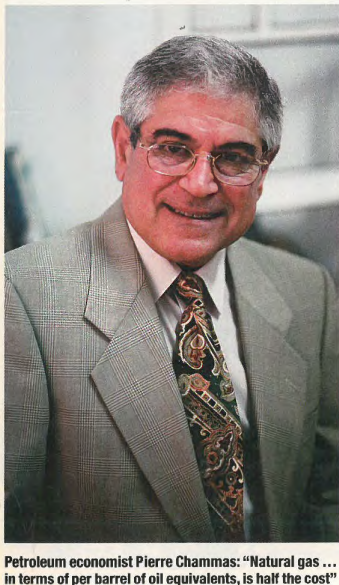
Additionally, gas turbine equipment for electricity generation is two-thirds cheaper than that of a fuel oil plant and is much more efficient. EDL’s current method of producing energy, generating steam with fuel oil to run the turbines, involves huge losses. “Out of every 1,000 tons of fuel, only 30-35% generates power,” says Ronald Diab of National Energy Consultants. “With gas it’s between 40-60% efficiency, depending on the technology used.” Two technologies are available: one-cycle and combined-cycle gas turbines, with the latter the most efficient at up to 60% energy output.
Combined-cycle gas turbines produce electricity, and the gas exhaust then goes into a steam turbine which also produces energy. “One-third of the energy that you put into the gas turbine comes out free of charge, from the heat of the exhaust,” explains a private consultant.
There are other benefits. Operating and maintenance costs are less, because natural gas does not wear out equipment as quickly, giving it a longer life. It is estimated that these benefits alone could save EDL a further $100 million every year for 25 years.
Natural gas is also more environmentally friendly than fuel oil, which is sulfur-polluting and causes acid rain. There is a cost element here, because when oil is burned it must be desulfurized. The desulfurization process, says Chammas, is very costly. Natural gas also produces 60% less CO₂ than fuel oil, which has implications for the future. At the Kyoto convention, a commitment was made to reduce carbon dioxide emissions by major industrial polluters, namely the US, Japan, and Europe. The WTO will punish countries not complying, with a CO₂, or “green tax,” on emissions. In time, with the growth of energy systems in developing countries, they too will be required to reduce emissions. And Lebanon’s demand for electricity is growing at 4-5% every year.
So why doesn’t the government begin switching to gas immediately? Currently nine of the country’s 11 power plants run exclusively on fuel oil, building these plants was more convenient because fuel oil is more readily available. Only two new power plants, in Zahrani and Badawi, are ready to receive natural gas, built with the more efficient combined-cycle gas turbines at a cost of $600 million. But because natural gas is not yet available in Lebanon, these plants were built with dual systems, and can run on gas oil, which is even more expensive than fuel oil.
All depends on getting gas to Lebanon. Unlike fuel oil, natural gas cannot be bought off a ship. One way is to have it transported in its natural gas condition via pipeline, a heavy investment and often a politically difficult prospect. Israel, for example, is in negotiations with Qatar, owner of the world’s second largest natural gas reserves, to supply natural gas via a pipeline. But this cannot be realized until a peace settlement is reached.
Another alternative is to use special tankers to import the gas as liquefied natural gas, LNG. The compressed gas has to be received in special terminals then reconverted to gas, the facilities for which will need to be constructed. With these kinds of investments involved, importing LNG is more expensive than natural gas via a pipeline.
Syria, another producer of natural gas, has agreed to provide one billion cubic meters of natural gas every year for 25 years, three million cubic meters daily, with the quantity to be increased if more reserves are found in the future. The project involves building a 230-km pipeline from Homs to Badawi, then extending it to Zahrani. If work on the pipeline begins this year, gas could start running to these two plants by 2002. Suleiman Traboulsi, the minister of petroleum, told EXECUTIVE: “For this project to happen, we have to look for a source to finance it, or to find a way not to burden the treasury.”
Last year Elf Aquitaine Gaz International and its foreign partners presented a proposal to provide Lebanon with its natural gas needs under two different 25-year build-operate-own-transfer (BOOT) contracts. In the first, Elf is proposing to build the pipeline from Syria to the plants in Badawi and Zahrani. But if EDL converts all its power plants to natural gas turbines, by 2005 between nine to 11 cubic meters will be required daily. Its second contract proposes the rest be imported from Qatar, which has offered to supply 7-8 million cubic meters of LNG per day. Elf is offering to build two LNG tankers, a receiving and re-gassing terminal, outlined for Batroun, and additional pipelines to the other power stations. The tankers are each valued at $200 million, and the import area is estimated to cost $500 million to $600 million. The entire project is valued at almost $1 billion, which Elf will pay. If approved now, by 2004 the other power stations will be supplied with natural gas.
However, the government would have to cough up the money to refurbish the power plants running on fuel oil, estimated at $40 million to $50 million each. “This project will make Elf Aquitaine by far the biggest foreign investor in Lebanon,” says Chammas.
Considering EDL’s financial woes amidst the rising price of fuel oil, some experts are aghast, although not enough to go on record, at the government’s delay in giving the go-ahead on the project. But the current administration has gained a reputation for delay. Its 1999 budget was four months late, so too its five-year plan. Its tax collection program has yet to be implemented, and so far no concrete steps have been taken to restructure Tele-Liban and MEA.
Realistically, however, to convert the power plants to natural gas means scrapping or selling expensive equipment recently purchased, before recouping any return from it. And it requires large investments, which the government cannot afford.
The government’s oft-expressed goal of privatizing the utility could provide the funds, but that hardly seems realistic given EDL’s current financial and administrative status. To make it attractive to private investors, the government would have to invest heavily in restructuring or face selling it at fire-sale rates.
Instead, the government should focus just on improving billing and collection. Last year, 40% of the delivered electricity remained unpaid and Traboulsi has said that $466 million is owed to EDL by its customers. If EDL could demonstrate the ability to be profitable, private investors would be more willing to get involved.
Alternatively, the government could spin off some of EDL’s operations. One example might be to keep the generation and transmission public, but sell the distribution arm, which includes billing and collection, to the private sector under a profit-sharing agreement similar to the one which the government has with the cellular providers.
There is one other alternative, deregulation. Removing the monopoly and inviting the private sector to compete would result in less efficient power producers, in this case EDL, having to upgrade or fold. Minister Traboulsi has already indicated this is a possibility.
Whatever the government chooses, privatization and/or deregulation will have to figure. The UN’s ESCWA recently presented case studies of the Jordanian, Egyptian and Yemeni electric utilities, which have all been privatized. Egypt is presently the fastest growing country in terms of power generation in the Arab world. “They now have in excess of their needs,” says Diab.
As George Corm, the finance minister, likes to say, if other countries in the region can do it, then why not Lebanon?
The ‘other’ factor
The natural gas market for electric power generation is skyrocketing worldwide; it is predicted to rise by 2.5% every year for the next 20 years. In 1998 the value of gas turbine production worldwide was about $25 billion, 71% of it associated with aviation gas turbines. However, in the near future its application to electrical power generation is expected to exceed that of aviation gas turbines.
Besides being cheaper and environmentally friendlier, natural gas is readily available. The world’s gas reserves are estimated at 54 trillion cubic meters, over one-third being in the Middle East. With existing reserves estimated to last 60 years, utilizing it will help preserve oil resources, with current reserves estimated to last 40 years.
To preserve its oil reserves, Saudi Arabia has invested $25 billion to encourage its industries to run on gas. Presently a quarter of the country’s industries have shifted to natural gas.
In a related issue, an Israeli report commissioned by Jerusalem’s Hebrew University claimed that Syria’s petroleum reserves will run out in 10 years. Being Syria’s main export commodity, this typically led to rumors that Syria was pressuring Lebanon to convert to natural gas to preserve its oil reserves. Pierre Chammas, a petroleum economist, thinks that is beside the point. “Anybody who knows this business knows that the switch to natural gas is the option to do.”
Syria produces about 12.5 million cubic meters of natural gas daily, but the figure is expected to rise to over 18 million by next year. Chammas says that Syria is doing Lebanon “a favor” by promising to supply natural gas, as it presently cannot supply enough natural gas for its own needs. Between Syria’s proximity and the fact that gas is cheaper in its natural state via pipelines, the supply from Syria alone is expected to reduce costs by 30%. “It will be a good push for the Lebanese economy,” says Chammas.
