
Computer geeks are all the rage these days. Just about everyone is looking to jump on the high-tech bandwagon towards economic growth, and is dreaming of spawning the world’s next Silicon Valley. This country’s administration has frequently voiced its support for turning Lebanon into a high-tech haven since last summer, while Vladimir Putin, Russia’s acting president, recently announced that encouraging investment in high-tech industries would be central to his economic policy.
And so the race is on to catch a ride on the digital wave. “IT is one of the industries Lebanon should rely on most,” says Michel Nseir, owner of Software Design. “It’s one of the sectors that might succeed here.” Software is often pinpointed as an industry where the Lebanese can excel. Pure exports are just a couple of million dollars, but Nseir estimates that Lebanese software development generates some $100 million abroad. Software Design and BML Istishirat are both based in Beirut but have foreign operations in several countries, while Lebanese companies like Infoplus, Murex, Integro and Computech are based abroad but have local development facilities. The local software industry is estimated at about $25 million, excluding in-house software and imports.
While the war did irreparable damage to Lebanon’s position as a tourist destination and financial center, natural resources are virtually non-existent and the high cost of labor and land make it difficult for industry to compete against countries like Egypt and Syria. “We’re on the cusp of the information century,” says Paul Salem, a development analyst. “This sector needs no raw materials; it is not location specific and we in Lebanon can situate ourselves as servers and engineers and constructors, and be players in the whole Arab information future. There’s going to be 20 to 30 years of rapid growth in the sector.” If the Arab common market is ever successful, Lebanon could potentially be to this region what Ireland is for the European Union in high-tech exports.
But a few trump cards will be needed, as will a concerted effort from the government to create an environment where this sector can flourish.
To be fair, Lebanon does have a competitive edge in some respects. The big advantage is its human resources, a young, educated and multilingual population. But there is a gap between the skills of graduates and the market needs. “High-tech development occurred during the period when Lebanon was in the worst of times; the heavy toll is witnessed in the lack of proper candidates. Top-level people can be found, but at the second level, for example engineers and skilled labor, we have missing links,” says Yahya Hakim, director general of the Ministry of Finance and a member of the government committee working on concepts needed to turn Lebanon high-tech.
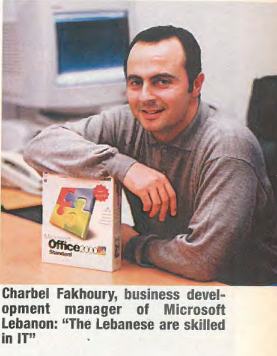
That could be redressed through better coordination between universities and the private sector, the establishment of technical institutes and a greater focus on engineering and technology as has happened in Ireland. Others suggest creating research centers and greater investment in training from the private sector. “But the education is there and the Lebanese are skilled in IT,” argues Charbel Fakhoury, the business development manager of Microsoft Lebanon. “It’s not a long process; in three to five years Lebanon could have a very highly skilled population.” Many believe that with the proper opportunities, Lebanon could also reverse its position as a net exporter of brainpower and lure some talent back to fill skilled positions.
And despite its technological backwardness, this country is advanced for the region. Take the Internet. While the number of users and providers has shown continual growth, the Internet has only recently been introduced in Syria. With some 100,000 users, among the few places in the region that Lebanon lags behind are the United Arab Emirates with 200,000 and Israel with over 250,000. The government has spent over $1 billion to upgrade the telecommunications system since the end of the war, while the private sector has spent another $1 billion. The result is one of the most advanced networks in the region and one of the highest penetration rates.
More investment will be required, however. While the government has talked of introducing integrated services digital network, ISDN, to provide high bandwidth services using the existing infrastructure, some are calling for digital subscriber lines, DSL, the newer and cheaper technology that provides up to 1.5 Mb/s and is helping to force rates down in the United States. “DSL technology allows you to deliver video, voice and data over copper wires,” says Chammas. “It wouldn’t require the expensive cabling and would give virtually the same result.”
The sector also needs to be deregulated, which could spur investment in fiber optics from the private sector and make prices more competitive. Services like Net2Phone, with tariffs of less than 10 cents/min, and the cut-rate offered by callback cards demonstrate how overpriced communications are in Lebanon.
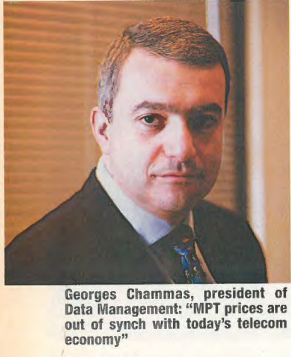
“The government needs to address the cost infrastructure of the monopoly until telecommunications are privatized,” says George Chammas, president of Data Management. “It’s out of sync with today’s telecom economy.” He points to rates on T1 links, 1.5 Mb/s, that are now going for $285 a month in the United States with MCI WorldCom, while its 64 kb/s links go for a monthly flat rate of $150 regardless of distance. Flashcom, the largest DSL provider in the United States, offers dedicated links for as little as $49.95 per month for one to two users and $110 for 160 kb/s for multiple users. Installation and modem are free in most cases.
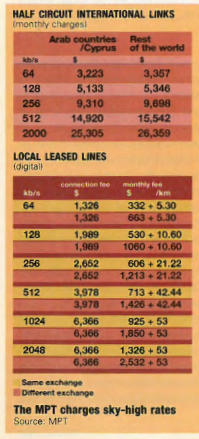
There is no Internet node in Lebanon. So on top of the local line, Internet service providers are forced to pay for international links, which cost up to $26,359 for an E1, 2 Mb/s, per month for a half-circuit, in order to hook up to the Internet. That’s a very costly prospect if a Silicon Valley is to emerge. With an Internet node, only a local leased line would be required to have an international connection. These are also used by businesses to connect to ISPs or to link different office sites. But leased lines are expensive, don’t include the prices of modems and can take several months to get due to the red tape. “If the cost of connectivity was lower, it would be much easier to decentralize from Beirut; in the West it doesn’t matter where you’re based,” says Roger Karam, assistant general manager of Sodecal, which is developing the Makse Industrial Park in the Bekaa Valley.
Since the Ministry of Post and Telecommunications is the second contributor to the treasury after customs, bringing in $593 million last year, a 37% increase over 1998, the government won’t be eager to reduce rates, despite arguments that it could spur demand. Hakim acknowledged that lower rates on communication links are unlikely to become a reality for another couple of years.
Other measures can be taken to create a lower-cost place to do business, including stamping out corruption. More than 62% of businesses acknowledge paying bribes to bureaucrats, according to a recent survey by the Lebanese Center for Policy Studies, much higher than the rest of the Middle East at 35%.
While income tax carries a maximum of 10% and the corporate tax rate is still low at 15%, this is an over-taxed society. Employers pay a social security tax of 27% on the first LL900,000, about $600, plus 8.5% on total salaries, meaning a total of 35.5% for most employees. That compares to a social security rate of 7.65% in the United States or the United Kingdom’s graded rate of 3 to 10% on national insurance contributions. Tariffs on utilities like electricity are high. So too are customs duties, which were raised on more than one occasion last year.
“What’s the government’s strategy to bring companies here?” says Karam. “If they don’t offer incentives, it’s useless to say they want a high-tech industry.” There are calls for the government to speed up the replacement of customs by a value-added tax, and to allow the creation of free zones to encourage exports in technology.
Legally there is also no shortage of work to be done. Last year’s passage of the new copyright law was a move in the right direction, albeit not enough to encourage real investment. The bottom line is that laws need to be enforced, says Fakhoury. So far there has been little, if any, evidence that the law is being implemented. If Lebanon can become a high-tech gateway to the Arab markets, its neighbors’ actions will be just as vital. New laws will also be required to regulate e-commerce.
Lebanon’s leaders can ill afford to waste any time if they are serious about spurring economic growth on the back of high-tech industries. Israel, Egypt and Dubai will make for tough competition.
Dubai Internet City is being dubbed as the world’s first free trade zone for e-business. It will also be home to an Internet university and R&D center. IBM, Microsoft, Sun, Cisco, and Yahoo have all been approached to set up software development centers. DIC is offering 100% foreign ownership and 50-year renewable leases, as well as no corporate tax, no personal tax and no import/export taxes.
Israel is already a high-tech success story. It has one of the highest research and development levels in the world at 3% of GDP and counts a higher percentage of engineers and technicians than the United States. Israel’s high-tech and electronics industry grew by more than 15% in 1998 to reach $8 billion. The highest growth was in software, up by 50% to reach a total of $1.5 billion. The Israeli high-tech sector counts some 3,000 companies with an estimated 150 new start-ups each quarter, while venture capital for technology had raised over $800 million by the end of 1998. Israel has over 100 listings on US stock exchanges and a higher presence on the NASDAQ than all of Europe combined. Foreign direct investment increased from less than $400 million in 1991 to more than $2 billion in 1998. Motorola, Digital Equipment, IBM, National Semiconductor and Microsoft have all set up shop. Israel’s telecommunications network, now fully digitized and deregulated, is more advanced than Lebanon’s. This has helped give Israeli electronics an important presence in foreign markets.
With such tough competition, Lebanon will have to get its act together and lobby companies hard; here a valuable lesson can be learned from Ireland’s Industrial Development Agency, IDA. Officials from the Lebanese agency have contacted their Irish counterparts and are studying their success, but it remains to be seen whether the Industrial Development Agency of Lebanon, IDAL, will play such an independent and aggressive role as the IDA.
IDAL has been given the government’s project for a high-tech park. Dubbed the Beirut Emerging Technology Zone, the project was awarded a $174,000 grant from the United States to carry out a feasibility study. But that money has yet to be used. Nonetheless, IDAL believes the study can be finished by mid-year and that the marketing of BETZ can then begin.
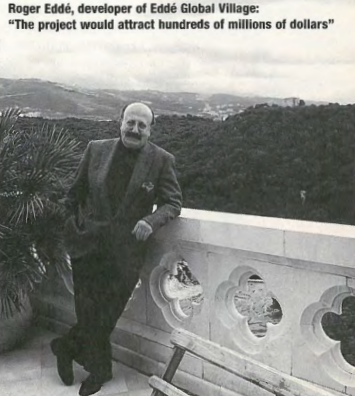
Two similar projects have been proposed by the private sector. Probably the most grandiose is businessman Roger Edde’s plan to create a complex for multimedia, e-business as well as online healthcare and education through agreements with universities abroad. Some 2 million m² of his own land near Jbeil has been earmarked for what would be called the Edde Global Village. Edde estimates that the project will require an initial investment of $27 million, including about $6-7 million to create a satellite dish farm and teleport hotel, or the network of other telecommunication links and equipment required for the village to become connected.

According to Edde, Sumitomo Bank will be the financial advisor on the project. Chase Capital and ING Barings are to be investors in the Internet incubator. They hope to attract international companies and be a feeding ground for local start-ups.
The other contender, the Makse Industrial Park, is slated to have a cluster zone for medium and high-tech companies, about 15 to 20% of the total area. Sodecal, the developer, is 75% owned by the Karam Group. It hopes to attract clients primarily by offering cheap prices, $20 to $32/m² or leasing at $2 to $3.50/m². Although Karam acknowledges that the distance from Beirut could be a drawback for small software companies that don’t require much space, he believes that assembly line operations will be interested.
Despite high-tech being singled out as the direction Lebanon should take, few are optimistic that the necessary changes will happen anytime soon. So far Silicon Valley has been little more than talk. The administration’s stupidities, like banning voice over IP and callback cards or blocking Intel chips because of the company’s Israeli operations, are not the best way to invite foreign investment or encourage high-tech.
“The problem with the governing elite is that they haven’t even heard of the new economy,” says Edde. “They just marvel at watching the US and European markets’ unbelievable financial growth, look at it as an artificial bubble without realizing that it’s the beginning of the harvest of the new economy.”
The Celtic roar
Silicon Valley hopefuls might look to the land of leprechauns for a lesson in how to achieve and pray for a wee bit of the luck o’ the Irish. No more a country of just whisky and Guinness, the technological revolution has seen the economy of Ireland, aka the Celtic Tiger, advance by leaps and bounds in the past decade. Ireland has had the fastest growing economy among OECD countries for the past five consecutive years and its standard of living surpassed that of Britain in 1997. Estimates for 1999 put Ireland’s real GDP growth at 7.9% compared to 3.7% for the United States and 1.1% for the UK. Despite worries that the Irish economy is overheating, GDP is generally forecast to increase by 5% to 6% for the next decade. Unemployment dropped about 10 percentage points in the past five years to reach its current level around 5%.
More than 1,200 foreign firms have set up shop in Ireland. There are over 500 companies from the United States alone, among them some of the world’s top high-tech companies. Apple, Microsoft, and Hewlett-Packard have all established operations in Ireland.
The influx of international companies and surge of local start-ups has made Ireland the world’s second largest exporter of software after the United States. It produces more than 40% of all packaged software sold on the European market. The electronics sector generates more than one-third of the country’s total exports and, since 1980, 40% of all new US investment in European electronics has gone to Ireland.
Some impressive statistics indeed for a country that just a couple of decades ago had been the backwater of Western Europe. How could this tiny nation of less than 4 million possibly have pulled off such an incredible turnaround? It certainly didn’t happen overnight.
Since the 1960s, Ireland has consistently worked on creating a pro-business environment and aggressively gone after foreign investment, abandoning its previous protectionist policies.
The government created the Industrial Development Agency, IDA, which specifically targeted international pharmaceuticals and technology firms and is now involved in the establishment of digital parks. Its first high-tech catch was Digital Equipment in the early 1970s. Ireland also snared Dell. All its PCs sold in Europe, the Middle East and Africa are assembled in Ireland.
But the big fish was Intel, and it didn’t get away. Ireland decided it wasn’t going to miss out when the US chip manufacturer announced plans to launch European operations. The IDA did its homework. A possible lack of qualified engineers was one of Intel’s main concerns. So Ireland hired a consulting agency to locate Irish people working in that field in the United States who might also be interested in returning to the old country. Intel’s $2.5 billion plant west of Dublin is its biggest outside the United States, and is the single largest foreign investment in Irish history. Returnees filled many of the senior engineer positions at the start-up in 1993. By the mid-90s Ireland managed to reverse its migration flow, becoming a net importer rather than a net exporter of human resources.
But Ireland did more than simply provide potential investors with a list of Irish expats. It also offered multinationals a low-cost place to do business. Corporate tax is just 10% until the end of 2002, after which the rate will be increased to 12.5%. Industrial electricity prices, office overhead and wages are also comparatively low versus other industrialized countries. Agreements between employers and employees have kept wage inflation relatively low, although in recent years there has been more upward pressure on pay.
In July 1998, Enterprise Ireland was created out of the former Irish Trade Board and other government agencies to offer financing, create links between educational institutions and industry and to assist companies in building export markets, research and development, and training.
Ireland has also created a generation of highly educated young people. Investment in education since the 1970s includes the establishment of nine regional technical colleges and a concerted effort to push kids towards higher education. Since 1992 the number of students entering post-secondary education has increased by about 22%, including a 35% increase in those studying engineering and technology.
The government also invested heavily in infrastructure, including $5 billion spent to overhaul the telecommunications network in the last decade. The deregulation of the Irish telecoms in 1998 is expected to bring significant additional investment in the coming years. Five telecoms companies, including MCI WorldCom, have plans to lay additional fiber.
But Ireland also has a few natural advantages, not the least of which is its young and English-speaking population. It also didn’t hurt when the country joined the European Union in 1973, opening up trade with Europe. As one of the poorer members, Ireland received funds for regional development and social programs. Receipts were about 2% to 4% of GDP over the past decade. Though not enough without the government’s efforts, these factors certainly helped make Ireland more attractive, especially to US companies looking for a base in Europe.
