The South’s liberation has brought back into the public eye a 40-year-old
plan to turn Lebanon into an agricultural breadbasket. With the exception
of Turkey, Lebanon is the only country in the region with more water than
it needs. But most of this water is left to flow into the sea or evaporate. The
$400 million Litany project, expected to take 14 years to complete, will channel
and contain the water of the country’s longest river for irrigation and drinking.
The river stretches 170 km and has a 2,700 km² basin, a little more than
one quarter of Lebanon’s surface area. Unfortunately, 50% of this water runs
off into the Mediterranean Sea.
A World Bank loan for the project was initially approved in 1976, but the
war put those plans on hold, until now. The government recently
obtained a $2.5 million grant from Arab donors to update studies
done on the Litany project before 1975. On May 20, Dar Al Handasah Shair
(DAH) started revising project plans.
The Litany project will be completed in several stages along with a number
of sub-projects. The biggest of these is the 800 Project, which involves
building a 57-km channel that will link the waters of Lake Qaraoun to 15,000
hectares of agricultural land in the South. Another project involves building
channels connecting Lake Aanan and Lake Qaraoun with Sidon, Iqlim
Al-Kharroub, Nabatieh and Zahrani, where 23,000 hectares of agricultural
land are cultivated. There is also the Khardali dam, which will be built on
the lower Litany to provide drinking and irrigation water.
But even before the war, the project was controversial. “The Litany water
project will have a huge impact on the current state of agriculture and drinking
water supply in the South, but it’s a crucial source of conflict in the region,”
says Marwan Iskandar, an economist. Since their 1976 invasion, Israelis have been salivating at the chance to tap
into the Litany River, says Iskandar.
And the USA has backed them all
the way on the issue. “If this [World
Bank] loan is to be approved again,
US-Lebanese relations will have to
improve and the project will have to be
part of the peace process,” says
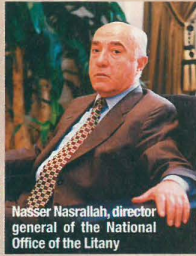
Iskandar. But Nasser Nasrallah,
director general of the National Office
of the Litany (ONL), says that
Lebanon will not bargain over access
rights to the waters of the Litany.
“There is a government decision not to
include the Litany as a bargaining chip during any regional peace talks. Lebanon’s right to full use of the river
is not an issue,” he says. Nasrallah is convinced that the entire project will
have little difficulty obtaining funding from the World Bank, which has already
financed a number of similar projects in the country.Iskandar feels that there is an alternative. “Why take a loan if the project
can be done as a BOT (build-operate-transfer),” says Iskandar. In many
cities around the world, such as Jakarta, Sydney and London, water projects
have been done this way. Nasrallah feels that making the Litany project
a BOT is a possible alternative, but unlikely. This project is not purely
profit-driven, he says. Rather, it serves to improve the social and economic
situation in one of the poorest areas of the country