Isn’t turning a good profit on sales the
whole essence of business? Al-Fajr
insurance company, which has a capital
of more than $2.3 million, appears to
march to a different beat. Last year it
ranked 20th in the Lebanese insurance
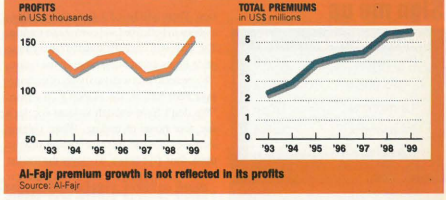
market in premiums, while turnover
increased to $5.6 million, up 132% from
$2.42 million in 1993. Sounds promising so
far. But despite the growth, profits rose
less than 10% from $142,000 to $156,000,
while its profit-to-sales ratio nose-dived
from 5.8% to 2.8%. Such low returns
make little sense when Middle East
Assurance and Reinsurance Company
(Mearco) is capable of generating profits of
$159,000 with a portfolio of just $1.13 million,
a 13% profit-to-sales ratio.
The strategy of Al-Fajr leans towards survival
by extending its loyal client base on low
margins. But this comes at a cost: tiny profits.
Certain lines of insurance have a tendency
to not generate profits and quite often
result in losses, the biggest culprit being
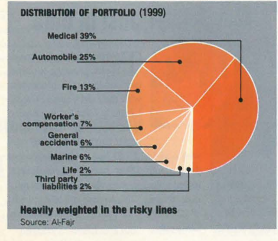
healthcare. Al-Fajr’s medical portfolio was
previously maintained below 20%. Now it
constitutes the largest line of insurance in Al-Fajr’s
portfolio, at 39% or $2.2 million. Not
smart. “Even in the best of circumstances,
medical insurance never generates profits of
more than 10% of the medical premiums collected,”
says Joseph Issa, Mearco’s lawyer
and one of the largest shareholders. The
firm’s chairman, Rached Rached, claims
that the line results in losses more often than
not. Aline Kamakian, general manager of Insurance Investment Consultant (IIC) and a shareholder in Mearco, similarly finds
medical insurance too risky. “We as brokers
have a portfolio of over $8 million in
medical, but rather than keeping the risk, we
pass it on to other underwriters,” she says.
“It’s just not worth the risk.”
Mearco is among the few local underwriters
that stay completely out of medical,
which still accounts for half of non-life
insurance premiums. Fouad Sawaya, Al-Fajr’s
manager, admits that healthcare is
most often a money loser, but views it from
a different perspective. Avoiding it completely
comes at the price of losing potential
clients who wish to get all their insurance
from one company. “We usually try to keep that line below 20%,” he says. “But
when your client purchases other forms of
coverage from you, you can’t refuse to provide
health insurance; the next year they’d take
their business elsewhere.” In fact, according
to Al-Fajr, the main reason behind the
increased medical portfolio is that when it
began providing coverage for the Beirut
port, offering medical to the port’s employees
was part of the package deal.
The next largest line of insurance at Al-Fajr
is auto insurance, which constitutes 25% of
its portfolio. Not as risky and unprofitable as
medical, but not a whole lot better either.
“One of the main reasons behind auto
insurance carrying risk and being generally
unprofitable is the lack of proper regulation,”
says Pierre Salameh, vice president for the
Middle East and North Africa for Caisse
Centrale de Reassurance (CCR). “Rates are
the lowest in the world while the motorists
are not disciplined and their driving history
isn’t taken into account.”
Al-Fajr is also taking some excessive risks.
Even with its sizeable medical portfolio, it still
doesn’t deal with third party administrators
(TPAs). “You need a TPA when your portfolio
starts to get really big on the medical side
and ours grew only just recently,” says Bassel
Hibri, Al-Fajr’s assistant manager. “A TPA
would help reduce unnecessary costs, boosting
profitability, and leave Al-Fajr’s management
free to focus on and develop more
profitable branches.
The company is also taking a risk in collecting.
Some 90% of premiums are collected
within three months, just within the limits of solvency. But the firm gives extended
facilities on some larger policies, up to a year
for some respected clients. “Should an accident
occur, the balance of the payments is
deducted from the settlement. And if the
client defaults on payments, they’re no longer
entitled to a settlement,” says Sawaya.
Leniency in payment terms could cause
liquidity problems for Al-Fajr. The market has
already demonstrated the folly of allowing
such extended payment terms, which caused
the downfall of more than one local insurer. “If
a company cannot count on its larger policies
for solvency,” wonders Joseph Mrad, a manager
at Adir, “what will it rely on, auto insurance
policies?” Others agree with Mrad. “I had
clients with whom I did business of nearly
$250,000,” says Kamakian, “but the most I
would allow was a month.”
But Al-Fajr isn’t leaving everything to
chance. It does have notable strengths, most
importantly its reinsurers, including ERC Frankona,
Swiss Re, Hannover Re, Lloyd’s of
London, Caisse Centrale de Reassurance
(CCR) and AXA. These
reinsurers, most of which
are rated triple A, will only
cover Al-Fajr’s portfolio for
the right price, which is one
of the factors behind the
low profits. Another example
is that it charges some of
the higher rates in the market.
The company is also
hesitant about using brokers.
“We have two or three
we trust, otherwise all business
is done directly
through the company,” says
Bassel Hibri. And potential
clients are closely scrutinized
beforehand, especially when the business
starts to get big. “Since it was established
in 1992, Al-Fajr’s portfolio has grown at
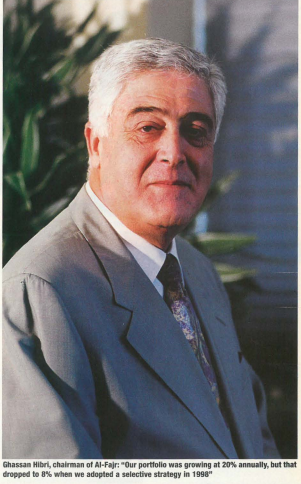
about 20% a year,” says Ghassan Hibri, the
company’s chairman. “But since the company’s
policy has been a selective one, growth
in 1998 and onwards subsided to 8%.”
Clients seeking medical coverage must see
Al-Fajr’s physicians, not a common practice
among local insurers, as well as filling
in questionnaires. Not nearly as effective as
dealing with a TPA, but the risk is still
curbed to a degree. Al-Fajr isn’t worried.
“When your clients are dispersed over several
sectors and you don’t have a TPA, you
can have problems,” says Sawaya. “Ours,
especially the medical portfolio from the
Beirut port, is contained.”
Life is among the smallest of Al-Fajr’s
branches. Only 2% of business is based on
what is considered to be the most profitable
of all insurance lines. Adir, for example, has
over 50% of its portfolio in life. With premiums
not much more than $4 million, Adir
retained profits of nearly $1.5 million in
1999, knocking its profit-to-premiums ratio
out of the ballpark at 35%. “We’ve had the life
license since we started operating,” says
Sawaya. “But life requires an altogether different
setup and a separate company to operate.”
Al-Fajr plans to develop this line soon.
Concerning expansion, Al-Fajr is in the
process of finalizing the establishment of an
insurance company in the Arab world.
Operations should start within two
months, but the company declined to disclose
further details.
Al-Fajr’s tactics are perhaps not the wisest,
but a point in its favor is that in providing
the riskier services to boost sales, it
also maintains a steady client base.