

It was a year most would like to forget.
When the new cabinet took office, it
brought with it a promise of fiscal and
administrative reform, recognition that
large budget deficits cannot be sustained and
that the public debt needs to be contained.
But when the year came to an end, the government’s
plan had turned into little more
than empty promises.
After most of post-war infrastructure and
reconstruction was completed under the
Hariri cabinets, Hoss’ team focused on
tackling fiscal issues. The cabinet’s first
budget projected a 40.2% deficit. Its five-year
economic recovery plan aimed to
reduce the deficit-to-GDP ratio from 21%
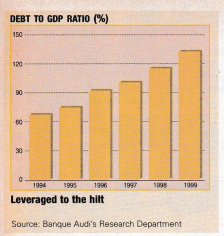
to 5% and the debt-to-GDP from 118% in
1998 to 96% by 2003. But what tricks
could the cabinet possibly pull out of its hat
to perform such an act? Privatization, controlled
spending, an improved taxation
system, better tax collection and the
restructuring of the public debt.
But the magician left the audience disillusioned
and confidence wore thin. The
government was late with both its 1999
budget, which took four months to complete,
and its five-year plan. Incredibly, the
country was being run without a budget
until July, when the year was more than half
over! And while the government was taking
a shot at reducing the budget deficit, in the first 11 months of the year
it reached 43.53% of
expenditures compared to
41.6% for the same period in 1998. The net
public debt totaled $19.28 billion at the
end of October. Forecasts showed that the
debt-to-GDP ratio would reach 129.6% by
the end of 1999.
To help solve its fiscal dilemma, the government
called on the taxman to raise revenues.
Tax, tax and tax some more seemed
to be the answer to almost everything. It
increased the upper limit of income tax
from 10% to 15% and jacked up taxes by
10-55% on a number of products and services,
including cellular phone calls and
tobacco. Was this a good idea? Revenues
from tobacco dropped considerably and
the use of cellular phones declined by
30%. It’s difficult to imagine that increasing
income tax could possibly make a difference.
The tax evasion rate in Lebanon is
estimated at 70%. The government has
trouble collecting elsewhere as well.
Some 40% avoid paying electricity bills,
while 25% talk to their friends on the
phone without paying a dime. Collection is
the name of the game. But the ministry of
finance has shied away from implementing
an aggressive tax collection program,
mostly due to political considerations.
To make matters worse, many believe that raising taxes during
an economic
slowdown will only
backfire. The Economist Intelligence Unit
(EIU) states that the increases in personal
and corporate income tax were “ill conceived.”
The cabinet’s strategy of implementing
tax hikes has helped move the
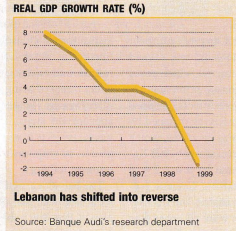
Lebanese economy from stagnation into
full-blown recession. Some local and international
financial institutions have estimated
real GDP growth rate for 1999 to be
up to 1%, while others have calculated a
contraction as far down as -2%. Of course,
the government’s forecast was on the optimistic
side, at 2%.
While the government’s tax dream was a
flop, it had to look elsewhere to find other
sources of revenue. It has been notorious for
being dependent on custom duties, which
account for 47% of revenues. But, alas,
due to increased tariffs (not such a smart
move if Lebanon eventually hopes to gain
membership to the World Trade
Organization) and economic slowdown,
revenue on custom duties rose by a mere
2.84% in the first 11 months of 1999.
All in all, raising revenue has been nothing
but a sore spot. The government’s revenue
rose by a paltry 4.63% in the first 11
months of the year compared to the same
period of 1998.
Since the cabinet found it
hard to make ends meet,
the best thing to do
would have been to lower
its expenditures.
Indeed, about 37% of the
government’s spending
represents wages and
salaries for public
employees, and it is no
secret that the inefficient
public administration is
grossly overstaffed.
However, the cabinet
has yet to put together a
comprehensive plan to
reduce the public payroll.
A case in point: An
attempt was made to
restructure the money-losing
state-owned Tele-Liban
through the dismissal
of most of its
work force, but this sole
attempt was abruptly
postponed due to political
pressures. And MEA,
which is chronically in
the red with just a handful
of airplanes and a staff
of more than 4,300, is a
drain on the central
bank. Last year saw no
concrete steps taken by
the government to find a
solution. And with a bad
track record so far, the
EIU concludes that the
government will be
unable to reduce spending
in any meaningful
way in the short term.
If administration reform
is not within reach, at
least privatizing government assets – ones they don’t particularly
need or are incapable of running – could be
an answer. It is estimated that the sale of
state-owned enterprises could generate $6
billion. Banque Audi’s research department
has figured that each $1 billion of
public assets sold to the private sector will
reduce the deficit by nearly 1% of GDP and
6% of public debt to GDP. Yet, once again,
the government was slacking. The privatization
draft law took
ages to get to parliament,
and markets are
still waiting for a
detailed timetable and
a structured implementation
plan.
In the capital market
arena, Treasury bill (T-bill)
rates dropped by
an average of 86 basis
points over the first
nine months of the
year, moving from 13.19% in December
1998 to 12.33% in September 1999. But
even though the T-bill yield curve has shifted
downward, it needs to go down much further
to give any lift to economic growth. It
also didn’t help the crippled Beirut Stock
Exchange (BSE), which was one of the
worst performers among emerging markets
last year: Average stock prices had plummeted
almost 30% by the late fall. You
couldn’t expect anything better. For the first
ten months of 1999, trading volume
declined 59.6%, while turnover amounted to
just $84 million, down 72.6% compared to
the same period in 1998.
Some of the listed companies themselves
took a beating. Solidere, the largest real
estate company in the Middle East and seen
by many as the best physical “index” for
the health of the country’s economy, reported
losses in the first half of last year. Some analysts
do not expect more than $10 million
in net income for the whole year – if they’re
lucky. For Solidere, the new government
comes into play again. Since Hariri left
office, building permits have been virtually
frozen, which has kept Solidere from doing
much to pull in revenue.
While most sectors have been suffering
from the economic slowdown in the last few
years, the banking industry was known to be
resilient to any external
damage. Until 1999, that is. For the first
time since the end of the war, the average
profit growth among
leading banks reported
a 3% drop for the
first nine months of last year.
But, believe it or not,
the new cabinet did
some good. One of the most notable – and
rare – achievements
was the reappointment of Riad Salameh as
the central bank’s governor for another six-year
term. The central bank’s main objective
remains to defend and strengthen the
Lebanese pound and keep inflation low. A
new board at the BSE was assigned with an
order to reactivate the bourse. It outlined a
five-point plan that includes increasing
transparency, developing the bourse’s
administrative structure and forming links
with Arab and other foreign stock markets.
And after waiting for years, the government
and central bank are brainstorming ideas for
a draft law to create an independent regulatory
body similar to the US Securities and
Exchange Commission.


On another positive note, Lebanon continued
to successfully raise funds on the
international markets through the issuing of
foreign bonds. This reflects the restructuring of the public debt as the Lebanese government
is gradually shifting towards foreign
financing in order to borrow at a lower cost
and over a longer period of time.
Dirty dealing has been a famous pastime
for the private sector when it comes to doing
business with the government. It’s estimated
that corruption increases the production cost
of local firms by 20% and is one of the factors
that discourages foreign and domestic
investments. Lebanon’s parliament passed an
anti-corruption law that bans and prosecutes
senior officials found guilty of acquiring
wealth illegally.
Last year parliament did at least pass a
long-awaited intellectual property rights law
after much lobbying from foreign governments
and multinational software firms. The
law is expected to encourage foreign investments
in the local high-tech and software
industries, but that will ultimately depend on
effective enforcement, which has so far been
lacking. And that is just a small step towards
giving Lebanon’s antiquated legislation the
complete overhaul that it needs.
No one should have celebrated the new
year. This government sauntered into office
with promises of a brighter future but those
optimistic words have since evaporated into
thin air.
The festivities should have been set to
rejoice the end of a year full of doubt.
If Lebanon is to enter the new millennium
with prosperity in sight, its fiscal crisis
requires drastic government action.
The feeling that change is imminent has
been sweeping across the Middle East. For
some that has brought a feeling of excitement,
while others are filled with anxiety.
With the decline of oil
prices largely over, a floor has been placed
under many Arab
economies for the first
time in a generation,
allowing a certain
degree of prosperity.
But prosperity will
not overflow into
Lebanon unless tough
decisions are taken to
put its house in order,
followed by soothing the nerves of the people who have seen the
economy reach a state of paralysis.
At the heart of the economic challenge lies
a state of public finances that has become a
cause of growing concern. The failure to
keep a lid on expenditures and reach revenue
targets has left the government with
chronic fiscal deficits that have created a
debt of nearly 130% of GDP. Despite moderate
adjustments, the budget deficit probably
reached 16% of GDP at the end of 1999.
The government has no choice but to
take action. It is now up against the wall: It
must maintain government solvency. But its
fiscal policy should be at the center of an
overall adjustment strategy to ensure a long-term, non-inflationary growth path
for the economy. Short-term reduction of
deficits through measures that cannot be
sustained should be cancelled out. Plans
based on temporary measures will not
reduce the country’s underlying deficit.
Such action will only be of temporary
value and may do more harm than good over
the medium term.
The government must focus on changes
that will produce an impact for the long
haul. There are no hard or fast rules about
how public expenditure should be cut. But
expenditure reduction has to be economically,
politically, and socially feasible. The
government has little
room to maneuver, since around
85% of its expenses –
debt servicing and
public-sector wages
- are more or less
fixed. Sustainable fiscal reform will
require a thorough
review of underlying
government policies
and spending. This will depend largely
on the factors fueling growth in spending,
as well as on the social and political constraints
facing policy makers. The answers
could very well be obvious, and yet political
inefficiency is often at the root of most
of our economic failures. Experience suggests
certain guidelines.
The interest bill, coming from the government
issuing Treasury bills, is the most
inflexible component of expenditure in the
budget. An accommodating environment
could allow the authorities to ease monetary
policy and reduce interest rates. It is estimated
that each 1% decline in interest rates
would generate a 6% decline in debt servicing
and a 2.5% drop in the deficit. The government’s recent strategy to borrow on
international capital markets bodes well
for trimming down borrowing costs and
extending the maturity of its debt portfolio.

Wage restraint in the public sector is
another important tool, since it can be a
major source of savings. There is, however,
a limit on how far wage standstills can be
made to operate effectively. Cutbacks in
civil service numbers are often a more
appropriate reform, especially since the public
sector has bloated in the past few years.
When it comes to privatization, many of
our public institutions are dysfunctional
due to the absence of modern and appropriate
public administration structures and
an underdeveloped sense of ethics.
Corrupt practices have thrived, owing to
a legacy of decades of internal strife.
Public enterprises should no longer be a
drain on the budget. If they remain under the
wing of the government, their pricing
structures must be adjusted,
their scope of
activities redefined,
their
employment
policies
reassessed, and
their capital
program rationalized.
But
many should be
privatized.
Besides helping
to reduce the debt by an estimated $4 billion to $5 billion, privatization
will greatly increase efficiency and draw private
investment.
Generating more revenue by raising
taxes, however, should be limited. One of
the dangers of raising taxes now is that it
could inhibit growth, especially while the country is in an economic slowdown.
More importantly, fiscal adjustments
should be accompanied by a genuine effort
to improve or even restructure the tax system.
Tax codes should be clearly drafted,
well defined and easily understood by the
tax-paying communities. For private
investment, it is especially important to
have tax rates that are both stable and predictable.
A simple, transparent tax system is
also relatively easy to administer and
would promote compliance.
The essential elements required for successful
tax reform include political commitment,
a team of capable officials dedicated
to the task, staff training and changes
in the incentives for both taxpayers and
administrators. Because of its efficiency
and revenue security, an ideal instrument to
achieve this objective is a value-added tax
(VAT) at a single rate.
But there are certain things that the government
must realize. Reform of the
tariff structure –
vital for joining the World Trade Organization
(WTO) and the
Euro-Med
Partnership – is
likely to reduce fiscal
revenues in the
long run. Custom
duties make up
about 40% of total
revenues. This will require changes in
other taxes to offset the loss of income from
custom duties. Unfortunately, Lebanon’s
accession to the WTO has been seriously
hampered by an apparent lack of political will
to join the globalization process, threatening
to isolate the country as free trade spreads
around the world.
Business confidence and growth
prospects appear to be recovering, albeit
slowly, in response to the government’s
five-year plan, which promises fiscal
restraint. The plan foresees a broad privatization
program, across-the-board spending
cuts and higher levels of direct taxation.
These plans need to be implemented
quickly and successfully. With growth
slowing to less than 1% in 1999, further
improvement in the fiscal balance will
depend on the successful implementation
of a comprehensive and credible plan
aimed at slowing the growth of the public-debt
burden while maintaining investor
and creditor confidence. The government
will also need to speed up the development
of capital markets to support private-sector
growth.
If the government succeeds in reducing
the budget deficit and expanding the public
revenue base within a framework of lower
interest rates, orderly privatization and a
more equitable distribution of taxes, it will
boost confidence in the country’s economic
prospects for the future. An abrupt
devaluation of the Lebanese pound could
then be ruled out and investment in the
country would surge. Yet, there remain
substantial obstacles, and the political consensus
on the need for significant fiscal
reform is still less robust than might be
desired. Political tendencies towards
wastefulness are unlikely to change
overnight, and revenue increases continue
to face strong popular opposition.
This country’s leaders need to realize
that the regional pace of change has
never been so rapid, and any wrong turns
at this stage have become almost impossible
to correct.
Ziad Maalouf is vice president of Middle
East Capital Group. He contributed this
article to EXECUTIVE.

