
The outlook for Lebanon’s economy
depends on several factors – the outcome
of the peace process, controlling
budgetary problems, joining international
trade agreements and, especially, implementing
reform in both social and economic
spheres. If the local economy is to recover
and grow, these factors are going to be the
big issues over the coming years.
The question then is how the government
will meet these challenges. The obvious
start is to implement structural changes at both
the macro and micro economic levels.
Identifying the necessary changes, however,
is not a simple process – the economic identity
of the country itself will have to be determined
first. That includes its present and
prospective comparative advantage as well as
its specific areas of competitiveness in both
local and regional markets.
A peace agreement
should help
lower the political
and economic
risks, which have
been one of the barriers
preventing
social and economic
development.
This would create a more suitable environment
for productive
investment,
while the liberation of the occupied zones could help transform
the Bekaa and south Lebanon from essentially
marginalized territories into economically
active regions.
The peace dividend might include compensation
for war damage caused by Israeli
attacks, which has been estimated at about $3
billion. Such a windfall, however, depends
largely on the negotiating skills of the
Lebanese side. But Lebanon can ill afford to wait for its knight in shining armor. It must get
ready for the post-retreat period, mainly in
developing the currently occupied territories
and in dealing with war consequences. A
recent plan for the occupied region estimated
that the development of the area would
require public spending of about $1 billion.
But how the government will be able to
mobilize the necessary funds given the tight
fiscal constraints is a primary concern. It
will undoubtedly be necessary to find loans
or grants as well as create incentives for the
private sector to participate in the development
process.
Nonetheless, the extent to which peace
can bring economic stability, let alone prosperity,
is debatable. Lebanon still has serious
problems that hamper real development. The
country is burdened by administrative corruption
and acute fiscal problems – a growing
public debt, an inefficient taxation system
that relies too heavily on indirect taxation, and
a gaping budget deficit – while the high cost
of production is hurting the competitiveness of
local industry.
Policy-makers have focused on stabilizing
the local currency, reducing the deficit and
attaining high rates of economic growth.
These policies have
produced undesirable
side effects,
however. Monetary
stability, for example,
was based
largely on high
interest rates and
was a contributing
factor in the economic
slowdown,
increased debt servicing
and the
deficit that has spiraled
out of control.
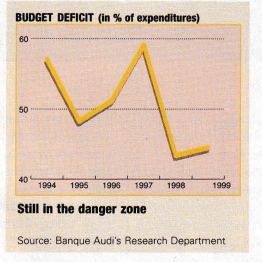
The current government
has chosen fiscal reform as a priority
and at the same time is preparing an economic
plan to assess the competitiveness of
the various economic sub-sectors. The government
is mainly relying on restructuring the
debt in order to reduce debt servicing, and on
improving taxation policies, such as the
introduction of a value-added tax, to
increase revenues. Some headway has been
made in tackling the budget deficit and getting the public debt under control, but the
government still has a very long way to go
before meeting its goals.
Lebanon is stuck in an economic recession,
which is clearly seen by the drop in economic
growth from 6.5% in 1997 to 2% in
1998 and an estimated less than 1% for
1999. At the same time government revenues,
which are mainly based on customs
receipts, were hit by a 12% drop in imports
during the first 11 months of 1999 compared
to the same period of 1998.
Recent moves by the government to tighten
its fiscal belt have negatively affected
potential investment.
So Lebanon will enter the new millennium
with an economy in critical condition, and
prescribing a cure for one problem could
adversely affect another. Policy-makers
don’t have many options; sacrificing one
thing at the expense of another will be necessary.
The government must recognize that
Lebanon’s economic model is becoming
more and more obsolete. It is high time to
implement radical reforms, taking into consideration
this country’s potential as well as
changes occurring both regionally and internationally.
These reforms should not simply
be a quick fix for Lebanon’s current ails, but
rather invoke long-term resuscitation of the
economy, addressing both the current and
underlying structural symptoms.
• Restructuring the public sector and implementing real administrative reform
• Implementing a selective and adequate
form of privatization covering activities of the
public sector that are not directly related to the
concept of “public social service,” such as
education and health.
• Establishing proper management of debt and
financial resources
• Moving progressively to an export-oriented
industry
• Enhancing the educational system in terms
of curricula, fields of specialization, and adequate
links with the needs of the labor market
• Addressing the social problems in order to
reduce disparities based on region, gender
or social classes
