
High production costs, inefficient
technologies and the lack of a
coherent government policy are
marginalizing this country’s cash-strapped
farmers. The sector has become unprofitable
and its contribution to the economy is
at its lowest level ever.
Agriculture’s average contribution to
gross domestic product plummeted from
about 20% in the 1950s to 10% in the 1980s.
That has dwindled even further in recent
years with agriculture now contributing just
8-9% of GDP. Exports are also on the
decline. In 1996 vegetable exports totaled
$75 million, or 10.28% of total exports. By
1998 that figure had dropped to $59 million,
or 8.29%. Statistics for October 1999 indicate
a further decline to just under $43 million, or
7.63% of total exports.
Why is the sector shrinking? According to
Waddah Fakhry, president of the Southern
Farmers Association, it’s because “it is the
policy of our state to ignore agriculture.”
Governments of industrialized economies
have clear policies towards agriculture
because of their active interest in the multi-trillion-
dollar agricultural business, says agro-
economist Riad Saade, of the Lebanese
Center for Agricultural Research and Studies
(CREAL). In contrast, this region has traditionally
depended on the oil and gas industries,
developing agriculture largely for food
security. But whereas our oil-producing
neighbors might be able to afford to keep agriculture
on the sidelines, Lebanon cannot.
The sector directly employs 8-10% of
the population. That figure grows to about
35-40 percent if related economic sectors
are taken into account. Upstream there are
companies selling machinery and input
items such as seeds, fertilizers, and pesticides.
Downstream are those involved in
getting the produce to market, as well as the
agro-industries that manufacture food
items. “Altogether they represent no less
than 25% of GDP,” says Saade.
But in contrast to these figures, just
1.81% of this year’s budget has been allocated
to the ministry of agriculture. And
that’s an increase over 1996’s paltry
0.48%. The budget allocation to agriculture
is actually higher, because parts of the sector
fall within the responsibility of the ministries
of economy and trade (wheat and
sugar beet), finance (tobacco), and electrical
and water resources (irrigation). The
allotments to these segments are 6.86%, 0.7%, and 0.7%, respectively, bringing the
government’s total agricultural budget to
10.07%. But in comparison, Syrian agriculture
gets about 20% of the state budget,
according to Saade.
The fact that no single department takes
care of agriculture highlights the government’s
scatterbrained approach to the sector.
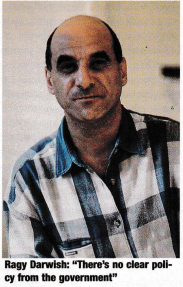
“There’s no clear policy from the government.
Is it favorable, neutral, or hostile? We
don’t know,” says Ragy Darwish, professor
of environment and resource economics at
the American University of Beirut.
The state of the agricultural sector makes
the government’s ambivalence all the more
unacceptable. The competitiveness of agricultural
produce has been undermined by
the high cost of production compounded by
the influx of imports, particularly items
that are smuggled in from Syria. The comparatively
high costs of water, labor, fertilizers
and pesticides have forced farmers to
“sometimes sell below cost,” says Fakhry.
But whereas agriculture is widely subsidized
in neighboring countries such as Syria and
Jordan, in Lebanon subsidies are limited to
tobacco, sugar beets, and cereals such as
wheat and barley. The subsidy on tobacco is
politically motivated, intended to ease social
tensions in the south.
“People are divided
over whether agriculture
should be subsidized
or not,” says
Zurayk. Although subsidies
are contrary to
World Trade
Organization (WTO)
regulations, farmers are
subsidized in Europe
and the United States.
The WTO does give
some leeway to developing
countries, providing
a grace period to
allow for subsidies.
The question then is
what sort of subsidy
should be given – direct
or indirect? Direct subsidies
mean that the government should contribute to production
costs or assure a market for farmers – as
with tobacco, which the government can buy cheaper on the open market, but guarantees
to buy from local farmers.
With indirect subsidies, the government
invests money in programs
that support
farmers either
through technical
supervision, market
regulation, or by opening
up export markets.
Zurayk believes indirect
subsidies make
more sense as “they
don’t create market
distortions.”
A key form of indirect
subsidies is the
extension services
offered by the ministry
of agriculture. While
this department is being
revived, its poor performance
to date only exacerbates the problems
of the agricultural sector. Effective extension services could advise farmers on the
type of crops that should be grown, based on
the needs of the market and agro-industries.
The current void leads to haphazard choices,
often resulting in an oversupply of certain
items and therefore
lower prices.
Extension services are
also meant to provide
farmers with information
on regulations and
new technologies that
would help increase
production and secure
markets. These
include the proper use
of pesticides, water
management through
drip irrigation, and
new crop varieties.
The lack of new crop
varieties is one of the main reasons local
production cannot
penetrate export markets
- which is crucial to the sector’s success.
Over 80% of crops grown in Lebanon are
traditional crops and old varieties of fruits and vegetables. Through tissue culture,
researchers in the United States and Europe
have developed genetically improved varieties
that increase
quality, quantity, and
durability. For example,
the new tomatoes
that are growing in
greenhouses produce
about 30-40 tons per
dunum (1,000m²).
With old varieties the
same area produces
just 3-4 tons. Because
these new varieties
meet international
norms and standards,
production of such
crops could help
secure export markets.
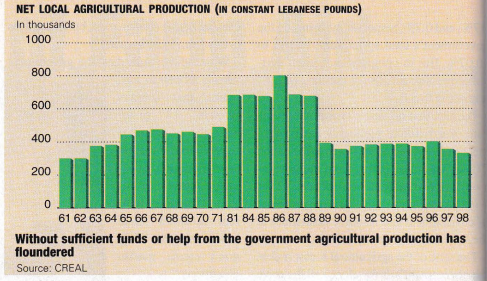
According to CREAL, agricultural production experienced a steep drop in
1989 and has not recovered since.
Again the main problem is the lack of regulations
and standards in marketing agricultural
products. “There are no regulations
on storing, packaging or grading agricultural
products – nothing,” says Saade. New
techniques in packaging and storage are
essential if Lebanon hopes to build export
markets. For example, international norms
require that crops are pre-cooled to enhance
quality. “The Jordanians understood this
five to six years ago,” says Zurayk.
What about exports? Securing export
markets through trade agreements is crucial,
but it may not be enough to guarantee
returns. “The price of food commodities is
at its lowest ever. So you don’t produce
things that are cheap on the market unless
you can produce huge quantities,” says
Zurayk. But this is difficult. Lebanon has
limited fertile land. Mountainous terrain
constitutes 85% of Lebanon’s land base, and
of the remaining 15%: “I would bet that 5%
are planted with concrete buildings,” jokes
Saade. The situation is exacerbated by the
absence of laws protecting agricultural land
from urban expansion. This has led to the
loss of 20,000 hectares of the most fertile
land in the previous two decades, according
to a report from the ministry of agriculture.
Additionally, agricultural holdings are further
fragmented because of the traditional
practice of partitioning land to heirs. The
average size of a farm is 0.5 hectares.
Lebanon’s agricultural sector does have
one comparative advantage. The country
has six ecosystems that can support different
types of crop production. Finding solid
niche markets could help Lebanon’s agricultural
sector become less dependent on the
highly competitive, traditional markets.
Zurayk sees organic agriculture as a possible
solution. While production costs are greater,
there are people willing to pay higher prices
for these specialty items. “This is the fastest
growing market in agriculture,” says
Zurayk. But it won’t happen without the
government’s involvement. The state would
need to create the proper regulatory framework
and provide certification guaranteeing
that a product is organic and free of pesticides.
Medicinal and aromatic plants are
other crops that have been suggested.
But even if information on alternative
crops and new techniques is trickling
down to the farmers themselves, they often
lack the finances required for such an
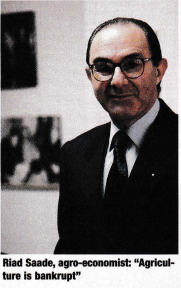
investment. “Agriculture is bankrupt,”
Saade says unequivocally. “A good diagnosis
is 90% of the solution.” But the reality
is that without funds nothing happens.
Agriculture is desperate for funds, but no
one is providing loans. Fakhry believes that
the government should establish agricultural
banks in order to provide soft loans to
farmers. But with its current budgetary problems,
the government will find it difficult to
subsidize a credit program for farmers.
Private banks also shy away from agri-
loans because agriculture is considered
bad business. The rate of loans to agriculture
is estimated to make up less than 1% of commercial
banks’ loan portfolios, according to
a report from the ministry of agriculture. And
for the most part, agricultural credit is only
extended to large reputable companies,
such as dairy farms Daliah and Dairiday, and
poultry farms Hawa and Tanmia.
Zurayk attempted to establish a private
bank that would provide micro-credit for
agricultural development. But the National
Bank for Agricultural Development never
saw the light because it failed to attract
private investors.
Mohamed Gabr, chief of the agricultural
section at Escwa, says part of the work being
done in his department is to encourage the
establishment of micro-credit for farmers
from non-governmental organizations, and
institutions such as the Arab Fund for Social
and Economic Development.
Farmers usually receive credit from supply
companies because they don’t have the
cash to pay for purchases up front. Debts are
generally paid at the end of each season, but
interest can be as high as 100%, according
to a report by the ministry of agriculture.
The fate of agriculture in Lebanon is
uncertain, but as Zurayk points out: “There
are social and political implications to the
breakdown of the agricultural sector.”
The development of a vibrant agricultural
sector will help rural areas to prosper; its
failure will result in greater rural-to-urban
migration and intensify social inequality.
Agriculture has to face the harsh economic
realities of the open market, but for now it
requires some special treatment .
The Pesticide Problem
The use of pesticides in most developing
countries is not properly regulated,
according to AUB’s Rami Zurayk.
Lebanon is an example. Misuse of pesticides
is widespread: for example, use of
old stock and internationally banned
pesticides.
Because of the inadequate extension
services offered by the ministry of agriculture,
farmers get their information on pesticide
use from the suppliers. A study conducted
by the Food and Agricultural
Organization (FAO) in 1998 showed that
pesticides were openly displayed and
handled without precautions at distribution
outlets. The FAO found that while suppliers
are apparently unaware of the danger
of pesticides, they are prepared to sell
and aggressively promote their use.
Some 1,000 tons of pesticides are
imported every year into Lebanon, of
which 70-80% are distributed or used in
the Bekaa valley. The valley is saturated
with pesticides, and littered with empty
contaminated pesticide containers.
Farmers tend to be unaware of the environmental
and health hazards of either
pesticides or contaminated containers.
The misuse of pesticides has long-term
effects on people’s health. Not only are
farmers at risk, but so are consumers who
eat produce with high levels of residues.
Often farmers do not follow warnings not
to pick crops until 15 days after using pesticides.
“If the price on the market is good
today, even if a pesticide was used yesterday
he will harvest it and send it to the
market,” says a spokesman from the ministry
of agriculture.
The inappropriate disposal of contaminated
containers – whether haphazardly
dumped, openly burned, or buried – puts
people’s health at risk and harms the environment.
Buried containers leak pesticide
residues that seep into shallow waters
and flow into rivers. There are also direct
economic consequences resulting from
the misuse of pesticides. Overuse adds to
the cost of production, while local produce
becomes unmarketable internationally
because residuals are too high.
