
‘Tis the season to be full of flu. But
chances are that most sufferers
will fight the virus with trademark
Panadol rather than a locally-produced
drug. Whatever the ailment, imported
pharmaceuticals are most often the prescribed
response in Lebanon, accounting for
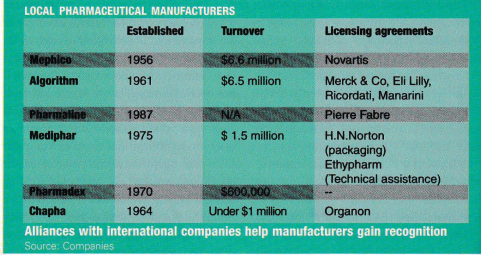
more than 90% of the market. Imports
have grown fivefold since 1991 and by
18% in 1998 alone. Already imports were
worth about $238 million at retail value in
1998 and are expected to reach $280 million
for 1999.
But where are the six local pharmaceutical
manufacturers in the nation’s health
equation? They account for just 6-7% of a
market that is estimated to be worth some
$255 million. “The local industry has
grown but at a slower rate than imports,”
says Johnny Chalhoub, general manager
of Chapha. “In Lebanon, we don’t create
new molecules. But the importers have
registered many new medicines, so their
business has grown.”
Despite having one of the strongest pharmaceutical
sectors in the Middle East prior
to the war, the local industry has since
floundered, while other countries in the
region have built up their own facilities. Lost
export markets, the flood of imports and
lack of quality assurance are hurting local
pharmaceutical manufacturers.
An open market is meant to stimulate
competition and provide quality products at
a reasonable price. “There isn’t a country or
a company that is not trying to register its
medication in Lebanon. And since this is a
free country, you cannot reject a file until it
has been examined,” says Armand Phares,
president of the Lebanese Pharmaceutical
Importers’ Association. But Lebanon’s
open-door policy makes it difficult for
local manufacturers to compete since their
medicines are largely marketed against
foreign brands, which like themselves are
imitating not innovating drugs. Up to 80%
of the import market is the older generation
off-patent drugs, according to a recent
report by the Pharmaceutical Research and
Manufacturers of America (PhRMA).
But while prices have been kept low,
proper quality control of both imports and
local production has proven unreliable and
unfeasible given the current constraints.
Legal exemptions from registration channels
have been used to bypass the technical
committee. And those have not always
been of a reliable quality.
One of the major problems facing
Lebanese pharmaceutical manufacturers,
then, is the lack of a respected government
body that gives its stamp of approval to local
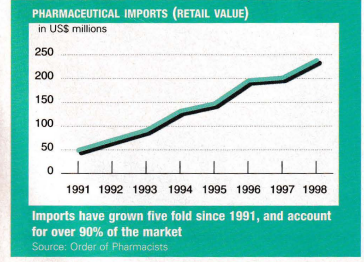
medicines. Testing performed in the central
laboratory is at best inadequate. “I respect
their efforts but they don’t have the necessary
team on board nor the necessary
equipment,” says Dr. Moussa Moussa, production
manager at Algorithm. “They have
to test water, juice and pharmaceuticals.
It’s a big undertaking.” Algorithm admits it
is forced to be self-regulating.
Proper quality control is a problem across the region, according to Omar Bizri, of the
technology section at the Economic and
Social Commission for Western Asia
(Escwa). “Even if you are producing a
tablet out of bulk powder material it needs
to be analyzed and tested, and that is not
always done. I believe that throughout the
region central quality control is at an
embryonic stage,” he says. To make matters
worse, the technical committee has been so
swamped that registration of all drugs, both
imports and local products, has been suspended
since June.
One way to fight back is by adopting
standards that meet World Health
Organization’s (WHO) standards, or ISO
standards. Local producers all stress that
they do follow those practices. But again,
the qualifications of inspectors from the
ministry of health that are sent to verify
WHO standards are questionable.
While foreign firms have created formidable
competition, they have also provided
local manufacturers with a much-needed
boost through cooperation agreements.
Multinationals began promoting the
Lebanese industry in the 1960s by establishing
a plant or forming alliances.
Algorithm, for example, was formed in
1987 when Merck and Co. divested itself of
smaller plants and the Ghoryaeb family
bought the local outfit. That allowed them
to walk into a ready list of medicines that are
still produced under license with an international
stamp of approval on quality.
“Merck products made under license in
Lebanon at Algorithm are produced under the
strictest quality control,” says Jeffrey
Kemprecos, external affairs director of
Merck’s Middle East division. “Our engineers
regularly visit, inspect and re-certify that the
Algorithm plant meets Merck standards.”
Turnover figures show the success of
licensing agreements even though the
Lebanese do not always trust local pharmaceuticals.
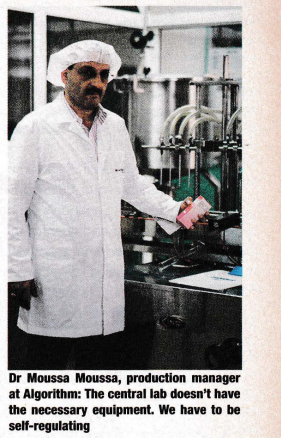
Algorithm saw a turnover of
$6.5 million in 1998 and an annual growth
of 10 to 12% over the last few years, while
Mephico had sales of $6.6 million producing
medicines under license with Novartis
since 1964 alongside its own products.
Algorithm recently signed an agreement
with France’s Eli Lilly and produces under
license for Italy’s Ricordati and Manarini. The advantage of foreign alliances in
getting quality recognition in a market that
has not always been properly regulated has
not been lost on other manufacturers. All but
Pharmadex now have some kind of licensing
or technical agreement – albeit not as
extensive as those of Algorithm and
Mephico – allowing them to use the name
of an international company.
Mediphar has a technical assistance
agreement with Ethypharm of France to
produce a slow release cardiology medicine
while it also packages medicines for UK-based
Norton. “We make two kinds of cardiology
drugs either under license or with
technical assistance. We can make them
on our own but to avoid being questioned
about quality assurance, we got a license,”
says Fouad Fadel, managing director of
Mediphar Laboratories.
Pharmaline, the Sarraf group’s pharmaceutical
division, recently began producing dermatological products under license
from French producer Pierre Fabre.
While producing under license seems to
be the surest way of gaining quality recognition,
it costs the local companies a premium.
“One reason to produce our own
products is profit. There are royalties associated
with producing under license, anywhere
from 3-7%, and the required chemicals
can be very expensive,” says
Moussa. Algorithm has five of its own
products on the market, but has plans to
beef up the local line with the introduction
of another seven in 2000.
Estimates put Lebanon’s pharmaceutical
production at no more than $20 million,
while just 1 or 2% of that is manufactured
outside licensing agreements. Figures suggest
that it is more difficult to sell truly local
medicines. Mediphar sales for 1998 stood
at about $1.5 million, Chapha’s was less
than $1 million, while Pharmadex had a
turnover of about $600,000. The companies
have experienced difficulty during the past
year. Mediphar has not seen any growth this
year although it was previously averaging
5 to 10%. “We are struggling to get one percent
market share,” said Fadel.
Producers are calling for a more restrained
import policy of common medicines, and that
is being supported by both the pharmacists’
and doctors’ syndicates. “We have the
capacity to produce what we call the classical
products and we are asking that the
importation of such products be limited,”
says Leila Khoury, president of the Order of
Pharmacists. “Examples are paracetamol
and cough syrup. The local industry can meet nearly all our needs so why import
more?” One small way the government
could help out is by properly controlling parallel
importation, which allows companies
other than official agents to bring branded
medicines into Lebanon. Pharmaceutical
products that are produced locally are being
brought in as parallel imports, despite a law
that forbids that practice.
The local manufacturers are also faced
with a lack of access to export markets,
which was at one time their mainstay.
When Pharmadex began operations in the
1970s, 85% of its products were exported to
Africa. Exports currently account for just
15% of turnover. Export markets are now
being actively sought, though making
inroads will not be easy.
Pharmaline strongly pursued exports in
1999, and claims to have sold 60% of its
products on foreign markets. Algorithm’s
exports are also up to 30%, helped
undoubtedly by the reputation it has garnered
through its licensing agreement.
“Generic exports to the Middle East are not
successful,” says Moussa. “They need to
know where the medicine originates from.
They prefer to have a branded product.”
Producers are actively pushing for reciprocal
treatment in registering drugs on
regional markets. While medicines produced
by companies in neighboring countries
can easily gain access to the Lebanese
market, local manufacturers argue that the
reverse is not true. Regional markets would
introduce economies of scale to a country of
Lebanon’s small size and make local companies
more attractive to foreign firms looking for a springboard into the region. “If
you are negotiating for a license for
Lebanon, it’s one thing, but if there is a
joint venture with another country such as
Syria, it would be something entirely different,”
says Abi Karam. Apart from pushing
the government to help open up markets,
local manufacturers believe that forming
strategic alliances with firms in the region
will help them gain access to those countries.
On top of reaching other markets, the
local industry must convince the Lebanese
to buy locally produced pharmaceuticals.
Abi Karam believes that the industry has not
done enough to help itself. “Our budgets are
smaller than multinationals. But as a local
industry we have not promoted our own
products enough and doctors and pharmacists
are not used to thinking about local
medicines,” says Abi Karam. “Changing the
consumers’ attitude towards buying local
drugs instead of imports will require a lot of
effort.” Arguably, better promotion could
help manufacturers broaden their reach.
Although piracy is not a rampant problem
in Lebanon, further licensing agreements
and technology transfers are less likely to be
forthcoming unless a modern patent law is
passed. “Domestic Lebanese, Jordanian,
UAE and Syrian pirate companies are
aggressively pressuring Lebanese health
authorities to register unauthorized copies
of internationally patented pharmaceuticals,”
reads a recent PhRMA report.
“There is considerable risk that without
sustained pressure to upgrade the existing
patent law, Lebanon could go the way of
Syria and Jordan.” According to local
manufacturers, just
two companies currently
produce a pirated
drug. Most regard
breaking a patent as a
double-edged sword.
“If we copy we will
produce a cheaper
quality of drugs and
get a bad image,” says
Chalhoub. “It is just a
way to make quick
money.”
A draft law on patents is
before the minister of
economy, but will still have to be approved by cabinet and passed by
parliament. If Lebanon hopes to gain World
Trade Organization (WTO) status and win
recognition as a legitimate pharmaceutical
industry, that will have to come sooner
rather than later.
“No one is saying, however, that a new
patent law will mean lots of new bricks and
mortar projects in small countries, although
it should not be ruled out,” says Kemprecos.
This begs the question of bigger markets
and an official government policy to help
Lebanon use its comparative advantage – a
highly respected medical sector supported
by high-caliber university graduates and a
relatively reputable industrial base.
“Other countries in the region have provided
benefits to encourage multinational
companies to establish production facilities.
The pharmaceutical industry in those
countries benefits from know-how and is
able to prosper,” says Abi Karam. The
Lebanese government, however, has done
little to help the industry. WTO is bound to
have an impact on an industry already suffering
from fierce competition and unless the
companies can strengthen their negotiating
power collectively or individually, their
future remains uncertain.
