
Incoherent government policies
The government’s laws and policies are essentially a direct measure
of the state’s commitment to the private sector. In other
words, if the laws and policies are compatible with the private sector,
they create a friendly business environment in which investment
can be undertaken. How does the Lebanese government perform?
According to the survey, the private sector seems to be operating
in a highly uncertain environment. This is particularly obvious
in the agriculture, industry and tourism sectors and is a result
of these sectors’ limited participation in decision-making, being uninformed
about policy changes and having little faith that the state
will implement its policies.
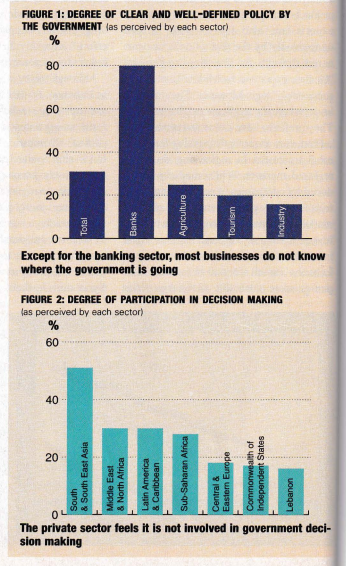
More precisely, according to the survey, 31% of the private sector
respondents did not believe that the government has clear and well-defined
policies towards their respective sectors. In fact, a closer look
at the figures shows more interesting results. No more than 25% of firms
in the industrial, tourism, and agricultural sectors think that government
policies are clear and well defined. This is in contrast to the banking
sector, where 80% believe that the government does have a clear
and well-defined policy towards their sector. (figure 1)
However, clear policies do not necessarily translate into compatible
ones. According to the survey, government policies are also not compatible
with the private sector – at least 69% do not think so. Here
also the results differ by sector. On one hand, the three sectors (industrial
(67%), agricultural (82%), and tourism (69%)) do not believe
that government policies are compatible with their sectors. On the
other, only 20% of the banking sector think the same.
The lack of clarity and compatibility of policies is essentially due
to the fact that the private sector is neither involved in decision-making
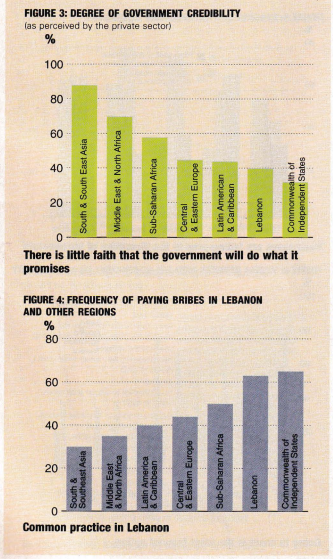
nor informed about policy changes. Based on the survey, only
16% of the respondents have participated in economic decision-making.
In comparison to the World Bank study – which serves as a
benchmark – this is equivalent to the level in Central and Eastern
Europe (18%) and the Commonwealth of Independent States
(17%), and actually worse than other Middle East and North Africa
countries (30%) and even Sub-Saharan Africa (28%). (figure 2)
However, the level of participation differs by sector. In fact,
around 80% of banks interviewed participate in policy changes.
This is generally attributed to the effectiveness of the Association
of Banks – which represents the concerns of 75 banks in the country.
This contrasts sharply with the hundreds and thousands of firms in the industrial and tourism sectors. Besides banking, the three
other sectors have little impact on policy-making. In fact, only 12%
of industrialists, 13% of agricultural firms, and 15% of tourism companies
in the survey say they have access to express their views
about government policies.
In addition to the limited participatory role, the private sector
seems to be kept in the dark about policy changes. Only 22% of
firms are actually informed about policy changes compared to 60%
of firms in East Asia – which is a reason that makes the region business
friendly. The uncertainty level expressed by Lebanese entrepreneurs
is significantly worse than Middle Eastern countries
(39%) and Latin America and the Caribbean (38%).
Again, 80% of the banks in the sector are informed about policy
changes, versus just 25% of industrialists, 14% of tourist establishments,
and 10% of agricultural firms. The lack of participation
and being ill-informed about policy changes creates an uncertain
business environment. This can have negative repercussions on
investment decisions.
Another variable that is important for undertaking investment is the
credibility of the government. A government that adopts a participatory
approach in its decision-making will not positively influence
investment unless the government implements the policies.
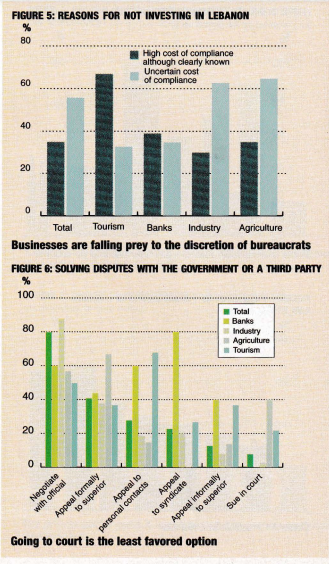
The Lebanese government suffers from a lack of credibility.
According to the survey, only 40% of firms believe that the government
will implement its policies. The credibility of the government
expressed by Lebanese firms fares only better than that of the government
of the Commonwealth of Independent States, hardly a
comfortable indicator. The governments of South and South East Asia
and Middle Eastern countries enjoy far higher credibility with their
entrepreneurs. (figure 3)
The credibility of the government is highest in the banking sector
(80%) and lowest in the agricultural sector (18%). Whereas only
36% of the industrial sector and 40% of the tourism sector have confidence
in the government.
Inefficient bureaucracy
Recent research has proved that bureaucratic inefficiencies, red
tape, bribery and corruption reduce economic growth by
increasing transaction costs for firms. Based on the survey results,
bribery and corruption frequently exceed the levels in many
developing regions. The main cost is decreased investment.
Although banks pay bribes most frequently, the uncertain cost of
complying with government regulations has the worst effect on the
industrial and agricultural sectors.
Bribing public agencies is known to be common practice in
Lebanon, where firms and even citizens expect to pay a bribe in return
for goods or services. But the frequency of bribes is nonetheless surprising
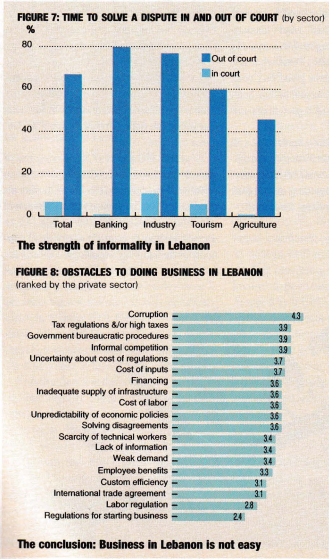
in comparison to other regions in the world. According to the
survey, 62% of firms admitted making payments to bureaucrats, compared
with 35% of their counterparts in other Middle Eastern countries.
Corruption in Lebanon is on a par with that in the Commonwealth of
Independent States, and worse than the countries in Sub-Saharan
Africa, Central and Eastern Europe, and Latin America. (see figure 4)
Delays and inefficiencies fall disproportionately on different sectors.
The bureaucracy is most often corrupt in dealing with banks
- perhaps because the bureaucrats know that they can always extract
bribes from the richest crowd. The banking sector reports in the survey
the highest level of corruption (100%) of the sectors.
The survey found that 70% of firms in Lebanon know in
advance the amount they have to pay for services or goods. In addition,
banks (100%) seem to be the most certain about the amount
of bribes they have to pay. This is logical since firms that pay most
frequently have a very good estimate of how much is expected.
In fact, 51% of surveyed firms say that they have held back investment
because of problems related to compliance with government regulation.
Out of those firms, 50% blamed the uncertain cost of compliance
as an impediment to investment – bureaucrats have the discretion
to interpret the regulations as they wish and 32% cited the high
cost of regulations. The agricultural and industrial sectors seem to suffer
most from uncertainty over the cost of compliance. They fall prey
to the discretion of bureaucrats. This may be due to the complexity of
the licenses and permits needed from different ministries and agencies
- which increases the probability of bribes. To operate an investment
project may require the approval of all or any of the following: the ministry
of agriculture/industry, directorate general of urbanism, the ministry
of finance, ministry of interior (muhafazzat and/or qaimmaqam),
the ministry of environment, the municipality, etc. On the other hand,
the tourism and the banking sectors seem to suffer mainly from
excessive regulations, which are legal if extreme. (figure 5)
Corruption also takes managers’ time away from productive matters.
This, too, is an additional cost. In Lebanon, 36% of respondents
spent at least 15% of their time negotiating with government officials.
This is in line with other regions where 39% of entrepreneurs in the
Middle East and 38% in Latin America spent at least 15% of their time
negotiating with government officials. It is thought firms pay more
bribes to buy savings in terms of the time in getting the officials to
certify compliance with regulations. However, new research studies
show that firms that pay more bribes experience more – not less
- time with officials on matters related to regulation.
Costly judicial system
A fair and predictable judiciary is essential for a market economy
to function effectively. Firms must be able to undergo complex
interactions with confidence that any second party will not renege
on the agreement. Otherwise, firms will either avoid such business
contracts and lose investment opportunities or will face the difficulties
of solving conflicts outside court. How do firms in Lebanon perceive
the role of the judiciary in the economy? The picture is mixed. On
one hand, the judiciary is not seen as a major impediment, but, on the
other, it is the least preferred mechanism for solving disputes. This
is because it is time-consuming and costly to go to court. The burdens
of the judicial system fall most heavily on the banking sector.
According to survey results, 30% of firms consider the unpredictability
of the judicial system as a major problem. Lebanon fares
better than many developing regions in the world; the unpredictability
of the judiciary is low compared with other regions, even South and South East Asia (49%). However, it is important to note
that 35% of firms did not respond to the question. This could be due
to the fact that either they have not had the experience of dealing
with the judiciary or that they fear answering such a question.
The low result is an indication of one of two things or both. Either
the judicial system is relatively fair and predictable, or there are other
more established mechanisms to solve disputes. In fact, in the case of
a dispute with the government or a third party, firms in the survey cited
going to court as their least favorite option. In other words, when asked
about all the different mechanisms used to solve disputes with the government
or a third party, only 8% resorted to the court whereas 84%
opted to negotiate with the official, 43% appealed formally to superiors,
and 32% appealed to family and friends.
In terms of solving disputes, the survey exposes two common features
across sectors. Firstly, (except for the agricultural sector) going to court
was the least favorite option, probably due to the cost in terms of time
and fees. Secondly, negotiating with government officials was very often
exercised by at least 49%. This is because it is the easiest option in terms
of time and costs. To negotiate with officials on the spot or soon after is much cheaper than appealing to the boss or going to court.
However, the mechanism for resolving conflict varies by sector.
For instance, 80% of banks in the survey appeal to their banking association
in a dispute. This seems to be an effective method for two
reasons: one, given the relatively small number of banks in comparison
to the thousands of industrial firms, the banking association
can respond to problems quickly and attentively. Two, the option of
resorting to the association and hence exposing the problem to other
banks can be a sufficient deterrent to solve a dispute, as the third party
may prefer to resolve the conflict rather than acquire a bad reputation
with the whole banking sector. In addition to appealing to their
association, banks exercise all the options available to solve disputes,
except going to court: 59% negotiated with officials, another 60%
appealed to personal contacts, 40% appealed formally to superiors,
and 40% appealed informally to superiors.
In addition to negotiating with officials, the industrial sector’s
second most-favored option is to appeal formally to superiors.
However, there is a huge discrepancy in exercising these two
options. For instance, where 86% of firms in the survey negotiated with the officials, only 37% appealed formally to superiors.
Moreover, only 19% appealed to their association for help, a big
difference with the banking sector. This is probably due to the sheer
number of industrial firms in Lebanon and the inability to meet the
needs of all members on one hand and the heterogeneity of the sector
on the other hand. Finally, resorting to court was the least
favorite option. In contrast, 39% of agricultural firms go to the courts
- the highest among all the sectors. (figure 6)
Although all sectors prefer to solve disputes out of court, there are interesting
differences between them. First, the banks surveyed seem keenest
(80%) on solving conflicts out of court within the first year, followed
by the industrial sectors (75%). If banks cannot quickly solve a dispute
- which may involve a large sum of money – this must be reported to
the Banking Control Commission. Banks would rather avoid this, as
it may suggest to the wider sector that it is facing problems with creditors.
But if a bank is unable to solve the dispute within a specific period,
then the formal process is the most likely mechanism.
According to the survey, an obvious reason for avoiding the formal
process of resolving disputes is that the procedure consumes
a lot of time. Just under 50% of entrepreneurs in Lebanon opted
not to go to court because they considered it too time-consuming.
According to the survey, solving disagreements out of court was
far more efficient than going to court. Within a one-year period, only
7.2% of firms were able to resolve their problems in court, as against
67% who did so out of court.
Besides the expense of going to court, firms may opt to solve disputes
out of court because social networks and closely-knit business
groups may act as a substitute for the formal process. (figure 7)
Second, a lower but still high portion of the tourism sectors in the
survey (60%) have settled their disputes out of court within a year.
Third, a lower share of the agricultural sector (45%) has resolved
a problem out of court.
Corruption: The No. 1 obstacle
Given there are many institutional problems facing the private
sector in Lebanon, which ones are the greatest impediment
to the private sector? The survey asked the firms to rate the various
obstacles to growth and future operations on a scale of one (no
problem) to five (serious problem). (figure 8)
Out of the 19 listed concerns, 17 have averaged a score of three
and above – which translates into moderate to serious problems. The
greatest obstacle cited by the private sector is corruption, which
scored 4.3 out of 5. More generally, the overall problems are both
regulatory and bureaucratic in nature. They include corruption, tax
regulations, government procedures, and informal competition.
These are followed by problems in the costs of production such as
the cost of inputs, financing, and labor. Legal reforms and unpredictability
of economic policies are important but secondary.
If the government is serious about making Lebanon an important
economic player in the region, this survey shows that it has a longer
way to go than it thinks.
