First prize in
innovation
Banque Audi, ranked fourth in total
assets and customer deposits in 1998,
has pulled off another coup that proves it is
the leader of the pack when it comes to originality.
It announced a stock buyback of two
million of its global depository receipts
(GDRs), the first among Lebanese listed
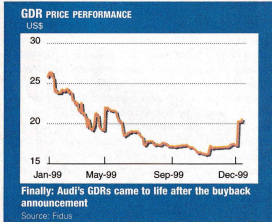
banks. The offer was $20.75 a share, well
above the cost the day before the
announcement ($17.50), which pushed
prices close to the buyback price.
The buyback aims at taking in over 41%
of Audi’s GDRs (4.8 million in total) at a
cost of $41.5 million. The bank will start by
buying the shares out of its own reserves but
will have the option to finance some of the
buyback from the proceeds of an international
debt issue. The offer will last until
January 12th.
According to Michel Aramouni, head of
Audi’s capital markets division, there were
several reasons why the bank decided to
buy back shares. First, Audi considered the
price of the GDRs as cheap – down about
31% this year when the offer was made –
and considered it a good buy, thinking that
the prices will increase over time. The
bank also made the move to increase its
earnings and dividends per share. The buyback
also offered an opportunity for shareholders
to withdraw from the market with
a better selling price.
Senior investment officer at Arab Finance
Corporation Tarek El-Ahdab considers the
buyback as a good decision. “It was good for
Audi to improve on their ratios and they
bought GDRs at a cheap price. The buyback
will also inject some liquidity into the GDR
market.” After all, Audi was the first to
launch free Internet service and a buyback.
Pay attention to what they do next.
Solidere in the
black … maybe
Local brokerage Fidus is forecasting
that Solidere, Lebanon’s largest real
estate company, will generate about $10
million in net profits in 1999. Although a
drop from $54 million in 1998 and $78
million in 1997, the figure is somewhat
encouraging after net losses of $435,990
for the first six months of 1999.
“Solidere always does better in the second
half, but our report was based on a deal
going through before the year end; if it
doesn’t they’ll be in the red,” says Rudy
Sayegh, deputy general manager at
Fidus. Sayegh would not comment on
the nature or value of the deal in question.
Solidere is planning to further reduce
costs in 2000 by 30%, following a reduction
of 25% in 1999, in the hope of cutting
expenses by $5 million. “Solidere’s
style of management tends to be lavish,
paying extremely high
wages and looking
grandiose, but in a recession,
these tactics will
generate bad numbers,”
says Sayegh who wasn’t
convinced by the results
of the company’s previous
cuts. Sayegh says
the peace process is the
best hope for Solidere’s
revival in the long term,
already indicated by a
rise in GDR stocks from
$6.5 to $7 following the
current peace talks.
Targeting high
net worth
Intercontinental Bank of Lebanon (IBL),
a medium-sized privately-held bank,
announced plans to expand its private
banking activities in the near future. The
bank plans to increase its private banking
services with some 15 clients to a full-fledged
private banking operation by late
2000 with over $100 million in funds
under its management. IBL will seek the
help of major foreign institutions that specialize
in private banking, and is negotiating
with a large American institution to
introduce tailor-made products for the
Arab world. “A small institution will face
tough competition from big foreign players
already in the market,” says Ziad Maalouf,
vice president at Middle East Capital
Group. Locally, Merrill Lynch is the leader
in handling high net worth clients using its
own investment vehicles. In the last two to
three years, banks such as Societe
Generale Libano-Europeenne de Banque,
Banque Audi and Banque du Liban et
d’Outre Mer have been developing private
banking as part of their services. Maalouf
believes that local banks are getting into private
banking to establish a launching point
to the Levant. But what are IBL’s chances
for success in trying to become an institution
for private banking? “It all depends on
their ability to attract high net worth clients
who are comfortable with the level of
expertise that meets or exceeds their own
level of sophistication in private investments,”
says Maalouf.
A strategy in
place, but …
Al-Mawarid, a medium-sized bank with
ten branches and total assets of $202 million
at the end of 1998, received a senior debt
rating of B+ and a short-term local currency
debt rating of LC-2 from Thomson Financial
BankWatch. BankWatch sees that Al-Mawarid has a high level of liquidity, a diversified
deposit base and conservative treasury
management. The bank is also preparing for the
future by focusing on retail banking. Al-Mawarid
is a major issuer of debit and credit
cards and is restructuring its information system
to better tackle retail banking. The rating
agency believes that the bank’s retail banking
strategy is on the right track. “Banks need to go
towards the high necessity products, and Al-Mawarid
is focusing on this,” says senior vice
president at BankWatch Nicolas Photiades.
“Al-Mawarid is developing products for the
middle class and aiming at what the customers
need.”
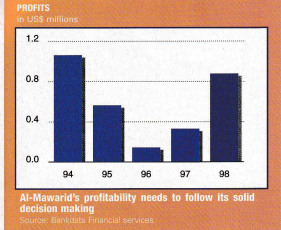
Although Al-Mawarid has reported
impressive asset growth in recent years, up
from $94 million in 1995 to over $200 million
in 1998, BankWatch considers the
bank’s profitability questionable.
“Profitability will take time to come around,
and in the future Al-Mawarid will be suffering
from competition with big banks,”
says Photiades. Al-Mawarid’s strategy may
possibly see results in the medium term, as
BankWatch does not forecast the bank’s
profits to increase significantly this year or
next from $878,000 in 1998.
Not so gun shy
Allied Business Bank (ABB), with 17
branches and $648,000 in net profits
for 1999’s half-year results, is a privately
held medium-sized bank known for its “gun shy” approach in
managing its money
(see “Gun Shy”, June
1999). Now it seems to
have changed strategies.
The bank is considering
a merger with
several local banks that
would create an entity
able to compete with
the larger banks like
Byblos Bank, Banque
Audi, and Banque du
Liban et d’Outre Mer.
ABB’s general manager
Habib Abu Fadel, who
could not be reached for comment, is
evaluating several small banks to find
potential candidates. Abu Fadel expects
that if ABB merged with the four or five
banks it is considering, it would result in
a new entity with assets of $1.5 billion and
would take the bank into the ranks of the
top ten. But what is keeping the trend of
mergers that has so far reduced the number
of banks from 100 to 75 moving forward?
“Small banks are finding it hard to compete
against the level of new services, products
and sophistication that the leading banks
are reaching,” says Munzir Al Khatib,
director of the Riad Al Solh branch of
Credit Libanais. He believes this will ultimately
drive the number of banks down to
about 30.
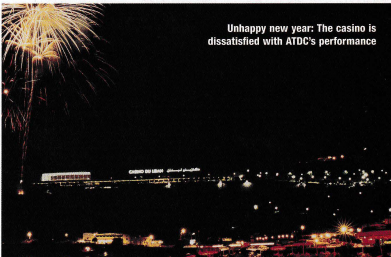
A bad deal?
Daoud Moukhaiber, the financial director
of Casino Du Liban, confirmed that
its board of directors is in the process of
reviewing the contract between the casino
and the Abela Tourism Development
Company (ATDC), in an attempt to reduce
costs. ATDC has a ten-year contract that
expires in 2006 to manage a range of services
in exchange for a cut from the casino’s revenues
from gaming and non-gaming operations.
“Some board members have long
questioned the performance of ATDC and it
prompted the dismissal of some ATDC
directors in 1997,” says Moukhaiber. He
says that the casino’s board is in the process
of preparing financial documents for
upcoming negotiations. ATDC is a joint
venture between the Abela Group and
London Club that netted $13 million in both
1997 and 1998. In addition to the board’s
hopes of saving a minimum of $5 million
from renegotiations, Moukhaiber says the
casino is considering listing its shares on the
Beirut Stock Exchange (BSE) in 2000
should market conditions improve. Its
shares are currently traded on the over-the-counter
market. The casino’s net income
reached $12 million on revenues of $70.85
million in 1998, while it declared profits of
$6.3 million in the first half of 1999 on revenues
of $45.75 million.