The unprecedented growth of foreign
direct investment (FDI) in
1998, up 39% to $643.9 billion,
largely bypassed the Arab world. According
to the 1999 World Investment Report of the
UN Conference on Trade and Development,
FDI flows to Arab countries fell by
6.5%, from $6.3 billion in 1997 to $5.9 billion
last year, ending a steady growth trend
since 1995. Arab countries’ share in world
FDI in 1998 was less than 1%, down from
about 1.4% in 1997.
The cornerstone of 1998’s surge of FDI
was the marked growth of flows into the US
(up 77%) and Western Europe (up 76%),
reflecting their solid fundamentals. Developing
regions present a different picture;
their share in total FDI inflows rose from
26% in 1980 to 37% in 1997, but subsequently
fell to 28% in 1998, reflecting
reduced inflows to Asia that year. Flows to
Asia and the Pacific were down by 11% to
$85 billion, a better-than-expected performance
due to currency devaluations, FDI liberalization
and the region’s still solid long-term
prospects. Flows to Central and East
Europe also fell by almost 5.5%. Despite the
turbulence of financial markets, FDI flows
to Latin America and the Caribbean rose 5%,
accounting for 11% of total flows.
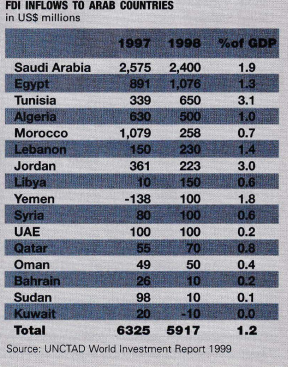
Among Arab countries, eight drew in
higher FDI in 1998 compared to 1997; six
attracted lower flows; two maintained 1997
levels while Kuwait recorded a net outflow
of $10 million. FDI as a percentage of GDP
remains very low for almost all of the
region, averaging 1.2% for Arab countries as
a whole and ranging from 0.1% (Sudan) and
0.2% (UAE, Bahrain), to more decent levels
of 3.0% in Jordan and 3.1% in Tunisia.
Morocco saw the largest decline in FDI in
1998, down 76% to $258 million after
being North Africa’s largest recipient in
1997. The massive drop was mainly due to
a fall in privatization-led FDI in 1998 to previous years’ levels. FDI inflows to Algeria
and Sudan also fell substantially.
Egypt, now the second largest Arab recipient
of FDI after Saudi Arabia, received
$1.08 billion in FDI in 1998, an increase of
more than 20% on the year before.
Investments were concentrated in chemicals,
construction, engineering, food, metal, textiles,
and tourism. Tunisia, one of six
African countries singled out by UNCTAD
earlier this year as “African FDI front-runners,”
has shown particular dynamism in
attracting FDI throughout the 1990s. FDI
flows to Tunisia almost doubled in 1998 to
$650 million and the country was ranked as
one of the five most attractive destinations in
Africa for FDI from 2000-2003.
Foreign direct investment in Middle
Eastern Arab countries fell marginally in
1998 to $3.27 billion, in contrast to a
sharp rise in 1997. The report ascribes this
slowdown to last year’s fall in oil prices.
Saudi Arabia saw a drop in FDI from
$2.58 billion in 1997 to $2.4 billion, but
remains the region’s largest beneficiary of foreign direct investment. FDI inflows to Qatar rose to $70 million in 1998, from $55 million in
1997, flows into Bahrain –
already at low levels of $26 million
in 1997 – dropped to $10
million, while Oman and the
UAE maintained 1997 levels. In
the Levant, FDI flows to Lebanon
rose by more than half to
reach $230 million in 1998,
while Syria recorded more modest
improvement, from $80 million
in 1997 to $100 million in
1998. In Jordan, FDI inflows
fell considerably from $361 million
in 1997 to $223 million in
1998. However, significantly
larger flows are anticipated for
1999 in light of several joint ventures with foreign partners in mining
and the $508 million that the privatization
of the telecom company is likely to bring.
Total FDI this year is expected to exceed
$700 billion and Arab countries should
account for a larger share than in 1998.
Several Gulf countries are opening up their
oil and gas sectors to foreign participation,
while others have been introducing liberalization
policies safeguarding intellectual
property rights, institutionalizing new business
laws and making their countries more
hospitable to foreign investment. A privatization
drive among some Arab countries is
expected to pick up momentum next year and
will also increase the Arab world’s share of
global foreign direct investment.
FDI has become an important source of
private external finance for developing
countries. Governments in the Arab world
need to address corruption, cut red tape,
establish a clear legal infrastructure and
provide incentives for investors. Capital
always goes to where the rules of the game
are clearest.