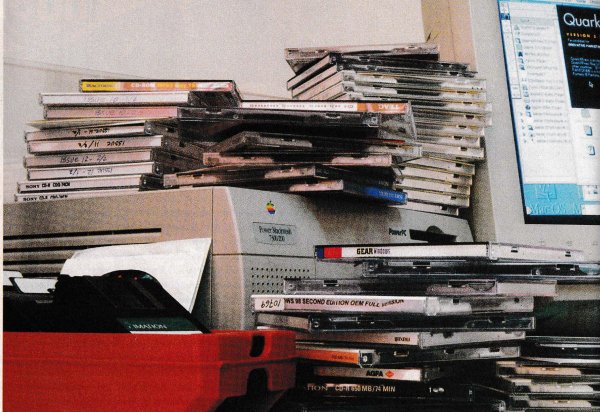
It was the law that promised so much and delivered so little. The Intellectual Property Rights law went into force in June last year—banning the sale of pirated computer software and music albums. Overnight, it also made the operations of some 1,200 unlicensed cable television providers illegal.
By no means was the law perfect. When the IPR bill was debated in parliament, legislators feared it would make computer programs too expensive for students. They promptly tagged a clause onto the bill allowing educational institutions to copy software and distribute it to their pupils.
But despite its flaws, the IPR law was touted by its supporters, including Nasser Saidi, minister of economy and trade, as Lebanon’s key to the information age. Proponents argued that it would help attract foreign investment, protect the works of local artists, develop the fledgling software industry and help usher Lebanon into the World Trade Organization (WTO).
It seemed that many of these rosy expectations might come true. The titan of the software industry, Microsoft, opened an office in Beirut. A number of outlets for pirated products cleared their shelves and started selling only legitimate merchandise. And suddenly, it seemed that almost everyone was talking about turning Lebanon into the Silicon Valley of the Middle East.
But the high hopes were short-lived. The IPR law has had about as much impact on piracy as traffic regulations have had on driving habits.
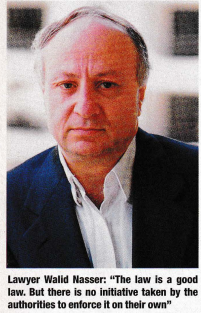
“Disappointment continues to be the main headline with respect to enforcement of the law,” says copyright lawyer Walid Nasser. “The law is a good law. But there is no initiative taken by the authorities to enforce it on their own, even though the law grants them that power.”
Cable TV still enters an estimated 400,000 homes for as little as $10 a month. Last year losses to the motion picture industry were estimated at $8 million, according to the US-based International Intellectual Property Alliance, while the music industry lost $2 million and book publishers $2.5 million. Those figures are on par with 1998 losses.
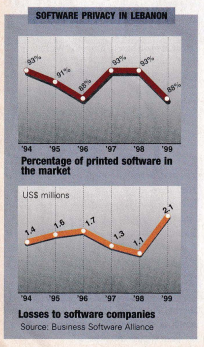
Lebanon has the fifth-highest rate of software piracy in the world, according to the Business Software Alliance, an international anti-piracy organization representing software companies. While the rate dropped from 93% to 88% between 1998 and 1999, losses to software manufacturers soared from $1.1 million to $2.1 million, the highest level on record for Lebanon.
Recently, EXECUTIVE went shopping for software in the same neighborhood as the ministry of economy and trade, which has been designated the official IPR watchdog. A block and a half away, at a store called Microsystems, posters urged customers to purchase only licensed products. But this reporter was offered a pirated version of Windows 98 (retail price $230) for LL10,000 or Windows 2000 (price $340) for $20.
As legal counsel for the BSA and several US film studios, Nasser is serving on the front lines in the war against pirates. Since the IPR law went into force, he has chalked up a few victories. Nasser has convinced the public prosecutor to order raids on two suspected retailers of unlicensed software. He has gone to court and obtained permission to carry out inspections of an engineering firm and bank suspected of using illegal software. And he has used the law to press charges against cable TV pirates on behalf of seven US-based film studios.
But Nasser feels that he is being forced to do the government’s job. The ministry of economy and trade—which is authorized to carry out raids on shops and other businesses suspected of selling or using pirated products—has failed to enforce the copyright law.
Last November, says Nasser, the BSA filed seven separate petitions with the ministry, requesting raids on specific businesses.
“The story given to us was that the ministry could not send out inspectors because they were not sworn in,” says Nasser. “We kept getting promises but nothing was happening.”
Finally, the BSA called a press conference at the beginning of this year to voice its protest at the government’s inaction.
“The next day, I got a call from the minister’s office and was told [Saidi] was upset,” says Nasser. “I said, ‘If he’s upset, let him do something about it.'”
Soon after, inspectors were sworn in, but a crackdown on pirates did not follow. Salwa Faour, head of the intellectual property rights branch of the ministry, says that her team is able and ready to carry out raids. But a company whose products are being pirated must first lodge a complaint with her department.
But despite complaints lodged by BSA on the part of software companies, the ministry has yet to raid a single shop or business over a copyright violation.
For now, Nasser has given up on the ministry, which he says is neither experienced nor ready to carry out effective copyright enforcement. That means going through the court. But the public prosecutor hasn’t been much more effective in enforcing the law than the ministry.
“The public prosecutor can take the initiative on his own, investigate, prosecute and take people to court,” says Nasser. “That’s not happening.”
The two police raids carried out on suspected software pirates came only after the BSA filed formal complaints with the authorities. And seven months after Nasser filed criminal charges against the cable pirates, no serious action has been taken.
“We have seven lawsuits pending before the police, on behalf of the seven major studios. They have called in 15 or 16 pirates, but things have lingered,” complains Nasser.
Even admissions by pirates haven’t resulted in formal charges—or the confiscation of equipment. The response from Adnan Addoum, the public prosecutor, is that his office is waiting to shut down all the pirates at once rather than individually.
“We need a solution that goes to the root,” he says.
Nasser is skeptical. He is now considering fighting the cable pirates through the civil courts: going to the judge of urgent matters to seek an injunction. But there is one major drawback to this approach—an injunction must be sought on each individual pirate.
“We would have to file 1,200 lawsuits,” he says. “I don’t think my clients can spend that much money, but going after five, ten or 20 would send a clear message.”
Tony Srour, an unlicensed cable operator in Ashrafieh, offers 65 channels for just LL20,000 a month to about 400 clients. He’s not worried, at least for now.
“The authorities are letting people enjoy themselves, but I believe that one day they’ll come and shut us all down. In the end, it’s their [the copyright holder’s] right,” he says, adding: “The average person will not be able to afford to pay $150 for 65 channels.”
The government’s impotence in the face of mass piracy has been disheartening for many companies. Upon locating here last June, Microsoft hoped to turn Beirut into its Levantine headquarters. The passage of the IPR bill was the primary condition set by the company for opening a local office. The software maker even promised to offer students discounts of up to 90% if the IPR law was approved.
One year later, Microsoft’s sales in Lebanon have barely moved.
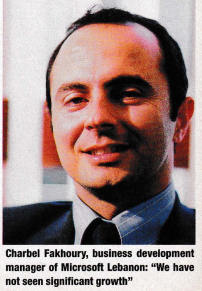
“We have not seen significant growth, to tell you the truth,” says Charbel Fakhoury, business development manager of Microsoft Lebanon.
Not even the plan to offer discounts to students has worked. Customs officials factor the normal price of the software rather than the student discount price when calculating the tariff charge. The student software costs $99, but Microsoft must pay $100 in duties.
“A lot of resellers said they don’t want to sell it anymore,” says Fakhoury. “We want to stop the program.”
Cable Vision, believed to be the sole cable TV provider paying royalties, has been facing similar problems.
“We are not making money,” says Benjamin Hajjar, marketing manager.
Cable Vision offers 25 channels for $25 a month, while pirates offer as many as 70 channels for as little as $10 a month. Nonetheless, Hajjar has managed to build up a law-abiding customer base of over 1,000 subscribers. The firm claims to compensate for its higher prices by offering top-notch customer service and legitimacy.
“When a client asks me, ‘What’s the difference between you guys, charging me $25 a month, and the other guy charging me $10 a month, for more channels?’ the only defense we have is to say that the other guy is not paying royalties,” says Hajjar.
Satellite television broadcaster Showtime reports that it has lost millions of dollars in the Lebanese market from illegal cable distributors re-broadcasting its channels. Showtime has pressed criminal charges against the cable pirates and is waiting for the authorities to take action.
Nor has the music business seen positive results from the copyright law. Mohamed Hamzeh, label manager of Warner Music, has watched sales of CDs and cassettes decrease by 50% to 55% since last year. He complains that the piracy problem is worse now than before the law was passed, estimating that 95% of Warner Music’s retailers and customers are selling pirated music.
“Nobody has done anything to the pirates,” says Hamzeh. “There’s no will on the part of politicians and the government to push this law.”
Cracking down will require political courage.
“The Lebanese were used to getting any software they want for $10, if not $2 or $5. About 400,000 households enjoy almost free [cable TV] programming,” says Nasser. “For the government to take away that privilege is not going to be looked upon very favorably.”
But if the government does not get serious about stopping piracy, the country’s long-term economic interests will be harmed. Foreign companies won’t want to invest if their products are not protected, local artists won’t have an incentive to create and Lebanon will be hard-pressed to develop its own software industry.
More importantly, Lebanon is negotiating to become a member of the WTO and one condition is that copyright, patent and trademark laws be compliant with the 1995 Trade-Related Aspects of Intellectual Property Rights (TRIPs) agreement. With the exception of the clause allowing educational institutions to copy software, last year’s IPR law is TRIPs-compliant.
A second law, covering patents and trademarks, is going through parliament.
“But a lack of enforcement could be an obstacle [to WTO membership], and we will surely raise that,” says Nasser.
Lebanon must decide whether the privilege of cheap satellite TV and software is worth it. If so, this country can forget about the benefits of free trade, attracting foreign investment and that glorious dream of turning Lebanon into the next Silicon Valley.
The great
toothbrush crush
It was dental genocide. Thousands of toothbrushes, worth $3,000 in total, were stacked in an empty field in Raouché and, in front of spectators and a television crew, their virgin bristles were smashed into the earth by a steamroller. It was all very entertaining, but behind this orthodontic execution lies an important message: selling pirated products does not pay.
The “Mr Fresh” toothbrushes, manufactured in the Far East, are imitations of SmithKline Beecham’s patented Aquafresh Flex toothbrushes, says copyright lawyer Walid Nasser. As the local legal representative of SmithKline Beecham, Nasser intercepted the toothbrushes before they entered the local market. Through the court of urgent matters, he won an injunction to stop the shipment. The importer agreed to allow the toothbrushes to be destroyed in public if Nasser stopped legal action against him.

Under Lebanon’s patent and trademark law, which dates back to the 1920s, new toothbrush designs are protected, but everything from pharmaceutical products to the electrical configurations of microchips is not. The proposed new law has a small number of local pharmaceutical manufacturers—some of which produce drugs that are patented in other countries—worried. The new law might threaten their business and make certain drugs prohibitively expensive for Lebanese, they argue.