
The Eagle ~
has landed
The first real estate investment company
in Lebanon, Eagle One, has been set up
by The Property House, a subsidiary of local
finance firm The Investment House. The ten-
year,
closed-end fund, pays dividends
derived from rental income and capital gains.
The firm’s focus is on commercial properties
rather than residential units. “The purpose of
the project is to purchase income-producing
real estate,” says Karim Salameh, project
manager. “With the market at a standstill,
now is the time to buy. We can buy at a discount,
pay dividends from rental income,
then when the property values appreciate,
we’ll sell at a profit.”
The firm has already identified $20 million
worth of prime commercial properties in
Beirut that can offer annual yields of 12.5%.
Income from the properties would cover
management fees, taxes and expenses, and the
balance would be paid as dividends twice a
year. Structured like American real estate
investment trusts (REITs), Eagle One offers
investors long-term income from both dividends
and capital gains. It also provides foreign
investors, currently restricted from complete
ownership of local real estate, indirect access
to the Lebanese market. There are plans to list
Eagle One on the Beirut Stock Exchange this
spring and to issue global depository receipts.
The firm has already targeted corporate
investors interested in the Lebanese property
market and it has conducted a pre-marketing
tour of the Gulf and Europe.
FNB looking
to buy
First National Bank SAL (FNB) has
expanded its shareholder base as a
forerunner to a possible acquisition of
another local bank. Among the new shareholders, who now have a 62% share of the
financial institution, are Lebanon
Holdings, Promotion des Investissements
SAL, Abdo Kassir, Salah-El-Din Osseiran, Elias Pierre Sabbagh, Darar Kanaan, and Kabalan Yammine. The sale of shares raised the bank’s capital from $5.33 million to $24 million. “Some banks are now being considered for acquisition,” says Mounir Freiha, operations manager at FNB’s Hamra branch. “Although some appear to be likely candidates, nothing has yet been finalized.“
“These investors didn’t come in to wait for the bank to grow,” says Nicole Gebara, assistant manager for corporate
finance at Lebanon Holdings. “The
bank is now looking to acquire another
bank through which it can expand its
coverage. But, for the time being, we
can’t disclose any names.”
Wedding’s Oli?
There was talk on the street in February
that Bank of Beirut (BoB) was getting
close to acquiring Allied Business Bank
(ABB) for between $30 million and $35 million.
BoB, one of the top ten banks with $1.8
billion in total assets and $1.3 billion in customer
deposits at the end of 1999, had
already proven itself capable of marriage by
smoothly merging with Transorient Bank
last year. The acquisition of a medium-size
bank would have catapulted BoB’s branch
network from 30 outlets to 47.
Both BoB and ABB officials have denied
the rumor. But it looks like ABB is still interested
in merging. Last December, Habib
Abu Fadil, the bank**’**s managing director,
announced that the bank was interested in
consolidating with several other banks. But
it is not clear if that means ABB is off the auction
block. Jordan’s Al-Ahli Bank and local
First National Bank have shown interest in
scooping up ABB.
Whether ABB merges or not, it looks as
though consolidation in the banking sector is
heating up. Analysts believe that now is the
time. If there is a peace agreement in the near
future and Lebanon opens up to the international
market, there is fear that large foreign
heavies will start buying out local banks.
“The time has come to consolidate to be
ready when the environment changes quickly,”
says Freddie Baz, an advisor to Banque
Audi’s chairman. Are the banks showing more interest in mergers and acquisitions?
“Banks have become interested. Three years ago it was a taboo. Today there is a lot of talk.
It is a clear perception among the major players that someday we’ll have to join efforts,” says Baz.
World Bank is
open tor business
The World Bank opened an office in
Lebanon at the end of January in a
move that may help speed up the implementation
of projects funded by the organization.
The bank has approved allocations totaling
$135 million this year to support ten projects,
some still in the pipeline. Should
there be a greater need, the bank can
increase its support to $200 or $300 million,
according to Hari Prasad, the resident representative
of the World Bank in Lebanon.
Over the years, the bank has disbursed
$600 million in loans to Lebanon. But so far
only about $350 million of the allocated
funds have actually been used.
Bureaucratic inefficiencies within the government
administration have been the
main barriers to the implementation of projects.
The problems are not new to the
bank according to Prasad who was stationed
in Colombia from 1986 to I994. In
his opinion, “the essence is to modernize”
and to “reach the stage where loans can be
disbursed more rapidly.” Apart from the
thorny issue of administrative reform, the
bank may provide technical assistance to the
government if it decides to go ahead with its
plans for privatization.
The bank’s complement of 12 staff
members will also be available to offer
consultation to other countries in the
region that do not have representation on the
ground. The bank has offices in Egypt,
Morocco, Yemen and the West Bank/Gaza.
Passive about
privatization
There will be no privatization of the
country’s telecommunications sector
before the middle of 2001, Issam Naaman,
minister of post and telecommunications
recently announced. Even partial privatization,
he says, must wait for parliament’s
passage of a law restructuring the
telecommunications sector. The government’s
five-year plan, proposed last year,
included projects to raise $5 billion,
including $1.4 billion this year, through
privatization of everything from the country’s
utilities to Middle East Airlines. The
revenue was to be used to reduce the public
debt, currently 130% of GDP. But, so
far, very few steps have been taken
towards selling off state-run entities.
Naaman hopes that a law restructuring the
telecom sector will be passed by the end of
April. That will be followed by the ministry
replacing the two cellular operators’ BOT
contracts with licenses and issuing a third
license, most likely to the state-run telephone
company Ogero. Naaman has indicated
that granting Ogero a license would
increase the value of the telecommunications
company, thereby making it more
attractive to buyers.
But according to one economist, the
more the government waits, the less benefit
privatization will bring. The debt will
only be growing larger in the meantime.
“We will be back to where we were in
1998,” he says.
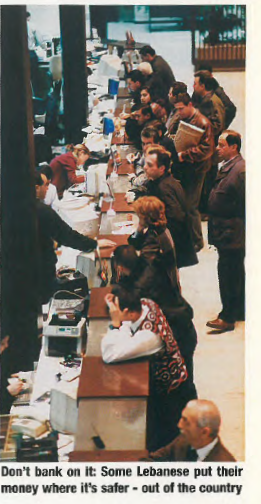
Money under
the mattress
InfoPro, a local market research firm,
has released some disheartening news
about the country’s banks. Even though
Lebanon’s banking industry is the
strongest sector in the country, making up
around 15% of the country’s GDP last
year, in the first quarter of 1999 only 30%
of individuals surveyed had bank
accounts, down from 37% in 1997. A further
28% of people questioned said that, while
they previously had a bank account, they no
longer did. On the service side, 72%
claimed that they never applied for a loan,
while 54% of those who had applied had
been turned down.
Nicolas Photiades, senior vice president
at Thomson Financial BankWatch, gave
several reasons for the study’s results. He
says that the economic slowdown, which
started in 1996, has increased the number of
people below the poverty line. Another cause was the steady flow of Lebanese
leaving the country. But Photiades felt the
main explanation for why people were not
banking is due to a waning confidence in
Lebanon. A rise in political and economic
uncertainty, he says, may be prompting
people to put their savings outside the
country. There is proof of a link between
political uncertainty and money flows.
According to Merrill Lynch, the majority of
deposit growth in 1999 came in the fourth
quarter, partly due to the re-activation of the
peace process between Israel and Syria.
Some banks consider the high number of
people without bank accounts to be an
untapped market. Banque Audi is aggressively
expanding its network of branches. It
opened 13 new branches last year, up to 55
outlets, and has plans to open 12 more this
year. Byblos Bank is aiming at areas that are
considered untapped, such as the Bekaa
Valley as well as north and south Lebanon. But
if the government doesn’t do more to bring the
economy out of the doldrums and peace
remains a dream, the uncertainties may make
it difficult to get a better flow of deposits.
