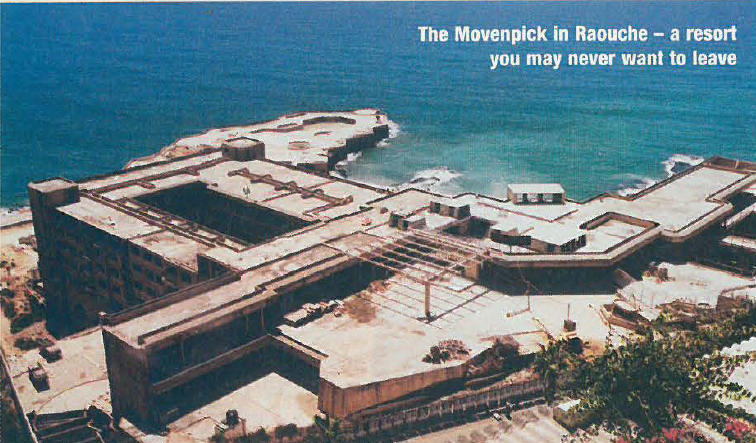
Construction at the $100 million
Movenpick resort in Raouche steams
ahead. The 72 chalets and 1,000 cabins
have already gone up 7% in price since hitting
the market on August 1, and while
Kingdom Holding won’t reveal the figures,
the diagrams in the on-site sales
office suggest sales are going well.
Sales manager Samer Abu Ayash admits
that the project has faced a credibility gap.
“Everyone knows the checkered past under
the old owners,” he says. “This makes it
more important that we get things right and
on time.” Movenpick has similar resorts at
the Dead Sea and Sharm el-Sheikh.
Branding is important. Alwaleed Bin Talal
is himself a brand name. “When he says the
project will be finished in summer 2002,” says
Abu Ayash, “people believe him.”
The project has a 4,000m2 health club, a
30,000m2 hotel, a l ,500m2 shopping mall,
swimming pools, restaurants, chalets, cabins,
a marina and 700 parking spaces. The
shops, says Abu Ayash, will attract local
residents as well as those using the resort.
The biggest unit until now is 80m’,
although the design allows up to 200m2
“Visitors to the hotel will be able to do
everything within the resort,” says Abu
Ayash. “This is unique in Lebanon. They
can rent a boat, put the kids in their own
pool, have a mud bath and go to a restaurant.
Some people who go to Sharm el-Sheikh
never leave the resort for two weeks.”
The main interest in chalets has come, says
Abu Ayash, from Lebanese expatriates,
while interest in cabins stems mainly from
Beirutis. The largest chalet, around 208m’, is
close to $ l million (with prices between
$4,250 and $5,250 perm’) and the 6m2 cabins
are $25,000 to $30,000. Not cheap. But
there is no rival project on the horizon.
Score one for SMGH
The Saudi-run Societe Mediterraneenne
des Grands Hotels (SMGH) has finally
received permission to demolish the old
Hilton, amalgamate the plot with an adjacent
one and keep a built-up area (BUA) of over
31,000m’ on the combined site. That clears
the way for a new 20-storey Hilton.
The company bought Mi net el Hosn plot
111 – complete with the 27,000m’ ruined
hotel – in 1980. When the Solidere master
plan came into effect, the appraised value
of the site was around $ 11 million, but the
owners decided to keep it rather than take
Solidere shares. SMGH then paid $4 million
for the adjacent plot with 4,300m’ of
BUA. Under current regulations, new
build on I LI would have been restricted to
around 10,000m’, but the council of ministers
has granted an exception and
allowed the combined site to retain the
existing BUA of 31,300m2
It adds up to a shrewd move by the owners.
If they had bought at current Solidere
prices, they would have paid around $31 million
for both plots. Construction will take
around three years. The company is confident
that Lebanon can accommodate more
five-star hotels in addition to the Phoenicia.
Building a
bad reputation
Architect Charles Hadife had a shock in
June when he opened a newspaper
and saw a picture of his home in Beit
Chehab house. “A traditional Lebanese villa
developed by the Hayek Group,” he read. Not
true. Hadifeh did the renovation himself.
The newspaper explained that the Hayek
Group is using the Internet to market themselves
to Lebanese expatriates, offering services
from brokerage to engineering, finance
and legal advice.
Hadife was livid. “I sent someone to
Hayek group asking if I could buy the house
– they said they’d sold it.” EXECUTIVE contacted
the Hayek Group and asked where to
find the house and whether Hayek renovated
it. “I think it’s in Beit Mery or Broummana,”
said the receptionist, “and no, that’s not one
we did.” Strange, then, to choose a house that
has been featured in international architecture
magazines and belongs to one of Lebanon’s
best-known architects.
Southern bargains
The market is even more sluggish in the
South than in Beirut. A 1995, 320m’
duplex with four bedrooms, three bathrooms
and five balconies on the edge ofTyre can be
yours for just $80,000 – and yet it’s been on
the market for several months. The brokers are
Cedarweb (www.cedarweb.com).
Real estate in the south declined with the
Israeli attacks of 1996. The stagnation, says
Tyre developer Ibrahim Mourtada, has been
not so much in prices – which have fallen up
to 20% since 1996 – as in the delay or
amount of a fust payment. Smaller units of
around 120m’ are about $250 per m2, with
new duplexes fetching $320-$350 per m2
This suggests the Cedarweb duplex is a bargain
– provided you have the necessary: It’s
a cash sale with no credit facilities.
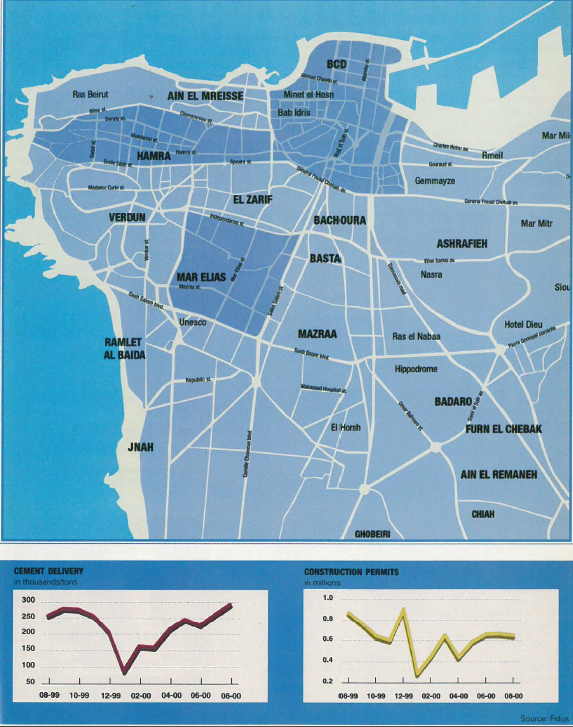
EXECUTIVE has teamed up with international real estate consultants Healey & Baker to provide information
about market activity in Beirut and its suburbs. The real estate listings change monthly and
are updated quarterly. The following profiles will be revisited in February.
The BCD residential market is currently skewed by Solidere’s pricing strategy at Saifi,
which is to sell at $1 ,750 per m’ (base) and rent from a base of $85 per m’ – a strategy
followed by the company in order to attract residents downtown when clients are unwilling
to buy at these prices. The rate outside Saifi is around $1,500 perm’ for sale and something
over $100 perm’ for rental. It will be interesting to see how this develops over time,
especially as approximately 65% of BCD is zoned for residential.
After all the delays, and the ups and downs, the market in BCD now seems to be
finding its level. Refurbished offices are fetching between $150 and $175 perm’ in
annual rental, and new build, like the Atrium, is going for up to $250 per m’. Demand
is now focused on new build (especially from international companies), with less for the
renovated buildings.
Solidere’s target price for retail is $5,000 per m’ for sale and $500 per m’ for rental.
The highest price achieved so far for retail downtown appears to be $9,000 per m’
in the Atrium, where proximity to the souks and Banks Street has proved a crucial factor.
The cheapest ground floor retail is available for less than the Solidere target. This
is very much a market that will change quickly, especially when the souks project
comes on stream.
Ever popular for homes, Hamra is a genuine community with local amenities and a
busting, cosmopolitan atmosphere. The cheaper residential is the older buildings,
and there are some bargains here for those seeking character rather than up-to-the
minute luxury. Parking problems, traffic and honking horns will always limit the potential
for growth.
Hamra is mixed as a business area, just as it is in retail. There are no obvious benchmarks
for pricing offices. While there is attraction for some businesses to be in such a busy area,
others – especially international companies – will be deterred by the traffic congestion, the
very low number of up-to-date office blocks and the general lack of purpose-built parking.
I n the best locations, retail prices in Hamra remain high. At the same time, there are a
number of badly designed malls that have fallen into disrepair. The opening of the
Crowne Plaza should give Hamra a big lift, adding to the boost already given by names
like Starbucks, lntimissimi and The Body Shop. Hamra will endure the opening of the
souks downtown if it can continue to offer impulse, easy-access shopping. Don’t
expect large stores in the area.
Mar Elias became a popular retail destination during the war, and subsequently has
suffered because of Verdun’s proximity. The development of retail downtown will
lead to a further deterioration. Housing in Mar Elias – including new build – is of mixed
quality and not helped by the large amount of property let at old rents, which act as a
huge disincentive for owners to carry out repairs, much less improvements. Most rental
is at the medium level.