
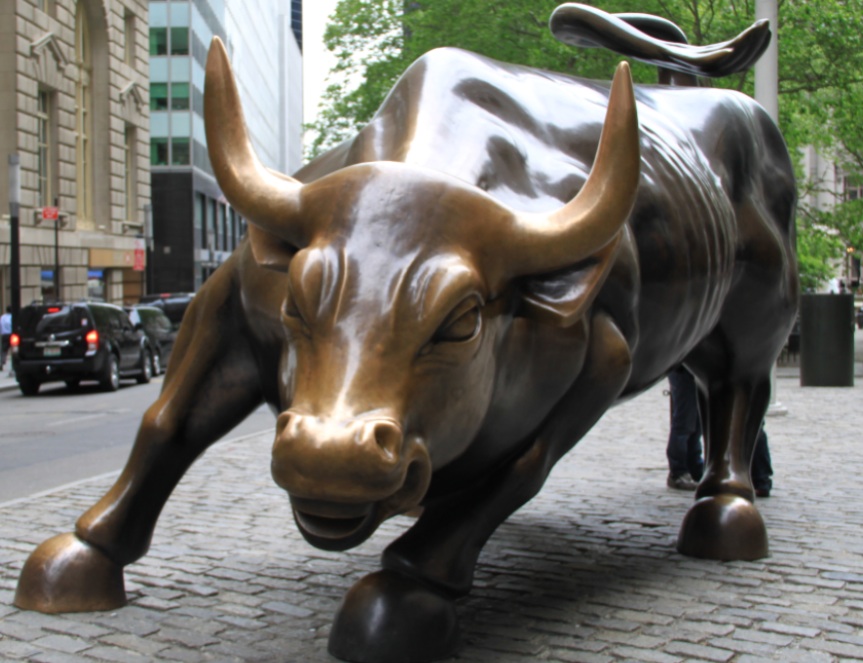
Today five years ago, spring birthed a new bull in global finance. Security market annals refer to March 9, 2009 as the point where the United States equity market bottomed out and finally started gaining. While the recession in the American economy remained, the securities markets in the developed economies have risen consistently since that point.
Observers and stock advisors on developed financial markets are using the anniversary as a chance to contemplate the unexpected strength of these markets and their chances of lasting another year. At the same time Arab stock markets, with the limited attention they get in comparison to the bulls and bears in the developed and the larger emerging markets, are quietly having their own spring of market gains.
In 2013 and the first ten weeks of 2014, it is fair to say there has been something of an Arab spring for Middle Eastern stock markets. If that is the case then the United Arab Emirate’s Dubai Financial Market (DFM) has been leading the revolt. When comparing the DFM index position of 4,154 points on March 6 at the end of the past trading week with the index opening of the first trading day back in 2013, the Dubai securities market has moved up 156 percent, to two-and-a half times the 1,622 points of back then. The corresponding year-to-date and twelve-month DFM index variations are 23.3 percent and 130.3 percent, according to Bloomberg Finance.
The Abu Dhabi Exchange (ADX) was Dubai’s sibling in growth. It broke free from a multi-year trough at the end of 2012 and has since climbed by impressive ratios – 15.3 percent in 2014 to date and 50.8 percent over the past twelve months – while it also reached a new five-year high at the end of February. Both UAE exchanges dropped about one percent in the trading week that ended last Thursday [Mar 6].
Oman showed a moderate gain in the year to date and its Muscat Securities Market reached a three-year high at the end of January. The Kuwait Securities Exchange, exhibiting a different dynamic from the UAE, had a slight drop in the year to date; it had seen a solitary period of strong gains between November 2012 and end of May 2013. But the bulls have kept roving in the first ten weeks of 2014 in Qatar and Bahrain and, most importantly, in Saudi Arabia, the largest Arab exchange. The Saudi exchange represented almost 42 percent of the MENA region’s cumulative market cap of $1.2 trillion on the first of this month.
While the year-to-date gain of the Saudi Stock Exchange are ‘only’ 8.6 percent, it led to a new index high on March 6. Notably, the SSE’s index rode to this five-year high of 9,252 points from a paltry 4130 points five years earlier in an increase that was more evenly spaced over the period when compared with the concentration of growth in 2013 and 2014 to date that occurred in the UAE equity markets.
Some meadows void of bovines
But while some bulls may be rampaging, others look a little short on grass. The Amman Stock Exchange (ASE), which had seen more down periods than up times in the past five years, had a March 6, 2014 close that was more than 400 points, or almost 16 percent, lower than on the same day five years ago. It achieved, as hint of an upswing, a year-to-date improvement of 6.25 percent as part of a six-month period of gains that added 20 percent to the March 6 ASE Index close of 2,188 points when compared with early September 2013. In Beirut, despite a brief outburst of premature spring feelings right after the announcement of the new government in mid-February, there has been no subsequent charge – with the Blom Index’s 4.11 year-to-date gain only slightly higher than the 12-month gain of 3.4 percent.
Farthest afield to the west, the MASI on the Casablanca Stock Exchange was up barely two percent last Friday when compared with the start of 2013. Its five-year performance was negative and the year-to-date and one-year gains of 4.6 and 13.3 percent, respectively, are probably not enough to inspire much confidence in the market’s predominantly local investors.
This leaves the core Arab Spring countries of Tunisia and Egypt. The smallest active exchange by market cap ($9.2 billion on March 1), the Tunis Stock Exchange ended last Friday flat from a year ago and up 5 percent since the beginning of 2014. When viewed against the economic hopes and political transitions of the past two years, not much of anything has been made visible. The Tunindex had slipped already in the last three months of 2010 and did more so throughout the Arab Spring period; its recovery in the second half of 2011 and the first seven months of 2012 was notable but not impressive when compared with the market’s strong earlier growth between March 2009 and the third quarter in 2010.
Egypt, the country with the bourse that reflected the most ups and downs of the Arab Spring, had more than a fair share of tumults in the past 10 months but nonetheless saw its EGX 30 index climb strongly, pretty much from the day that the military deposed of President Mohammed Morsi at the end of June 2013.
The bird’s eye view of the impact of the epoch of turmoil since January 25, 2011 on the stock market shows three phases: a time of deep uncertainty between the precipitous fall and temporary closure of EGX and the election of Mr. Morsi in summer of 2012; a period of indecisive index moves during his presidency, with a drop that corresponded to the growing hostility towards him in June 2013; and from July last year, a continuous rise with a two short interruptions to a new five-year high on the first trading day of March 2014.
Predictability, anywhere?
Few things in the world lend themselves as easily to aimless speculation as the numbers in our stock markets. This reading of meaning into unpredictable numbers is sophistry in the worst sense of the word.
In a demonstration that much-voiced expectations have no strong evidence of correlation with actual market events, the rise of Dubai in 2013 began well ahead of the DFM’s upgrade announcement to emerging markets status which will be implemented [when] and the rise has not slowed in any way.
From a behavioral vantage point, the index curves of Arab stock exchanges since the burst of all exuberance in 2008 give the impression of the great reluctance to enter a new relationship that follows a first broken commitment among young adults. Inexperienced, local investors were important actors on the securities scene in those years.
Their excitement and willingness to borrow money for stock purchases in the Gulf markets’ first hypes in the early 2000s were punished in two boom-and-bust periods before 2009 and so while Standard & Poor’s started to show a bull sentiment from March 9, 2009, the key Gulf markets stayed on the fence until 2012.
From the perspective of political interferences, the changes and upheavals in the Levant and North Africa impacted the non-GCC markets to the point of total disruptions in Libya and Syria and major direct disturbances in Egypt.
Morocco, Tunisia, Jordan and Lebanon were each impacted in their own ways, underscoring perhaps that the political Arab Spring and its impacts were much more nuanced and created more diverse short-term outcomes than what has so far been understood about this historic turning point.
Whether the Arab bulls of the Gulf and Egypt will keep going strong in the coming months is as challenging a question as the one how long the current bull market in developed economies will last. In the Gulf region, investor behaviors will be worth studying to see inasmuch they have become used to to the behaviors in older markets.
While emphases on protests in international reporting from Bahrain and outcries over workers’ mistreatments in Qatar did not seem to have impact validations from market trends in Doha and Manama, political impacts on the Cairo market still look like a downside risk factor. Small issues of the rule of law and implementation of political democracy may not be very influential on the market but the risk of upheaval remains based on the volatility caused by large events on the streets.
